



In all rooms where there is a risk of toxic or explosive gases, the installation of a gas detection system should be considered. The necessity of such a solution may arise directly from legislation. Some of the most important legal acts are the Decree of the Minister of Internal Affairs of June 7, 2010, on fire protection of buildings and the Decree of the Minister of Infrastructure of April 12, 2002, as amended, on the technical conditions to be met by buildings and their location.
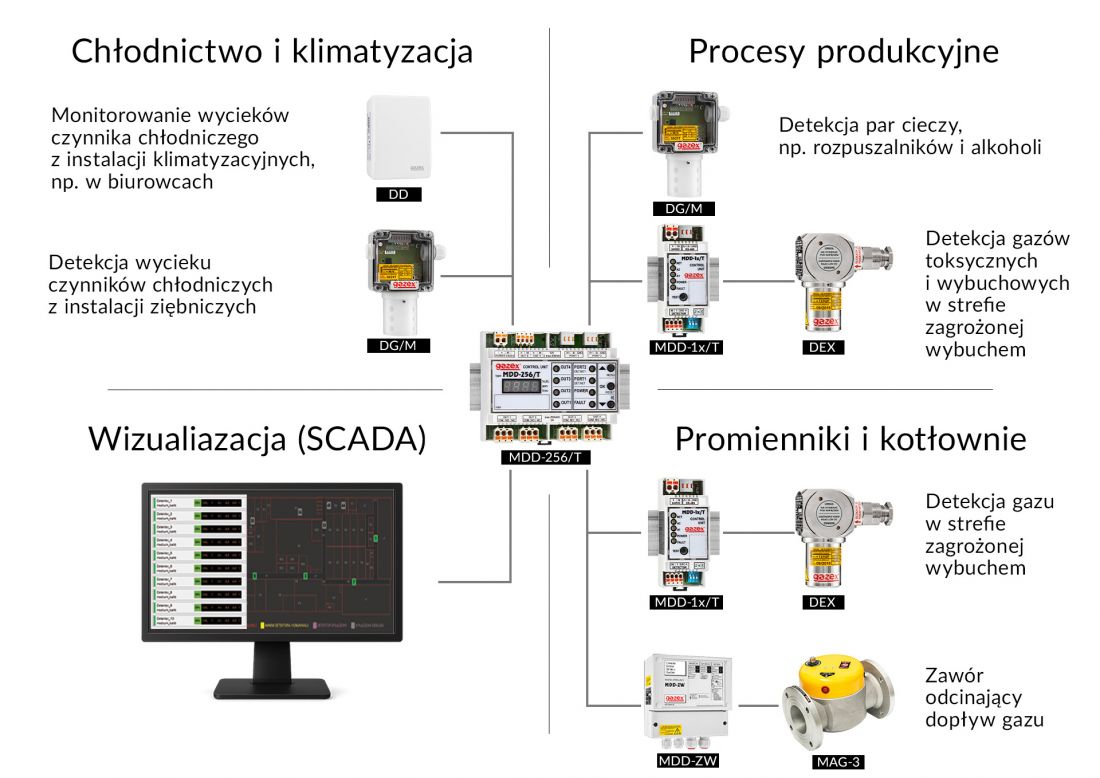
CSDG® Digital Gas Detection System
© GAZEX
For example, the former classifies explosion prevention and mitigation devices as fire protection devices. The latter mandates the use of signaling-cutoff devices in all rooms where the total heating power of gas appliances exceeds 60 kW. A signaling-cutoff device is a gas detection system coupled to a shut-off valve.
In newly built facilities, the installation of detection systems is already provided for at the design stage, in existing buildings it is often a requirement of the insurer or fire expert.
In less demanding facilities and lower risk of dangerous gases, it is worth using stand-alone gas detectors with basic control capabilities for signaling, ventilation and other actuators. For convenience, they can offer four devices in one (Gas detector; Control module with contact and voltage outputs; Optical and audible signaling; Power supply). A good example is Gazex's new WG/Fx detector.
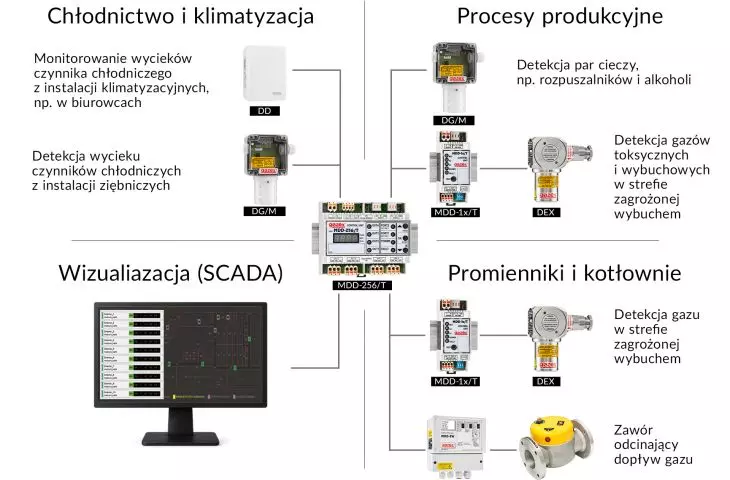
On the other hand, digital gas detection systems (e.g., CSDG® from Gazex) are widely used in large-scale facilities such as industrial halls, storage halls, and underground garages. CSDG® is a universal system - it can be freely expanded, modified, change its functionality. It allows the configuration of both small systems consisting of a supervisory module and a few detectors, and the construction of extensive systems consisting of several hundred devices. Gazex has a full range of gases used in industry, which allows the use of a single CSDG® and its arbitrary expansion if necessary
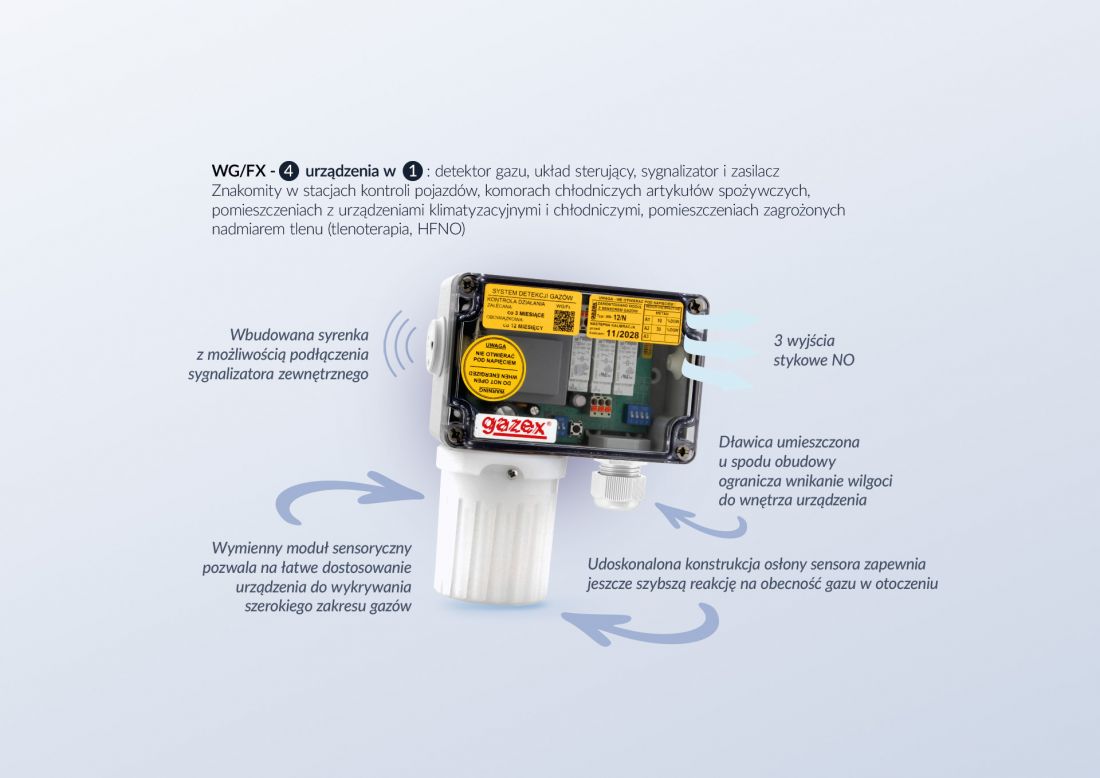
WG/Fx threshold standalone gas detector
© GAZEX
Digital Gas Detection System Architecture
The CSDG® architecture is based on 3 product groups: supervisory modules (e.g. MDD-256/T), gas detectors (DG/M or DG-EN/M and DEX for ATEX zones in combination with MDD-1 module) and executive devices such as shut-off valves (MAG-3), GSM modems (GSM-M8), visualization modules (MDD-L32/T) or controlling other systems in the building through contact or voltage outputs (MDD-C32/T).
The system should have a logical structure divided into groups so that , within each group, independent alarm and control functions can be carried out using executive modules.
Gazex's CSDG® is a distributed system in which elements communicate digitally with each other in the RS-485 standard in accordance with the Modbus RTU protocol. The MDD-256/T supervisory module collects and analyzes measurement data and controls the executive modules. The module can be connected directly to the BMS facility management system via analog outputs and the bus, or indirectly via a signal converter and any computer.
The MDD-CV/T digital signal converter allows connection of any PC/laptop to the RS-485 port of the MDD-256/T control module. After installing the MDD256 View program, the user is given access to control selected functions of the MDD-256/T module. Through the MDD256 View application, it is possible to set the parameters of individual detectors and devices connected to the digital bus. Gazex offers a map of system registers, which allows integration with any BMS system.
CSDG® can be expanded with a visualization system based on Scada Promotic software. The application monitors and controls the operation of individual gas detection system components on the monitor screen. It records and archives alarm conditions in defined groups, displays current alarms, and allows viewing the history of events.
For a stationary gas detection system to work properly, 4 basic conditions must be met:
- Proper selection of equipment taking into account the conditions of the monitored facility and the needs of the users.
- Proper selection of detector installation locations.
- Proper execution of the system installation.
- Correct operation of the system in accordance with the instructions and common sense.
Gas detection systems are a critical component of safety, so their selection, installation and service should be consulted with experts (such as Gazex Technical Consulting).
For more information, visit the company's GAZEX Sp.j. page on the A&B portal.