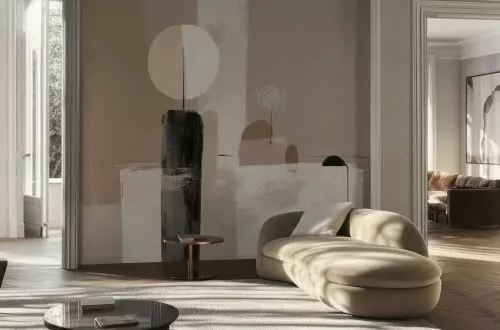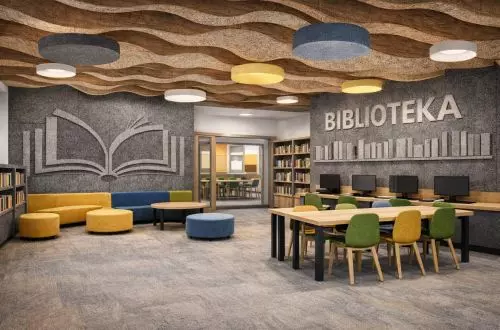






STUDIO e. is a place where interior design becomes a story about people and their needs. Its owner, Ewa Lompart, has been developing her own design language for years, combining functionality with the emotional dimension of space. As an ambassador for Kontakt-Simon, a manufacturer of electrical installation hardware, she emphasizes the importance of detail and thoughtful design, in which new technologies help shape the character of an interior. In this interview, she discusses her professional journey, the contemporary challenges of interior architecture, and why a well-designed home should, above all, meet the needs of the people who will live in it.
Ms. Ewa, how do you define interiors in the context of contemporary design challenges?
For me, an interior is much more than just a composition of materials and colors—it’s the backdrop against which people will create their own stories. In today’s fast-paced world, the greatest challenge is creating a sanctuary that meets the emotional needs of its residents. I love talking to people and listening to their stories, because that’s what allows me to “tailor a design to their needs.” The moment that gives me the greatest satisfaction is when I hand over the finished home and see it come to life with its new owners.
What directions in your professional, design, or business development do you consider most important in the coming years?
My business is currently moving toward full-service, comprehensive design. I want my clients to feel completely taken care of—from the concept, through material selection, all the way to overseeing the construction process. To achieve this, I’m working intensively on automating the design phases. Thanks to the implementation of modern processes, work proceeds faster and more efficiently, which allows me to devote more time to the creative aspects of the project and direct interaction with people.
Which aspects of your daily design work do you consider key to maintaining high-quality execution, and which ones require the greatest flexibility from architects today?
For me, the key to high quality is flawless work organization and accuracy in technical documentation. This is the foundation that ensures contractors know exactly how to bring the vision from paper to reality. On the other hand, working with people requires flexibility on my part. Every project involves different personalities and emotions. It takes immense patience and full commitment to reconcile the client’s dreams with technological reality, while maintaining the joy of creation.
How do you view your role as a Kontakt-Simon Brand Ambassador, and how does your design experience translate into a conscious collaboration with a manufacturer of electrical installation hardware?
For me, the role of Ambassador is a blend of aesthetics and functionality. As a practitioner, I know that fittings are the “jewelry of an interior”—a detail that must be as beautiful as it is reliable. My design experience allows me to engage in an informed dialogue with the manufacturer; I know what my clients need and how important it is for technology to make their daily lives easier while also being an integral part of the design.
Do your non-professional experiences influence your design sensibility and creative decisions, and if so, how?
My life journey—starting college in my 30s and balancing it with motherhood—has taught me incredible empathy. Being a mom means that in my projects, I think very practically about the needs of families. My experiences have shown me that in design, just as in life, “anything is possible if you want it enough.” This gives me the courage to propose solutions that not only look great but, above all, make everyday life easier.
What led you to choose a career as an interior architect, and did you have a mentor along your professional path who significantly influenced your approach to design?
For years, I ran a company in a completely different industry. The turning point came when I was decorating my own apartment—I didn’t know any design software back then, so I sketched the design with a pencil on a piece of paper or directly on the walls of the construction site. That’s when I discovered that planning spaces gives me immense pleasure. Going to college was a “crazy” idea of my husband’s, who always believed in me. I had only two months to learn how to draw! Even though juggling full-time studies with two children was extremely difficult, it taught me extraordinary discipline in time management and task logistics. As soon as I stepped onto campus and was introduced to my first professional design software, I was completely hooked. Today I know that the most important thing is to love what you do—that love for my profession is my best guide.