



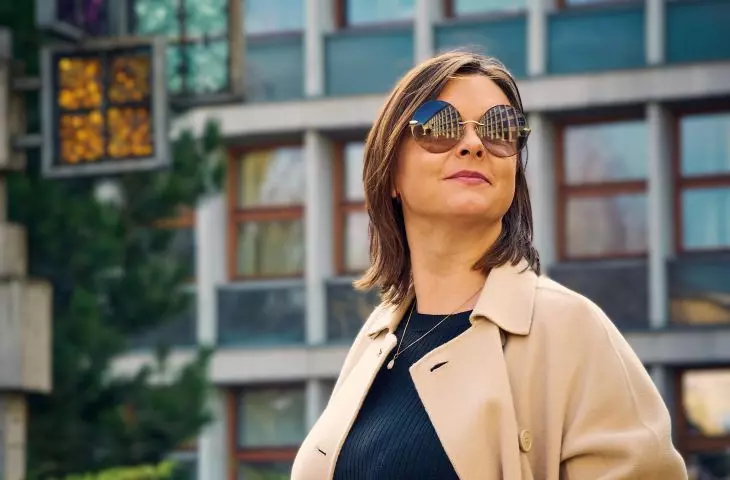

Starting on September 23, Gliwice will host the 7th Polish Urban Planning Congress under the theme “Urban Planning at a Crossroads.” We spoke with Prof. Agata Twardoch—an architect and urban planner who has headed the Gliwice City Planning Office for the past two years—about whether we are indeed at a crossroads in urban planning, as well as about Gliwice’s newfound confidence and comfort.
Polish Urban Planning Congress, September 23–25, 2026, Gliwice — ,
© Organizers’ archives, © Organizers’ archives
Ola Kloc: You’ve been Gliwice’s City Planner for two years now, the first person to hold this position in the city’s postwar history. I imagine that building the City Planning Office from the ground up was a massive challenge. What was that process like?
Agata Twardoch: It really was—and still is—a huge and, at the same time, difficult challenge for several reasons. One of them is that the role of the City Urban Planner differs from that of other departments—we’re technically part of the municipal office, but we operate somewhat from the outside. We strive to serve as a think tank and a quality control body, so we introduce new standards and procedures designed to ensure that quality. This can be difficult to implement in an institution that has operated within established procedures for many years.
It was also challenging to build a team, because the tasks we carry out had never been done here before. One example is organizing design competitions independently so that they not only meet all standards but are also accepted by the professional community.
We’d like to convince the City to organize competitions, to show that it’s neither very difficult nor very expensive, and that it can yield excellent results.
Ola Kloc: Did you have any points of reference when creating the City Planning Office? Did you look for similar practices in Poland or abroad?
Agata Twardoch: I was strongly inspired by the work of Piotr Lorens from Gdańsk and Marlena Happach from Warsaw. What we’re doing in Gliwice lies at the intersection of these two approaches. On the one hand, our activities touch on the architectural scale—something Piotr Lorens doesn’t do—but on the other hand, I’m not the head of the architecture or urban planning department; rather, I’m an external entity, much like Piotr in Gdańsk.
It’s difficult to draw inspiration from foreign examples, given the Polish spatial planning system and its very limited role in the entire investment development process. In many cases, we can serve in an advisory or expert capacity, but beyond local zoning plans, we have no real influence over private developers.
In many Western countries, the conditions set forth in local plans are fairly general, and then each development project is negotiated with the authorities, or the provisions are interpreted more in the spirit rather than the letter of the law. The fact that in our country they are treated strictly according to the letter of the law often leads to many difficulties.
When evaluating a project that is approved by the architecture department, one cannot analyze it in terms of what the plan’s author intended—even though everyone knows this—but rather in terms of whether they placed a comma incorrectly somewhere or if the wording leaves room for interpretation. We must adhere to the applicable provisions.
Ola Kloc: The City Planning Office occupies a middle ground among the various units responsible for spatial planning and urban development. It deals with what is happening—or should be happening—before formal decisions are made. How did you manage to implement this process and begin this collaboration?
Agata Twardoch: The beginnings were simple, but then it turned out that sometimes our points of view are so divergent that reaching a common position is difficult. In those cases, we engage in what I call “poldering,” a term I borrowed from a colleague of mine in the Netherlands.
Ola Kloc: Meaning?
Agata Twardoch: Because the Dutch had to reclaim the land they live on from the sea, it’s crucial for their way of life to reach a consensus and convince literally the entire community of the validity of the chosen solution. Everything the Dutch do so far has to be thoroughly discussed; everyone has to agree. Sometimes it’s two steps forward and three steps back. We work similarly here: we have to adapt to the city’s rhythm. Everyone in my department is from outside the system; apart from one person, none of us had previously been civil servants. We also sometimes have the temperament of architects, which can be challenging—architects are often perceived as arrogant or know-it-alls, so we have to temper our natural personalities, while the other departments need to learn that we are an additional element in their analyses—one that hasn’t been taken into account until now. Previously, analyses focused on financial aspects and immediate substantive needs, while issues of space and quality took a back seat.
Ola Kloc: There’s a widespread belief that government offices still operate in silos, lacking the communication needed to make better, collaborative decisions.
Agata Twardoch: That’s often the case, indeed. Since we don’t really have our own statutory administrative duties, we serve as a bridge between the various departments. We operate in a way that breaks down silos because we look at every issue slightly differently than the departments directly responsible for the subject matter. For example, we created a task force on green spaces, which includes representatives from all departments responsible for various green areas. In Gliwice, these responsibilities were divided: the Municipal Public Services Administration handled parks and squares, the Municipal Roads Administration handled roads, and the Housing Management Department handled residential areas. So we created an interdepartmental team that, together with the Department of Spatial Planning and Architecture, takes a broader view of urban green spaces. We are currently finalizing standards for managing urban green spaces to ensure consistency across all departments. We’re also aligning this with future plans; for example, we’re taking care not to sell off areas that could form part of a comprehensive natural system.
Ola Kloc: Gliwice adopted its general plan on July 3, and the work on the document was accompanied by the longest public consultations in the country—what were the main points of discussion? In your opinion, what led to such strong engagement from the city’s residents?
Agata Twardoch: This engagement stems in part from the limitations of the general plan as a tool. Gliwice is almost 100 percent covered by local zoning plans, so in our situation, the general plan is, in short, a redrawing of the existing plans. When we tried to introduce generalizations into the plan, residents would come to us because they didn’t like the fact that, according to the local plans, they were supposed to have development type X in a given location, but the general plan specified type Y.
Ola Kloc: What does that mean?
Agata Twardoch: If a given area had both single-family and multifamily housing, we classified it under the multifamily housing category. The general plan doesn’t break things down into specific types of development—we think about the urban structure on a broad scale and consider the entire urban unit, not just individual lots. It was difficult to convince residents that this provision doesn’t mean someone is going to build a huge apartment block right in their backyard.
Besides, there’s growing interest in what matters most to people. This doesn’t necessarily mean they’re engaged in thinking about the city as a whole and its broader horizons, but if certain provisions might affect my investment, my property, or my lot, then I’m interested in them.
There were also people who thought more broadly. They asked why we couldn’t increase green spaces in the city, since we’re introducing a general plan. We then had to explain that we couldn’t, because the current local plan takes precedence over the general plan. So if certain areas are designated as industrial zones in the local plan, we cannot convert them into green spaces. Even though we all agree that a given area is valuable from a natural perspective, if someone decided twenty-two years ago that it would be an industrial zone, then now, in order to change its status, we would have to either buy it out or pay compensation to the owners. In Gliwice, significant areas were designated as industrial zones at the beginning of the 21st century; that was the trend back then—development, investments, and attracting business were the top priorities. Twenty years ago, that may have been the right way of thinking, but things are completely different now. Today, these areas are mainly being developed into logistics centers, which is the worst possible solution—they take up a lot of space, contribute significantly to the creation of an urban heat island, and do not attract— pardon my French —the creative class to the city.
Ola Kloc: So, in the case of Gliwice, did the general plan prevent adjustments to localplans that might no longer be in line with the times ?
Agata Twardoch: The master plan had to incorporate information from the local plan. So we couldn’t use the master plan to change what we didn’t like in the local plans. If we want to make any changes, we first have to amend the local plan.
Ola Kloc: That’s a shame, since the local plans were adopted under different circumstances.
Agata Twardoch: The master plan was created “toothless” —it didn’t give us the ability to make changes. What’s more, as I’ve already mentioned, every change to a local plan entails compensation—we’re talking about enormous sums of money. It would be great if the general plan were the overarching document that made the urban structure more logical. Unfortunately, in places where local plans already existed, this was impossible to do, as if the legislature hadn’t anticipated such a situation. I am convinced, however, that such a change would be unacceptable in Poland at this time. Regulations that in any way interfere with private property stand no chance—the prevailing mindset is “do as you please in your own home” and “I have it, so I demand it.” This is what most hinders rational land-use planning, especially since this approach lacks pro-environmental considerations and factors related to development as it is understood today—which in Poland should be qualitative rather than quantitative. Given depopulation and demographic trends, we really don’t need much more development. We should redefine what development can look like—something that is impossible within the capitalist paradigm of profit, because financial growth stems primarily from quantitative growth.
Ola Kloc: What’s mine is mine, and what’s shared belongs to no one?
Agata Twardoch: There’s always a group of social activists who speak out loudly about environmental needs; they say, for example, “we need to create a green buffer zone here.” The locations they point to, however, are private plots of land. If the owner of such a plot said, “Create a green buffer zone here,” we’d do it in 15 minutes! But he’s more likely to say, “Do it at the neighbor’s.” Participation in Poland very often takes precisely this form—looking out only for one’s own interests. Everyone agrees on the idea, but when we talk about a specific piece of land, who owns it turns out to be more important. We won’t be able to deal with this in this way.
We can only implement our ideas on city-owned land. If it weren’t for the sell-offs carried out over the last thirty years, if we still had the amount of land in our inventory that the Polish People’s Republic left us, we’d be able to implement the best urban policy!
Ola Kloc: Despite such extensive coverage by local zoning plans , are there likely to be cases where the ZPI procedure is applied , in which the City has the opportunity to negotiate how a given space will be developed?
Agata Twardoch: ZPI can be applied as part of a local plan amendment. It must also be financially worthwhile for the developer to use this instrument. If a given area is industrial and the developer wants to build residential housing there—it can be done.
In Gliwice, some genius who drafted the plans introduced low-density development limited to four stories. As a result, we have total spatial chaos—at first, people wanted to build single-family homes, so they built them under the low-density zoning. Now investors have come in and are building apartment blocks. There’s chaos and major conflicts—yet everyone is within the law. In such a case, an investor is unlikely to be interested in a ZPI.
In my opinion—though of course I’m not objective— urban planning is much more important than architecture. We don’t have a problem with good architecture in Poland, but the quality of what lies between the buildings is poor.
Ola Kloc: I feel that there’s a lack of public awareness regarding the impact of planning regulations on emerging architecture. It’s easy to judge something negatively, even though sometimes the design of a given development is the result of local zoning regulations from twenty years ago for some context-deprived patch of land…
Agata Twardoch: My dream is for architects to have enough guts and moral backbone not to take on such projects. But it’s also hard to place all the blame on them; if something is built in accordance with the law, then it’s built in accordance with the law.
In college, I was taught how to get around the local zoning plan, but there was rarely any discussion of how to design a good building that would fit into its context and align with what’s in the zoning plan. So it happens that, as architects, we harbor a certain arrogance—the conviction that we know better and that no local zoning plan will dictate what we should do.
Ola Kloc: The mayor of Gliwice, Katarzyna Kuczyńska-Budka, wrote on her Facebook profile that the master plan is a “map of the future” for Gliwice. What kind of future would you like to see for this city?
Agata Twardoch: What makes me very happy—and is a clear direction for Gliwice’s development—is investing in affordable housing; we’re designing a lot of municipal and TBS housing projects, and we’ll be carrying them out.
What’s more, we’re doing this through design competitions. We’re also introducing housing experiments —the city’s first senior cohousing project, as well as buildings where young people, young professionals, and older residents can live together, places where there will be room for mutual support. We’re building apartments using various construction technologies—prefabricated and eco-friendly. Through these projects, we’re creating developments on a human scale; we’re striving to set a certain standard with them, including for private-sector developments.
We hold design competitions—and until now, there were virtually none in Gliwice! Following the last three for multi-family residential development, we will announce two more, which we are organizing as the City Planning Office. One of them is a design competition, which required negotiations with the City. It concerns the Kłodnica Boulevards—the river that flows through the entire city and serves as its backbone. Over the years, as is often the case with rivers in Poland, it became overrun with industry and polluted. My grandfather used to swim in it; all I remember is that it smelled terrible. Now it doesn’t stink—so we’re heading in the right direction—but residents’ attitudes toward the river still aren’t the best, and we want to change that. So we’re organizing a design competition to explore ecological connections, a new identity, and a new narrative. I encourage you to participate!
We’re focusing on green spaces, introducing not only the standards I mentioned but also a system of green areas in accordance with the 3–30–300 principle. Every resident should be able to see three trees from their window; 30 percent of residential areas should be covered by tree canopies; and every apartment should have the nearest green space no more than 300 meters away. We’ve managed to meet this goal in urban development areas. Of course, there are exceptions—we won’t start tearing down existing buildings just to create a park—but we strive to apply this principle to as much of the city as possible.
We’re also working on removing paved surfaces. Using European Union funds, we’ve managed to create a rain garden behind our city hall that collects water from the entire building. This is a showcase project we hope will inspire others. This is a truly great, well-located city that, until now, has been very technocratic. We want to change that—I envision the future of Gliwice as a friendly city.
Ola Kloc: The city is also gaining new confidence with its new strategy, “The Power of a Convenient City,” and its promotional slogan , “Gliwice with Confidence .” Does a “convenient city ” mean a smart city, or perhaps a 15-minute city?
Agata Twardoch: Gliwice is actually both a smart city and a 15-minute city. It also depends on how we understand the concept of a smart city. I don’t subscribe to the idea of a smart city as a technocratic space where technology is an end in itself.
The truth is, however, that in Gliwice we’ve benefited from the technocratization that took place here during previous administrations. For example, we had Poland’s first advanced traffic detection system, which effectively eliminated traffic jams. We’re now modifying it so that it pays more attention to pedestrians, buses, and cyclists, because until now it has favored cars. Our current efforts are aimed at making life easier for residents on many levels. To solve the parking problem, we’re creating transportation hubs and multi-level parking garages at locations where cars can be parked outside the city center. We have to think about parking because the city is the county seat and part of a metropolitan area; we cannot expect everyone to suddenly switch from cars to public transportation, which—due to the region’s dispersed urban structure—will never be as efficient as it would be in a monocentric layout.
We’re also changing the character of Zwycięstwa Street, the city’s main thoroughfare. We began by prototyping with road narrowings, temporary street furniture, and changes to traffic flow. We also conducted surveys, and after a year of work—first by our team and then by the Municipal Roads Authority—we are ready to implement real changes on the first section of the street. There will be wider sidewalks, greenery—including trees planted in the ground—and places to sit.
Ola Kloc: This fall , the 7th Polish Urban Planning Congress will take place under the theme “Urban Planning at a Crossroads.” I get the impression that where we stand today in terms of spatial planning is very challenging, and the paths to choose from are unclear…
Agata Twardoch: I think we were at a much greater crossroads thirty-seven years ago, during the political transition. Now we’d rather find ourselves at a crossroads, change course a bit, but everything seems to indicate that it’s business as usual — a straight path, a retreat from the role of urban planning, the public sphere of our lives shifting toward the private, social stratification deepening, and the impoverishment of part of society continuing. So I’d like for us to be standing at a crossroads from which we could turn in a different direction, but I don’t see that crossroads.
Ola Kloc: So how do we change course? An attempt was made three years ago, during the amendment of the Act on Spatial Planning and Development ; new urban planning instruments emerged then , which we discussed, but it seems we’re still in the same place.
Agata Twardoch: The system of real capitalism is difficult to change without a revolution. To change the tools, everyone would have to be convinced of the need to do so. However, those who hold power, influence, and money won’t want change, because they benefit from the current situation. In my view, this is a very broad problem that cannot be solved with half-measures.
Ola Kloc: So is it time for a revolution?
Agata Twardoch: People need to discover their own strength. The mere threat of a revolution can lead to many positive developments. The first reforms related to social, sanitary, and housing conditions in Europe—for example, Bismarck’s reforms in Germany or the Torrens and Cross Acts and the Housing of the Working Classes Act in England — came about under the influence of revolutionary movements that arose as a result of rapid industrialization and the resulting social stratification and inhumane living and working conditions. Urban parks began to emerge, attention was paid to ventilation and lighting in apartments, and social insurance as well as standards for working conditions and hours were introduced.
Ola Kloc: Gliwice will be the host city of the Congress, a model of a modern approach to the role of urban planning in improving the quality of human life. What good urban practices from Gliwice would you like Congress participants to draw inspiration from and perhaps implement in their own cities?
Agata Twardoch: One thing we’re pleased with—and which helps us manage space more effectively—is our own urban planning office. We draw up local plans ourselves, and the people responsible for them truly understand the needs of the city and its residents. The Urban Planning Office also introduces an immeasurable factor into the urban puzzle; if we have good arguments, we can sometimes bend the rules a bit in Excel spreadsheets.
In addition to the housing policy we discussed, we’re also proud and pleased with our collaboration with the Silesian University of Technology. We hold architectural competitions for students, and we’ll be implementing one of the municipal development projects based on the winning concept from our competition—it’s an engineering project by one of the students.
Thanks to the students’ involvement, we were also able to save a historic building from demolition. The students were able to convince city officials that the building’s value outweighed the financial losses we would incur by preserving it.
Ola Kloc: I think we already know who will start this revolution! Thank you for the interview.
The Polish Urban Planning Congress will take place from September 23 to 25, 2026, in Gliwice. Detailed information about the event and participant registration is available on the TUP website: LINK
Interviewed by: Ola Kloc
more: A&B 9/2026 – Competitions,
download free e-editions of A&B