




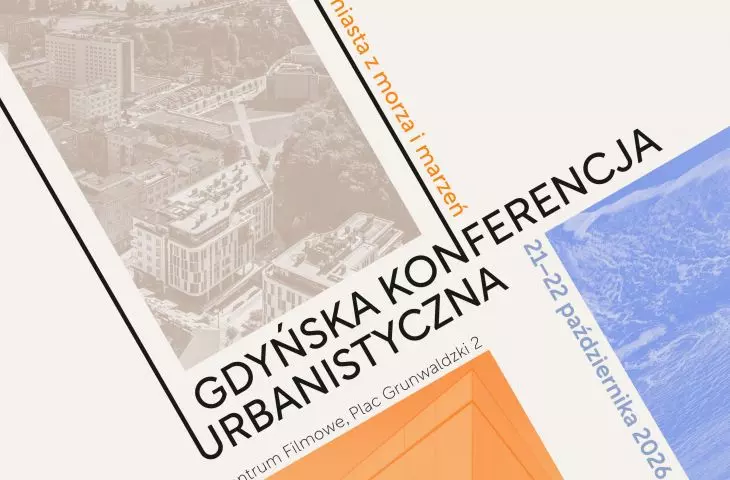

This is an important year for Gdynia —its 100th anniversary and the numerous events accompanying the celebrations, as well as its inscription on the UNESCO World Heritage List, which could significantly impact the city’s future. It’s also a good opportunity to take a closer look at the city and its development. On October 21 and 22, 2026, the Gdynia Film Center will host “Gdynia Urban Planning Conference: A Century of the City of the Sea and Dreams.” And while Gdynia will be the main focus of the event, there will also be discussions on reforming the spatial planning system, as well as contemporary urban and social challenges. Today we’re discussing these topics with Łukasz Pancewicz, an urban planner, co-founder of A2P2 Architecture & Planning, and assistant professor in the Department of Advanced Urban Planning at Gdańsk University of Technology.
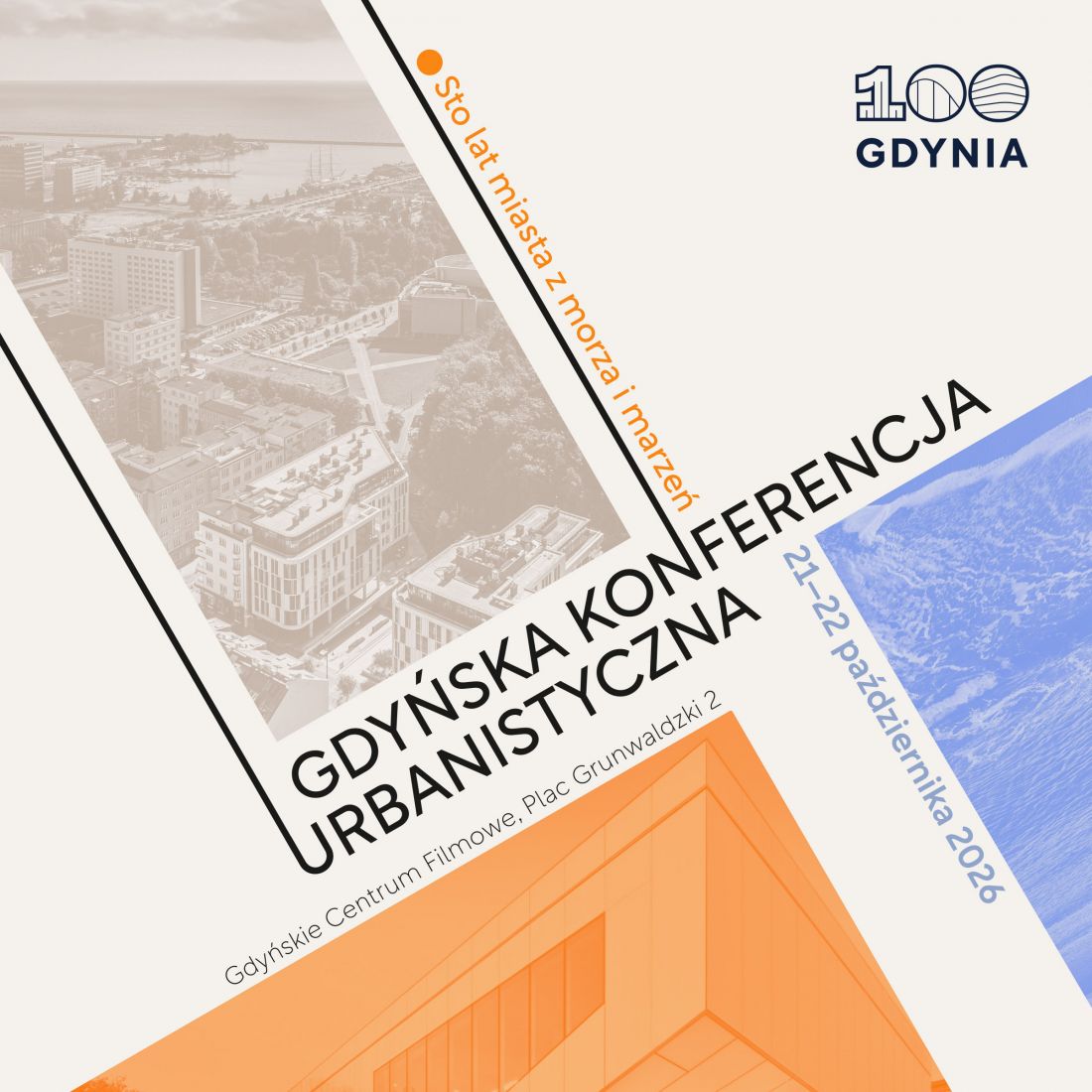
Gdynia Urban Planning Conference “A Century of the City of the Sea and Dreams”
© organizers’ archive
Ola Kloc: Gdynia’s modernist downtown has recently been recognized by UNESCO — in your opinion, will the decision to inscribe this area on the World Heritage List affect the city’s future urban development, and if so, how?
Łukasz Pancewicz: The UNESCO zone encompasses Gdynia’s modernist downtown, and it is this area that is protected. Furthermore, the modernist urban fabric is also protected by our national regulations. Gdynia’s downtown is very interesting from an urban planning perspective — it’s quite enclosed, bounded by the sea, a railroad line, and the port, so there isn’t much room for maneuver.
However, a key element that will be the subject of much discussion is the buffer zone [an additional protected area designated around a site inscribed on the UNESCO list; its purpose is, among other things, to protect the monument or, as in this case, the entire zone from the negative impact of new developments — Ed.]. Many development sites are located within it — Międzytorze, Molo Rybackie, and the port areas. Development projects underway there will therefore be assessed for their impact on the protected site and reviewed by advisory bodies, ICOMOS, and NID. And there are temptations to carry out very intensive development in these areas, the prime example of which is the aforementioned Międzytorze.
Ola Kloc: Gdynia is celebrating the 100th anniversary of receiving its city charter this year — it’s a relatively young city. Has it managed to avoid the urban planning mistakes that other Polish cities face?
Łukasz Pancewicz: No city is immune to the processes that affect them; they may simply manifest themselves in different places.
Gdynia started from a very strong position — as the only major city in Poland with a downtown located directly on the sea. This makes it unique. From the very beginning , it was also a compact “15-minute city” with a very dense downtown. It also avoided severe deindustrialization by maintaining its relationship with the port — though this is certainly not an easy neighborhood to live in, Gdynia thrives alongside the port.
Of course, Gdynia is not just its downtown area. Beyond the ring road lie new development areas, such as the Chwarzno-Wiczlino district. In coordination with the city, a fairly intensive investment program is underway there. It was also here that, for the first time in Poland, such a large-scale charrette workshop was held to plan a new district.
It is clear, then, that Gdynia has always had a strong tradition of urban planning and consciously manages its development.
Ola Kloc: Nothing but positives?
Łukasz Pancewicz: Of course, Gdynia also faces challenges. These include an aging population and depopulation, as well as the decline of the downtown area as a hub for commerce and services. The challenge, then, is to reimagine Gdynia’s downtown in such a way that it doesn’t function as a separate district, but is truly a center — not just a symbolic one — for all Gdynia residents.
Ola Kloc: Inclusion on the UNESCO list may bring new challenges related to increased tourist traffic and, consequently, the displacement of residents from the city center.
Łukasz Pancewicz: It seems to me that Gdynia, compared to Gdańsk, has never been treated as a major tourist attraction. Gdańsk dominated as the city with the longer history, which, in my opinion, wasn’t entirely fair — Gdynia is unique precisely because of its modernist heritage. It isn’t a monument or a museum city, but a living city.
Ola Kloc: Let’s move on to less pleasant topics, namely Polish urban planning…
Łukasz Pancewicz: I don’t know if I’m a good debater on this subject — I’m not filled with bitterness or disappointment. There’s too much work to approach it that way!
Ola Kloc: That’s fantastic news! So tell me, how do you assess the latest urban planning tools: general plans, restrictions on issuing building permits, and Integrated Investment Plans (ZPI)?
Łukasz Pancewicz: Unlike many in the field, I think this is a good step, and I consider the reform’s objectives to be sound.
General plans will streamline the old development studies, which weren’t very effective tools for steering urban development. For a large local government, preparing such a study meant several years of hard work, and the document itself combined a vast list of conditions with a meager layer of information regarding the steering of the municipality’s development, blending spatial planning with toothless attempts at development management. The idea that a city’s development is guided by a strategic document containing a spatial component [general plan — ed.] is also very wise. It finally equips spatial planning with development tools.
This is a positive step in the reform process that still lies ahead of us. Municipalities will begin updating their strategies, and this is rarely discussed. I think urban planners do not fully understand how important this element is.
Of course, one could argue that general plans are documents of a general nature; however, they do establish certain principles — zoning, land use, and building parameters. And with the optional designation of Areas for Supplementary Development (OUZ), the new general plans effectively strengthen the role of local plans, delivering something the urban planning community has always insisted on — that land-use plans will guide the municipality’s development, rather than decisions on building conditions.
I also appreciate the government’s consistency regarding development permit decisions —they will finally be treated as a tool related to administrative and legal proceedings. Their duration will be limited, and they will also be assigned to the person who owns the property for construction purposes, which may finally curb speculation.
And the third point, the Integrated Development Plan (ZPI) — in my opinion, this formalizes something that municipalities have already been trying to implement informally. Potentially, this is a solution that will help plug local governments’ financial gaps. Private developers are key players in the Polish market; under the ZPI, their projects will be contingent on the construction of public infrastructure —until now , municipalities have borne the costs associated with urban development planning without any mechanism to recoup those costs. The introduction of urban planning agreements strengthens the position of municipalities.
Importantly, the ZPI does not amount to a transfer of power to developers; the municipality retains planning authority. When preparing a ZPI, developers become involved in the lawmaking process; they are invited to the negotiating table but do not take control of the process. It is the municipality that holds the cards. If the municipality is aware of this and knows how to act assertively, it will be able to set conditions for property owners.
Ola Kloc: I understand that strengthening local plans through general plans can be a good thing, but what if a municipality has outdated local plans that are ill-suited to contemporary urban planning challenges and must “redraw” them into general plans without the possibility of making corrections?
Łukasz Pancewicz: The reform is not an amnesty for municipalities that have made mistakes. If they deliberately failed to exercise their authority—specifically, their planning powers — or did so carelessly or irrationally , they will face the consequences.
If municipalities carried out their tasks properly but left certain gaps, the reform allows them to correct course.
For municipalities that have managed their space well, the reform is not a challenge.
Ola Kloc: I’m afraid that it is primarily the residents who bear the consequences of these mistakes made by the municipalities.
Łukasz Pancewicz: Yes, but residents’ awareness of the consequences of unplanned development is growing. Residents are protesting against the development of green spaces, tree cutting, and oversized buildings in their neighborhoods. The question is how local governments will respond to these concerns. I believe that resident engagement and keeping a close eye on local authorities will help improve planning. It must also be said that some residents of these municipalities have benefited from the existing system, easily obtaining permits to build houses in the countryside or to speculate on land — these individuals will also be unhappy with the changes to the law.
Ola Kloc: You mentioned zoning conditions — in the wake of the reform, they’re being issued en masse to beat the deadline before the general plans are adopted, which will also affect the surrounding area. Could this have been avoided?
Łukasz Pancewicz: Not in Poland, and not with such strong lobbying influences and politicians’ fears.
Two forces are at odds in this reform — one that wants to streamline the system, clean it up, and regulate it, and the other, which is constantly driven by the vested interests of property owners and some local government officials who do not want the system to change; they want to continue having the freedom to manage land use without the restrictions imposed by law.
I believe that allowing for transitional periods was a rotten compromise, the consequences of which we will continue to face for several or even a dozen or so years. However, simplifying the procedures for drafting the general plan allows us, during the next revision of this document—especially if the decisions issued have been implemented through development—to incorporate some of these changes and later eliminate those that were made for speculative purposes.
Unfortunately, spatial planning in Poland—with very strong protection of property rights—sometimes operated in such a way that zoning decisions were treated like lottery tickets — often, property owners or speculators secured building rights as a form of financial reserve for the distant future, which in many cases was not backed by actual construction activity. I think these speculative activities will come under scrutiny when municipalities are faced with depopulation. This will be a true test of the extent to which real estate speculation translates into actual construction activity.
Ola Kloc: Let’s return to the ZPI for a moment—of course, it can be a great tool for municipalities, provided they know how to use it. For smaller local governments, this may prove to be quite a challenge.
Łukasz Pancewicz: Municipalities have access to various training programs and opportunities to develop their staff; the challenge is rather that local government employees are overburdened with too many responsibilities and may not necessarily be able to take advantage of this assistance.
I’m always puzzled by situations where someone claims that a tool—such as a local land-use plan—prevents a local government from taking action. Yes, land-use planning tools are subject to various conditions set forth by law, but it is not the case that a municipality is powerless, uncontrollable, or forced by some regulation to do certain things. Nor is it the case that when an investor comes along, the municipality can only give in and relinquish its authority. It all depends on the policies pursued by a given local government and on the quality of its mayor and his team. This is the key to land-use planning—not urban planners or regulations, but how the local government exercises its rights and privileges.
It’s important for local governments to be able to think like a developer, because the ZPI is, at its core, a business negotiation. They need to understand how much gross floor area (PUM) and usable floor area (PPU) the applicant can develop on their property, and what profits they’ll generate. They should consider what share of the property’s value they want to secure, and what needs they must address to ensure that the resulting development is viable and not just a predatory real estate project. There are also many environmental regulations that allow for quality requirements. If we start thinking this way—and in my opinion, there are small and medium-sized local governments that are already thinking in these terms—we’ll be able to act assertively and negotiate our interests quite effectively.
Ola Kloc: So is there hope for Polish urban planning?
Łukasz Pancewicz: I keep hearing that urban planning is dead — I hate that. Our firm focuses on innovation in planning: urban design, public participation, shaping public spaces, and organizing competitions—and we’re constantly very busy. So when I hear that spatial planning is dead or doesn’t work, it really gets under my skin!
Ola Kloc: Thank you for the interview.