

We need to stop complaining that someone isn’t paying us and start demanding payment. “Unfortunately, today we often go about it in a ridiculous way and undermine the profession’s prestige ourselves,” says Karol Nieradka, an architect, entrepreneur, and president of the Szczecin chapter of SARP. In an interview with A&B, he talks about salaries, the motivations of young architects, fair rates, and why architects need to speak the language of business.

Karol NIERADKA — A graduate of the Faculty of Civil Engineering and Architecture at the Szczecin University of Technology. Since 2010, he has run the maxberg design firm in Szczecin. He has served two terms as president of the Szczecin branch of SARP, and since 2024, he has been chairman of the Municipal Urban Planning and Architecture Commission in Szczecin.
Ewa Karendys: The situation for architectural firms in Poland is dire. Do architects entering the job market today also face an uphill battle?
Karol Nieradka:My mission is to debunk the whining that we have a terrible profession and that, for example, tile setters earn more than architects. That’s not true, because if it were, we’d all be tile setters. It’s not as if things are somehow drastically better elsewhere. Not counting the IT industry, which, incidentally, is undergoing a major transformation today and the “employee’s market” is coming to an end. My second point is that we’re a terribly disorganized industry when it comes to business management and making money.
Ewa Karendys: Terribly?
Karol Nieradka: No one teaches us this; senior architects very rarely serve as positive examples of good business management, which is why I decided to start learning it on my own. A long time ago, I took advantage of a grant for project management training, which opened my eyes to the financial and psychological aspects of running a business. Right now, I’m pursuing an MBA at the Kozminski University in Warsaw. I’m from a generation where most people worked on a contract-for-service basis, off the books, or received cash under the table. Running our own firm, we try not to make those mistakes and to pay our employees fairly under honest contracts.
Ewa Karendys: “Adequately”—what does that mean?
Karol Nieradka: I searched for a long time for a point of reference, until in 2024 the Central Statistical Office (GUS) began publishing the median wage—that is, the earnings of the “average Pole.” Last year, it was approximately 6,700 gross, or just 4,670 net. When designing the pay system, we assumed that employees should earn between one and two medians, or roughly 5,000–10,000 PLN take-home pay. Only 20 percent of the population in Poland earns more than two medians. And so, in May 2025, the average salary at the maxberg office was 7,079 zlotys net, and the median was 7,625 net for a full-time position.
We varied the pay scale based on length of service, employee performance reviews, and weekly hours. This allowed me to explain to people how much they earn and where the ceiling is. Because if they want to earn 20,000 at a design firm, they probably won’t get that much at any studio—unless they become partners, and that’s a completely different level of responsibility and risk.
That said, eight years ago we decided that not everyone has to work full-time; in practice, this often means 7/8 (7 hours a day) or 4/5 (four days a week) of a full-time position. Roughly half of our staff works full-time. When the office first started, this gave me a sense of security—I had an employee for a slightly lower salary, since we divide the median salary by the time the employee spends at our office—and the peace of mind that I wasn’t the only one responsible for someone else’s paycheck. Thanks to part-time work, employees can earn extra income or focus on their children. The first three people are the hardest to hire. By the twelfth and fifteenth, it’s smooth sailing.
Getting back to young people: if anyone claims they’re entitled, they’re wrong, because demanding an employment contract isn’t an entitlement, nor is demanding a salary at least equal to the median wage in Poland.
Ewa Karendys: Aren’t young architects in a worse situation than their older colleagues?
Karol Nieradka: When it comes to self-employment, in my opinion, it has never been easy. I didn’t hire my first employee until seven years after starting my sole proprietorship. You have to be prepared for the fact that, figuratively speaking, every year I’ll be pushing a pebble forward by a centimeter so that someday—perhaps—I can lift it above the “rain cloud.” It’s easier to get started after winning a competition, but that, in turn, is very difficult to achieve. That’s when substantial funding, project implementation, and publicity come into play, allowing for faster growth.
Our profession is interesting in this respect because it offers a wide range of activities: social, artistic, curatorial, graphic design, technical work, administrative roles, and so on. We’re technically skilled and creative. I don’t feel any pressure at all from younger colleagues—at least in Szczecin—who are eager to open their own firms and create competition. And perhaps in this sense, it’s harder for young people to start a business, because they themselves have less motivation, while at the same time the market has become more professional, and it’s not easy to compete with those who have larger budgets and already employ a dozen or several dozen people.
On the other hand, the image of employers has improved: there are more firms that hire legally, understand labor laws, and try not to overuse overtime. In terms of employment conditions, things are therefore a bit easier for young people. Although there’s still room for improvement when it comes to finances—one would hope that the median salary for architects were significantly higher. It seems to me, however, that the worst is behind us: young professionals are pushing for better employment standards and higher rates for design work. It turns out that no one wants to work for 3,000 zlotys anymore. And that’s a very good thing.
Ewa Karendys: Let’s say a young architect starts their own firm. How do they attract their first clients?
Karol Nieradka: We did our first two major projects (Bałtycki Apartments and Greeneri Apartments) with a client for whom we had previously built a single-family home. So you could say we got a bit lucky, but it was luck we earned. Now we once again have clients for whom we designed a house, and they’re coming back to us for the design of a factory and a housing development. Building long-term relationships and continuous growth are very important—if we were the same firm we were a few years ago, we wouldn’t be getting the projects we have today.
Ewa Karendys: Which commissions are the most lucrative? What pays off the most: competitions, individual projects, or development commissions?
Karol Nieradka: We started out with single-family homes, but it stopped being profitable for the company altogether. Even though we were paid 70,000 or more per project, after more than 400 hours and 9 months of work, the profit amounted to only 15,000–20,000. It costs at least 100,000 zlotys to keep the firm running for a month. We produce a lot of concepts and analyses, which, unfortunately, are still a cost, because developing a concept for a competition or a real estate development project takes us 400–700 hours and costs around 100,000 zlotys.
This amount is rarely recouped through the fee for the concept alone. We rarely enter SARP competitions. On the one hand, because I am the president of SARP Szczecin, we do not enter competitions organized by our branch. On the other hand, it’s because it represents a huge effort and expense for the firm. In September, we won second prize in a SARP competition for the TBS housing development in Gliwice. We devoted 624 hours of work to this project, which, together with the visualizations, cost the firm 86,000. Meanwhile, the prize for second place amounted to approximately 30,000 gross, minus VAT and income tax. Sometimes, however, we take risks because it’s a learning experience, it’s motivating, and it offers the opportunity to secure a good contract.
Our main source of revenue is residential development, in which we specialize, as well as hotels and apartments. A new source of revenue comes from master plan projects and integrated investment plans, which allow investors to increase the value of their properties and enable us to share in that profit.
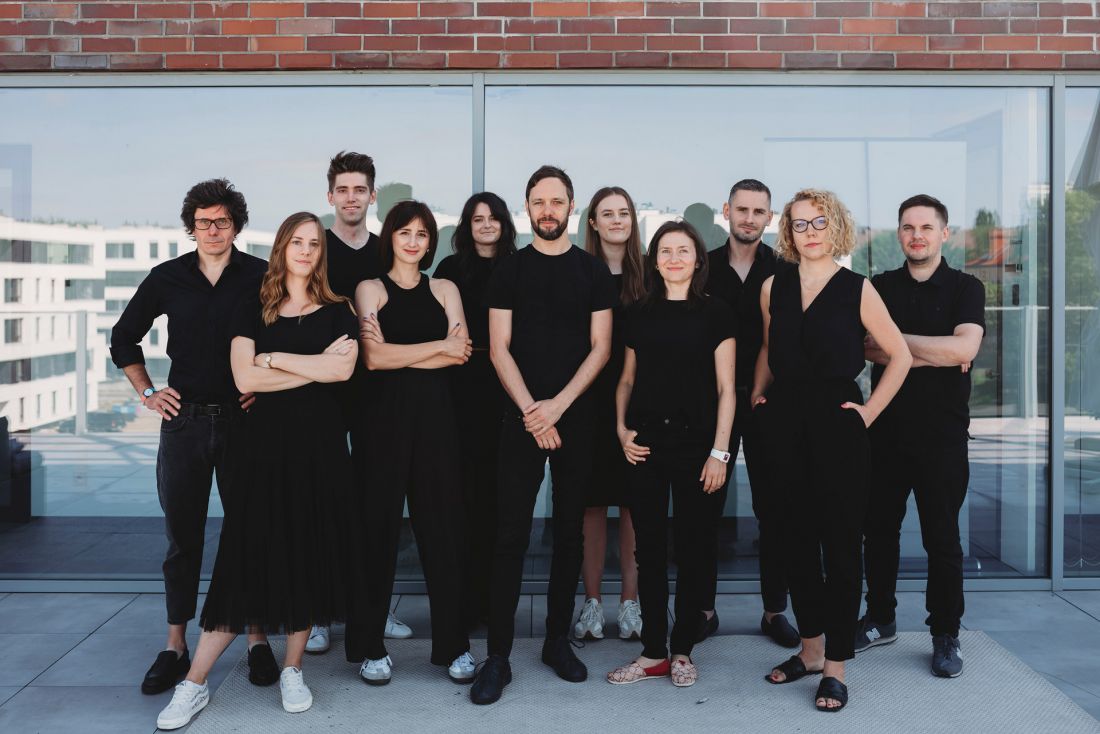
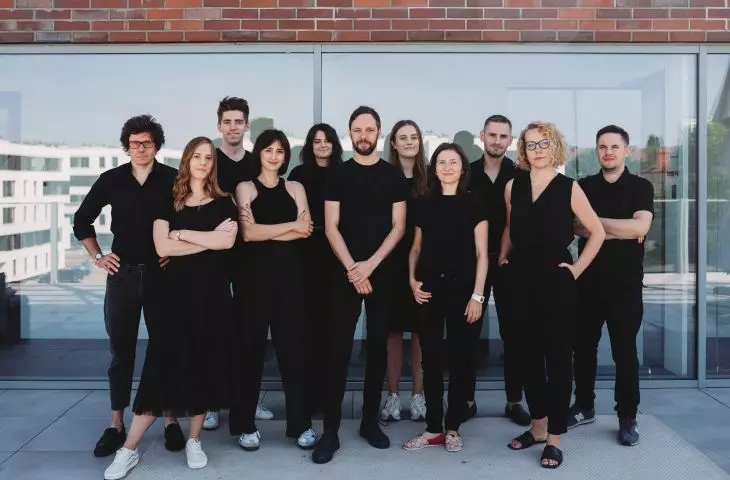
The Maxberg Team
Photo: Sylwia Orłowska
Ewa Karendys: Is there anything young people struggle with today?
Karol Nieradka: I must admit that I’m pleased with the young people who come to us. I appreciate their dedication, though one challenge for employers is changing their mindset. After a few years, for example, young people might say, “It was really great, I really enjoyed it, but I’d like to move to Zurich.” They’re much more casual about making life decisions than they used to be. They have more opportunities and fewer limitations—and that’s also a positive change.
Ewa Karendys: Marcin Kozikowski, a popular architect in Gdańsk, told me that the economic viability of running an architectural firm is often in question, partly because of young architects who enter the market with rock-bottom prices, hoping to land their first project and build their business.
Karol Nieradka: In my opinion, this market has been ruined not by the young, but by the old. The old have been in it for a long time, and the problem has also been around for a long time.
Ewa Karendys: Could you explain that?
Karol Nieradka: I see that my former university professors are proposing outrageously low bids in tenders. It’s true that young architects don’t know how to price projects, and older designers aren’t sharing reliable knowledge with them. They tell them to use the “chamber” rates, even though they don’t use them themselves, or they say, “the market won’t pay more.” I’ve heard this many times myself: “No one will pay more than 30,000 zlotys for a house design in Szczecin.” But we were doing projects for 70,000–100,000 zlotys, not including interiors. It took me over a dozen years to figure out how to price a project realistically. Today, we successfully negotiate fair hourly rates for our work, rather than haggling over a few zlotys per square meter of usable floor area. Statistics we’ve been collecting for several years have helped us in this regard [see A&B 10/2025].
Ewa Karendys: Staying with the topic of young professionals who are just starting their careers, what do you look for when hiring? How can you stand out?
Karol Nieradka: I always joke that you can tell whether someone is good or not just by looking at their resume. You don’t even need to read it—just glance at it. If it’s written in a poor font or has a bad photo, that speaks for itself. You can teach architects the law and how to use design tools, but you can’t teach them a sense of aesthetics or how to think. But seriously, the portfolio is all that matters. Even when I hire people I know, I always ask them to send their resume and portfolio. All it takes is for someone to have three good projects, and you can already tell if they have a sense of architecture that’s not just pretty, but smart.
Ewa Karendys: Young architects are thinking about their future. Do you have any advice for them?
Karol Nieradka: Maybe this isn’t so much advice as a perspective from a distance that they don’t yet have: this is a very interesting profession. Many will tell them otherwise, but if someone has a bit of wisdom, creativity, and drive, they should prepare themselves for the fact that it will be hard work—but interesting and necessary. For those who enjoy growth, it will be a great profession that you can keep learning throughout your life.
However, if someone is counting on quick results and big money, this isn’t the profession for them. After college, we need at least five years of practical experience; later, we might design something of our own. After three to five years, we’ll see our project come to fruition. Only then can we take a photo and show it off. Around the age of thirty-five, we’ll have our first tangible evidence of our work—and of our talent, or lack thereof. After that, it gets really exciting! While athletes and musicians end their careers without knowing what’s next, we’re just getting started. I like that prospect.
Ewa Karendys: In a 2024 interview with A&B, you said: “We’ve lost our prestige because of low wages in our industry.” How can we regain that prestige?
Karol Nieradka: We need to stop complaining that someone isn’t paying us and start demanding compensation instead. Unfortunately, today we often go about it in a ridiculous way and end up undermining the profession’s prestige ourselves.
Ewa Karendys: Ridiculous?
Karol Nieradka: I mean, in a non-businesslike way. We talk about our values—and yes, that’s important—but nobody cares, and—let’s not kid ourselves—they never will. That’s why we need to educate ourselves in management and business operations. There’s a lot of money in this industry. Every smaller investment involves millions, and larger ones: tens or hundreds of millions. We simply don’t know how to take that money. It’s difficult, but we have to learn to work with business, not convince business to understand our perspective.
Ewa Karendys: Big money and staying true to your values—can you combine the two?
Karol Nieradka: You can’t help but combine them! You can create beautiful architecture by working yourself to the bone, burning out your employees for the sake of higher ideals. And that’s noble and beautiful, but still a bit short-sighted. It has to be done—almost all of us do it—but we can’t operate that way all the time. In my opinion, we can only realize architectural values—whether social, aesthetic, or environmental—by using money. Values are important, but they’re only possible when we have the time and resources. We can’t make employees suffer for our ideas. You can do more good with money. Let me remind you that the JEMS Architekci firm got involved in rebuilding homes for flood victims. Zbyszek Maćków devoted himself entirely to the Nowe Żerniki project for Wrocław. I myself got involved in the work at SARP and the Municipal Urban Planning Commission in Szczecin precisely because the firm is organized well enough that I can engage in social activities.
Ewa Karendys: “Let’s put our values on the back burner and make money”—can this approach work? One popular architect told me that if he doesn’t do what the client wants, the client will go elsewhere. He takes on the commission, but these projects, unfortunately, are quite often criticized.
Karol Nieradka: You’ve opened yet another Pandora’s box. Indeed, we also get clients who couldn’t care less about architecture: gated communities, cramped apartments, and a lot of gross floor area. They take a “sell and forget” approach. And every time, we try to sell them on the value, convincing them that they’ll profit from it. We don’t design what the client asked for, but rather what we consider the best solution for both parties—the developer and the community. We maximize gross floor area as much as possible, while at the same time upholding the values we’ve outlined on our website and in which we believe: density, urban planning, quality of life, sustainability, prestige, and attention to detail.
We’ve had cases where a client came to us asking for twenty townhouses. After a few weeks of work, we ended up with thirty homes featuring more interesting floor plans, better urban design, and much better common areas. The client was delighted and bought absolutely everything we proposed, even paying for the extra square meters. In the process, we managed to incorporate better architecture and more interesting details.
We also designed an apartment building in Świnoujście; according to the original plan, it was supposed to be a massive cruise ship-like structure, but we proposed two smaller buildings that are much more architecturally interesting and have significantly more net floor area than what was envisaged in the initial concept. As a result, we designed better architecture, and the developer had enough budget for wooden facades and interesting common spaces. We managed to create a good building because we provided more gross floor area than the client thought they could expect. Paradoxically, the more you can offer the developer, the more money there is to create good architecture and good common spaces.
Ewa Karendys: Thank you for the interview.
Interviewed by: Ewa Karendys
more: A&B 2/2026 – Education,
download free digital issues of A&B