






If a child asked you who a city architect is, what would you say? You won’t find a provision in general Polish law that states, “A person may become the chief architect of a city if…” The entire process is based on flexible local government regulations, and the final form, authority, and rules for appointing an architect in a given municipality depend solely on the vision, decisions, and orders of those in power.
It’s a matter of chance
The role of a city architect in Poland is to… Well, exactly what? To coordinate the city’s spatial and architectural development? To serve in an advisory capacity? Or perhaps a supervisory role? If so, over whom? Local authorities? The planning department? The questions are endless, as are the answers, because this position is not mandatory in a municipality. Consequently, as is often the case, it varies wildly from place to place.
In practice, the person who is supposed to be independent finds themselves caught somewhere between piles of administrative paperwork, meetings with officials, designers, developers, and the media, and the creative process of developing a spatial vision—if they’re even allowed to do so. The only thing we can confirm is that they do not personally engage in design work at the same time, as this is prohibited by law.
So what can a city architect actuallydo? This role takes various forms, such as that of a department head: director, chief, head of a separate office (“City Architect’s Office”), representative, or an advisory position to the mayor. This role is often combined with leading the relevant department or division of the city administration; however, it is sometimes a much lower-ranking position that reports to the deputy mayor or to directors of higher-level units. Thus, the city government may have an entire City Architect’s Office (or its equivalent, such as “Chief City Architect,” etc.), a representative, or the role may simply entail serving as the director of an existing unit. This second solution is most often intended to circumvent the problem of establishing the architect’s position within the city administration’s structure. There are also cases where this role is not separate at all or remains unfilled.
In terms of supervision, the city architect most often reports directly to the mayor or the deputy mayor. This diversity is also reflected in the names of administrative units, which include architecture divisions, urban planning offices, and departments of strategy and urban development. There is no list of such individuals or a registry of currently held positions. To get an overview, one must check each office individually by reviewing the Public Information Bulletin (BIP).
A House Built on Sand
Many large and medium-sized cities have their own city architect. “Have,” because the longevity of the position varies. For example, in Warsaw, this position existed (only) from 2016 to 2024. Today, under the “City Architect” tab on Warsaw’s Public Information Bulletin (BIP), we can still read the words of Marlena Happach—who no longer holds this role—about challenges, the desire for order, and cooperation. Bartosz Rozbiewski has taken over as acting director of the department. It was he who noted, during a debate in late 2025, that in Warsaw, combining these roles entails too broad a scope of responsibilities and that these positions should be separated, perhaps following the example of certainWestern European cities.¹ Marta Sękulska-Wrońska, CEO of the WXCA studio, when asked which architectural event she considered the most important in the first half of 2024, readily pointed to “the lack of a new city architect forWarsaw”2. Two years later, the position remains unfilled.
Also in 2024, Stanisław Podkański, who had served as City Architect of Katowice for a decade, stepped down from the position. Following his departure, the city abolished theposition³. Sandra Hajduk, a spokesperson for the Katowice City Hall, explained at the time that tasks related to urban planning and architecture would be handled by the Department of Architecture and Construction and the Department of Spatial Planning and Urban Planning. On April 1, 2025, the position reappeared within the city’s organizational structure—and fortunately, it was no joke. The City Architect’s Office was elevated to the status of a department and reports directly to the mayor. The position was filled by Aleksandra Tomkiewicz, the former head of the Department of Architecture and Construction.
In March 2021, the Organizational Regulations of the Wrocław City Hall were amended, resulting in the dissolution* of the city’s architect’s office. This came as a surprise, as the changes were neither announced nor consulted on. The decision ended a long-standing collaboration with Piotr Fokczyński, which had been well-regarded by architects, urban activists, and developers. It surprised and outraged the Chamber of Architects, SARP, and other organizations operating in Wrocław.
The paradox of this decision lies in the fact that, until recently, Wrocław was held up as an example of a city where the strong position of the city architect, a clear vision for development, and consistent collaboration with the authorities and the design community made it possible to think about the city in an integrated way. The initiatives cited as examples combined the public interest with architectural quality; a prime example of this was the Nowe Żerniki project, implemented as a contemporary reinterpretation of the WuWA exhibition concept, involving leading Polish architects and based on multi-level coordination of planning, infrastructure, and organization with the participation of public and private entities, while also striving to avoid the urban planning mistakes typical of Polish residential developments. In a broader context, the inclusion of architecture in the program of the European Capital of Culture 2016 and the activities of the curator for architecture were also significant. We witnessed the strengthening of the city architect’s role and the treatment of architecture as an element of urban culture, which translates into improved quality of public spaces and living conditions, as well as long-term image and economic benefits for the city.
In a 2024 discussion about the state of this position, representatives from the Regional Chambers of Architects—Anna Kościuk (Lower Silesia), Renata Święcińska (Subcarpathia), and Leszek Horodyski (Lubusz), emphasized that in many local governments, the role of the city architect in Poland has been reduced to an advisory and representative function, devoid of decision-making authority. Yet past experiences—cited, among other examples, in the case of Wrocław—show that a model of a strong, independent city architect is possible, one who heads the structures responsible for architecture and urban planning or coordinates spatial development, rather than merely carrying out piecemealinterventions.⁴
Archival texts also contain words of praise for Szczecin, which served as an excellent example of how effective collaboration between city architects, development agencies, and local authorities allows visionary projects to be integrated into a well-defined urban framework. Competition results became the most important element of this strategy, symbolized by the Mieczysław Karłowicz Philharmonic Hall, designed by the Barozzi Veiga studio and honored with the prestigious Mies van der Rohe Award. This success was no accident, but rather the result of a long-term process initiated by a grassroots community initiative that received the full support of Mayor Piotr Krzystek and the city’s architect at the time, Jan Łukaszewski. The mutual trust between the developer and the designer, their determination in pursuing their goal, and their courage in choosing unconventional concepts made it possible to create architecture of European caliber that even fit within the established financial constraints.
Do it or don’t do it—there’s no such thing as “trying”
It is worth noting that the city president (or village administrator, mayor) has exclusive authority to shape the structure of the office under his or her jurisdiction; thus, he or she can create such a position and manage it. In 2021, a special advisory team composed of architects, officials, and researchers was established in Rzeszów, which developed a framework for thecity architect’s role.⁵ Due to the lack of top-down regulations, the principles governing the role were based on internal regulations. After analyzing models from other large cities, the experts concluded that, to effectively shape spatial policy, the architect must have a strong position within the agency’s structure and oversight of planning units. This will ensure consistency between the study and zoning regulations and streamline the flow of information. The team recommended that the candidate be selected through a competition, possess high competence and authority in the field, and have the endorsement of professional associations (SARP and IARP)—a process that would, however, require appropriate amendments to the regulations of the Rzeszów City Hall.
Janusz Sepioł, an architect, art historian, urban planner, and former Marshal of Małopolska, then assumed this position. After 11 months on the job, he resigned to retire. The city therefore announced a new competition, to which only one person applied—Janusz Sepioł. He thus resumed his duties in this office. Starting in September 2024, he began serving in a dual role, this time as Chief Architect of the City of Kraków. When he moved to the capital of Małopolska, Kraków’s mayor, Aleksander Miszalski, said that the role of this office would change and that “it will have much more say.”⁶ He also noted that much needs to change in the city, and the city architect is to become a thought leader on urban development. Stanisław Mazur, deputy mayor of Kraków, added that the expansion of the office’s powers is the implementation of one of the points of the Pact for Space, a document initiated by Małgorzata Tomczak, editor-in-chief of A&B, and supported by various groups. Janusz Sepioł was one of the co-authors of the document, which was signed by both Stanisław Mazur and Aleksander Miszalski.
It might follow from this that every city should hope to have Janusz Sepioł take office; after all, when he assumes a role, that role becomes increasingly powerful. Or perhaps cities can simply learn a lesson from this? Believe that it is possible to establish a strong mandate for a city architect?
May the force be with you
“A city architect must be a creator of bold plans or ideas, with a vision reaching into the distant future, or at least a dreamer with a vivid imagination. For it is on his imagination—but also on his consistency—that the urban landscape future generations will see depends”—these words summed up a conversation with Adam Popielewski, City Architect of Toruń, in 2017.⁷
From various statements regarding this position, we can discern a clear message: the person serving as city architect must have a well-defined point of view and not limit themselves to merely politely and quietly representing the office. However, this should not be confused with an authoritarian approach or imposing one’s own opinion, even if it sounds tempting. That path is disastrous. What is needed is a vision of sole responsibility, but one that does not stifle the creative vision for the city’s development.
A decade ago, Jerzy Szczepanik-Dzikowski of JEMS Architekci rightly expressed concern in an interview that this role might be reduced to that of “just another mindless bureaucrat.” In his view, the recipe for the ideal city architect does not rely on statutory compulsion or rigid competencies, but on the commitment and wisdom of people who care about the urban environment.
The architect emphasized that as long as procedures take precedence over immeasurable experience and artistic principles, it is difficult to expect that specialists trapped in a maze of regulations will be able to effectively improve the urban fabric in a way that goes beyond a purely bureaucratic framework and truly serve the city’s best interests. In doing so, he echoed the remarks of Piotr Fokczyński, the former architect of Wrocław, who in 2009 expressed his hope for “less administration and more analysis and planning.” “It would be good to reverse today’s proportions,” he said, adding that he would prefer to create the conditions—including legal ones—so that the rest would happen automatically throughplanning.⁸
Piotr Lorens, the City Architect of Gdańsk, recently noted that, in the context of legislation, such a role is not overly significant, though it is primarily of a “non-statutory” nature.⁹ In practice, this means that it is not based on hard competencies enshrined in regulations, but on soft measures that go beyond the formal framework of the law. There are already many city architects working in Poland today, and their primary task remains ensuring the quality of architecture—a matter that cannot be directly regulated by any legal act. Land-use planning merely defines the parameters that buildings must meet, and the urban planning and architecture departments in city offices verify the compliance of designs with building codes, technical requirements, and the provisions of local zoning plans. However, none of these instruments or institutions determines whether a given architectural design truly harmonizes with public space. It is precisely in this area that the role of the city architect comes to the fore, understood primarily as the informal safeguarding of the quality of public space. This role is carried out by providing expert opinions, facilitating discussions, engaging in dialogue with developers and designers, and suggesting solutions that can help specific projects contribute more effectively to creating a high-quality environment.
In the aforementioned debate among representatives of the architectural chambers, the speakers also pointed to a systemic problem of a lack of understanding of this role by city executive authorities, a lack of dialogue with the local architectural community, and arbitrariness in filling this position, arguing that the city architect should be recommended by the professional community and supported by an advisory team, and that his or her responsibilities should include influencing spatial policy, initiating architectural competitions, and participating in planning anddecision-making processes.¹⁰ For in holding this office, it is not only professional competence that matters, but also character traits. For example, in Katowice, after Podkański stepped down, there remained—in my view—the unfortunate impression that he had little influence on what was happening in the city. And although he tried, he lacked clout. Subsequent mayors of Katowice “didn’t really listen to his advice, even though, as people who had the opportunity to work with him say, that advice was oftensound”¹¹.
The fact is that the democratization of urban transformation processes, as they grow increasingly complex, requires interdisciplinary cooperation among many stakeholders. It’s worth speaking up in this discussion—and even expanding the circle of participants. When taking on this role, one must strive to reach compromises, organize debates, and advocate for sound solutions. Not everyone is cut out for this. “The ideal urban architect should combine mediation skills with inspiring vision, recognize conflicting interests, but also take different opinions into account, and invite people with diverse perspectives on the city—including those outside the circle of architects and urban planners—to collaborate,” — wrote the authors of the report “Strengthening the Social and Substantive Factors in Shaping UrbanSpace”12.
hello darkness, my old friend
While writing this article, I delved into the archives on this topic. The sad truth is that for years, exactly the same content, statements, and proposals have been appearing. For example, in June 2007, the City Architect of Łódź spoke about failed urban planning interventions and chaotic investment decisions resulting from the lack of local zoning plans and the city architect’s limited tools for influencing the aestheticsof projects.¹³ He pointed out that building codes do not provide a basis for evaluating the quality of architecture, and the city often has to accept solutions dictated by the economic interests of developers. All of this led to the conclusion that the city’s development depends on consistent planning, better coordination of administrative decisions, and a conscious approach to architecture as part of a long-term process of rebuilding urban identity.
In 2011, the Council of Architecture, in *Polish Architectural Policy*, identified the following as one of its first recommendations regarding the professionalism of spatial management: “architectural authority should be exercised by a city or municipal architect recommended by professional associations and creative organizations, and appointed by the municipal authorities,” and: “The city or municipal architect should make decisions based on the opinions of an urban planning and architectural commission, whose professional membership should be designated by the relevant professional associations and creative organizations.”14 Nothing new here. Contemporary experts and urban architects could sign off on these very same proposals. Perhaps we should arbitrarily adopt this position, just as we do in matters of historic preservation. And we should not limit ourselves to metropolitan areas. After all, the need for this role extends not only to large urban centers but also to smaller cities and the county level, where the absence of such an institution particularly clearly results in spatial chaos. In the aforementioned report, “Strengthening the Social Factor…,” the authors wrote that “the position of city architect is a popular solution primarily in centers that are members of the Union of Polish Metropolises.”
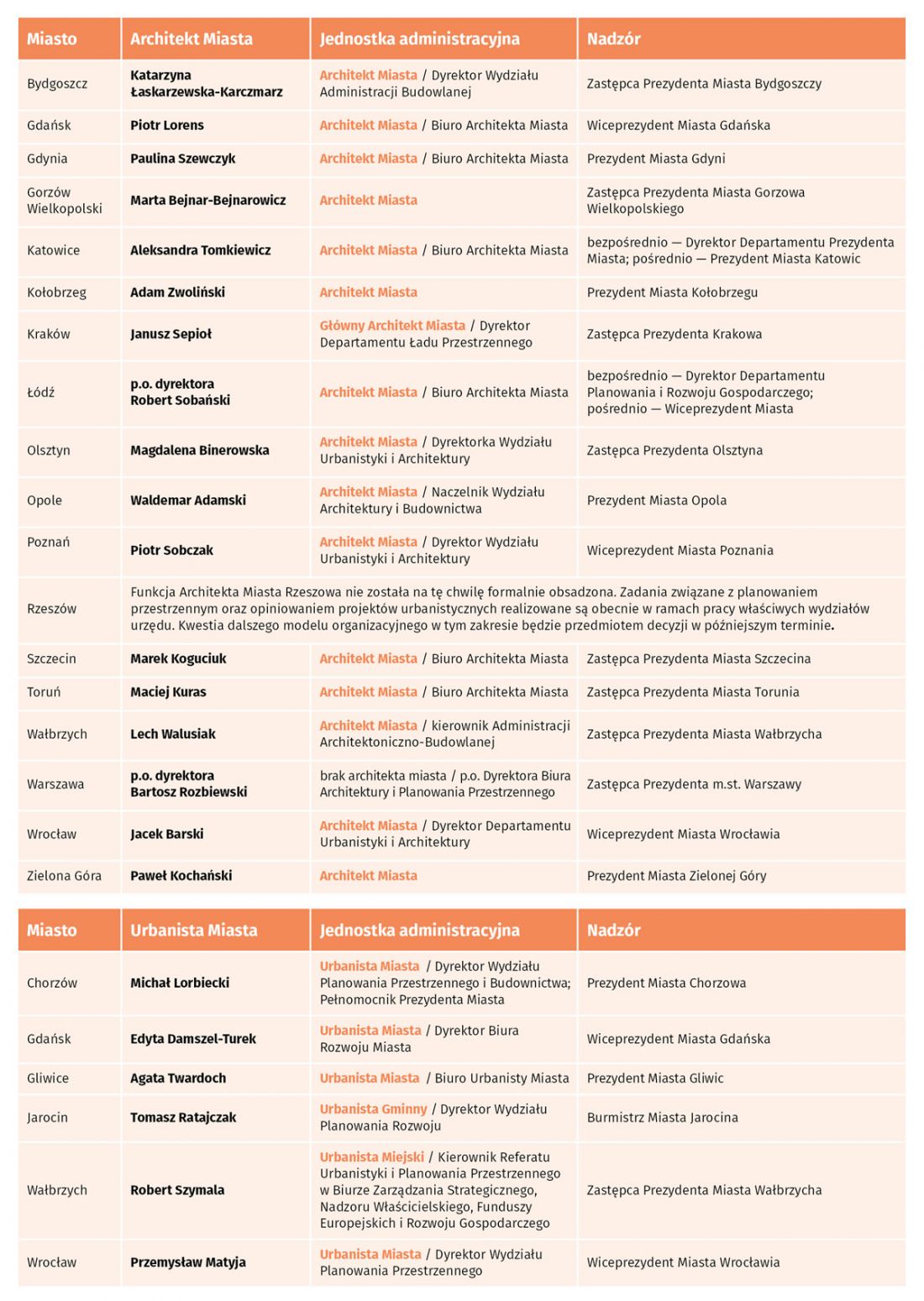
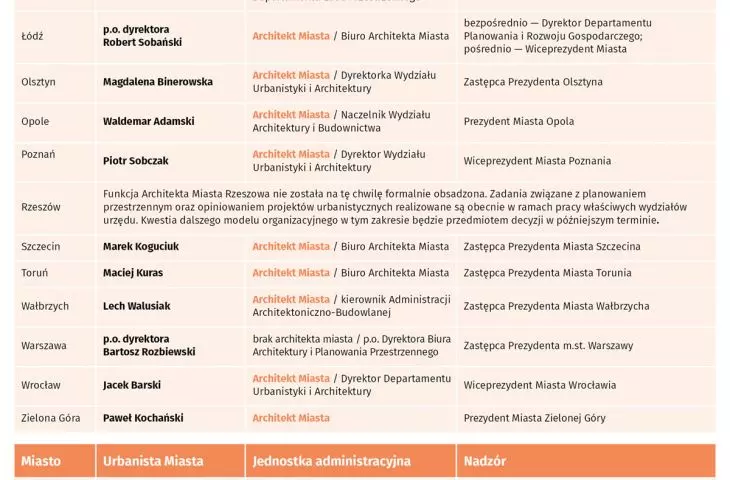
List of urban architects and urban planners in Poland
© Magdalena Milert
Postscript
It is also worth noting the case of city urban planners—a role that is essentially the counterpart to that of the city architect, though one that emphasizes different competencies and a different scale of influence. While the city architect often focuses on the quality of specific projects and their relationship with public space, the city planner operates primarily at the level of structure and long-term spatial vision. This role lies at the intersection of strategy, local planning, and the coordination of spatial development, while also requiring similar mediation skills and the ability to engage in dialogue with stakeholders. Among others, Agata Twardoch in Gliwice and Michał Lorbiecki in Chorzów serve as city urban planners. The city urban planner focuses on the structure of the entire urban organism, its functional and social relationships, because what is at stake is also social quality—understood as creating a good quality of life, ensuring access to green spaces, aesthetic quality based on attention to architectural coherence, and ecological quality encompassing responsible planning and environmental protection.
A similar initiative concerns green space management. In Kraków, the position of city gardener has been established to coordinate the activities of the units responsible for green spaces; Katarzyna Opałka currently holds this position. The city gardener’s responsibilities include ensuring the complementary and uniform implementation of the Green Space Development Program, including monitoring compliance with the provisions of relevant documents, coordinating cooperation between municipal departments and city agencies with entities such as such as the Polish Allotment Gardeners’ Association, the Provincial Conservator of Historic Monuments in Kraków, and the State Water Management Agency “Wody Polskie,” as well as with nongovernmental organizations. Their responsibilities also include implementing urban planning standards related to green spaces, auditing development projects, preparing urban planning studies and standards for the development of public spaces, formulating recommendations regarding the selection of plant species, and participating in design competitions designated by the City Architect. A key area of focus remains the Green Streets Program, which aims to develop blue-green infrastructure along roadways through new tree plantings, rain gardens, and rest areas, as well as providing expert opinions on road projects and developing landscape architecture designs. This role also includes coordinating work on the Catalog of Urban Furniture and participating in teams that prepare programmatic documents prior to their submission to the mayor.
1. https://www.youtube.com/live/79cpI5RV6H0, 47:14 [accessed: March 3, 2026].
2. https://www.propertydesign.pl/wywiady/109/marta_sekulska_wronska_warszawa_potrzebuje_architekta_miasta,48266.html [accessed: March 3, 2026].
3. https://katowice24.info/artykul/katowice-znow-beda-n1520809 [accessed March 3, 2026].
* The city reinstated this position in early 2025, forming a ten-person team led by Jacek Barski,
https://www.wroclaw.pl/dla-mieszkanca/w-trosce-o-jakosc-projektowania-wroclaw-powoluje-architekta-miasta-zostal-nim-jacek-barski [accessed: March 3, 2026].
4. https://www.izbaarchitektow.pl/pokaz/architektura-i-wladza,2863/ [accessed March 3, 2026].
5. https://czytajrzeszow.pl/?idd=24&id=17954&poz=mr1&show=-1&pagebda1_mobile=0 [accessed March 3, 2026].
6. https://gazetakrakowska.pl/byly-marszalek-wojewodztwa-malopolskiego-janusz-sepiol-zostal-glownym-architektem-krakowa/ar/c1-18774027 [accessed March 3, 2026].
7. https://nowosci.com.pl/architekt-miasta-musi-byc-wizjonerem/ar/c3-11642939 [accessed: March 2, 2026].
8. Piotr Fokczyński, “The Role and Tools of the City Architect—Experiences from Wrocław,” Zawód Architekt No. 12.
9. https://www.facebook.com/watch/?v=4066629100251613 [accessed: March 3, 2026].
10. https://www.izbaarchitektow.pl/pokaz/architektura-i-wladza,2863/ [accessed: March 3, 2026].
11. https://katowice24.info/artykul/katowice-nie-maja-juz-miejskiego-architekta-bedziemy-zabiegac-o-to-stanowisko-n1481327 [accessed March 3, 2026].
12. https://politykipubliczne.pl/en/raport-wzmocnienie-czynnika-spolecznego-i-merytorycznego-w-ksztaltowaniu-przestrzeni-miejskiej [accessed March 3, 2026].
13. https://lodz.naszemiasto.pl/lodz-caly-czas-musi-budowac-swoja-miejskosc-mowi-marek/ar/c13-6668919 [accessed: March 3, 2026].
14. SARP, Polish Council of Architecture, Polish Architectural Policy. Policy on the Quality of Landscape, Public Space, and Architecture, 2011.
Magdalena Milert
more: A&B 4/2026 – The City Architect,
download free digital issues of A&B