



The growing microprocessor shortage and geopolitical risks have prompted Elon Musk’s tech empire to take an unprecedented step. Construction is beginning in Texas on a complex with a target value of $119 billion, which is intended to make the production of robots, autonomous taxis, and orbital infrastructure independent of factories in Asia.
Elon Musk, who heads SpaceX and Tesla, has unveiled his project, called Terafab. This venture is set to become the largest and “most valuable” building on Earth, serving as an autonomous production center for advanced integrated circuits. The founder describes the entire initiative as a chip factory designed to meet the technological needs not only of Earth but also of operations in orbit.
Officially confirmed in early August 2026, the Terafab project operates as a strategic joint venture between Tesla and SpaceX, which, following their merger in February 2026, also joined forces with the startup xAI. The main goal of this venture is to secure the technological independence of both entities in an era of rapidly growing demand for advanced microelectronics.
Scale and Architecture of Terafab
The Terafab industrial complex is to be built on an area exceeding 929 hectares (100 million square feet). This size places the project at the top of the global ranking for the size of industrial and commercial buildings. By comparison, the main assembly building at the AvtoVAZ plant in Russia covers approximately 6 million square meters, the New Century Global Center in Chengdu has a floor area of 18.9 million square feet, and the combined volume of the Pentagon, Apple Park headquarters, and the Mall of America is still smaller than that of the planned Texas giant.
Terafab approximate size comparison between Giga Texas, the Pentagon, Apple Park, and the Mall of America.
— Nic Cruz Patane (@niccruzpatane) August 6, 2026
There has never been a building this large. Elon Musk says it will be the most valuable building by far. pic.twitter.com/GCmpfeduJn
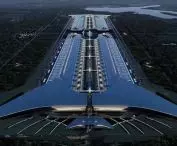
Architectural renderings depict Terafab as a symmetrical structure consisting of two elongated and parallel factory wings, topped by a smoothly curved roof. A central traffic artery runs between the wings.
The project aims to integrate the production, packaging, and testing of memory and advanced integrated circuits into a single, massive facility. This is certainly a challenging approach, bringing all stages together under one roof on an unprecedented scale.
Why is Musk betting on his own AI chips?
The main driving force behind the investment is the growing shortage of computing power. The total demand for microprocessors across Musk’s companies is expected to exceed one terawatt, far surpassing the current capacity of the global supply chain. Despite publicly expressing gratitude to its existing suppliers, it is officially the growing disparity between demand and market supply that has become the direct cause of the decision to establish its own manufacturing complex.
Tesla’s current demand for integrated circuits is fully met by external partners and divided between two main suppliers. The first of these is Samsung, whose factory in Taylor, Texas, is already producing AI5 processors, and an additional, separate $16.5 billion contract covers the production of next-generation AI6 chips. The remainder of the semiconductor demand is covered by Taiwan Semiconductor Manufacturing Company (TSMC). In the first quarter of 2026, Intel joined the project as a strategic partner, although the precise division of its responsibilities within the factory’s structure has not yet been specified in detail.
It is worth noting, however , that over 90% of the world’s most advanced microprocessors are currently manufactured in Taiwan by TSMC. Therefore, in the event of a potential naval blockade or armed conflict with China, the U.S. technology, automotive, and defense sectors would be immediately paralyzed. Another issue is the fact that reducing dependence on Asia and bringing manufacturing back to the U.S. (reshoring) is a strategic goal being pursued through both federal legislation and state programs supporting technology investments. Donald Trump himself has for years made the revitalization of American manufacturing and reducing dependence on Asia one of the main pillars of his economic agenda. He has repeatedly stated that the United States’ dependence on Taiwanese chip factories is a strategic mistake of past decades, and the Trump administration actively pressured foreign manufacturers (such as TSMC), leading, among other things, to the expansion of multibillion-dollar investments in new production facilities.
Terafab Texas will be by far the largest and most valuable building on Earth.
— Elon Musk (@elonmusk) August 6, 2026
And it will be stunningly beautiful. pic.twitter.com/4NweOqTL7y
Regardless, the components manufactured in Texas will be used directly to power Cybercab autonomous vehicles, the space-based data centers planned by SpaceX, and the Optimus humanoid robots being developed by Tesla.
The new campus is located in Grimes County, about 110 kilometers northwest of Houston and 160 kilometers east of Austin. The development site includes the grounds of a former coal-fired power plant that closed in 2018, situated above the Gibbons Creek reservoir. SpaceX announced that the facility’s cooling system will draw water exclusively from this reservoir, eliminating the need to tap into local groundwater—a direct response to concerns regarding the factory’s water footprint.
To power the entire facility, the company plans to build new natural gas-fired power plants connected to industrial energy storage systems. The official energy plan does not currently call for the implementation of large-scale photovoltaic installations.
Billions in investment and tax breaks
The construction of Terafab involves private funding as well as public support mechanisms. Texas Governor Greg Abbott announced that the first phase of the investment will cost over $16.8 billion and create approximately 3,000 direct jobs, and the state will support the project with a $30 million grant from the Texas Enterprise Fund. However, official regulatory filings indicate that the total cost of all phases of the project could ultimately reach as much as $119 billion.
Terafab vs. Burj Khalifa https://t.co/H2CIJYo2gH pic.twitter.com/7Kufz2cjZW
— Dr Singularity (@Dr_Singularity) August 7, 2026
Grimes County authorities approved a property tax abatement in exchange for a one-time payment of $10 million and annual payments of $20 million over a 35-year period. In addition, the investors submitted applications under Texas’s JETI program, requesting that maintenance and operating taxes be frozen at 48% of assessed value for a decade for each phase. The applications explicitly state that the absence of tax incentives would reduce the internal rate of return below the break-even point, which would likely… force the investment to be relocated to competing states.
Despite the grandeur of the presentation, the official prospectus filed by SpaceX in June 2026 defines Terafab in rather general terms, lacking fully binding implementation agreements between Tesla and SpaceX, a defined division of intellectual property, or an absolute obligation for both parties to continue their participation. The very parameter of one terawatt of computing demand reflects Musk’s personal ambitions and his desire to colonize space, rather than a widely accepted market standard. This therefore calls for careful monitoring of the entire process and the approval of subsequent funding tranches.
Terafab and Its Neighbors
The announcement of the factory’s construction in Grimes County—an agricultural county with a population of approximately 30,000—naturally sparked deep concern among the community. Residents even formed an organization called Grimes County Citizens for Responsible Development (GCCRD). GCCRD members complained that they learned of the scale of Musk’s plans not from the authorities, but through open records requests, fragmented press reports, and incomplete maps. They publicly voiced their opposition to the lack of transparency in the procedures and the drastic intrusion into their environment and the lifestyle they have enjoyed up to now, which is shaped by the area’s location. During informational meetings, issues raised included the overburdening of the water supply system, the management of chemicals, increased truck traffic, the strain on emergency services, and the pressure on infrastructure caused by the influx of thousands of construction workers. To this day, there has been no full disclosure of the list of chemicals used in chip production or of plans for the disposal of industrial waste.
Terafab: The Present and the Future pic.twitter.com/MRhyb4FoBw
— TeslaZoa (@TeslaZoa) August 15, 2026
In response to the upcoming changes, a civic association has prepared a twelve-point safety plan aimed at compelling corporations to provide concrete guarantees for the protection of local resources. However, the scale of the land transformation is already affecting residents’ life decisions, as exemplified by the project’s immediate neighbors, who—witnessing the deforestation and the loss of the area’s rural character—have decided to sell their properties.