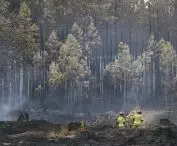
The ongoing heat waves, severe droughts, and record-breaking wildfires ravaging Europe—to put it mildly—are calling into question current land-use management methods.
In late August, news reports and photos appeared in the media highlighting the benefits of land restoration. On the grounds of a historic estate—largely located within Exmoor National Park and owned by the British charity the National Trust—the natural course of the rivers has been restored and wetlands have been reestablished. This area remained lush and green despite the five heat waves we experienced this summer. In stark contrast, the surrounding countryside was virtually brown from the drought.
Ben Eardley, the estate’s project manager, stated that nature provides solutions to some of the greatest challenges facing society today. He added that the project sought to reverse what had been done for generations—namely, draining wetlands, straightening rivers, and diverting water as quickly as possible. Now, by reconnecting river systems with the surrounding landscape and creating a natural absorption system—the so-called “sponges” in the landscape—a solution has been achieved that stores water during droughts and, during storms and extreme rainfall, slows its runoff, helping to protect downstream villages from the risk of flooding. All of this is thanks to the preservation of wetlands and surrounding habitats.
So, let’s get to work—let’s create wetlands and restore rivers to their natural course and character? Before we blindly plunge into these changes, it’s worth looking at the issue from a broader perspective.
Can a wetland burn?
Rewilding itself is the large-scale restoration of ecosystems to a state in which nature is able to take care of itself. It aims to restore natural processes and—where appropriate—missing species, thereby enabling them to shape the landscape and the habitats within it.
There are still few studies directly examining water flow through landscapes subjected to such interventions. Gemma Harvey, a professor of physical geography at Queen Mary University of London and one of the lead authors of the paper “The Role of Renaturalization in Mitigating Extreme Hydrological Events: The State of the Evidence, ” emphasizes the importance of considering the combined impact of changing animal and plant communities on the water cycle in renaturalized landscapes. The study she co-led revealed, among other things, a gap in habitat analyses in lowland projects in temperate zones characterized by vegetation. In her view, this limits the reliability of certain predictions from existing studies. Harvey notes that the renaturalization process drives multiple, mutually interacting ecosystem changes in the same location and warns that future research must take this complexity into account.
The economic costs of floods and droughts are, of course, enormous—they require significant expenditures from national budgets every year (more on that in a moment). Since the beginning of 2026, nearly 650,000 hectares of land have burned in Europe. During the same period, 1,840 fires were recorded. “New” nature-based solutions—that is, those that allow for rewilding—would offer a promising path toward a more cost-effective way of addressing these challenges. But can nature manage on its own?
Findings from Spain, Italy, and France
One of the best-documented examples is Doñana National Park in Andalusia. A fire that broke out in the southern part of the park on May 24 burned approximately 500 hectares. Based on Sentinel-2 satellite images from May 20—before the fire—and May 27—after the fire had passed—it was shown that the fire did not enter the wetland area. The burned areas were concentrated mainly along depressions covered with pine forests and Mediterranean vegetation. The fire did not reach the marshy areas, where abundant surface water helped slow its spread. However, it wasn’t just the wetlands that stopped the wall of fire.
View this post on Instagram
Active sand dunes and sandy areas also played a huge role here. Partially free of flammable vegetation, they acted as natural firebreaks, helping to limit the fire’s spread. It’s also worth noting that weather conditions—and especially wind direction—played a role in limiting the fire’s ultimate extent.
Doñana is the site of extensive efforts to restore natural water conditions and is one of the most important wetlands on the entire European continent. Among other things, the Spanish Ministry of the Environment is carrying out the renaturalization of watercourses and canals, the removal of some artificial drainage systems, and the restoration of hydrological connectivity in former wetlands. It can therefore be concluded that the preserved or restored natural water retention in Doñana is one of the landscape elements that created a distinct barrier against the fire during the blaze.
In Lago Salso, a wetland complex within the Gargano National Park, where activities described by the park as “ripristino delle zone umide”—that is, wetland restoration—are underway, a fire broke out on July 6, 2026. The fire destroyed significant areas of reed beds. The renaturalization efforts did not prevent the fire. Under conditions of extreme drought, even vegetation associated with wetlands can become fuel, especially when the fire reaches a dense reed bed. Drought is a worsening phenomenon, so it can also deprive areas strongly associated with water of their water supply. Restoring natural water levels, including in wetlands, increases the landscape’s resilience to fire.
View this post on Instagram
In southwestern France, a similar pattern was observed during the massive wildfire in the Saumos region of Gironde. The Copernicus system used satellite imagery to map the fire’s spread and the extent of the burned areas. During the firefighting operation, it turned out that one of the existing wetland areas there was so dry that firefighters decided to artificially rewet it to use it as a firebreak. The French fire service described this operation as the flooding of a dried-out wetland.
This is a very vivid example of the importance of water for maintaining the resilience of the landscape, but it should not be presented as evidence of successfully carried out restoration. On the contrary, it shows that a dry wetland, deprived of an adequate amount of water, can lose part of its protective function. Restoring or maintaining hydrological conditions can make it a useful element in limiting the spread of fire, but flooding the area by firefighters is not renaturalization. In this case, however, it is worth noting the broader context of this site.
In the immediate vicinity of the fire, work had previously been carried out to restore the natural water conditions of a historically drained wetland. The project, completed in December 2025, aimed to raise the groundwater level, restore water retention, and rewet approximately 30 hectares of historic wetlands. One of the stated goals of the project was to increase water retention during the summer and, specifically, to reduce the risk of wildfires. Thus, there is a clear correlation between restoring water retention in the landscape and preparing it for worsening fire conditions.
View this post on Instagram
The Costs of Wildfires in Europe and the Complexity of the Problem
Droughts and wildfires are not marginal problems nor are they limited to southern Europe. According to data from the Global Wildfire Information System, by the end of week 31 of 2026, 13 percent more land area had burned in the European Union than the average for the years 2012–2025. The greatest losses were recorded in Spain —38 percent of the total EU area affected by wildfires. In France, the figure was more than three times the country’s average for the corresponding period from 2012 to 2025. Italy, Portugal, and Greece also lost large areas of land. The scale of this year’s crisis is terrifying, but it also highlights the need to change the conditions under which the landscape is planned: periods of high temperatures, water shortages, and extreme fire risk are becoming key factors that must be taken into account in environmental planning.
Moreover, the costs of these fires cannot be reduced to the area of vegetation burned. According to Professor Simone Varotto of Henley Business School at the University of Reading, as early as the beginning of August 2026, the economic costs of this year’s fires in Europe were estimated at approximately 3 billion euros. This figure includes losses to crops and real estate, disruptions to economic activity and tourism, health effects from smoke, additional burdens on public budgets, and a potential increase in insurance costs. As Varotto points out, this year’s fires mainly affected forests, scrubland, pastures, and farmland, but in many places the fire also spread to built-up areas. We know that the boundary between suburban areas is increasingly encroaching on the landscape, which is prone to fires.
View this post on Instagram
Of course, the data do not allow us to draw the simple conclusion that every restored wetland will be fire-resistant. However, the value of restoration may lie in increasing water retention, maintaining soil moisture, and reducing vegetation desiccation—and thereby altering the conditions under which fire does or does not spread. We can therefore speak of a clear relationship between restoring water retention in the landscape and preparing it for worsening fire conditions.
This does not mean, however, that renaturalization can be reduced to a single parameter—water. Restoring natural processes triggers a whole sequence of interrelated changes: groundwater levels, vegetation, soil structure, and habitat conditions all change—and with them, the entire ecosystem. This, in turn, influences how water is retained, stored, and transported within the landscape. Therefore, an assessment of a renaturalized area’s resilience to drought, heat, or fire should take these combined effects into account.
On the Path to Nature Restoration
However, the example of England shows just how far we still have to go before such an approach is recognized as a fundamental component of spatial and environmental policy. On July 13, 2026, the British government presented a plan to achieve the 30by30 goal, under which 30 percent of the United Kingdom’s land area is to be effectively protected or managed for nature by 2030 . However, government data shows that currently only about 7 percent of the country’s land area meets these criteria, while another 32 percent has the potential to contribute to this goal in the future.
The plan has been sharply criticized by environmental organizations and some experts as “pathetic” and “completely inadequate,” primarily because it relies largely on the voluntary participation of landowners rather than establishing new, binding mechanisms for nature conservation and restoration. The strategy was described as “deeply disappointing and wholly inadequate,” citing, among other things, the lack of a plan and timeline for creating new sites of special scientific interest.
At the same time, the Church of England rejected a proposal to set aside 30 percent of its land for restoration by 2030 —currently, only about 3.5 percent of its more than 40,000 hectares is used for nature restoration.
Even the best-functioning ecosystem cannot be restored without access to land, money, effective regulations, and long-term management. Nature cannot manage on its own —especially in a landscape that has been drained, fragmented, and subordinated to specific economic functions by humans for decades. Therefore, we need to consciously create conditions in which natural processes can recover and then be sustained.
View this post on Instagram
This year’s wave of wildfires is a test of how we think about the landscape. It will be difficult to effectively respond to extreme events solely through an ever-increasing number of technical devices, retention basins, firebreaks, or emergency interventions. Nature-based solutions are, of course, not a universal cure nor a guarantee that fire will not pass through restored land. However, they can increase the landscape’s resilience precisely because they restore its ability to retain water, regenerate, and respond to changing conditions.