




The technological revolution has its dark, or rather extremely hot, side. Recent analysis shows that AI data centers are generating such enormous amounts of heat that they are capable of raising temperatures within a radius of many kilometers. The phenomenon is an entirely new technological heat island, superimposed on existing global climate change, which doctors and sociologists warn is hitting society in an extremely uneven way.
digital boom is heating up
The development of algorithms, language models and cloud services requires unprecedented computing power. JLL estimates that global server room capacity will double between 2025 and 2030, and artificial intelligence data centers will be responsible for half of this gigantic demand. The scale of this phenomenon is well illustrated by Meta's new Hyperion complex, which cost $27 billion to build. Its energy demand is as high as five gigawatts - the amount of power that as many as ten conventional gas-fired power plants must saturate.
Seeing this exponential growth, Andrea Marinoni of the University of Cambridge and his team decided to see how such drastic energy consumption and concentration of computer equipment affect the immediate geographic environment of the server room.
Heat islands around the server room
The researchers analyzed measurements of the earth's surface temperature over the past two decades, comparing them with the exact coordinates of more than 8,400 giant data centers, the so-called hyperscalers. To exclude the influence of other factors, the researchers deliberately focused on facilities located far from densely populated urban areas.
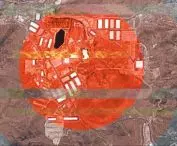
The results turned out to be surprising. After the facilities were put into operation, the ground temperature in their vicinity increased by an average of 2 degrees Celsius. In the most extreme cases, a jump of as much as 9.1 degrees Celsius was recorded. This effect was not limited to the immediate vicinity of the server plot. Thermal anomalies were detected at distances of up to 10 kilometers, and at a distance of 7 kilometers, the heating intensity dropped by only 30 percent! Scientists estimate that more than 340 million people currently live in the zone of influence of these artificial heat islands. Sustained temperature changes that cannot be explained by other factors have already been observed in Mexico's Bajío region and Spain's Aragon province, among others.
"The results we obtained were quite surprising," comments Andrea Marinoni. "This could become a huge problem. The message I would like to convey is that great care must be taken in the design and development of data centers."
Skepticism and debate in the scientific community
While the temperature rise around IT infrastructure is itself a measurable fact, its exact mechanism continues to spark debate among experts. Chris Preist of the University of Bristol suggests that further research is needed to determine precisely to what extent the heat generated by the processors themselves is responsible for the rise in temperatures, and to what extent the architecture of the giant halls themselves is to blame. After all, large building surfaces, roofs and concrete structures heat up from the sun's rays, also giving off heat to the environment.
The report's biggest critics agree with this theory, (for example, columnist Andy Masley), who has sharply criticized Cambridge's methodology, claiming that the satellites simply recorded the classic effect of solar heating of buildings, not emissions from equipment. However, whether the source is electricity or building physics, the presence of giant technological facilities and heats up local ecosystems.
climate anomalies
Artificially raising temperatures - in this case by galloping digital infrastructure - is, of course, part of a broader, worrisome context of climate impacts on public health. A study by the Barcelona-based Institute for Global Health (ISGlobal), published in the journal Nature Health, recently showed for the first time precisely how heat and cold waves affect human mortality by socioeconomic status. The analysis of data covering more than 161 million deaths between 2000 and 2019 in 32 European countries proved that climate change selectively hits specific social groups.
In Europe alone, there were more than 180,000 deaths linked to extreme heat between 2022 and 2024. Although statistically low temperatures are still responsible for more deaths, increasing temperatures are gradually closing the gap.
wealth and urbanization is a trap
The relationship between wealth status and resilience to the vagaries of weather is fraught with paradoxes. Regions with higher GDP per capita and longer life expectancy fare muchbetter during cold waves. This is due to better home insulation, the prevalence of heating systems and stronger health care. However, the same rich and highly urbanized areas show much higher mortality during heat waves. This phenomenon is directly linked to the urban heat island effect. Concentrated economic activity, dense buildings, ubiquitous asphalt and lack of vegetation make cities act as heaters.
The approach to locating investments, including technological ones, that we have known until now is becoming an anachronism. Pure profit analysis is not enough today. It is imperative that the new environmental and thermal considerations be taken into account in broad spatial planning, municipal climate change adaptation plans, and in the master plans that are being developed. I imagine that in order to ensure that such projects do not surprise local communities with a sudden rise in temperatures, local governments must reach for newer solutions. Krakow, which has a dedicated "Climate of Krakow and MWC" (Municipal Heat Island) map, could quietly use these maps to analyze new projects. Such advanced analytical tools can become a starting point and a guideline for design.
In Poland, we are increasingly beginning to feel the pressing problems of climate change. I am dismayed to see that many municipalities do not seem to recognize the impact of this phenomenon, sometimes panicking and burying their heads in the sand. My requests for public information do not yield answers on how to manage such a crisis or how the center plans to protect the public from the newly built data center. I hasten to drop a hint to the authorities - you need to take an interest in the topic, because the current actions can be summed up by the famous meme "Modern Problems Require Modern Solutions" and it is a distraction from the problem.