






An interview with Chorzów’s first Urban Planner—Michał Lorbiecki, who has also served as director of Chorzów’s Department of Spatial Planning and Construction since last year. In a conversation with Marta Kulawik, he discusses the pros and cons of building a position from scratch within the municipal bureaucracy, his fresh approach to the roles entrusted to him, and the opportunities and challenges currently facing the city. Finally, he shares his ideas for Urban Lab and explains how he has managed to engage residents in civic participation so far.
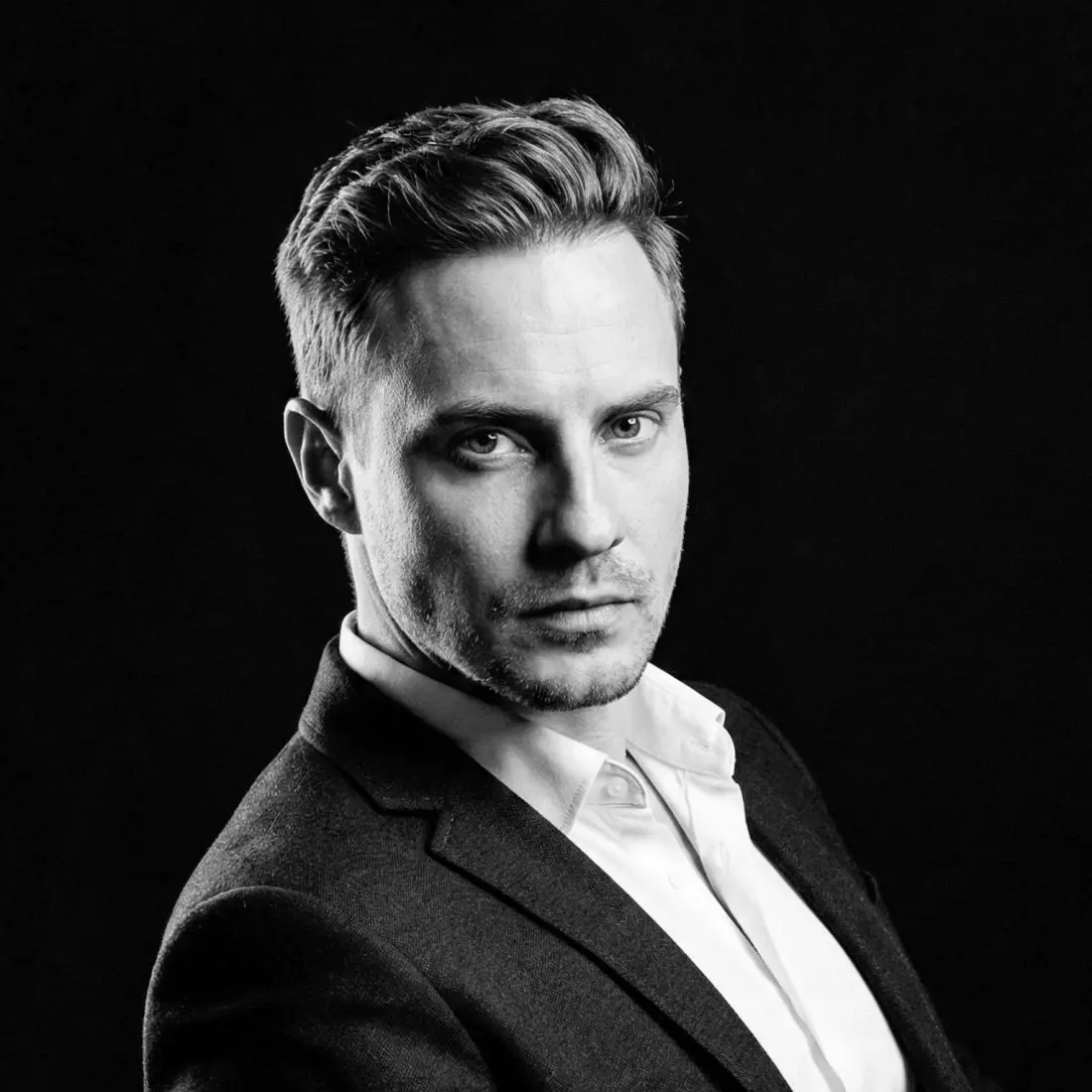
Michał LORBIECKI — Urban planner, Ph.D. in economics and finance, expert in sustainable development, and certified change manager. Currently, he serves as the Mayor’s Representative for the City of Chorzów—City Urban Planner and Director of the Department of Spatial Planning and Construction. Vice Chair of the Real Estate Committee of the Polish Chamber of Commerce. Previously, as a representative of the Mayor of Tychy, he authored the master plan and coordinated the strategic development of the new city center. Co-author of key urban policies in the areas of development strategy and mobility. He actively bridges the gap between practice and academia. Lecturer and co-creator of a postgraduate program at the Warsaw University of Technology, and member of the Program Council for the Spatial Planning program at the University of Economics in Katowice. He serves on municipal urban planning and architectural committees. Recipient of several awards, including a nomination for the 2024 Smart Development Leader Award and the POP Science Award at the Silesian Science Festival. He shares insights on space and mobility on social media as @urbanomista.
Marta Kulawik: You are Chorzów’s first City Urban Planner, and it was on your initiative that this position was created, even though you had applied through a competitive process for the position of director of the Department of Spatial Planning and Construction. Ultimately, you hold both of these positions.
Michał Lorbiecki: Yes, there was a competitive selection process for the position of director of Chorzów’s Department of Spatial Planning and Construction, during which candidates were required to present their vision for how the department should operate. I proposed that the director also serve as the city’s chief urban planner. I wanted to serve as a liaison between spatial planning and development projects, as well as the primary point of contact for community initiatives. Instead of a typical bureaucrat, I preferred the role of an advisor to the mayor on the city’s spatial development. I wanted to bring together many disciplines, because we cannot discuss the city’s spatial development without addressing other issues, such as transportation, housing, and the environment.
My vision went well beyond the scope of the department. I wasn’t just thinking about the two main branches of that department—the first being spatial planning related to the preparation of local plans, and the second being the issuance of building permits.
As the City Planner of Chorzów, I serve a dual role. I won the competition to become director of the Department of Spatial Planning and Construction in the city—so formally, I am responsible for spatial planning as well as architectural and construction administration. At the same time, I was appointed as the mayor’s representative—the City Planner of Chorzów. This is an example of innovative thinking about urban development.
Previously, I worked as an urban planner in Tychy for nine years, so working in local government is nothing new to me. Thanks to this experience, I have insight into how cities function, how others handle various processes, and what we’re lacking—especially in the areas of urban planning and urban design.
In my opinion, the chief urban planner should serve as a manager of urban processes. He or she doesn’t have to be an expert in everything, but must maintain a dialogue with all sectors of the city. A major problem with how city offices operate is the compartmentalization of departments. We have a department for spatial planning, a department for investments, a department for fundraising, and so on. Many areas are simply separated. These departments often report to different deputy mayors. I’d like to see a more horizontal way of thinking to break down these silos—to connect different areas and foster collaboration between departments. Of course, this happens in many offices, but often on a collegial basis: department heads and employees work together because they know each other well, but everyone still has their own scope of responsibilities.
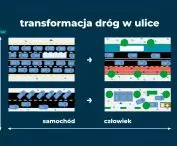
The best example is the street. When we think of a street, we automatically think of the road authority, so we refer the issue to the Municipal Street and Bridge Authority. After all, a street isn’t just about car traffic—it’s also about pedestrians and other users. Instead of dividing them into drivers, cyclists, or passengers, we should take a broader view of the street—recognizing, for example, that it can also be a space for greenery. A street doesn’t have to be just a transportation corridor. It can be a vibrant public space: a meeting place where you can sit on a bench, have a coffee in an outdoor café, or support local businesses.
A street can serve many functions, and reducing it to mere traffic management is a major problem stemming from silo thinking. In my view, the role of an urban planner is primarily to act as a bridge between these interdisciplinary urban planning issues—both in terms of space and the city’s economy.
As it happened, the mayor [Szymon Michałek has been the mayor of Chorzów since 2024—Ed.] liked my idea, and he had his own as well. He was considering creating a separate position to keep track of processes across various disciplines. Ultimately, I hold both of the aforementioned positions.
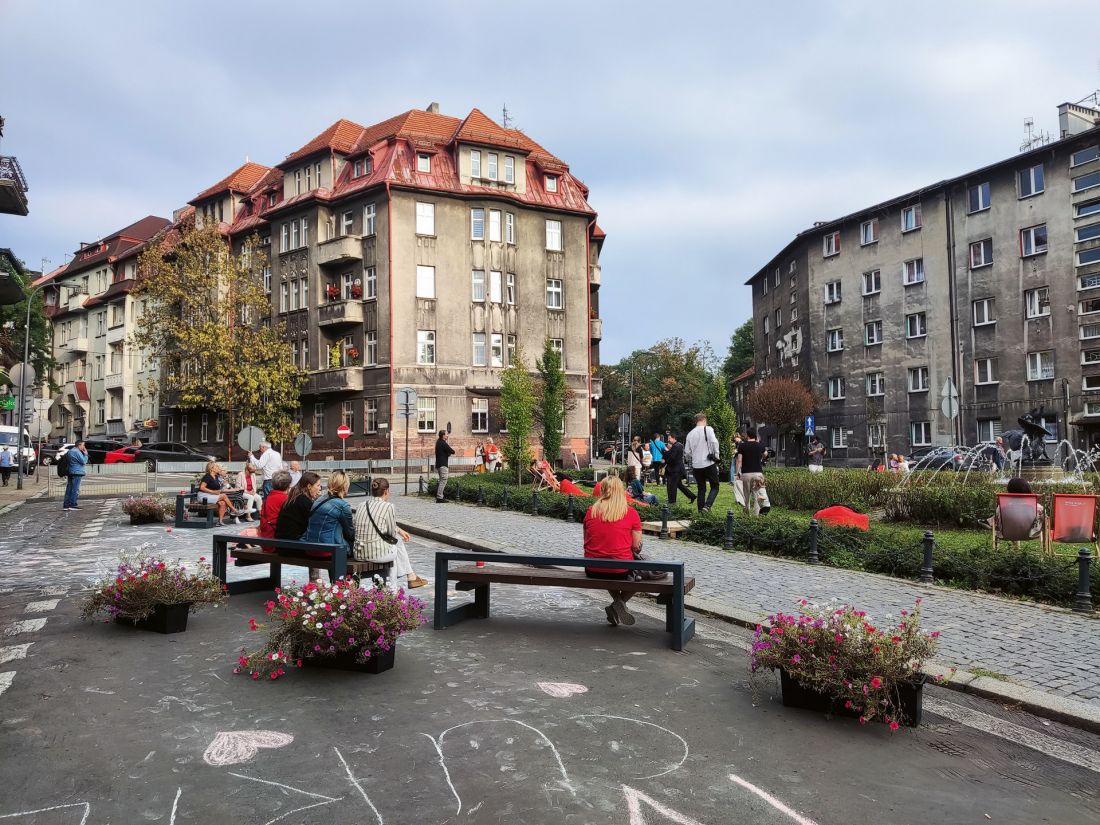
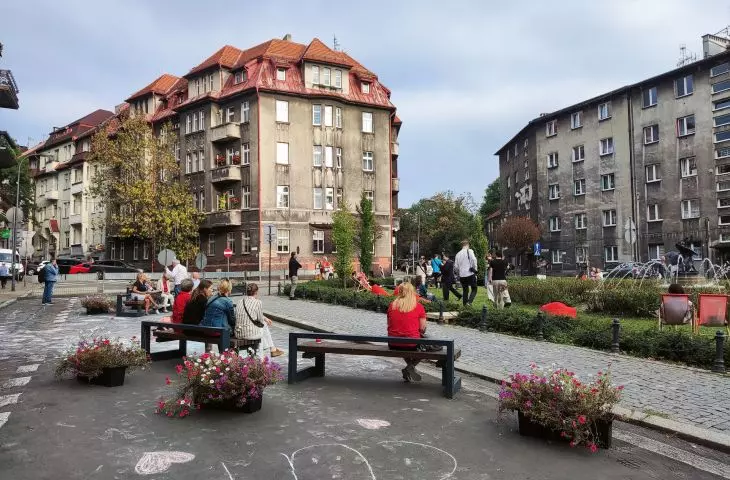
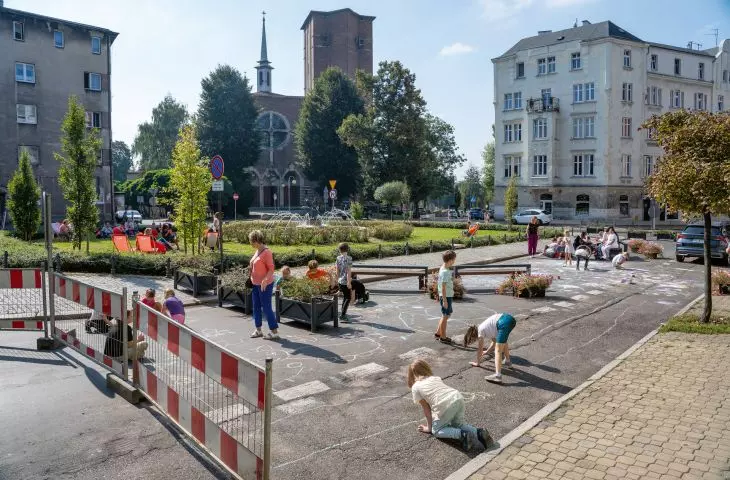
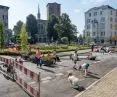
urban prototyping at Matejko Square in Chorzów
Illustrations courtesy of the City of Chorzów
Marta Kulawik: In your opinion, what is the best model for addressing these issues?
Michał Lorbiecki: The context in which we implement this function is always of great importance here. Due to statutory requirements, government offices typically have very similar, siloed structures, as I mentioned. They may function quite differently in smaller cities than in larger ones. These structures may be organized differently, and officials’ responsibilities may also vary, leading to different approaches to carrying out the same tasks. For the role of city planner to function effectively, the position must have the authority to bring together different departments and form teams to work collaboratively. As a city planner myself, I currently do not have a team to carry out my tasks. My “team” consists simply of other departments, and my direct supervisor is the mayor. This positioning within the hierarchy and the organization’s operations is very important.
A different example—but one closest to my heart—is the city planner of Gliwice, my colleague Agata Twardoch, who heads a separate department and, in a sense, acts as a complement to the functioning of the municipal organization. We’re in touch, and I think we’ll inspire each other not only through our work for the city but also simply in terms of how we operate.
Marta Kulawik: I conducted an interview with Prof. Agata Twardoch, so readers will also learn about her perspective and this different model of operation. Is it easier to create an urban planner’s role from scratch, or would you prefer to work according to established guidelines?
Michał Lorbiecki: Definitely creating one. I’m developing my own operational model, which is very flexible. It has to be that way because we’re living in times of great crisis. There’s no one-size-fits-all solution for every problem. I would definitely not recommend applying exactly the same operational model to every urban complex.
There are advantages to starting with a clean slate, but there are also disadvantages. I’m a newcomer who stirs up some confusion. Not everyone has to like that. It’s worth noting that someone in a role like mine will, unfortunately, never please everyone. It’s a position under intense pressure from various stakeholders. The role of an urban planner isn’t limited to design work; it requires skillfully navigating conflicting interests.
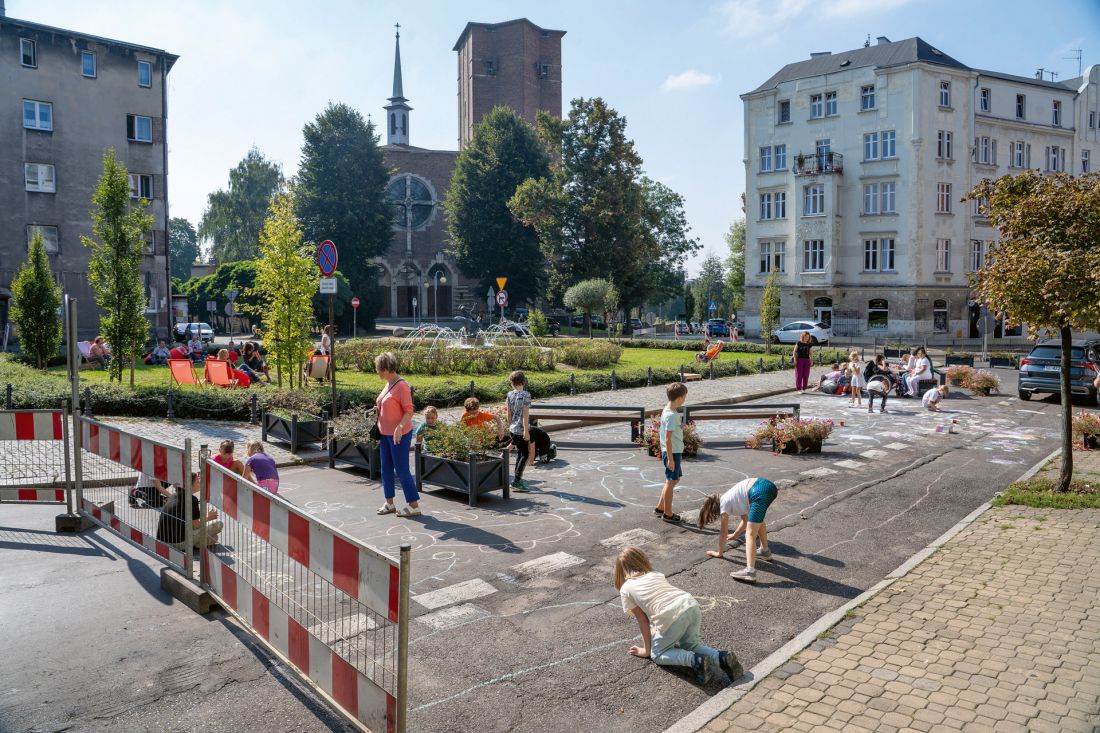
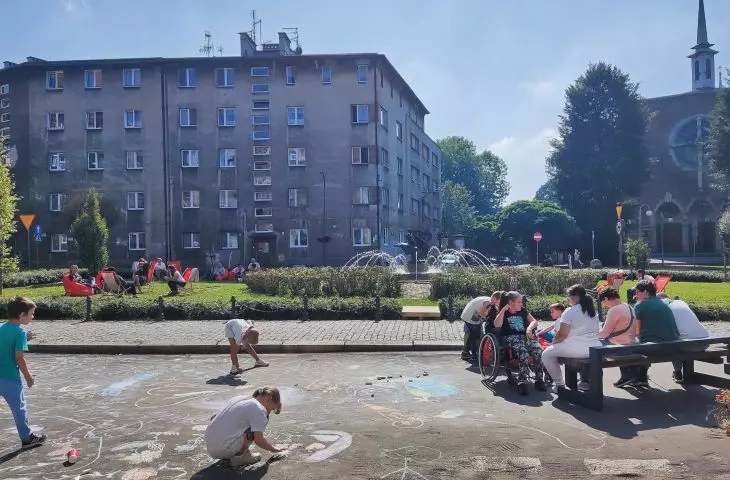
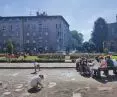
Children playing at Matejko Square in Chorzów, a place usually dominated by cars
Illustrations courtesy of the City of Chorzów
Marta Kulawik: There are many cities and towns in Poland that do not have their own urban planner or city architect, or whose role is merely symbolic and limited to rubber-stamping documents. I’m curious—do you have any ideas on how to make such a position a statutory requirement?
Michał Lorbiecki: That could devalue the role. I believe that in many local governments, an urban planner would be—to put it bluntly—an empty seat created by a statutory requirement. Urban planners could actually be constrained by such a mandate, because it would then impose a specific scope of their responsibilities. Thanks to this flexibility—and the fact that ideas for such positions are diverse and tailored to specific contexts—we can do this work to the best of our ability and in a way that works best for a given area. It’s also a matter of specifying how an urban planner or city architect is formally appointed, what their authority will be, whether they’ll be able to issue any decisions, what oversight they’ll have over staff, and, finally, what actual influence they’ll have on the city.
Marta Kulawik: What might that formal and informal influence look like?
Michał Lorbiecki: As for the structure we’ve adopted, as the mayor’s representative, I have individual authority to perform the mayor’s functions to a limited extent—primarily regarding development policy, spatial planning, transportation, and mobility. I oversee other departments in areas most closely related to urban planning and the city’s spatial development. There is no formal chain of command; instead, informal discussion plays a very significant role—not only in an advisory capacity for the mayor himself or for other employees of various departments, but also in raising awareness and providing education. At least, that’s how I try to explain it and operate. I would very much like to shape this awareness and influence not only city officials but also residents, members of the public, restaurant owners, and employees who reach out to us. When we’re dealing with decades of deepening dependence on cars, it’s difficult to convince residents to change. This is a challenge for us; we also need to learn how to build trust in our ideas and actions. We need to start with the smallest changes and decisions—for example, whether we’ll replace thousands of pansies at the roundabout every few months or plant perennials once that will take care of themselves—and not at the roundabout, but where people actually gather. It’s about aesthetics, but also about the ecosystem. We want urban development projects to be initiated not only in response to building permit applications in accordance with the current plan. Fortunately, there are already investors who are willing to consult on their ideas. The city’s urban planner engages in dialogue and supports investors in such a way that they not only carry out projects that benefit the city but also help resolve potential problems the investor would face if they hadn’t reconsidered their project. The city planner thus exerts both formal and informal influence. The former stems from their position within the municipal administration, while the latter contributes to raising awareness and transforming the way people think about the city.
Marta Kulawik: Sometimes crises or catalysts arise that force a revolution or accelerate evolution. One such catalyst could have been the technical condition of the overpass above Chorzów’s market square (part of National Road 79).
Michał Lorbiecki: Perhaps we’ll be able to bring about a certain revolution in how we think about mobility in Chorzów and throughout the entire metropolitan area. But I don’t think the overpass is our biggest problem. We’re operating in a crisis situation, and we could have prepared for this and planned our next steps. This situation, of course, has a very negative impact on both the functioning of the city and the metropolitan area, of which we are an important part. This crisis, like any other, is not only a challenge to be overcome but can also be an opportunity for innovation and wise changes.
Unfortunately, cities often have to repeat the same mistakes made by their neighbors, for example. Perhaps the most glaring example is what is colloquially referred to as “concrete-ization” of public squares. After all, for ten years now, people have been saying that cutting down trees in public squares and turning them into concrete slabs is not the right direction to take, but it continues to happen, and new squares and marketplaces keep popping up, all of which have had to follow exactly the same path.
Marta Kulawik: In your opinion, what skills are essential for the position of urban planner?
Michał Lorbiecki: I think managerial skills are of enormous importance here. Such a person cannot, for example, be solely a designer who thrives only in peace and quiet; it must be someone resilient to the intensity of all these processes. I’m not an architect by training; I majored in spatial planning, which is a highly interdisciplinary field. It combines elements of design, urban planning, and the environment, as well as issues related to local government, law, transportation, and aesthetics. It really covers the entire spectrum of how a city functions. I also earned a Ph.D. in economics and finance, which gives me insight into the city’s economy. I also completed a postgraduate program in sustainable development management, which means I pay particular attention to these issues. All these qualifications related to strategic thinking and envisioning a long-term goal are very useful. And not just the goal itself, but the result one wants to achieve.
Marta Kulawik: And what challenges is Chorzów currently facing? What are the biggest problems you see?
Michał Lorbiecki: I’d like to start not with a problem, but with the city’s enormous potential. Chorzów is an incredibly European city in terms of urban planning. It’s compact, multifunctional, and has beautiful tenement houses and neighborhoods. It’s not your average Polish city made up of blocks of apartment buildings. We have a very European urban fabric here, beautiful not only aesthetically but also in terms of how the city functions. The concept of the “15-minute city” resonates strongly here; in essence, it’s a return to the very essence of urban thinking—everything should be close by, and the city should be accessible. Chorzów is exactly that: multifunctional and compact.
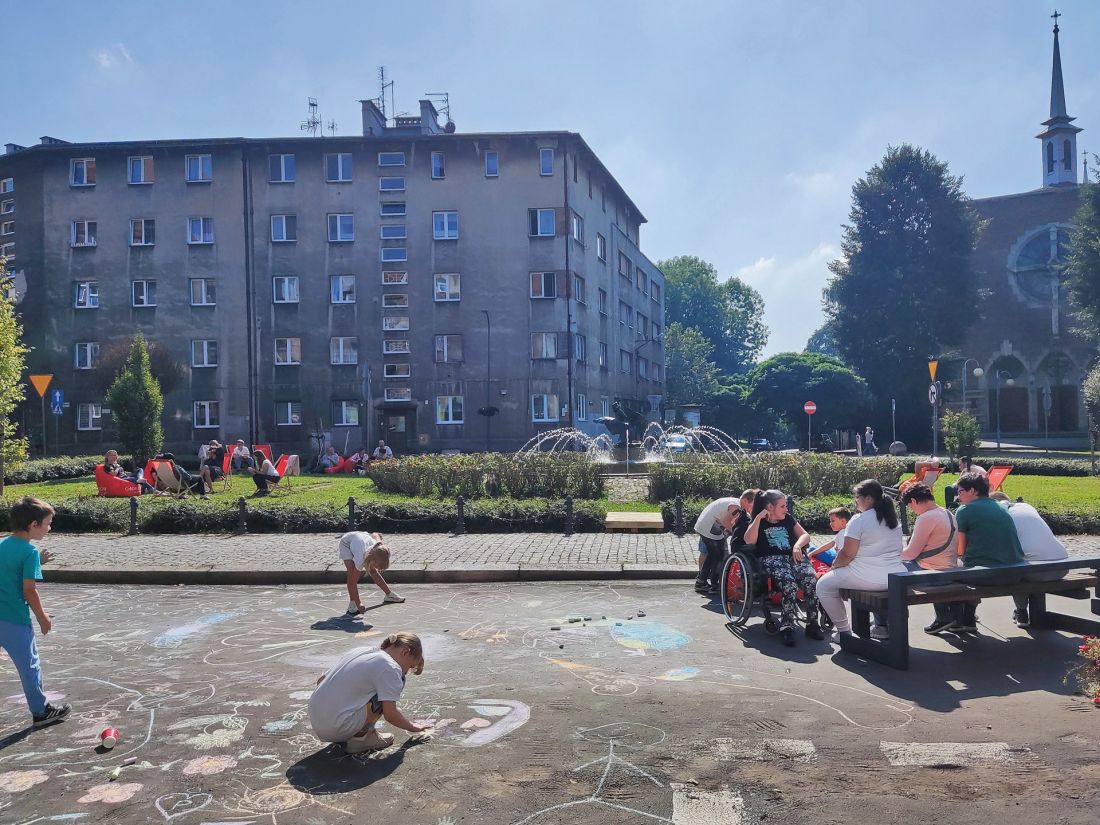
Public space filled with residents during urban prototyping at Matejko Square in Chorzów
Illustrations courtesy of the City of Chorzów
Marta Kulawik: The percentage of green space relative to the city’s total area is also impressive.
Michał Lorbiecki: Yes, that’s largely thanks to Silesian Park, which is really a huge district of Chorzów, but also to many other parks. If we were to look at it purely proportionally, Chorzów is indeed an incredibly green city. However, there are certain historical legacies and habits here that we’re only just beginning to tackle—namely, the overabundance of concrete in many key areas of the city.
One of the challenges is introducing greenery and infrastructure into public spaces. I’d most like to start by planting trees along the streets. That in itself isn’t the challenge; the challenge is convincing the officials responsible for tree planting that it can be done. We still encounter the mindset that a tree under a window means nesting birds that will make a mess, and on top of that, they’ll chirp loudly—which is often seen as a drawback because it’s noise. There will always be people who say that a tree just litters the sidewalk and requires raking leaves, that it takes up our parking space and dirties our car, and that linden trees are the worst because they produce pollen.
Another challenge for the city is undoubtedly housing. Chorzów has the advantage of having a truly large number of housing units. It owns a very large housing stock, proportionally larger than the average for other cities. However, the city is unable to maintain all of it. Half of these units don’t have bathrooms inside the apartments; they still have toilets on the landings of the stairwells. It’s hard to imagine in the 21st century, but it’s true. If this is the level of residential amenities we have now, where were we back when such massive bridge structures as the flyover were being built? When it was built, someone’s priorities must have been seriously misplaced. What was more important back then: building eight lanes for cars that are just passing through Chorzów, or ensuring the comfort of residents and equipping the apartments with basic amenities, such as restrooms? The real estate inventory is attractive because these are beautiful historic tenement buildings. Chorzów may not be known for its architecture, but if someone comes here and sees these magnificent tenement buildings, they’ll be impressed.
Marta Kulawik: I think that in Bytom, too, quite a few people might be pleasantly surprised.
Michał Lorbiecki: Yes. People talk a lot about Bytom these days, but it took several decades for anyone to really notice the city. Few people know that Bytom is older than Kraków. The same may be true of Chorzów—it’s a truly beautiful city; it just needs to step out of the shadows. Restoring its former glory also requires significant investment. On top of that, there’s the social aspect. If, for decades, we’ve made life in the city center dangerous—especially in terms of sanitation and health—because city centers are home to steel mills, heavy industry, coal-fired furnaces, and later an enormous number of cars that stink, make noise, take up public space, and leave no room for green areas, then any reasonable person, given the chance, will flee such a city center. This is a natural consequence of poor urban planning. In many cities, downtown areas are becoming increasingly depopulated as residents move to the suburbs. High-rise housing estates are associated with excessive population density, thin walls through which everything can be heard, or a lack of other services and amenities, so people decide to move out of the city. Typically, they move into a single-family home in the suburbs, which means they have to drive into the city to work. As a result, the problem of traffic congestion in the city is worsening. This is a phenomenon that must be prevented; in fact, we need to reverse this trend of residents moving from city centers to the suburbs. We need to encourage these people and convince them that it’s worth living in the city center, in the city itself. We must ensure that cities are not only an attractive place to live, but above all, that they are healthy and safe. One of the biggest nuisances in the city is cars. We can mitigate this problem through our individual decisions, habits, and actions, but the scale of such a change would have to be enormous. Only then can we count on the long-term effects of urban policy.
Marta Kulawik: There were plans to establish an Urban Lab in Chorzów. Has it been set up yet?
Michał Lorbiecki: For now,the Urban Lab exists in virtual form. New tabs have appeared on the city hall’s website. We’ve started announcing public consultations and publishing surveys on the site, and as we speak, consultations regarding the city’s master plan are underway. We created the “Urban Lab Chorzów” Facebook page precisely so that this idea of officials stepping out of the city hall could begin to take shape. “Urban Lab” is a working title; we want the final name to be different—one that people can identify with. We also plan to launch a physical Urban Lab—we’d like this space to be vibrant and active all the time, so it can’t be run solely by officials or through our own initiatives. An idea has emerged to integrate Urban Lab with a dining concept and name it in a way that makes it clear to everyone exactly which spot in the city we’re talking about. We’d like the venue to function primarily as a dining spot—meaning people could come for coffee or a bite to eat—while also having access to the Urban Lab space. We’re working on this solution; we want the concept of Urban Lab to already be part of the city’s development.
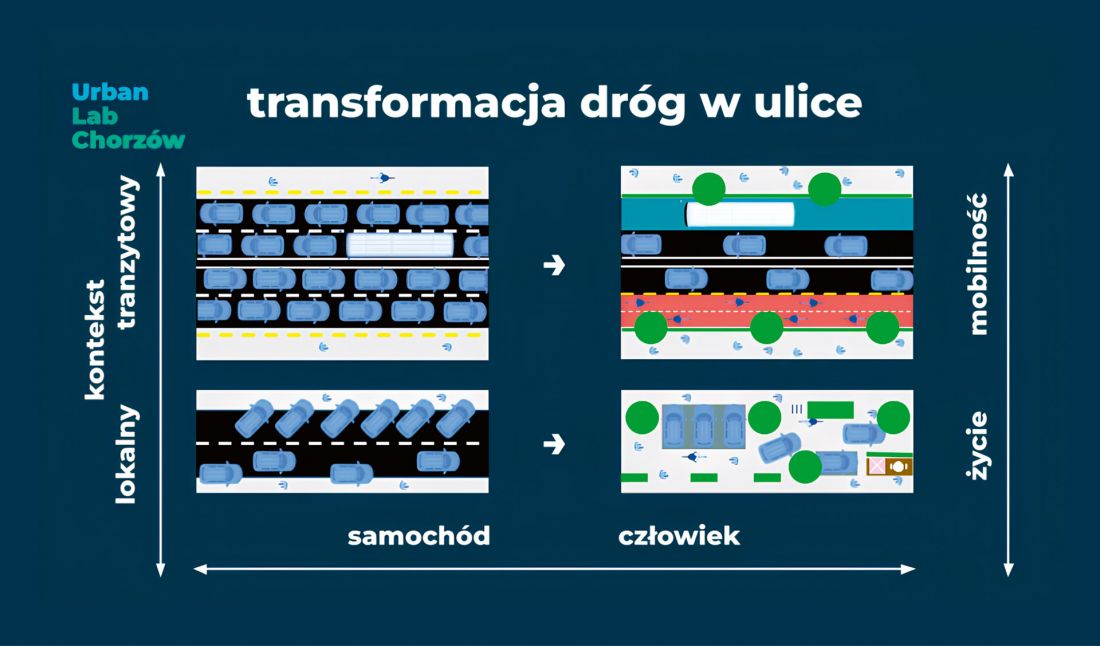
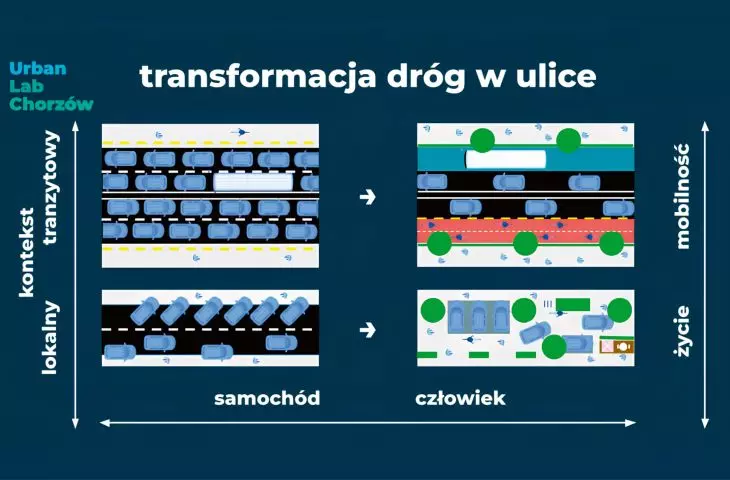
Key Principles of Chorzów’s Mobility Policy
Illustrations courtesy of the City of Chorzów
Marta Kulawik: The very fact that it’s open outside typical business hours—when most residents are at work—is already a significant gesture toward the people of Chorzów.
Michał Lorbiecki: It was very important to me not to waste the space in the venue. When we organize workshops, debates, or meetings, we’ll likely close off this shared space, but on a day-to-day basis, this “Urban Lab” corner can be part of the restaurant, where someone, instead of sitting at a typical table in the dining area, can sit on a couch in the Urban Lab section, pick up a book—such as *A Kind City: How to Shape a City with Care for Everyone*—which will convince them of its ideas. It’s no coincidence that I’m mentioning this particular book, as we had the pleasure of hosting its author, David Sim. We were able to meet him thanks to the Ładnie Foundation, for which we are very grateful, because such meetings inspire us to take action. I’d like to see a place created where we could invite various people to give presentations, to spread best practices, present visions, and share insights.
Marta Kulawik: We began our conversation with the vision you presented in the competition, which involved taking your ideas beyond the confines of a single department and reaching out to people. Such an initiative clearly demonstrates that you are truly making an effort to step out of your office and listen to public sentiment.
Michał Lorbiecki: One of my first projects in Chorzów was an urban design prototype at Matejko Square. It’s a wonderful square from an urban planning perspective, functioning as a roundabout—you simply drive around the fountain there. A beautiful fountain, featuring a sculpture by Theodor Erdmann Kalidi titled “Boy with a Swan.” I coordinated with various departments to close off part of that space for one day and hand it over to the residents. I’m very convinced of this change, and it certainly proved its worth that day. I think that by demonstrating this within our city administration, many officials came to trust me more—they saw that such changes make sense. Opening up the square came as a big surprise to residents; it was warmly received and will bear fruit in the long run. I plan to involve residents more often in this form of community participation.
Marta Kulawik: I’m keeping my fingers crossed and wish you lots of patience and perseverance.
Michał Lorbiecki: Thank you—I’ll need it!
Interviewed by: Marta Kulawik
more: A&B 4/2026 – City Architect,
download free digital issues of A&B