




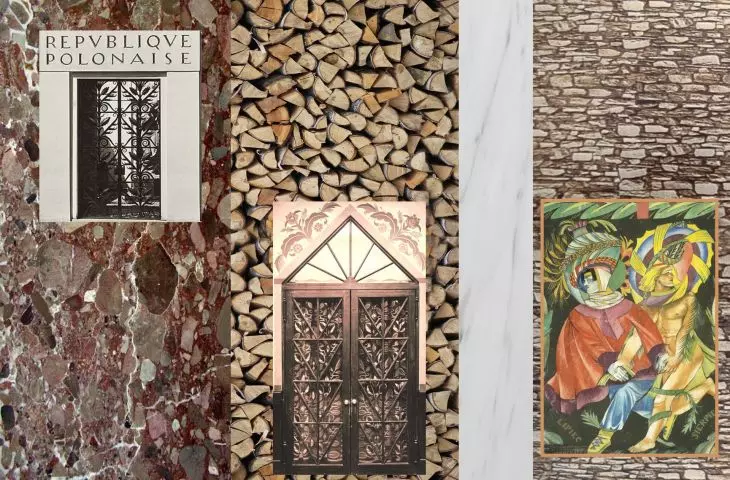

This year marks a somewhat forgotten anniversary - 100 years since the greatest success of Polish architecture and fine arts. At the 1925 Paris Exposition, the Polish Pavilion, designed by architect Jozef Czajkowski (1877-1947), with a painterly arrangement by, among others. Zofia Stryjeńska (1891-1976) - painter, graphic artist and illustrator, one of the most recognizable Polish artists of the interwar period alongside Tamara Lempicka - won as many as 35 Grand Prix and 200 honorable mentions.
The exhibition, which opened in Paris on April 28, 1925, was attended by 21 countries from around the world. On display were two emerging directions of modern art at the time. The first was represented by the modernist Pavillon de l'Esprit Nouveau designed by Le Corbusier and the constructivist pavilion of the Soviet Union - they were precursors of functionalism and modernism. The second, more decorative direction, however, breaking with Art Nouveau in favor of a geometrizing aesthetic, stood at the origin of the art déco popularized since this exhibition, derived from the name of the entire event: Exposition Internationale des Arts Décoratifs.
Although Polish artists created a temporal work that lasted six months as part of this exhibition, it became one of the most important achievements of Polish interwar art and today a somewhat forgotten reminder of our great success. Both the architecture of the pavilion and the paintings that filled it drew inspiration from folk art, "carved with a cosset," filtered through the emerging art deco style of the time.
This relatively short-lived style in Polish art originated from the Cracow Workshops, dissolved in 1926, and later from the "Ład" Artists' Cooperative. Among the works created in this spirit, one can point to the realizations of Jan Koszyce Witkiewicz (1881-1958), including the edifices of the Higher School of Commerce in Warsaw, or the Basilica of Saint Roch in Bialystok, by architect Oskar Sosnowski (1880-1939), whose construction began in 1927. This crystal-geometric aesthetic was obscured by the expansion of modernism; it is also mentioned perfunctorily today in the history of domestic architecture. It is a bit of a pity that this search for a national style did not result in a wider reception, and is a closed chapter. Nevertheless, it is awe-inspiring to see how, in the only recently resurrected Polish state, a group of artists made an effort to define an autonomous native style, embedded in the native tradition.

A difficult search for inspiration and a forgotten anniversary
© Piotr Średniawa
relationships with the landscape and regional buildings
Why has this fascination with indigenous art from 100 years ago been so significantly diluted, and the search for identity in architecture and fine arts forgotten? One can point to some distant and proximate causes, influencing and burdening our sensibilities. An important element in the search of the authors of the Polish Pavilion was the fascination with folklore, an enduring feature of Polish art in the second half of the 19th century and the early 20th century. Unfortunately, the devastation of war, border changes, resettlement and subsequent migration of the population to the cities destroyed authentic folk art, reducing it to a CEPELIA that no longer exists. It is difficult to find living inspiration in it today. It is therefore necessary to look for other, authentic sources of inspiration.
The basis for the search for identity is to appeal to the beauty of the landscape, which is hindered in our country by a lack of respect for nature and the native landscape, admittedly described by Le Corbusier himself as flat and uninteresting. The treatment of space in terms of peasant exploitation and source of livelihood, the building up of the country during the communist period with clumsy apartment blocks, and now urban sprawl, unrestrained also in the most scenically valuable regions of Poland, mean that our native space is perceived only in terms of immediate exploitation, and not in terms of value and common good. It is equally difficult to look for inspiration in the characteristic typology of buildings and building craftsmanship. The traditionally relatively low quality of building craftsmanship in our lands, is perhaps one of the barriers to such exploration. The only region with a high culture of building craftsmanship was probably the Podhale - it was no coincidence that Stanisław Witkiewicz derived the specific style of Zakopane Art Nouveau from it, having had the opportunity to rely on authentic, self-made, reliable craftsmanship. Unfortunately, the modern development of the Podhale region, predatory and out of control, has completely discredited this original direction of exploration.
In the Beskid region, which I have known for decades, the level of traditional craftsmanship was already somewhat lower. Wooden construction was and is not appreciated even by the native inhabitants, who have massively replaced wooden cottages with brick cubes made of aerated concrete. It's even hard to find a workshop that makes traditional split shingles anymore.
Good brick craftsmanship can be found in Pomerania, but we subconsciously recognize it as not ours and do not identify with it because of its Teutonic or Hanseatic provenance. On the other hand, referring, as it were, "straightforwardly," without any attempt at interpretation, to these historical buildings, brings questionable results, similar to a mock-up stage design, as in the case of the development of Granary Island in Gdansk. Similar doubts have been raised by the retrofitting of Old Towns in Elblag and Szczecin, still too fresh to blend into the urban fabric and too literal to claim to be contemporary architecture. For similar reasons, Lower Silesian fachwerk is also difficult to identify as an indigenous craft, much less a source of inspiration, except in naive attempts to resurrect a bygone era.
Territorial changes, population migrations and the totalitarian system effectively broke cultural continuity and the concept of identity. Unfortunately, the reliable construction craftsmanship that existed in the interwar period and the respect for it were completely destroyed by the more than 50 years of the past system. The last examples of reasonably good craftsmanship can be observed in some of the Socialist Realist buildings of the 1950s. The Gomulka and Gierek periods brought about its complete demise, symbolized by the large blocks of flats. Today's hurried development is also far from building craftsmanship, and does not contribute to respect for the art of construction. As a result, it is difficult to look for inspiration in technology and building craftsmanship, unlike the architecture of Switzerland, which is so admired in our country.
Material as a source of inspiration
If serious problems arise in interpreting the local landscape and the typology of buildings, it is worthwhile to turn to the inspiration of native building materials, which in historical and contemporary architecture have repeatedly provided the basis for the creation of outstanding works of architecture. Also in this area of creative exploration there are difficulties and barriers. Perhaps the small number of indigenous, inspiring and natural building materials is of some importance, nevertheless, the level of teaching at our architectural universities in this area, preferring knowledge of computer techniques, is also weak. Most graduates of architectural colleges have problems distinguishing granite from basalt, marble from sandstone, and beech wood from pine. The last 30 years of transition have also been a period of nouveau riche fascination with incoming mass imported building materials and products, used by trial and error. Their indiscriminate application leads to caricatured situations where frontages composed of new buildings more resemble exhibitions of building products than thoughtful application and composition.
Also, our attempts to use local materials are far from expectations and success. Thanks to the involvement of local craftsmen, large portions of the exterior and interior walls in the new St. Stanislaus Church in Bytom were successfully bricked with dolomite from the neighboring Radzionków Hills. However, this was a one-time incident that could not be repeated in other projects due to its labor-intensive nature. On floors and pedestrian and vehicular surfaces we used in large quantities - Strzegom granite interlayered with basalt. This is a difficult material, requiring great design care to avoid the effect of dead, somewhat sad or pessimistic pavements. We realized small squares in colorful porphyry and light limestone from demolished p avers. Also to a modest extent we managed to use native wood. In addition to a gazebo made of pine slats and numerous spruce roof trusses, we designed only a few pieces of furniture. From luminous ash according to our design, carpenters made furniture in one of the guesthouses we designed. We made rustic garden furniture with our own hands out of cherry trees of deep red color, broken in our garden by halny, and walnut with beautiful grains.
Unfortunately, it is easier than this beautiful native wood to buy imported species such as mahogany, meranti, or badi. When you enter the search terms, hornbeam wood, or birch wood, only fireplace wood appears in the Internet search engine. And this is basically the end of the short list of our attempts to use native materials, although this does not discourage us from making further attempts.
We were unsuccessful in our attempts to use native quasi-marble, the picturesque Sigismundstone, from which the shaft of the Sigismund's Column in Warsaw was originally made, replaced after the SecondWorld War II replaced by Strzegom granite, or the beautifully veined black Debnik from near Krakow, a favorite material of Giovani Trevano, from which many details of Krakow churches and palaces of the Vasa era were made, or the Lower Silesian White Marianna, named after the owner of the quarries, Marianna of Orange. Also unobtainable was alabaster, needed to complete the balustrades in a church being renovated in Piekary Slaskie. Despite the loss of its deposits in the Eastern Borderlands, there are deposits of this beautiful, slightly transparent mineral in Podolia, Podkarpacie, the region of Kanczuga and the Przeworsk area, whose exploitation was unfortunately ended in 1974.
It turns out that imported marble and onyx are easier to use. Native material is not only a connection with the land of a region, but also the history and tradition contained in it, both of a country, region or city, as well as small family stories encapsulated in our garden furniture, without which - contrary to appearances - it is difficult to move in today's culture and creativity. All these elements result in the fact that it is so difficult in mental and workshop terms to create architecture in Poland embedded in a real native context, identity, landscape and land. Nevertheless, it is worth remembering the anniversary, passing this year, of the great success of our art and architecture at the Paris exhibition.
Piotr Średniawa
Chairman of the Council of the Silesian Chamber of Architects,
Member of WKUA and MKUA in Katowice,
Since 2003 he has been running the Office of Studies and Projects in Gliwice with Barbara Średniawa