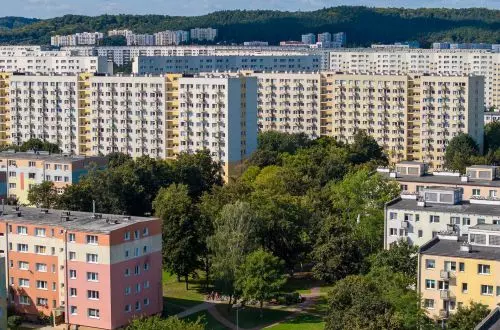






The country's authorities are finally fighting bad architecture. The prescription: don't show it. A new nationwide ban will help. In the capital there are already the first results.
Photo ban. It was sorely missed. I've almost forgotten how much joy he gave, and he's officially back and acting like a Proustian Magdalene. One look at the plate with the crossed-out camera and I feel it again: crisp evening, the smell of meadows, coal smoke. Masuria, August 1988.The stationmaster of the Kamionek Wielki train stop is rubbing my father's back as my father illegally aims his lens at a strategic steam locomotive. Across the strategic field, the locomotive drags a single carriage. In the field, a squadron of storks has an assembly before the invasion of Africa. Father snaps a photo. The railroader taps the placard, roars that it's forbidden, flies to us, spins his paws like a windmill. And suddenly he doesn't want to. He returns.
The film remains in the camera, and we - alive. Somewhere above us, an enemy satellite is taking pictures of Kamionek, probably more accurate than ours. I'm eleven years old and a good laugh. In a few years, all those placards with the forbidden camera will cease to mean anything.
April 2025- a new ban on photography goes into effect. And it makes me feel better again. The provision states: you can't take pictures of objects "especially important for the security or defense of the state, critical infrastructure and the military," but also many others, important less so, not quite sure what. There are 25,000 locations, but their list is secret. Military facilities: 3 percent. The rest: railroads, water supply, electricity, those things. If anyone gets caught, there's a cellphone, drone or camera to confiscate. There may be detention as well. I wonder if they'll take away the chisel if someone carves himself in wood, let's say, a barracks, because the regulation also talks about capturing an image "by other means." In a word: the regulation doesn't blow when everyone has at least one lens the size of a small button in his pocket. He may also have a camera in his button. He may have it in his glasses. He'll have it in his eyes in a moment. There are nearly 12,000 satellites circling and watching over us around the Earth. The globe is in the tentacles of the Internet. And we are going on a photo ban. Rightly so, although the mischievous are teasing, and in Gdansk they snapped photos of themselves from the beach against the backdrop of a distant strategic port. Then they reported themselves to the police. The police don't know what to do. Laughter up to the armpits. For the merry men failed to see the new regulations as a smokescreen.
The ban protects not so much existing facilities (satellites, Google and spies will take pictures of them anyway), but those that are persistently missing. For example: shelters and so-called hiding places. There are roughly as many of them as there were a year ago, when I quoted the crushing NIK report: as many as a cat spends. The absence of bunkers and shelters (as well as weapons, soldiers, sanitary points, plans for evacuating cities, and so on) is strategic information more valuable to the enemy than what is there and what the enemy will photograph for himself from space or a car camera. And for the domestic services a wonderful field of interpretation is born. Because in order for the ban to work, you need to inform about it with a placard. And how to hang a placard on the lack of a shelter? Some will say: a task for a philosopher. Others: simple, you can nail it where the bunker MAY be located. As it is convenient for anyone.
This flexible opportunity can be used not only by the military, but also, probably, by local government officials, road builders and developers. There will finally be an end to mean-spirited citizens taking photos of investment bubbles, stalled construction projects, illegal logging, and then turning these photos into memes to annoy local decision-makers. An arbitrary ban on photography will solve the problem, and if anyone muzzles using lawyers, they will add that a new water main, roadway or lamppost is of strategic importance (a road for tanks; water against fires; a lamp to shade it).
The same with failed buildings and developer housing developments - strategic, because their shabbiness will weaken the morale of every more civilized invader. This is already happening, by the way. Official signs banning snapping hung in mid-May in front of the famous Tower of Babel, the main TVP building on Woronicza. Truly.
Here is the real fight not only against the promotion of poor architecture, but also against poor framing. After all, under the new regulations, it is also forbidden to record people in the banned location. Not showing politicians and some presenters on TV is another advantage of the new regulation.
Banning photography at a time when this activity is almost as popular and easy as breathing will also boost the economy. Someone has to go after those thousands of snappers who, on one of their selfies, inadvertently fix an important bridge, lamppost, road or secret architectural nastiness in the background. Someone has to review the records of car cameras. Someone has to enforce the regulations. Finally, someone has to interpret them, because they are wonderfully holey and vague. Lawyers, security guards, guards, SOKs will make money. Maybe some new formation should be established?
And in order for the legal confusion to keep the average level of Polish legislation, a photography order should be introduced at the same time. I write this quite seriously, because we seem to snap billions of photos a year, and many spaces, buildings, streets, courtyards or outbuildings do not have their documentation. One that would help in future restoration, renovation, research, tracking changes. Many photos of architecture from a decade or two ago have already disappeared from the web, along with disabled media or studio websites. A lot of amateur but valuable iconography is also probably dusting away on private hard drives and in the clouds. It's true that Google Street View makes a good documentarian, but one, it's an offshore privateer and you never know what's going to pop into its head, and two, the whole resource could be disconnected from the network or maliciously deleted by someone.
Local governments or some new institution is therefore worth pouring some money into a mandatory and standardized documentation archived in civilized conditions. I just wonder if the resources of such archives are by any chance strategic objects. Will it be possible to make copies or photos of them?
Jakub Głaz
more: A&B 6/2025 - WARSAW,
download free e-publications of A&B