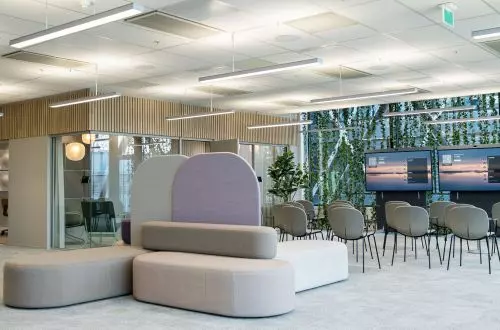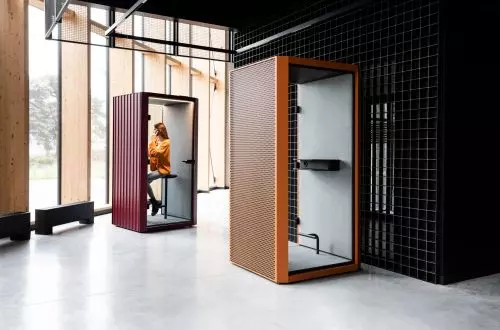
Location: A former bakery, now a design studio. The Bałuty neighborhood—and as everyone knows, the people of Bałuty and Chojny are a peaceful lot.
Kuba walks in, a little tired after his trip to Warsaw for the Architecture Congress. Lost in thought, he sets his foldable helmet on the conference table and sits down in Ernst Moeckl’s “Zetka” chair, lost in thought.
“Hey buddy, how’s it going?” Jakub joked, glancing at Kuba and snapping him out of his strange reverie.
“Great!” Kuba joked.
“I suppose I’m skeptical. I see post-congress fatigue, a somewhat reflective mood. Another industry-wide diagnosis that systemic changes and education are needed? More complaining about salaries, while nothing but luxury cars are parked outside the building?”
“Don’t be mean—the event was a huge success, but that’s not what I wanted to talk about. I thought Warsaw was beautiful and developing wonderfully, but this morning I had an appearance on a home improvement show, and the studio is on the very outskirts of the city.” I went on a bike ride and saw another side of the capital: I saw what life is like in different neighborhoods—high-rise blocks, villa estates, townhouses, cottages—and finally Bródno Forest, with a tin-roofed shopping center behind it, where the studio is located…
— Interesting—I wasn’t expecting these kinds of impressions at all from my visit to Warsaw for the Congress. No gossip? No classic in-group squabbles? Really? — Jakub sat down next to Kuba with a coffee mug designed by Malwina Konopacka, waiting for Kuba to explain what had prompted his reflections.
— Come on. “All quiet on the western front.” But when I was driving back through Warsaw’s neighborhoods, I reached the footbridge and looked at the skyline—and it felt like I was in two different cities. Suddenly, the calm of the suburbanites jogging or walking their dogs gave way to an atmosphere of pressure, stress, and a fast-paced life.
— I don’t quite understand — Jakub interrupted. — It’s the same city, after all; those calm strollers put on their blazers and suits and rush at breakneck speed to the glass-walled, certified office buildings to advance their brilliant careers. Of course. You can only find happiness in a big city! A good job, a house in the suburbs, an electric car.
“Pfft,” Kuba saidirritably . “And then I hear from these ‘happy people’: ‘One day I’ll quit it all and move to the Bieszczady Mountains.’ But when I ask if they’ve ever even been to the Bieszczady Mountains and how they know it’s a good place, they can’t answer.” On the other hand, a lot of people do end up escaping from the cities to the countryside after years of living there. But I wonder, Jakub, if it’s possible to fulfill your aspirations outside the crazy pace of life in big cities. Can you be happy in a small town?
— There’s something to that. Many young people are drawn to the big cities in pursuit of work, income, and a career, but they pay a high price for it: a thirty-year mortgage for an astronomical sum, the loss of personal freedom, and working in a one-person labor camp: slogging away at a full-time job from dawn till dusk, and after hours managing social media so everyone can see that you’ve made it. Is it possible to build a career, earn a decent living, and gain prestige and recognition in small towns? And yet, as you said, architecturally speaking, the outlying districts of large metropolises are no different from small towns. Not only that, but in my opinion, small towns usually have beautiful historic centers, cleaner air, less traffic, and everything is within biking distance.
“The real difference is in our heads,” Kubaconcluded . “In reality, people who live in big cities and those in small ones get in a bad mood just as often.” Architecture alone and the career opportunities in big or small cities don’t make people happier. Whether you live in a small or large city doesn’t determine whether you’re more or less happy, and maybe it’s worth thinking about what you really want in life. Isn’t it true that we flee from the countryside and small towns to metropolitan areas, and from there back to the countryside or the mythical Bieszczady Mountains? I know architects from Piotrków Trybunalski and Siedlce who have great careers and bodies of work. They’re highly regarded locally, but little known outside their own cities—that’s a fact. On the other hand, there’s a trend toward neighborhood identity, and residents’ lives may unfold entirely within their own neighborhoods without ever visiting the bustling city center—even if that means giving up access to theaters, concert halls, and luxury stores. Perhaps a similar trend could take hold for the small-town lifestyle?
— So we have a task. We need to discover not only “provincial actors” but also provincial architects and towns that haven’t been discovered yet. How do we do that? Simply go there, spend your vacation there instead of on an oceanic island. I suppose that’s what Alain de Botton’s *The Art of Travel* is all about. — Jakub opened his Moleskine notebook to plan his next vacation.
Kuba nodded and began to recite:
— (…) I feel myself breaking free / from the unnecessary excess of energy / that my youth has endowed me with / perhaps / I could use it differently / for example, to write four feature stories / on the prospects for the development of small towns /…
Jakub interrupted and, just to be safe, finished the line himself:
— …but small towns are in my heart/…but small towns are in my heart/…but small towns are in my heart.
The conversation was between:
Jakub Krzysztofik —architect and urban planner—and
Kuba Krzysztofik —urban planner and architect.
You could have met them at the Polish Architecture Congress in Warsaw. You surely recognized them. Both were dressed in black.
Note: This column contains product placement, although no one paid for it. Kuba and Jakub apologize to the heirs of Andrzej Bursa for the changes made to the song “Sobota.”
JAKUB/KUBA KRZYSZTOFIK
more: A&B 6/2026 – Small and Medium-Sized Cities / Architects’ Rates,
download free e-editions of A&B