
Could the eviction of a single elderly woman lead to early elections? In Spain, the story of 87-year-old Maricarmen Abascal sparked protests against the housing crisis, which had been escalating for years. This Spanish story may seem far removed from Poland, but the data show that housing availability is also becoming a structural problem here—albeit in a different form.
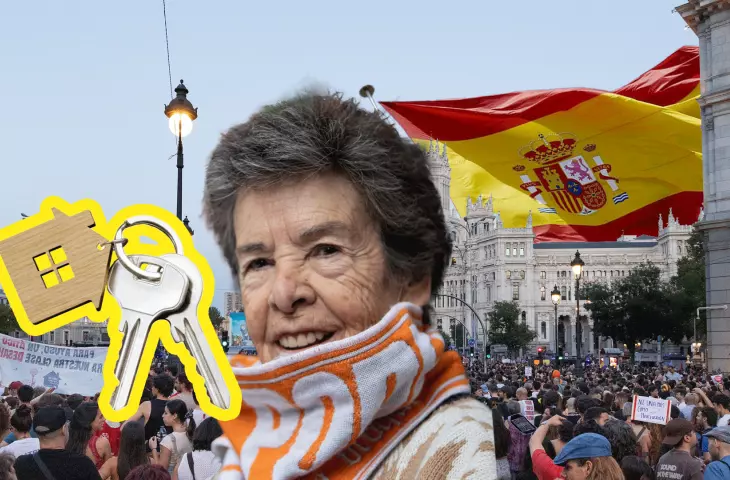
87-year-old Maricarmen Abascal was evicted from her apartment in Madrid’s Retiro neighborhood. She had lived there for over 70 years. The day before the scheduled eviction, the Madrid Tenants’ Union and local community groups organized a protest and an overnight vigil in front of her home, attempting to stop the fourth attempt at eviction. On September 23, after being given 30 minutes to leave the building and take only the bare essentials, the woman—who has mobility issues— was carried out of her apartment on a stretcher.
The reason? The building had been taken over by a developer who had significantly raised the rents. Hundreds of people protested in front of the building. They chanted, “Maricarmen, you’re not alone!” More and more protesters began to gather in Madrid’s Puerta del Sol square. At first there were dozens, then hundreds of people. The protest turned into a sprawling tent city, which over time not only occupied part of the square but also began to spread to neighboring streets and even to other cities. In a video that quickly went viral, Maricarmen appealed to Prime Minister Pedro Sánchez to effectively enforce a ban on evictions of people who had not been provided with alternative housing. The protesters announced that they would remain in place until the government adopted measures to increase tenant protection.
 Tents set up in Madrid’s Puerta del Sol square on October 1, 2026. Photo: Eneko Torres Peco / Wikimedia Commons, CC BY-SA 4.0.
On September 28, five days after the eviction, representatives of Maricarmen and the apartment’s owner, Urbagestión, reached an agreement allowing her to return to the apartment. An eight-year lease was agreed upon, with rent not exceeding 30 percent of her income. A day later, the elderly woman’s attorney confirmed that she had accepted the terms and would be able to return home after being discharged from the hospital. However, she never returned. On October 7, 14 days after the eviction, Abascal died in the hospital where she had been staying since leaving her apartment.
View this post on Instagram
Her case had already become a turning point in the housing conflict that had been escalating in Spain for years. In response to the protests, the government accelerated work on solutions that had already been under negotiation, and on September 29, the Council of Ministers adopted two housing decrees. Among other things, these decrees provided for strengthening protections for people at risk of eviction, extending lease agreements, regulating seasonal rentals, and temporarily restricting the purchase of apartments by investment funds. However, to remain in effect, they had to be approved by Congress.
On October 2, both decrees were rejected by votes from Junts, the PP, Vox, and the UPN. Junts argued that the proposed solutions would not effectively prevent evictions or speculation in the housing market, and presented its own proposals for changes. Three days later, on October 5, Prime Minister Pedro Sánchez announced the dissolution of Parliament and called for early elections on November 29.
However, the government did not abandon the proposed measures. On October 6, the Council of Ministers once again adopted the two decrees with the force of law, retaining the essential provisions rejected a few days earlier by Congress and supplementing them with new measures.
The first of these decrees retained, among other things, protections against eviction without guaranteed alternative housing, as well as the possibility of an extraordinary extension of certain expiring lease agreements for up to two years. At the same time, restrictions were introduced through December 31, 2030, on certain purchases of apartments by companies and funds that buy apartments or delinquent mortgages at prices significantly below their market value, as well as by entities considered “large landlords”. However, the restriction does not apply to all purchases made by funds or large owners: it applies, among other things, to the acquisition of apartments for less than 70 percent of their market value and provides for a number of exceptions, such as for apartments intended for social housing and affordable housing.
Both decrees were published in the Spanish Official Gazette (BOE ) on October 7. Due to the early elections, both decrees must still be approved by the Permanent Commission, which performs certain constitutional functions during the period between the dissolution of parliament and the formation of the new chamber.
Spain’s two largest labor unions, the General Union of Workers (Unión General de Trabajadores, UGT) and the Spanish labor federation Workers’ Commissions (Comisiones Obreras, CCOO), have called for a general strike on November 11 related, among other things, to the right to housing.
This is a turning point in a conflict that has, in fact, been escalating for years.
Where did Spain’s housing crisis come from?
The roots of the current situation can be traced back much further. Before the global financial crisis, Spain was experiencing a massive construction boom: in 2006, construction began on approximately 760,000 housing units. Housing investment accounted for 9.4 percent of GDP. After the bubble burst, the market collapsed abruptly.
The scale of this reversal was enormous. The number of completed housing units fell to about 45,000 in 2016. Subsequently, the construction sector recovered very slowly and, starting in 2021, has remained at a level of about 90,000 new housing units per year.
At the same time, however, demand increased. Between 2021 and 2025, the cumulative gap between new housing production and the growth in the number of households reached approximately 750,000 units, according to the Banco de España. More than half of this gap (52.5 percent) was concentrated in just six provinces: Madrid, Barcelona, Alicante, Valencia, Murcia, and Málaga. The expansion of the housing stock was primarily limited by a shortage of workers, protracted urban planning procedures, and a lack of land zoned for development.
The European Commission also points to population and household growth, as well as home purchases by foreigners. In 2024, foreign buyers accounted for 14.6 percent of home purchase transactions in Spain[1].
Added to this is the very limited supply of public housing. Spain has a small stock of over 318,000 public rental units. This represents just under two percent of the total number of households. Even when using a broader definition that includes protected and regulated housing intended for both rent and sale, their share amounts to only 2.5–3.4 percent, compared to the EU average of 6–7 percent
The result is increasing price pressure. In 2025, housing prices in Spain rose by 12.7 percent in nominal terms year-over-year, which, according to the European Commission, represented the largest annual increase since 2007. At the same time, the Commission estimated that housing prices were overvalued by approximately 18 percent. Young people are particularly hard hit by this problem: according to Eurostat, in 2025 Spaniards were leaving their parents’ homes on average only slightly past the age of 30, compared to the EU average of 26.3 years.
Does the housing crisis in Poland look any different?
In the current social climate, Poland is far from facing anything comparable to the wave of protests in Spain, but that does not mean there is no housing affordability crisis. As for our country, the European Commission’s 2026 report explicitly mentions a “serious housing shortage, ” especially in cities, as well as a deterioration in housing affordability over the past decade.
Since 2015, housing prices in Poland have risen by 117 percent, while rents have increased by 74 percent. For the EU as a whole, the figures were 62 and 21 percent, respectively. The Commission also calculates that the price of a reference apartment with an area of 100 m² in Poland corresponds to approximately 11.8 years of average income, compared to the long-term EU median of eight years. The “Safe 2 Percent Loan” program, introduced in 2023, was intended to make it easier to purchase a first home, but it increased demand and contributed to a rapid rise in prices. Approximately 91,000 loan agreements were signed under the program, which was terminated after six months.
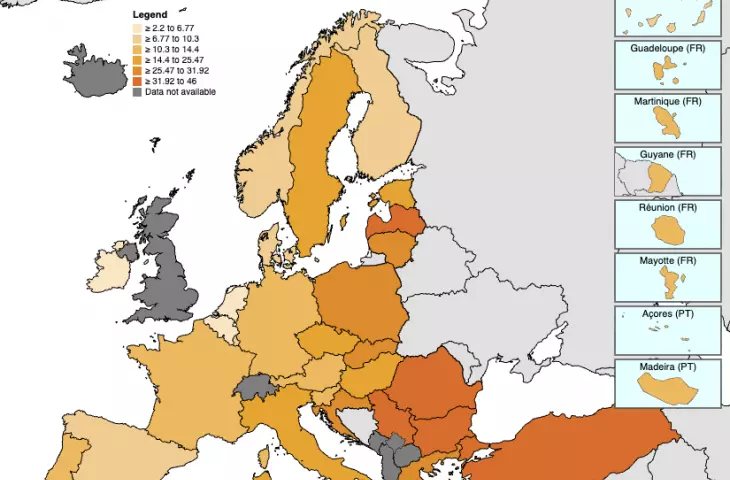
However , the Polish crisis has a characteristic that is almost nonexistent in Spain: extremely high housing overcrowding. In 2024, 33.7 percent of Poland’s population lived in overcrowded housing, compared to 9.1 percent of Spain’s population and 16.9 percent of the EU’s total population. Poland had the fourth-highest rate in the EU. But what does overcrowding actually mean? According to Eurostat’s methodology, it is not so much about the small size of a dwelling as it is about the number of rooms in relation to the number, age, and relationships among household members. It is assumed that a household should have at least one common room, an additional room for each couple, a separate room for each adult who is not part of a couple, and an appropriate number of rooms for children, depending on their age and gender. This means that even a relatively large apartment can be considered overcrowded if too many people live in it.
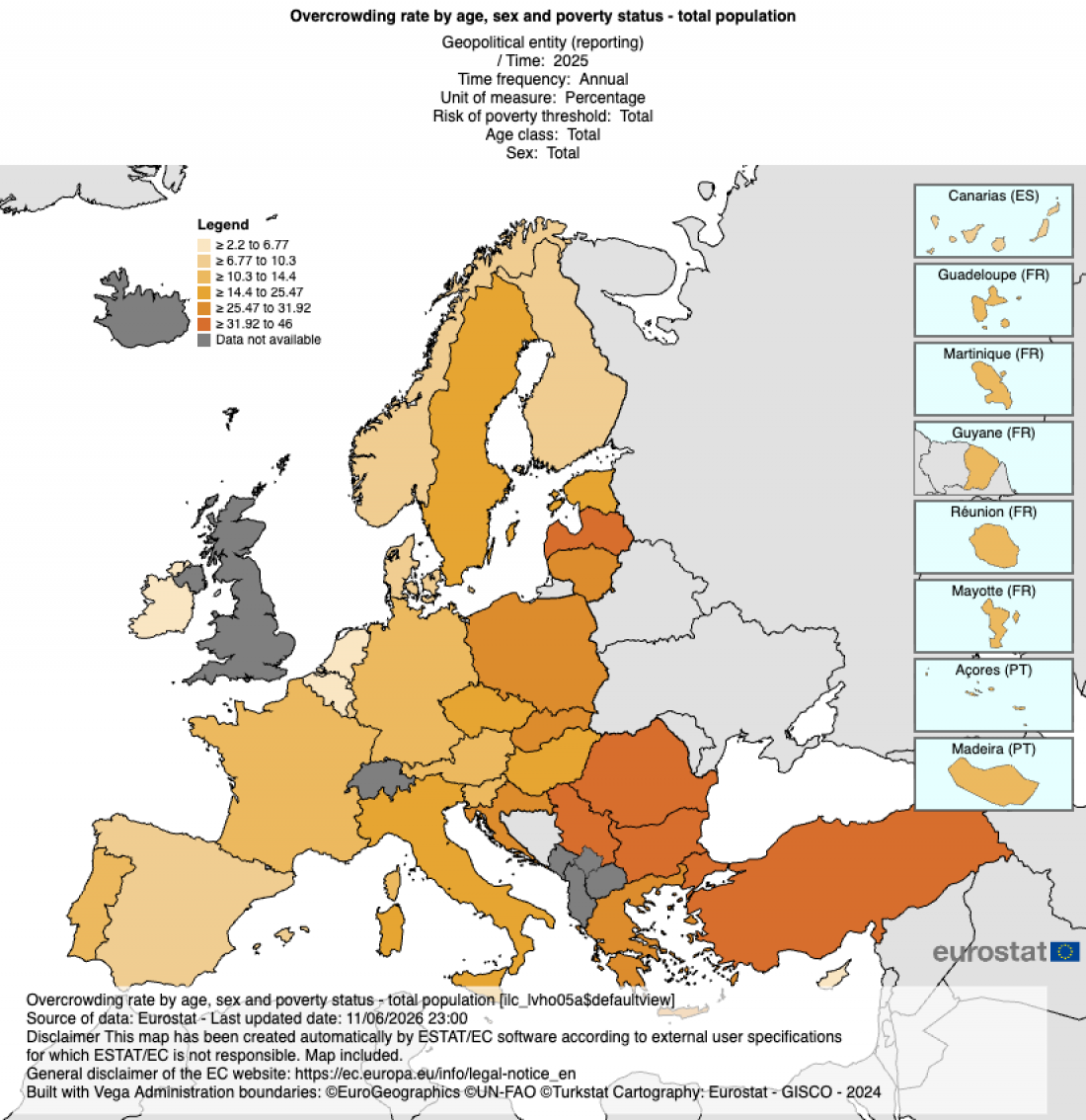
Percentage of the population living in overcrowded dwellings in European countries in 2025. — Overcrowding was determined based on the number of rooms available in a household relative to the number, age, and gender of its members.
© Eurostat
It is also worth noting the popularity of small apartments on the Polish market, including studio apartments. According to Otodom data, in January 2025, the number of searches for apartments with an area of less than 40 m² was 25 percent higher than a year earlier, and units of this size accounted for over 24 percent of listings for sale and over 33 percent of rental listings on the website.
This is significant in the context of Eurostat’s methodology, under which even a studio apartment occupied by a single person is considered overcrowded if it lacks a separate bedroom. When assessing overcrowding, it is not the apartment’s square footage that matters, but the number of rooms in relation to the number, age, and composition of the household members. Eurostat assumes that a single-person household should have at least two rooms—one common room and one designated for sleeping. A dwelling considered sufficient for one person on the Polish market does not necessarily meet European criteria for adequate housing conditions.
When the Housing Stock Is Shrinking
Given that Poland also faces a housing shortage, limited municipal and social housing stock, and low levels of housing investment, we can speak more boldly about this problem. In 2024, 117,805 Polish households were waiting for municipal housing.
Admittedly, Poland still ranks among the countries building relatively many units —in 2024, 5.3 housing units per 1,000 residents were completed, placing Poland among the EU leaders in this regard. At the same time, housing investments in 2025 accounted for just 2.2 percent of GDP—the lowest in the EU, with the EU average standing at 5 percent. The Commission estimates an additional investment gap of approximately 124,000 housing units above the projected supply. This means that the relatively high current production of new housing units is not sufficient to offset the previous deficit and meet current needs.
The public housing stock in our country is growing too slowly. Its expansion is not keeping pace with demand, and some local governments continue to sell the housing units they own. However, municipal policies vary, and the number of apartments sold does not necessarily correspond to an actual reduction in the housing stock. This is because the size of the housing stock is influenced both by losses—such as sales, demolitions, or changes in the use of units—and by increases resulting from construction, purchases, renovations, and other methods of acquiring housing.
The latest data from the Central Statistical Office, however, show that the number of rental units from the municipal housing stock continues to decline. According to preliminary data published in March 2026, as of the end of 2025, lease agreements were in effect for just under 590,000 such units, excluding replacement housing and temporary accommodations. This is 1.6 percent less than a year earlier. The decline was observed in both urban and rural areas.
For example, in 2024, Wrocław sold 846 residential units—the highest number in nine years—including 764 to existing tenants. A year later, sales accelerated even further: in 2025, the city sold 1,006 units—the highest number in a decade—and the number of apartments sold to tenants rose to 950. The municipal housing stock is clearly shrinking: according to the city’s latest report, the number of municipal residential units fell from nearly 32,000 in 2022 to just under 29,000 at the end of 2025. The housing stock management plan adopted for 2026–2031 anticipates a further decline.
In Świebodzice in 2025, the municipality sold 112 residential units, compared to 45 the previous year. In February 2025, the city council introduced the option to receive a 99-percent discount on the purchase of an apartment, provided that payment was made in a single installment and an application was submitted by the end of the year.
Of course, this does not mean that local governments do not spend any money on housing at all. Indeed, they finance renovations of existing buildings, modernizations, and sometimes new municipal housing projects, or expand their housing supply through social housing associations (TBS).
The problem arises when, in parallel with these investments, local governments are disposing of apartments faster than they can replenish their own housing stock. Furthermore, proceeds from apartment sales are not automatically converted into new municipal apartments on a one-to-one basis. As a result, a municipality can simultaneously “invest in housing” while permanently reducing the number of units in its direct housing stock.
The scale of these sales is by no means marginal. According to the Central Statistical Office (GUS), in 2023–2024, municipalities sold a total of 23,726 apartments, or an average of nearly 11,900 per year. This represents more than a quarter of all apartments sold during this period to individuals from the housing stock of the entities included in this study.
As calculated by Andrzej Prajsnar based on historical GUS statistics, between 2002 and 2015, municipalities sold 501,305 apartments, while in municipal housing construction, just under 39,000 new units were completed. Between 2016 and 2024, another 145,681 apartments were sold, while… over 13,000 were built.
Perhaps, in light of the protests in southern Europe, it is worth asking not so much how many apartments municipalities are building, but rather how many apartments actually remain available to households in need of public rental housing. A unit sold to its current tenant continues to meet the housing needs of that household, but it ceases to be part of the housing stock that the municipality can manage in the future. The sale, therefore, does not mean the physical disappearance of the apartment from the market, but rather a change in its ownership status and the loss of the municipality’s ability to rent it out again under municipal terms.
Maricarmen Abascal has become the face of Spain’s housing crisis. Naturally, this brings to mind Jolanta Brzeska and the history of reprivatization in Poland (though the mechanisms behind the two crises are different). In my view, what connects them is the question of housing security and the consequences of subordinating residents’ needs to the blind logic of the real estate market.
The difference between our countries, however, lies not so much in the very existence of the crisis as in its visibility in public debate. In Spain, housing has become one of the central issues of political debate and social mobilization. In Poland, despite growing problems with housing availability, it does not yet occupy such a central place in the debate. And without a long-term increase in the supply of housing available outside the commercial market, even a large number of new developments may not be enough to improve the situation of those who simply cannot afford to own a home or rent on the open market.
Magdalena Milert
[1] In 2024, the share of homes purchased by foreigners accounted for 14.6% of all sales transactions, compared to a historical average of 10.5% between 2006 and 2024.