









On railway properties in Gdynia and in Warsaw’s Odolany district, PKP plans to build a total of over 7,000 apartments in partnership with developers. Deputy Minister Jan Szyszko is calling for the construction of affordable housing on land owned by the state-owned company. “ As the number of commercially sold apartments grows, so too should the number of affordable housing units available. However, this must be a decision made at the political level,” housing expert Hanna Milewska-Wilk told A&B.
It has been known for over a decade that the railway company plans to build apartments on its land. In 2015, the state-owned company Xcity Investment was established to develop attractive plots in Polish cities in partnership with private investors. In Gdynia, 4,730 apartments are planned on former railway lands, along with office, retail, service, and hotel facilities. The new buildings and facilities are to be constructed in the city center, in the area known as Międzytorze, between Jana z Kolna Street and the Gdynia Port station.
PKP’s development projects: “Międzytorze” delayed, “Odolany” in the works
The project is off to a rocky start. Xcity Investment, a company established to handle PKP’s real estate development projects, signed a contract with the developer—the Gdynia-based firm Semeko—back in 2015. But construction—due to financial problems faced by the developer—has not yet begun. This is despite the fact that the entire massive project was originally scheduled for completion in 2026. Railway officials argue, however, that work will eventually pick up pace, as Xcity Investment signed a contract last December with another investor: the Tri-City-based firm NDI Development.
Międzytorze is currently in the preparatory phase and undergoing administrative procedures related to the first stage of the investment. “The first stage includes residential units with a commercial component,” says Izabela Balcerzak of NDI.
Although construction was supposed to begin later this year, few details are known so far.
Railway officials are undeterred by the delays and are planning another project. A new residential development is also set to rise on PKP-owned land in Odolany Kolejowe. The project involves the development of 22 hectares along Ordona Street in the Wola district of Warsaw. The plans call for 2,300 apartments, 42,000 square meters of commercial space, new public spaces, and green areas. The project will be divided into three areas for which PKP and Xcity are seeking not one, but three partners.

This is what the 2015 Międzytorze development plan looked like.
Source: PKP
Deputy Minister Asks About Affordable Housing
Both investments are linked not only by the sites’ railway history but also by the question: under what conditions should a state-owned company introduce housing into the city? Given the scale of these investments—in Gdynia and Warsaw—will some of the apartments also be available to people who cannot afford to buy a home at market prices? Jan Szyszko, Deputy Minister of Funds and Regional Policy, drew attention to this issue.
“How many of them [apartments in Warsaw’s Odolany district—ed.] will be affordable rental units ? It looks like zero, ” wrote Deputy Minister Szyszko.
He added that in such cases, “the government should not remain silent.”
The area is well-connected, owned by a state-owned company, and close to downtown and the business district of Wola.If this mythical “corporate social responsibility” exists, it should manifest itself in PKP also building affordable housing—or simply, public housing—on such sites. We have a choice—either increase corporate profits orbuild a truly new urban fabric —with affordable rental housing,” noted Jan Szyszko.
PKP understands, but has no plans for such housing
In response to questions from A&B, PKP confirms that such housing will not be built.
Development projects in Gdynia’s Międzytorze district and Warsaw’s Odolany district will be carried out in cooperation with private investors on a commercial basis,” admits Justyna Gawron of PKP S.A. - We understand and share the belief that increasing housing availability is an important social challenge. At the same time, PKP S.A. does not have the legal or financial tools necessary to engage in social housing activities.
According to PKP, “under the current legal framework, such projects fall outside the scope of the company’s mandated activities.”
Regardless, the projects carried out by PKP S.A. will contribute to increasing the housing supply in large cities and to the redevelopment of former railway sites,” explains Justyna Gawron.
PKP plans to allocate the funds generated, among other things, to the modernization and maintenance of train stations.
In the Warszawa Odolany project, part of the residential development will be designated for rental under the PRS program.
Hopes for the creation of affordable and social housing are also being dashed by the Ministry of Development and Technology, which is responsible for construction, planning, land use, and housing. The ministry believes that social housing should be built and managed by organizations that do not distribute profits to owners—such as SIMs, TBSs, or housing cooperatives.
This provides a better guarantee of proper, purpose-driven management of the resulting housing stock, according to the ministry.
Lack of cooperation, profit is what counts
Hanna Milewska-Wilk, a housing expert at the Institute for Urban and Regional Development , admitsin an interview with A&B that from the perspective of urban development, it would be beneficial for urban areas to be diverse in terms of residential development.
As the number of commercially sold apartments grows, so too should the number of affordable apartments available. However, the question of how to achieve this remains a challenge, Hanna Milewska-Wilk notes.
The expert adds that one of the obstacles is that our zoning plans do not designate specific areas for affordable housing, as is the case in many Western European countries.
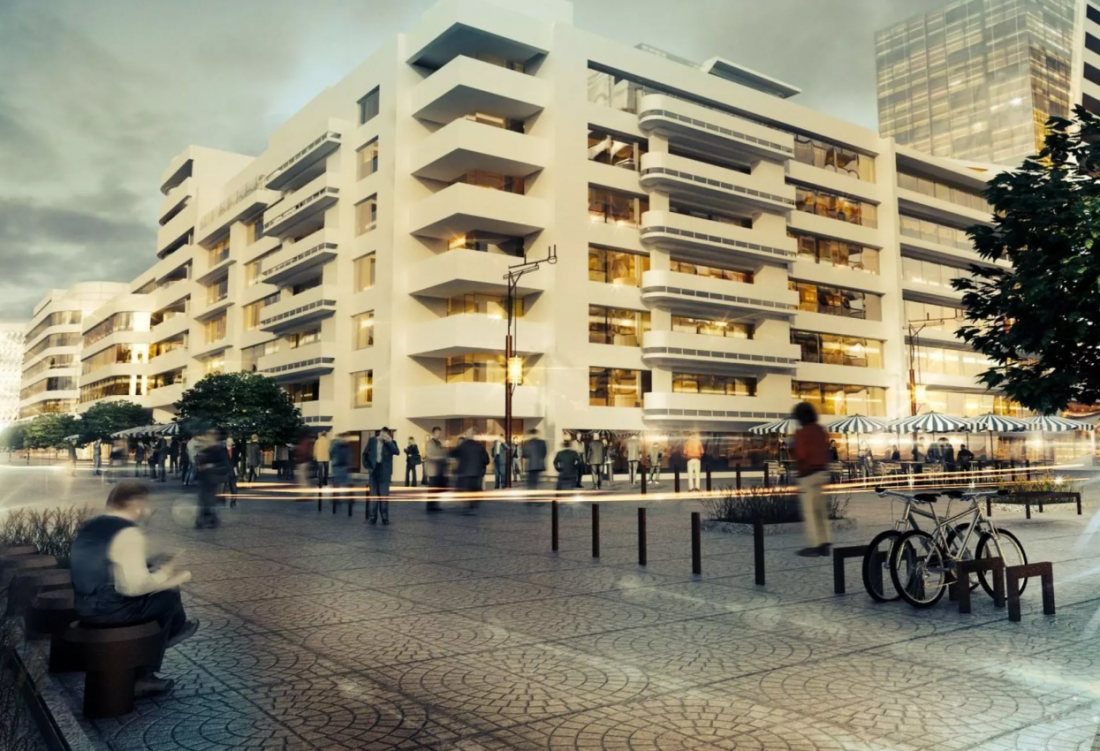
Apartments, services, and retail spaces are to be built in Międzytorze. However, these renderings are no longer current.
Source: PKP
On the other hand, railway companies are state-owned enterprises, but their social mission is limited. PKP and its special-purpose entities operate under the Commercial Companies Code, so profit is what matters most. Consequently, there is unfortunately no cooperation, for example, between PKP and other companies that own land and the National Real Estate Reserve, ” explains Hanna Milewska-Wilk.
So how can we make housing more accessible to the average person today?
This must be a decision made at the political level. Currently, several ministries are responsible for housing policy; there is no single body that oversees it. Housing policy is primarily implemented by local governments today. True, they have the support of the National Real Estate Reserve (KZN) and central institutions such as Bank Gospodarstwa Krajowego, but there is still a lack of coherent goals among the ministries,” says Hanna Milewska-Wilk.
According to a 2025 report by Habitat for Humanity Poland, 27 percent of people in Poland believe they are in a rent gap. In turn, one in five people lives in conditions that do not meet their basic needs, and 40 percent of respondents say they do not have enough space in their homes.
In the case of PKP projects, the land is state-owned, the need for affordable housing is well-known, and the projects are only just getting started. However, there is no decision that would tie these three issues together.