




On November 25, 2025, the competition to develop an architectural concept for a new library in Rzeszow was decided. The winning entry was prepared by Schick Architects and Kengo Kuma & Associates, which received 6 out of 11 possible points in the vote. Some members of the Competition Jury published a statement of dissent, the so-called votum separatum, pointing out irregularities in the competition procedure and factual errors of the winning work. Below we publish the full content of the votum separatum on the competition for the design of the "Nowa Library" complex in Rzeszow.
In connection with the statement issued by some members of the Competition Jury, we are sending an inquiry to Konrad Fijołek, Mayor of the City of Rzeszów, with a request for a reference to the content of the communication. We are waiting for a response, and we will continue the topic of the competition for the design of a library in Rzeszow in the pages of Architektura&Biznes.
full content of the votum separatum
Rzeszow, November 21, 2025
DISSENTING OPINION
to the decision of the jury in the SARP competition No. 1059 for the development of the Concept of the Complex of Cultural Facilities
of Culture entitled "Biblioteka Nowa" in Rzeszów
submitted by the judges
arch. Piotr Śmierzewski (chairman of the jury),
arch. Cezary Szpythma (referee),
arch. Wojciech Fałat (judge),
arch. Jakub Krzysztofik (judge)
Competition procedure: two-stage, limited, realization competition
Organizer: Municipality of the City of Rzeszow, 1 Rynek St., 35-064 Rzeszow
COMPOSITION OF THE JURY:
arch. Piotr Śmierzewski - chairman of the Competition Jury,
arch. Cezary Szpytma - referee,
arch. Wojciech Fałat,
arch. Jakub Krzysztofik,
arch. Artur Jasinski,
arch. Wojciech Małecki,
Dariusz Urbanik,
Katarzyna Bajek,
Katarzyna Solek,
Leslaw Majkut (absent during the deliberations of the first stage, participated in the deliberations of the second stage as a full judge with the
voting rights),
Bożena Janda
arch. Piotr Rzeźwicki (reserve judge, took part in the proceedings of stage I as a full judge with voting rights
replacing Leslaw Majkut and in the deliberations of the jury, at stage II as an observer ).
Secretary of the competition: arch. Jakub Brzewski and arch. Agata Podolec - assistant to the Secretary of the Competition.
As members of the jury in the SARP competition No. 1059, we submit a dissenting opinion relating to a part of the decision made, i.e. with regard to the awarding of the 1st Prize to the work numbered 23. We believe that:
1. the work that won the 1st prize is burdened with a number of defects of substantive nature, impossible to correct in the course of further work without violating the essential solutions presented in the competition work.
2. the selection of the work that won the 1st prize was burdened with procedural and formal irregularities. The procedure for the selection of the work that won the 1st prize remains non-transparent
In view of the above, we believe that the 1st prize for work No. 23 was wrongly awarded and that this work should be rejected from the pool of works considered for awards.
I - SUBSTANTIVE FLAWS
This work contains a number of flaws in terms of the criteria detailed in the Competition Regulations (particularly in Chapters VI and VIII) as well as in Appendix 6a to the Competition Regulations (Assumptions and Guidelines for the Development of Competition Concepts).
URBANISTICS
Competition work No. 23 is the only work of all those submitted in both stages of the competition, which has the multifunctional hall located on the side of Piłsudskiego Avenue. As a result of this spatial configuration, the showcase of the entire complex becomes a dead elevation with a maneuvering area serving the Hall. The basic layout of the building is erroneously based on an east-west axis, with the entrance unfavorably located on the side of the parking lot at the Marshal's Office. The result is a walkway connecting the aforementioned parking lot with the service road and the fence of the school next door. The combination of these unattractive zones also contradicts the expected natural traffic pattern within the plot.
ADAPTATION TO THE NEEDS OF PEOPLE WITH DISABILITIES
The spatial solutions proposed in Job 23 do not ensure that the building can be used by people with disabilities. Not all spaces of the building are accessible by ramps and elevators. On the other hand, the spatial arrangement of the library section, consisting of 50 half-levels connected by a series of stairs and ramps, has an
oppressive in nature, posing a danger to the elderly, people with impaired mobility and vision. The solution proposed in Job 23 caricatures the expectations contained in the competition guidelines for shaping the interior topography. The scope of changes that would lead to full inclusivity and legally required accessibility of the facility for the disabled would result in a complete change of the spatial assumptions around which the concept is built. In addition, the visualizations do not show the necessary double-sided railings on both sides, which, in the number of about 100, would very negatively affect the perception of the interior. We perceive this as a deliberate manipulation to hide this unfavorable element in the evaluation of the work.
During the jury's deliberations, we repeatedly pointed out that in terms of accessibility for people with
the competition work violates the following legal acts. Unfortunately, this was not met with
understanding of the other judges.
1. the Regulation of the Minister of Infrastructure of April 12, 2002 on the technical conditions to which buildings and their location should conform (Journal of Laws of 2022, item. 1225, as amended) §74 - In a public building, public rooms with differentiated floor levels should be adapted to the movement of persons with disabilities.
2 The Law of July 19, 2019 on ensuring accessibility for persons with special needs (Journal of Laws 2019, item 1696)
Art. 1. 1. The Law shall define measures to ensure accessibility for persons with special needs and the obligations of public entities in this regard.
Article 2. The terms used in the Law shall mean:
(2) accessibility - architectural, digital and information-communication accessibility, at least to the extent specified by the minimum requirements referred to in Article 6, resulting from the consideration of universal design or the application of reasonable accommodation;
Article 6 Minimum requirements to ensure accessibility for persons with special needs include:
1) with regard to architectural accessibility:
(a) provision of horizontal and vertical barrier-free circulation spaces of buildings,
b) installation of equipment or use of technical means and architectural solutions in the building that allow access to all rooms, except technical rooms (...)
FUNCTIONAL SOLUTIONS
The solution proposed in the competition work No. 23 puts a premium on one-dimensional spatial originality of the interior, which was realized at the expense of moderation in terms of urban solutions and practicality in terms of shaping the internal function.
The design in the library section is based on 50 half levels of usable space distributed spirally around a central atrium. This creates a dysfunctional layout of triangular platforms with excess circulation space and blind spots: uncluttered, difficult to manage with library shelving. Visualizations of the interiors show that there are very few library shelves, with the shelves reaching the ceilings treated only as interior decoration.
The entrance hall (foyer of the Multifunctional Hall) is also erroneously designed: consisting of a series of elongated spaces forming an irregular shape. In our opinion, this space is unable to accommodate the program's anticipated number of users (i.e. 2,500).
In addition, in many places amphilade layouts of spaces have been designed, which create further complications in the daily functioning of the facility.
FLEXIBILITY OF THE PROPOSED FUNCTIONAL SOLUTIONS
The solution proposed in Job 23 is a rigid, clearly defined spatial layout. Not being susceptible to possible changes within the spatial layout may result in a loss of functionality for the building during its operation.
CONSTRUCTION
Competition entry No. 23 assumes an extremely complex structural layout, the implementation of which would be a huge undertaking. The competition work does not prove that this layout is effectively solved. The opposite: the work shows a lack of structural continuity, the structure of the library section does not coincide with the structure of the underground section, and the possible transfer structure has no real thickness. In addition, the entire span of the Multi-Purpose Room with all the loads from the usable ceiling is questionably
transferred by the multi-nodal wall structure and further transferred to the underground part in a discontinuous manner. In our opinion, it is impossible to realize such a proposed structure, and after possible major changes it is still extremely complicated and thus economically unreasonable. At the same time, the proposed structure stands in stark contrast to the simplicity and economy of the structural solutions adopted in the other awarded works, which against its background seem relatively simple and economical to implement.
FIRE PROTECTION
Reservations are raised about the proposed solutions for fire protection, especially in terms of the area of fire zones and the fire resistance of the structure. In its recommendations to participants in the second stage of the Competition, the jury did not recommend the use of wood as the basic structure of the building. Contrary to these recommendations, the competition entry No. 23 retained a wooden ceiling structure (using CLT technology) based on slender steel columns that could not be protected against fire. The possible replacement of this structure with reinforced concrete, mentioned in the description, is not shown in the visualizations, so there is no answer to what the interiors would look like after changing the structure to reinforced concrete - certainly the change in the character of the interiors would be significant.
COSTS
The construction costs of the building declared by the authors of all six works qualified for the second stage of the Competition are very similar. At the same time, the structural solutions proposed in the five competing works seem, compared to work No. 23, to be relatively simple, rather typical, and therefore relatively economical. The structural solutions proposed in the work No. 23 are, in our opinion, extremely complicated, which calls into question the reliability of the cost estimate presented.
CONCLUSION
We conclude that the number and severity of errors in the competition work No. 23 should not allow this work to be awarded the prize. The errors listed above, are primary errors. The number of minor errors is significantly higher. At the same time, the listed errors are so significant that in our opinion:
THERE IS NO POSSIBILITY OF BRINGING THE COMPETITION CONCEPT INTO COMPLIANCE WITH THE MANDATORY GUIDELINES AT A FURTHER STAGE OF THE DESIGN WORK, WITHOUT FUNDAMENTAL CHANGES TO THE CONCEPT.
II - PROCEDURAL AND FORMAL DEFECTS
Non-transparent procedure and violation of competition procedures including secrecy of proceedings. Questionable role, legitimacy and status of experts appointed by the Contracting Authority's Manager.
BACKGROUND AND CIRCUMSTANCES
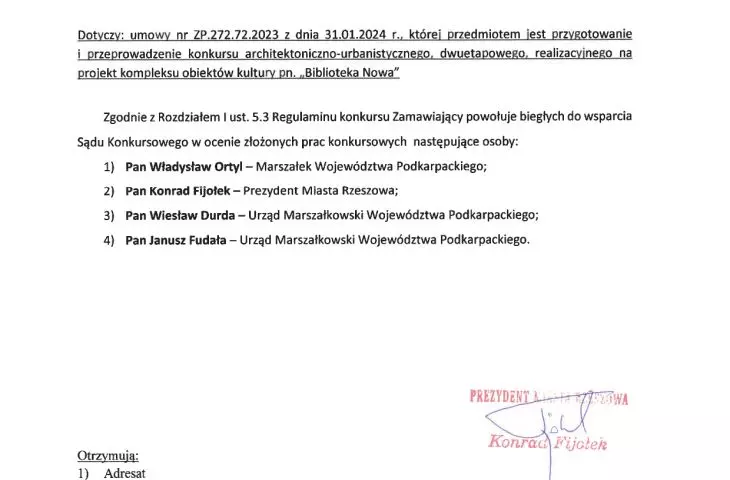
On November 12, 2025 (date of receipt November 13, 2025), the Head of the Contracting Authority (Mayor of the City of Rzeszow), in a letter (Attachment 1) addressed to SARP Rzeszow, appointed 4 experts pursuant to Section 5.3 of the Regulations: Wieslaw Ortyl - Marshal of the Podkarpackie Voivodeship, Konrad Fijolek (Mayor of the City of Rzeszow), Wieslaw Durda and Janusz Fudala (both Marshal's Office of the Podkarpackie Voivodeship).
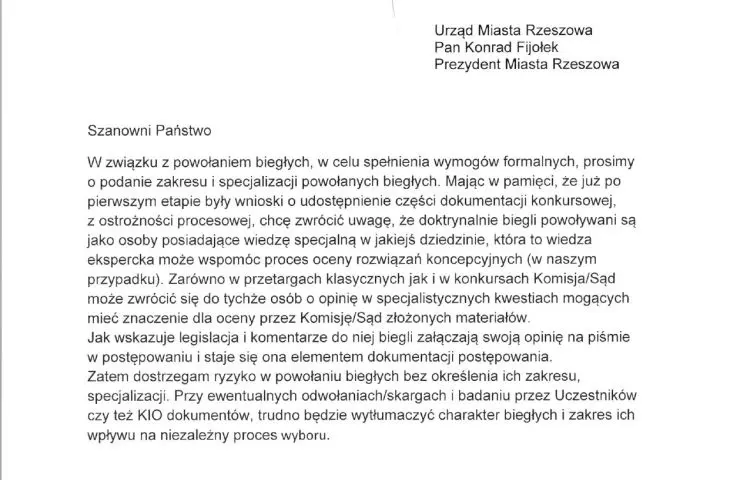
In response to the letter (Attachment 2), President of SARP Rzeszow arch. Wacław Matłok on November 14, 2025 indicated that in the practice of the work of the Competition Courts, the appointed experts should have a certain specialization of the expertise they possess, which can be used in the form of a request for an opinion by the Competition Court and such an opinion should be submitted in writing. By the time the Court began its work, the response to the request from the president of SARP Rzeszow had not been received.
At the jury deliberations on November 16, in addition to the Competition Jury, the following appeared, appointed by the Principal Manager: Konrad Fijołek, Wiesław Durda, Janusz Fudala. Expert Wieslaw Ortyl did not appear at the deliberations on November 16 or November 17. After the start of the Court's work, the Chairman of the Court, Piotr Smierzewski, asked the experts to introduce themselves and verbally state their specialties. Expert Konrad Fijołek described his specialty as "sociologist of the city," and the other experts as lawyers in the specialty of public procurement law, employed by the Marshal's Office. None of the experts provided the Jury with documents confirming their education and specialization. Nor did any of them present their credentials, a list of scientific publications or trade publications confirming their expertise.
In the course of the work, the greatest doubt of the undersigned was the presence of the Mayor of the City of Rzeszow Konrad Fijołek, who, as the Head of the Employer, appointed himself as an expert. On November 16, the expert Konrad Fijołek participated in the deliberations without speaking, and the Competition Jury did not formulate any question to him. On the following day, i.e. November 17, at 9:15 a.m. shortly after the opening of the session, expert Konrad Fijołek was the first to speak , expanding the scope of his specialization to a dual role: "sociologist of the city" and "President - Procurer". In doing so, he independently defined the scope and nature of his opinion. As the President-Commissioner, he commented on "the creation of a unique object," and as a sociologist of the city "in terms of social effect."
Expert Konrad Fijołek's opinion as President-Commissioner:
"The goal of the investment should be to create a unique facility with a new event function for the city. It is necessary to dare iconic solutions. This is to be the construction of the century of the 21st century. I feel like Lubomirski, who hires Tylman Van Gameren or Widemann. The same is true today. [My] understanding of iconicity: a building that is unique, original, which has always been a dream of Rzeszow. It's about the "Szczecin" effect, maybe not as much as the "Bilbao effect." Business card - an absolutely essential premise. Examples of such business cards are from Lublin, Szczecin, Bydgoszcz. [One must] get out of the association [of the city of Rzeszow] with the Monument.
Expert opinion of Konrad Fijołek as Sociologist of the City:
"The second aspect of the investment is the social effect, the city-forming element (replacing the shopping mall). The example of the transformation of the Rzeszow Market is positive. The investment as a cultural quarter organizing social and cultural life; social integration of culture."
In the course of his further statement of opinion, expert Konrad Fijołek began to formulate accusations against work number 03, which he described as "KURHAN". He accused the authors of this work of copying solutions from another Rzeszow competition for Garncarski Square by presenting the judges with a comparison of one visualization of work number 03 and one visualization of the winning work of the competition for Garncarski Square. Expert Konrad Fijołek stated: "I'm about to show why I can't talk about work 3 as the winner." With this, expert Konrad Fijołek stepped into a new role: an expert on the copyright of architectural works. By stating the lack of originality of the work in question, he de facto expanded the scope of his specialization as an expert for the second time.
The expert then presented his rankings of the works to the judges in the context of his two specialties, using specific nomenclature for the works:
Ranking one presented by expert Konrad Fijołek as President-Commissioner
("iconicity/coherent idea")
1st place - work No. 23 - WIR
2nd place - work No. 03 - KURHAN
3rd place - work No. 20 - TOWER
4. place - work No. 18 - WHITE GUYS
5. place - work no. 22 - LAMPION
6th place - work No. 05 - COLUMNS
Ranking two presented by expert Konrad Fijołek as a sociologist of the city ("to encourage social
interaction")
1st place - work No. 18 - WHITE GUIDES
2nd place - work No. 23 - WIR
3. place - work No. 22 - LAMPION
4. place - work No. 20 - TOWER
5. place - work no. 05 - COLUMNS
6. place - work No. 03 - KURHAN
It is significant that the expert Konrad Fijołek only gave work 03 a term with negative connotations of meaning; a barrow is a type of grave.
The expert's further statement about Job 03 read:
"I showed this project [work 03 - "barrow"] to a certain person - I can't say who it was - and this person said that this building looks like the National Bank of Poland."
By citing the opinion of a third party, expert Konrad Fijołek thus confirmed that he had violated the secrecy of the competition procedure, which requires absolute observance of the principle of confidentiality of entrusted materials; he made the competition material available to a third party for the purpose of seeking his opinionfor the purpose of seeking his opinion, and then presented it to sixteen people - the full jury (11 people), the reserve judge, the experts he appointed (2 people) and the Competition Secretariat (2 people).
Summarizing this part of the dissenting opinion, it should be stated that strong objections are raised to:
1. the non-transparent mode and manner of appointment of experts by the Head of the Contracting Authority just before the Competition Jury meeting (November 13, Thursday,) 3 days before the Jury meeting (November 16, Sunday), without providing any justification (see Appendix 1), thus putting the Competition Jury before the fact.
2. failure to respond in writing to the letter of the president of SARP Rzeszow arch. Waclaw Matlok, in which he postulated a precise definition of the scope of experts' specialization (Attachment 2).
3. unclear range of expert specializations, which were presented orally at the court session, without being in writing. These specializations were given by the experts themselves, and not by the person who appointed them. Attention is drawn to the lack of presentation of documents confirming the education and range of expertise of the experts, giving them credibility before the Court. Also, the appointment by the Employer of Marshal Władysław Ortyl and two employees subordinate to the Marshal as experts is perceived as an
an additional attempt to control the course of the deliberations, by providing the Employer with a numerical advantage among those participating in the jury session and exerting pressure on the judges during the deliberations.
4. the change extending the scope of expert Konrad Fijołek's specialization from "sociologist of the city" on the first day of the session to "sociologist of the city" and "President-Orderer" on the second day of the jury session, without specifying exactly what these words are supposed to mean in terms of the scope of the expert's specialization and the range of opinions presented by him.
5. the appearance of Konrad Fijołek in a dual role: as an expert and as the Head of the Procuring Entity able (in his opinion) to establish himself as an expert, which allowed him (in his opinion) to participate in the entire jury session, not only in the presentation of his opinion. In our opinion, the unlimited presence of the President was intended to put pressure on the decisions of the Court, composed in part of subordinate employees.
6. the presentation by expert Konrad Fijołek of his rankings, which in our opinion served to put pressure on the panel of judges.
7. assigning value terms to individual works by expert Konrad Fijołek, which in our opinion was negatively suggestive in the context of work No. 03. In addition, the expert suggested plagiarism in work No. 03, which was intended to discredit it in the eyes of the judges. It should be considered that such a claim was not true. Moreover, it was formulated by a person who is not sufficiently qualified in the field in question.
8. free, ad hoc interpretation of his expert specialty by expert Konrad Fijołek, who, depending on the situation, spoke as an expert in "sociology of the city", as an investor "President-Orderer", as an expert in copyright, as an architectural critic and theorist, and ultimately de facto - as a member of the Competition Jury.
9 Violation of the secrecy of the competition proceedings by expert Konrad Fijołek. It should be emphasized that this secrecy is regulated by the Public Procurement Law. The Act places particular emphasis on the secrecy and confidentiality of the materials entrusted to the Judges,and experts and secretaries of the competitions, especially in situations that could lead to a violation of the principle of anonymity, by making the competition materials available to third parties.
10. lack of expediency in the appointment of experts. No formal task was given to the experts prior to the jury meeting. The opinions delivered during the court session, by expert Konrad Fijołek, were free statements and did not take written form and were not submitted for the record. At the same time, it should be noted that the "ranking of works" given by expert Konrad Fijołek was recorded at the request of Judge Jakub Krzysztofik. It is significant that at the request of Judge Krzysztofik, Judge Dariusz Urbanik responded with the words: "What are you suggesting?" To this, Judge Jakub Krzysztofik replied , "I am not suggesting anything, I care about the consistency of the minutes with the actual situation that took place at the Court session."
In the context of expert Konrad Fijołek's statements from the course of the ensuing discussion, several statements are worthy of note. Judge Artur Jasinski summarized the statement of expert Konrad Fijołek as follows: : "That is, Mr. President sets his sights on an ambitious project," and after a while: "It is excellent that Mr. President spoke up and declared that the authority is not afraid of bold solutions. This helped me a lot in my decision-making," and later, "If the President had not declared himself then I would have been afraid to choose such a job."
In turn, Judge Wojciech Falat commented on the situation: "The President's opinions are devastating to the objectivity of the Competition," to which Judge Wojciech Malecki responded: "Let's talk about the works not the President." In the ensuing discussion, Judge Leslaw Majkut made a scathing statement to the undersigned , "The opinion of the Ordering Party must be respected, because ultimately it is he who builds!"
Judge Jakub Krzysztofik called for an objective, substantive discussion, reminding Judge Leslaw Majkut that the sovereign in the municipality of Rzeszow is the residents, while the mandate received by the mayor from the residents in the elections does not entitle him to force any decision on the independent Competition Court. Recognizing that the opinions and rankings of expert Konrad Fijołek could affect the impartiality and objectivity of some judges, he filed a formal motion for a secret ballot. After two votes, the motion did not receive a majority. It was rejected mainly by the votes of representatives of the City Council and the Marshal's Office
After a series of open votes, the 3 final entries (coded numbers 03, 05, 23) were selected and the order of awards had to be determined. Judge Majkut called for an immediate vote. Also Judge Dariusz Urbanik supported him, saying that every judge had dug in anyway and there was no point in discussing.
Judge Jakub Krzysztofik resisted and asked to speak in the discussion and recounted the more important provisions from the competition guidelines with particular emphasis on inclusiveness, accessibility and other provisions that apply to judges in evaluating competition entries, and then presented a comprehensive evaluation of each entry in terms of compliance with the Employer's guidelines. He then evaluated the compositional aspects of each of the 3 final works in relation to the theory of contemporary architecture, formulating the advantages and disadvantages of each.
The atmosphere at the deliberations of the Competition Jury is well illustrated by the comments of Judge Katarzyna Solek - a representative of the Marshal's Office, who interrupted Judge Jakub Krzysztofik's statement on Job 03 by interjecting her opinion: "This is a bunker!". Judge Jakub Krzysztofik pointed out that such remarks (she had previously commented by interrupting another judge's assessment of Job 03: "it's ugly!") lower the level of the discussion and contribute nothing to the merits of the case for that they are calculated to lower the value of his statement and throw him off balance. Concluding his statement, he also stated that Judge Katarzyna Solek's rude comments, combined with Judge Dariusz Urbanek's statement about "not supporting the Ordering Party" and expert Konrad Fijołek's dictation of his ranking with the order of the works, have caused him to feel great psychological discomfort for two days and to have a very bad feeling as a result of the Ordering Party's pressure.
Judge Jakub Krzysztofik briefly recounted his activities and scope of work on the Competition, as well as his experience and achievements as serving the Contracting Authority in the best settlement of the Competition, refuting Dariusz Urbanik's accusation of "not supporting the Contracting Authority." Judge Wojciech Fałat supported Judge Jakub Krzysztofik, saying that the judge's job is not to support the Contracting Authority, in particular not to vote as he wishes, but to objectively evaluate the works. In conclusion, Judge Jakub Krzysztofik asked the Court not to take into account the ranking and opinion of expert Konrad Fijołek when evaluating the works, appealing to the conscience of the judges to be guided only by merit in the final evaluation of the works in terms of compliance with the Regulations and guidelines of the Competition. Judge Wieslaw Majkut stated that he was "surprised by Judge Krzysztoffik's complaints about his well-being," with which he felt that Judge Krzysztoffik deepened the pressure exerted on him.
Summing up this part of the dissenting opinion, we strongly object to:
1. a number of opinions and statements made by expert Konrad Fijołek, including dictating his types to the Court, had an impact on the objectivity and impartiality of some judges. The statements of judges Artur Jasinski (3 in total) and Ryszard Majkut evidently testify, the opinions of the expert-President-Orderer and Ordering Manager in one person Konrad Fijołek were taken into account by at least some judges in formulating their assessments of the competition works and in the open voting, the result of which is documented in the minutes.
2 The lack of secrecy in the voting in light of the facts described above had a significant impact on the judges' decision-making during the voting and on their making independent objective judgments, statements and opinions.
3. the behavior and statements of some judges and experts caused a significant reduction in the comfort of the others. The situations described above, and unacceptable in the opinion of the undersigned, were continuous and affected the mental well-being of those participating in the deliberations. The deliberations were in the nature of confrontation instead of
substantive selection of the best work.
We believe that the basis of an architectural competition should be a fair procedure based on an honest substantive evaluation, aimed at selecting the best design that serves the public good, meets the competition guidelines, but is also feasible in construction and economically justified. Our position is that the competition procedure was violated and the circumstances of the selection of the works were non-transparent. The situations of violation of the competition procedure described above, the exertion of constant pressure and the lack of transparency in the proceedings affected the impartiality of the judges, the autonomy of their decisions and their mental condition throughout the jury session.
arch. Piotr Smierzewski (chairman of the jury)
arch. Cezary Szpytma (referee)
arch. Wojciech Fałat (judge)
arch. Jakub Krzysztofik (referee)
Attachment 1 - Letter on the appointment of an expert by the Contracting Authority dated 12.11.2025. :
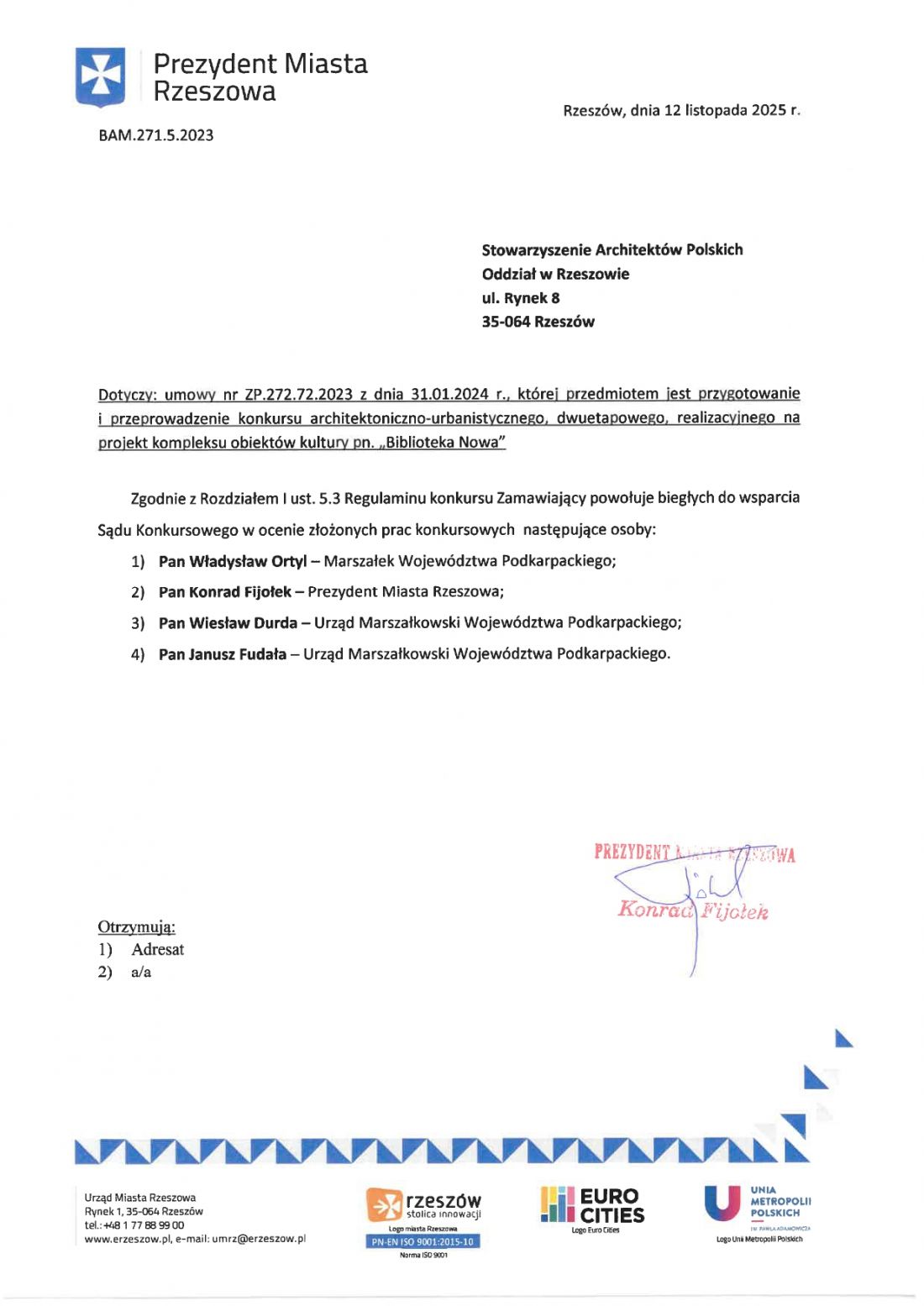
Letter on the appointment of an expert by the Contracting Authority dated 12.11.2025. - Attachment 1
Attachment 2 - Letter from the President of SARP Rzeszów dated 14.11.2025. :
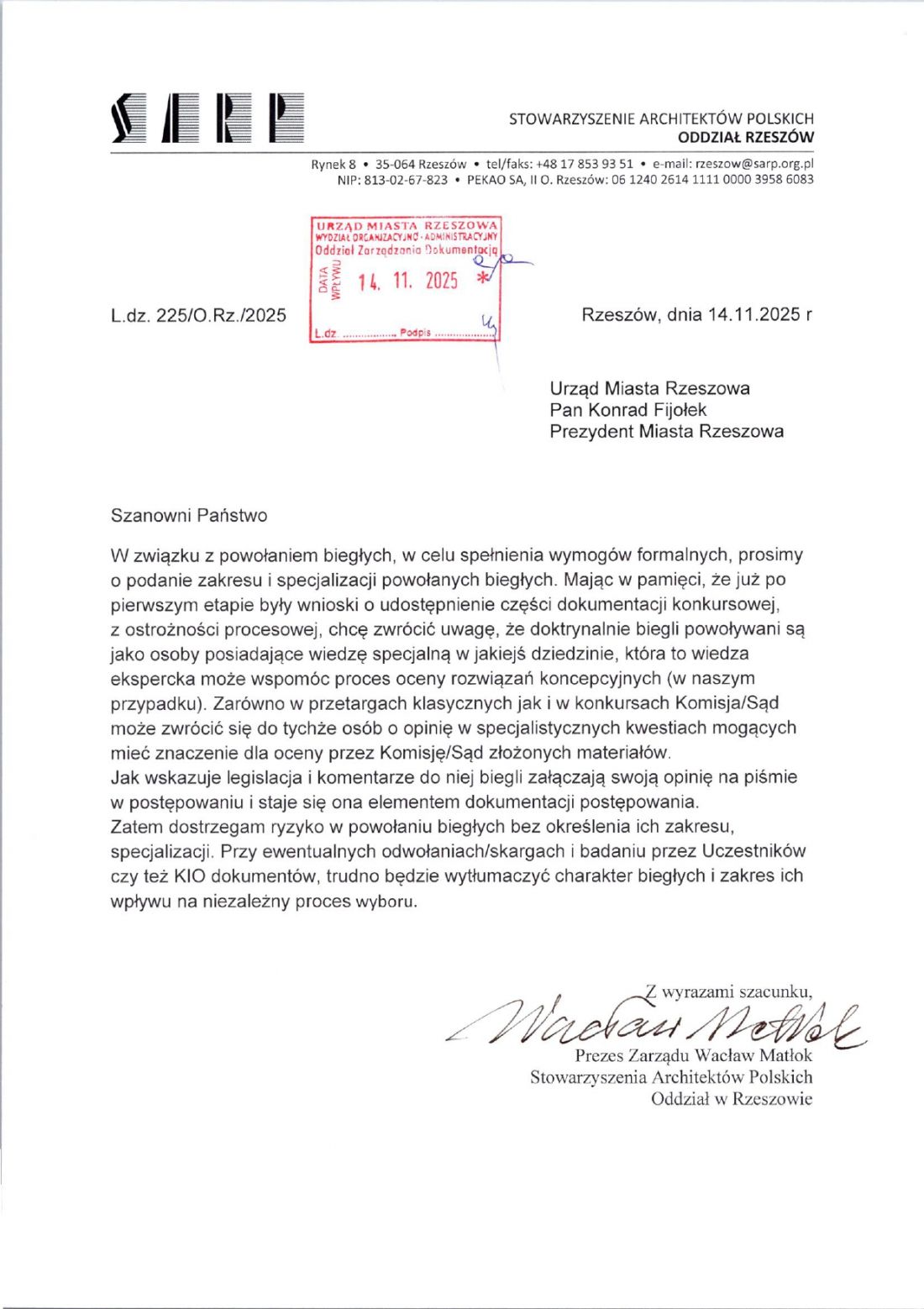
SARP's response to the Contracting Authority's letter of November 14 - Attachment 2