



Although the Venice Architecture Biennale 2025 was meant to be a space for discussing the future and inclusivity, many visitors left with a sense of confusion and fatigue. The loud openings, lack of quiet spaces and overload of content showed that sensory accessibility is still not talked about enough - including in the design world.
I can't say much about this year's Venice Biennale. Why? Although I saw most of the pavilions and exhibitions, I found it difficult to find my way around this overstimulated world without an inch of space for respite. My impression of the individual pavilions just blurred. It turns out that I wasn't the only one with a similar impression.
Much of the Architecture Biennale 2025 is located in the Giardini - the garden area of Venice, where the individual pavilions are arranged among greenery. In theory, this sounds like an ideal space for quietly contemplating the exhibitions, but in practice - especially on the opening days - loud conversations, bustle and heavy traffic of people were present almost everywhere. Even after the first quarter of an hour, I felt overwhelmed - not so much by the content, but by the form of its delivery. It was difficult to find any moment of silence.
Overstimulated Biennale: too much of everything
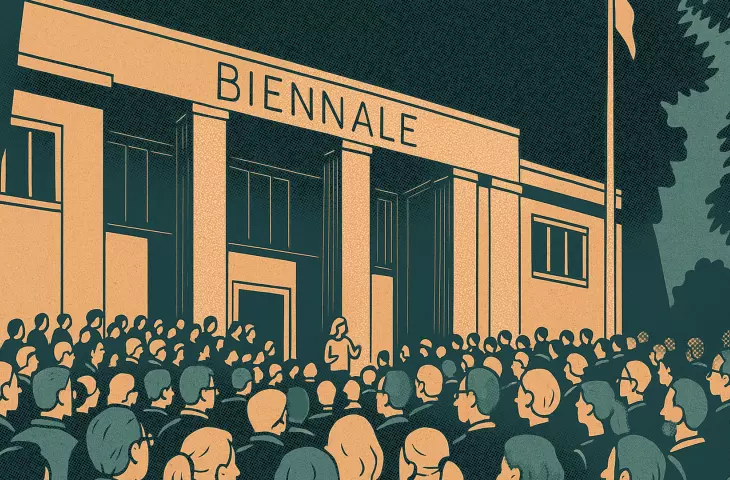
The common spaces became the place where crowds gathered for the inauguration of the next pavilions. The openings were often accompanied by officials - ministers of culture, ambassadors, government delegations - and with them also came the betting and organizational chaos. In many cases, alcohol was served in large quantities, often as part of official cocktails. This kind of atmosphere was more like a social banquet than a space conducive to reflecting on ideas. The impression of crowding, squeezing and confusion grew with each passing hour. The pavilions themselves could hardly have been more peaceful - each attracted groups of visitors, and it took almost superhuman effort tofocus on the exhibition or read the descriptions accompanying the main ideas of the exhibition.
Even at those moments when you found yourself in a less-visited pavilion, basic warning information was lacking. Signage regarding flashing lights or intense sounds was virtually nonexistent - appearing in maybe one, top two places. This is not just an oversight - it's a real danger, not only for neuroatypical people, but also for visitors with epilepsy or sensory sensitivities. In a space of such scale and stature as the Architecture Biennale, where there is talk of inclusivity, social change and responsible design, the lack of such basic precautions and empathy is simply alarming.
After the first day, when asked which pavilion I liked best, I was unable to say anything meaningful. Everything blended together in one multicolored, noisy miasma for me. It's a shame, because, after all, it's the ideas we should be talking about here - this is the Architecture Biennale, where each country tries to tell its story, its way of thinking about space, crises, the future. Unfortunately, it was almost impossible to contemplate in such an environment.
You can accuse me here of setting exorbitant conditions, an idea such as this cannot be achieved at such a large event (it can, but about that in a moment). The scale of this experience is difficult to describe other than as overwhelming. This year's edition of the Architecture Biennale attracted as many as 760 participants, or, as Oliver Wainwright noted in his review of the Biennale 2025 for The Guardian, many times more than in previous years. More does not always mean better. The visitor simply gets an endless stream of content, installations, screens and texts to digest.
Overload as a bodily experience
What in theory was supposed to be an exploration of different kinds of intelligence - natural, artificial and collective - has in practice turned into an "impossible task." As Wainwright calculated, even spending two full days on the main exhibition alone (at the Arsenal, as I wrote about when discussing the valley of the uncanny in architecture), a visitor would have only 72 seconds for each project. Then there are the national pavilions - hundreds more projects and ideas that are difficult to even notice, let alone understand, under such conditions.
The feeling of confusion and fatigue probably accompanied not only me and Wainwright. "It's like trying to complete the Internet - and it's not pleasant," Wainwright wrote, and it's hard to disagree. The biennial doesn't guide, doesn't narrate, doesn't direct - it floods the viewer from all sides, often with no clear structure, no respite. "The viewer is confronted with an intimidating volume of content, with no clear direction". - reads the review. And indeed: the Biennale 2025 was more like a chaotic, academic-technological marketplace of ideas than an exhibition about architecture understood as a space for humans.
An assault on the senses - a physical and emotional experience
While the crowd and lack of space were difficult to deal with, I found the exhibition itself to be the biggest challenge. The spaces of the Biennale, especially in the Arsenal, were saturated with screens, projections, flashing lights and layers of sounds - some looped, others played simultaneously. The impression of complete overload applied not only to the content, but also to the physical experience of being in this exhibition. There was a literal horror vacui - a fear of emptiness that manifested itself in every free wall filled with text, every nook and cranny where another object or screen was set up.
Arsenale 2025 - the main exhibition space - is an example of how to discourage exhibitions. Simultaneously displayed animations, robotic installations, algorithms trying to speak to the visitor - all this created the impression of a scientific fest on steroids. There was no room to stop, to quietly read the text or listen to the message. Objects often competed with each other for attention, as if each was trying to shout: look at me now!
This was not just an exposition - it was a physical confrontation that at times resembled an experiment on the visitor. Intense projections or simulations were let loose in the dark rooms, which could not be predicted. There was a lack of even a single marked rest area, where one could sit and calm down without being exposed to another portion of sound, light or text. Meanwhile, noise - both acoustic and visual - is one of the increasingly loudly commented environmental problems. It is talked about almost as often as overstimulation with screens, smartphones, and an overabundance of information that stresses the nervous system and interferes with the ability to concentrate. In such a context, creating at least one buffer zone - completely quiet, peaceful, devoid of stimuli - in the middle of this exhibition could become not only an act of care for the viewer, but also a place for real reflection on the modern and future world. It is there that the architecture that is silent - but speaks the most - could resound. The Biennale continues to be well-intentioned, overproduced and lacking in self-reflection.
I didn't just find the experience exhausting - it triggered a "fight or flight" reaction. For a long time I tried to defend myself: I tried to concentrate, to ignore the onslaught of stimuli, to look for meaning among the sounds and lights that attacked me from all sides. I fought against overstimulation and against the growing tension in my body. But in the end, I couldn't stand it. I ran away. I literally took a quick step across the hall, without reading a single caption or looking at the exhibits. I felt that a boundary had been crossed - not aesthetically, but physically and emotionally. An exhibition that was supposed to inspire and raise questions about the future of architecture forced me to turn away.
And it was then that I became most acutely aware of the paradox of the situation - an event that professes inclusivity, openness and sensitivity to the challenges of the present day, leaves no room for the basic need for peace of mind. In the design world today, we talk a lot about accessibility, about concern for the user, about diversity of sensibilities. Meanwhile, in the Biennale 2025, these ideas have completely blurred.
Attempts at rescue - is anyone listening?
The impression that the Biennale needs to survive rather than survive seems to grow stronger every year. So much so that Dutch magazine Volume created an ironic "survival app " for this year's edition - a tool to help visitors wade through the chaos of the exhibition, explaining incomprehensible descriptions and offering a personalized tour. The diagnosis could hardly be clearer: instead of an in-depth reception, we need support in embracing the hustle and bustle.
View this post on Instagram
However, this is not a new problem. Back in 2023, Lesley Lokko - attempted to change the tone of the event. Her exhibition, "The Laboratory of the Future," was to be less "festival-like," quieter, more focused on narrative and identity. While the theme was met with acclaim, the form itself again failed. Too many projects, too much stimulus, not enough air. Lokko was criticized for being "over-worked," which hindered reception.
It is surprising that despite these repeated experiences, there is still no design of withdrawal spaces, quiet zones or even rest areas with limited stimuli. In an era when inclusivity and neurodiversity are talked about as important aspects of design, the Biennale doesn't seem to hear it. What's missing is not just awareness, but simple care - for those with sensory hypersensitivity, for those who need a break, for anyone who doesn't want to walk through an exhibition like a battlefield.
All the more reason to remember that architectural and design exhibitions in other parts of the world have been testing solutions based on sensory empathy for several years now. Some of them even took place as part of the Venice Biennale - only not in the mainstream, but as side events or grassroots initiatives.
In 2021, architect Magda Mostafa presented the exhibition Autistic Imaginaries of Architectural Space in Venice, showing space from the perspective of neuroatypical people. Two years later, in 2023, Palazzo Mora hosted the exhibition A Case for Sensory Decolonization: Autistic Escape, designed as a physical story of sensory overload and escape. In one part, visitors experienced an overstimulated city, while in another they could enter an "EscapeScape" - a cocoon-like zone of silence. The whole show demonstrated the importance of withdrawal spaces in the design of modern cities.
In 2025, the theme is being developed further in a companion exhibition to Time Space Existence. Global design firm DLR Group will present the installation "Tactile," created for visitors with sensory hypersensitivity. The exhibit at Palazzo Bembo is divided into an active area - with soft tactile forms - and a calming zone with soft cocoon-like structures that limit visual and acoustic stimuli. The design is based on consultations with people on the autism spectrum and therapists.
View this post on Instagram
On a much larger scale, these solutions were introduced at Expo 2020 in Dubai. While there may be many comments and ethical concerns about the event itself (as well as the city), the event went down in history as the world's first sensoryaccessibility-certified exhibition. Four special quiet rooms equipped with relaxation areas, armchairs, sensory cushions and subdued lighting were organized throughout the event. In addition, each pavilion was rated for the impact of sound, light and congestion, and visitors could plan their routes with easy-to-read sensory guides.
A similar model is already being prepared for Expo 2025 in Osaka, which has announced a plan to deploy eleven quiet zones throughout the event[1].
An interesting example also comes from an earlier event: London Design Biennale 2018, which featured The Silent Room, an installation created by Lebanese designer Nathalie Harb. A sound-absorbing blue pavilion was set up, which offered anyone who wanted a place of total silence. As the curators emphasized, the project was meant to "make silence and rest available to all citizens - regardless of status or neurotypicality."
Silence as a duty, not a privilege
Against this background, it is clear how much the Venice Architecture Biennale needs a change. Not only in content, but also in the way it treats the viewer - his body, his senses, his needs. We already have experience that has shown that it is possible to design an exhibition experience based on attentiveness and sensory accessibility.
If the main part of the Biennale 2025 looked like a technological show of force, whose "fever dream from Silicon Valley" resembled a gadget festival rather than a conversation about the future of space, it's hard to talk about reflection and vision for the future. Architecture that does not give space to relax ceases to be for the people.
An event that wants to shape visions of cities must take into account the diversity of the audience - not only in the narrative, but also in the physical experience of the exhibition. The Biennale cannot remain a place where audiences leave more tired than moved, as C41 Magazine rightly noted.
If we are to talk about architecture as a tool for change, the first change should be how we show it.
Magdalena Milert
[1] There are to be 11 rooms in eight locations, including Accessibility Centers, service facilities and rest areas, and one location in Yumeshima Accessible Parking.