





The CVII (107) Open Discussion Forum of Urban Planners of the Cracow branch of the Society of Polish Urban Planners, combined with the Scientific Symposium of the Department of Spatial Planning, Urban and Rural Design (A-5) of the Faculty of Architecture at the Cracow University of Technology, was held on May 21, 2025. The topic of the meeting was "Coordination of spatial policy after urban planning reform." The forum was held online, with the Krakow branch adopting this form of meeting once a quarter, in response to requests from other TUP branches and the desire of people from all over Poland to participate in the events.
Two introductory speeches were prepared for the meeting. The first topic was delivered by Marcela Łasocha entitled. "Mutual correlation of municipal documents: strategy, general plan and local plan". The president of the Krakow branch of TUP presented what the current system of spatial planning looks like, along with the statutory requirements for the municipality's general plan (POG). He stressed the necessity, enshrined in the Law on Spatial Planning and Development, to take the strategy into account when drawing up the general plan and local plans, as well as the need for the local plan to be consistent with the general plan.
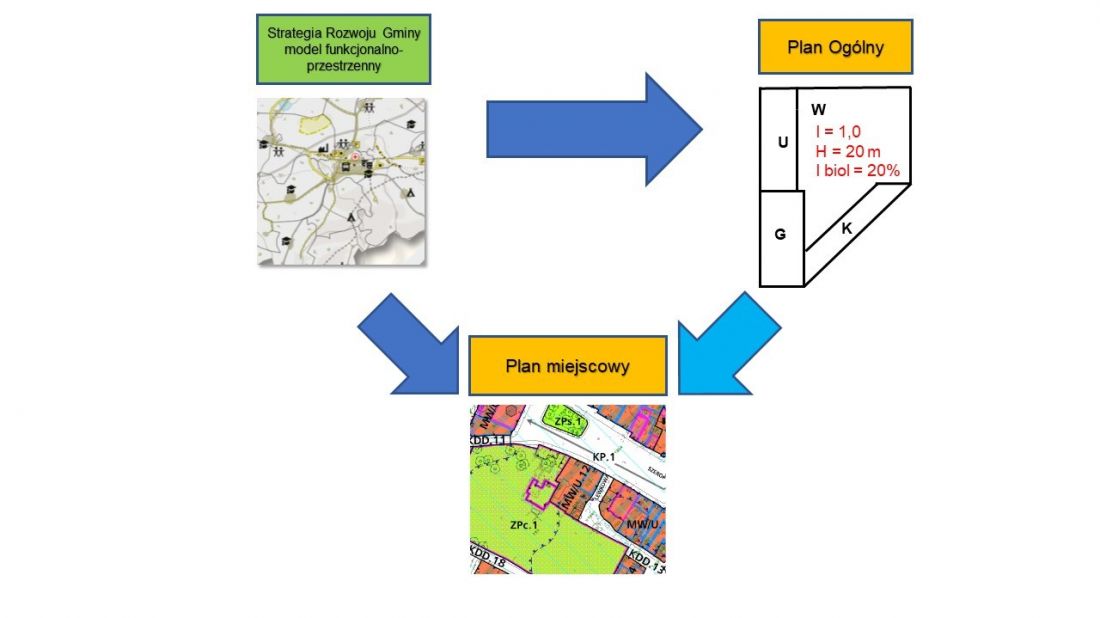
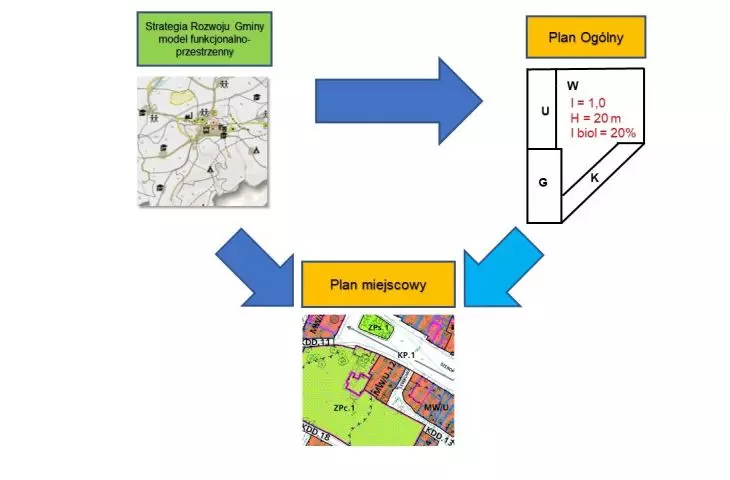
Diagram of the relationship between the municipality's development strategy, the general plan and the local plan - the arrows in blue indicate "consideration", the arrow in celadon "conformity"
© TUP Krakow Branch
As part of his speech, he pointed out that despite the very generality of the new tool, which is the general plan (which divides the entire area of Poland into planning zones and assigns development indicators to these zones), from the level of the municipality, with proper coordination of the general plan with the strategy, it is possible to plan space well, but this is possible on the condition that new municipal development strategies are consciously drawn up. It is worth recalling here that since 2020, development strategies have included a model of the functional and spatial structure, and in 2023, when introducing a new tool called the general plan, the legislator specified that the model is to include directional arrangements, which were previously defined in the municipal study (study of conditions and directions of spatial development).
The models include: the structure of the settlement network with the role and hierarchy of settlement units, the system of natural connections, the main corridors and elements of transportation networks, including pedestrian and bicycle networks(it should be noted here how much detail the legislator obliges municipalities to provide - up to bicycle paths, while studies only showed larger transportation corridors), and the main elements of technical and social infrastructure. In addition, the strategy will include the findings and recommendations resulting from the model for shaping and carrying out spatial policy for the above issues, as well as topics such as: the principles of protection of cultural heritage and monuments, and modern cultural assets (especially important for historic cities, including Krakow), the directions of changes in the structure of land use, including the determination of specific needs for new residential development, and many others, designated in Article 10 e (3) (5) of the Law on Municipal Self-Government. Failure to take the strategy document into account in spatial planning will lead to a situation where planners drafting local plans, despite the necessary compatibility with the general plan, will not have comprehensive spatial guidelines covering the entire municipality to implement in individual local plans. Such a situation could lead to the conflicts that have so far occurred at the borders of municipalities - i.e. uncoordinated and inconsistent spatial solutions, where, for example, a protected view in one municipality is designated for development and obscured in another.
The second presentation was a paper by Paulina Liszka entitled. "Formal-legal conditions for coordination of municipal planning documents with the logic of the planning record". At the outset, she referred to the model already discussed, pointing out the lack of existence of a legal and dictionary definition of the functional-spatial structure model, presenting a proposal of her own, based on the professional vocabulary.
According to the speaker, a definition of the model can help in its comprehension and serve to translate it so that it is better understood by the recipient, while it would be superfluous to define it in laws, since it is a concept in the field of urban planning and (like many others) does not require legal definition. The legislator, without defining the model, assumed that it is a "target arrangement of the components of the space" and listed the basic four elements (mentioned in a statement earlier, in the post of Article 10e of the u.s.g.).
The task of the model is to link the vision, strategic goals and ways to achieve them with the spatial conditions and directions of spatial policy pursued by the municipality. Since the adoption of the reform, the development strategy with a spatial component (the model together with the directional provisions on space) has become a municipality's spatial development programming act of an intentional and planning nature. The strategy should contain textual arrangements in the form of provisions with different levels of softness, characterized by specialized urban planning terminology based on the common rules of the Polish language, including professional and technical language.
An important point of the speech was the analysis of the possibility of creating spatial order through an indicative general plan document, which does not give the opportunity for conscious design thought and urban planning knowledge to move on, to tools that are: local plans, local revitalization plans, integrated investment plans, and then be implemented in space. The speaker shared her thoughts, posing the question of how to "transfer" spatial order from the strategy to local plans through the master plan, noting the issue of formal and linguistic translation of all documents. In order to create such a relationship between the two, it is necessary to study the translatability of urban languages, taking into account the hierarchy of planning documents and the conditions assigned to them by law: "shall be taken into account," "shall be designated," or "in accordance with" (with "by compliance is meant...") - but this is not enough. Spatial policy should primarily use the principles of spatial planning (also recognized as principles of planning law), including continuity, consistency and spatial order - the latter of which has (along with sustainable development) a primary rank as a statutory principle of spatial planning. In turn, the principles of continuity and coherence exist in Polish legal doctrine as certain accompanying planning ideas that have not been specified (in a normative way), but have such a strong axiological justification and such an important significance that they can claim to be "principles of spatial planning" (The manifestations of the ideas of coherence and continuity in the basic planning acts are the content, form and manner of the development procedure, as well as the relationship between these acts [related documents: strategy, general plan and local plans]).
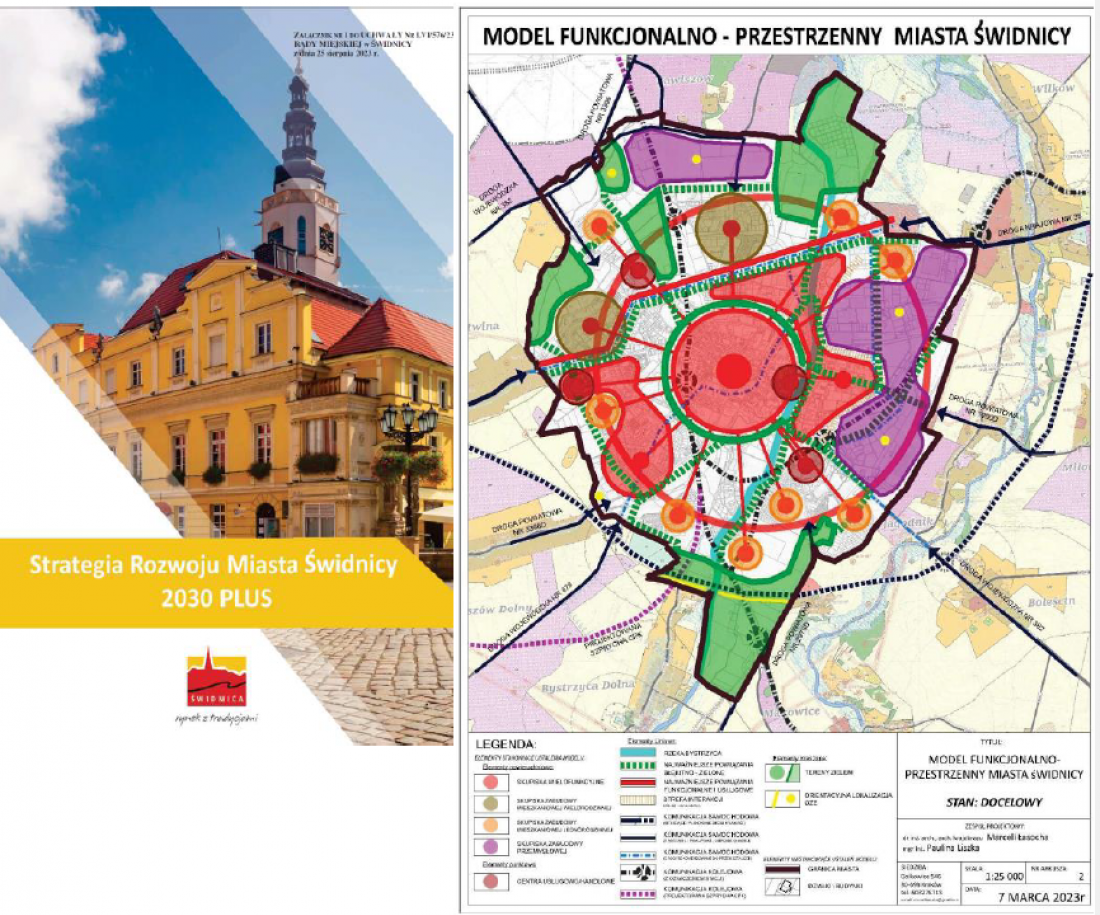
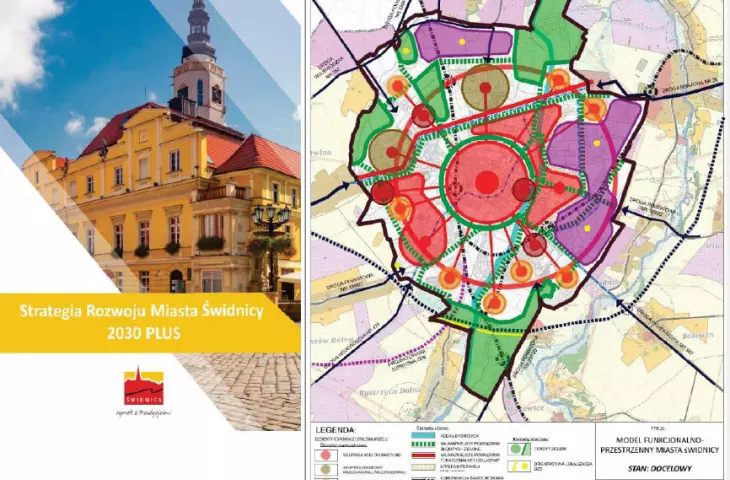
model of functional and spatial structure for the city of Świdnica based on the provisions introduced by the amended Law on Planning and Spatial Development - the model was adopted in 2023, the authors of the model are urban planners: Marcela Łasocha, Paulina Liszka
© TUP Krakow Branch
The difficulty in terms of linguistic translation of the provisions of the strategy (which has a graphic and textual form) through the master plan (a conceptual model described through the language of the conceptual scheme) into local plans appears to be one of the biggest challenges of the current system. Without clear principles and rules, the quality of local plans will diminish, and they will be reduced to a simple assignment of land uses, and even if there is an interesting designer's vision, the idea of coherence and continuity will probably not be preserved.
The speech went on to discuss the statutory regulations, in particular the transitional provisions and the resulting important deadlines for the strategy to proceed in order to be included in the master plan. Currently, it is not possible to include the functional and spatial structure model in the general plan, even if the existing strategy includes the model, because in terms of the regulations it is an "old strategy," and these are not included in the general plan. Only from January 1, 2026 (when municipalities will be obliged to develop a municipal development strategy with a model) will the obligation to include strategies in the general plan and local plans also apply to older strategies that are completely incompatible with current needs, which will bring further consequences, such as inconsistencies in spatial policy and planning documents.
Unlike provincial strategies, for which the legislator has introduced a transitional provision allowing the possibility of updating (adapting) the existing strategy to the new requirements (including the model of the functional and spatial structure of the province), until December 31, 2025 at the most, on pain of losing the validity of the provincial strategy (Article 31(1) of the Act of July 15, 2020 amending the Act on the principles of development policy and certain other acts), for municipal strategies no similar provisions have been specified on adapting the strategy and supplementing the part on spatial policy. In view of this, in order for the municipal development strategy to be included in the general plan of the municipality, and therefore for there to be a strong relationship between these documents, a new strategy must be developed. In order for the municipal development strategy to have the value of a document that is hierarchically and content-wise and content-wise related to the municipal general plan, its preparation should be commenced after September 24, 2023.
As part of the summary , postulates were presented to the draft amendment to the Spatial Planning Act, submitted by the Cracow branch of the Society of Polish Town Planners, in which a proposal was made that it should be the urban planners who compulsorily prepare the planning part - Model in the municipal development strategy (since it is the urban planners who have so far prepared studies, in which spatial policy directions were determined, and now their place is in the strategy, it is the urban planners with the appropriate qualifications who should obligatorily perform models of the functional and spatial structure [also on the basis of the acquired rights - the authority to draw up directions for spatial development of the municipality specified in Art. 5 of the Law on Spatial Planning and Development]. The lack of such regulation and response to the problem by the legislator weakens the planning system in the country and does not promote the creation of spatial order - as the urban planners of Krakow warned against already in 2022).
discussion
The following topics resounded in the discussion after the speeches:
Grzegorz Buczek (member of TUP o. Warsaw) expressed optimism about the presented approach and interpretation of the regulations with a number of reservations about the actual use of these tools. He stressed the value of using the principle of spatial order and raising this issue in the national debate. This is especially important for urban planners who want to use vague regulations to develop the best possible planning documents and clean up our cities. He also drew attention to the definition of public space, which the legislature removed from the Planning Law, and acknowledged that there is clear talk in the urban planning community about the demise of legislative technique.
Sebastian Pietrzyk (WSA judge) emphasized the essence of the provision defining the compatibility of the local plan with the general plan, differentiating this relationship in the case of the Strategy, which must be "included" in the general plan and the local plan.
Jacek Banduła (TUP o. Kraków) expressed concern about the designation of multifunctional zones in the general plan according to the wording of the provision specifying the order of designation of zones.
Prof. Barbara Bartkowicz (TUP o. Krakow) considered where in the new system there is room to indicate the tools for implementing the findings of the spatial policy, and what these tools could be so that the strategy is consistently implemented.
In response, Paulina Liszka pointed to Article 10e(3)(8), which says that the strategy shall specify a system for implementing the strategy, including guidelines for drafting implementation documents. (Within the framework of the guidelines, one can try to point to the necessity of drawing up in selected areas of the municipality: local plans, a local revitalization plan with indications for the municipal revitalization program regarding the revitalization area, integrated investment plans, as well as other tools that can contribute to the implementation of the directions of spatial policy set out in the strategy, while effectiveness will only be ensured by a strong link between the strategy and other local acts).
summary
Both speeches presented the speakers' recommended approach to the current planning system, in which responsible formation of spatial policy through coordination of all strategic-planning documents can bring positive results for space and complementarily regulate space. For the majority of municipalities in Poland, it would be advisable to develop a development strategy document in accordance with the formal-legal requirements of this document, established on the basis of the assumptions of the planning reform of 2023 (taking into account subsequent amendments), followed by or at the same time a general plan, and finally updating or drawing up local plans.
The meeting ended with a noted demand that the topic be taken up more widely, as relevant to those involved in urban planning and spatial planning.
During the forum, the important questions posed before the forum were answered:
- How to incorporate the goals, model and findings of spatial policy-making contained in the strategy into the master plan?
- How to develop the strategy so that the planning solutions adopted in it are taken into account in local plans?
- When is it possible to build strong links between: the strategy, the general plan and the local plan?
Marceli Łasocha
President of the Krakow branch of TUP, Employee of WA PK, Deputy Director of the Urban Planning Department of the City of Krakow for the General Plan
Paulina LISZKA
Member of the Board of the Krakow Branch of TUP, PhD student of WA PK, Employee of the Department of Urban Planning of the City of Krakow.