




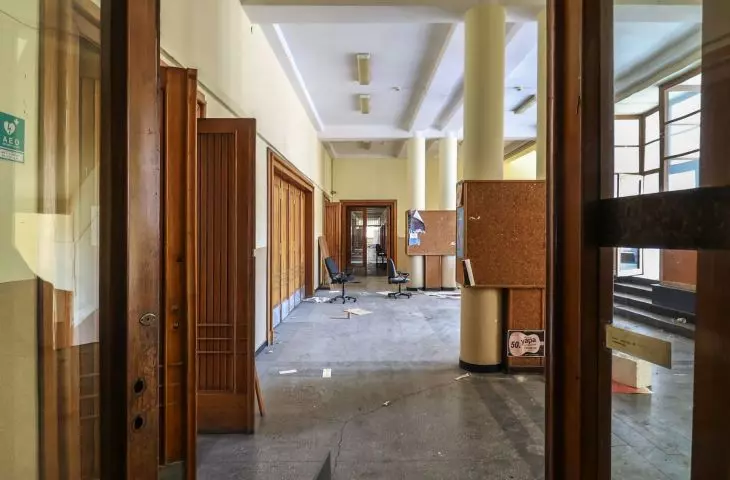
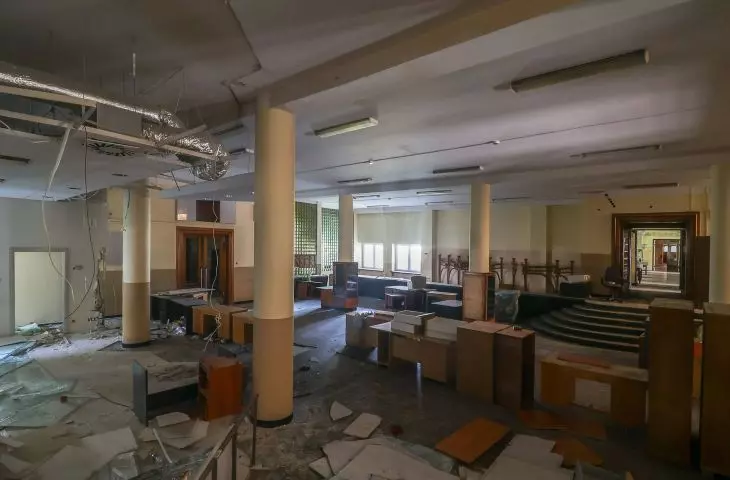
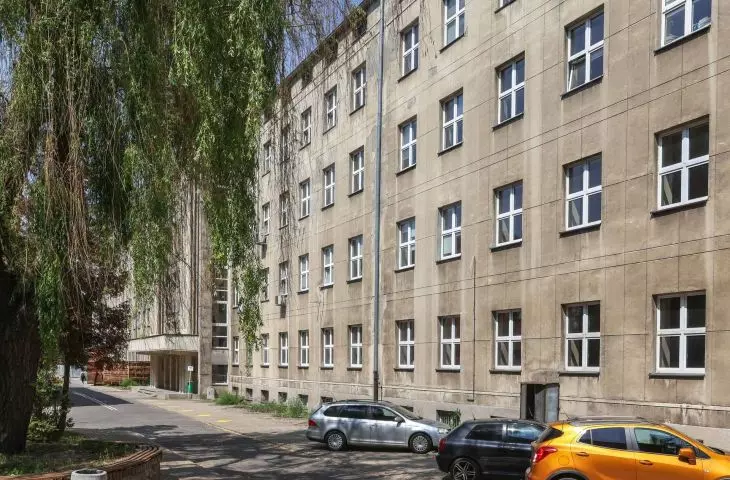
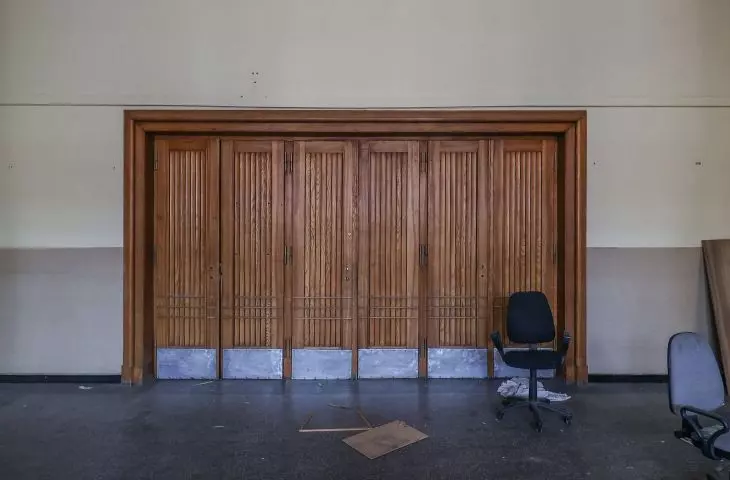
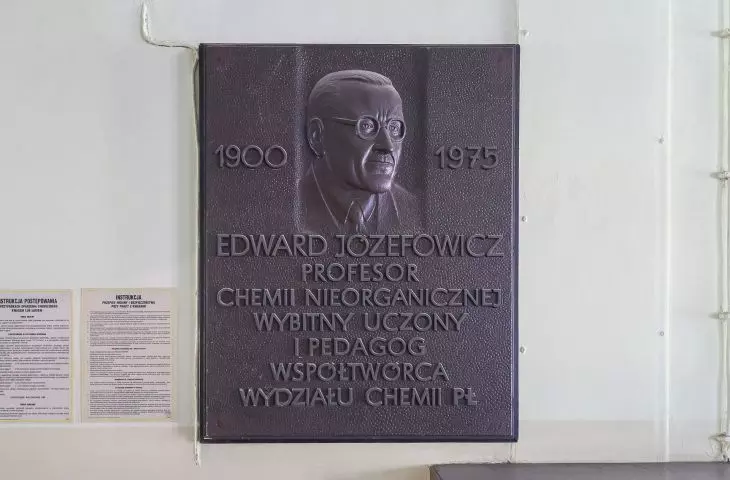
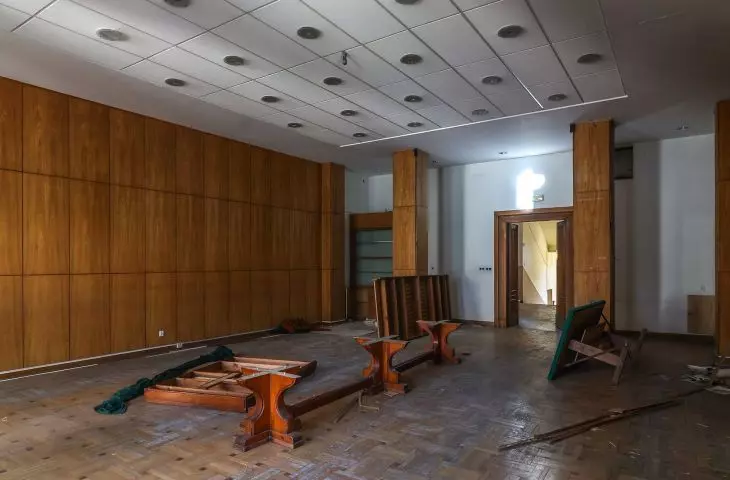
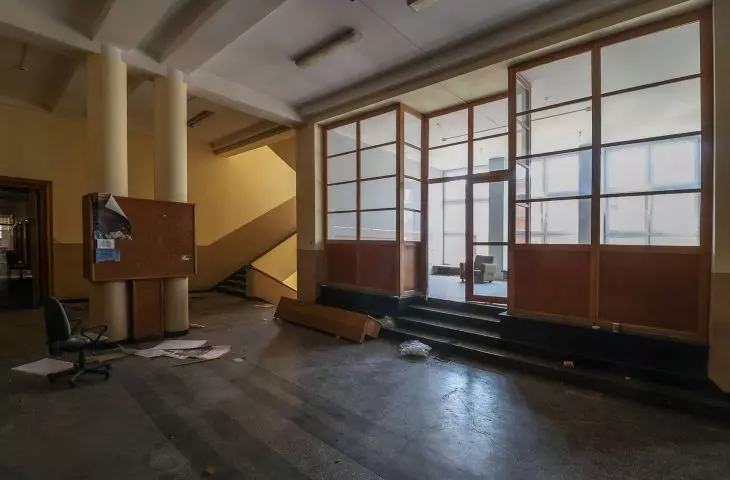
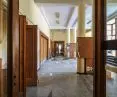
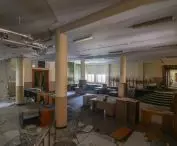
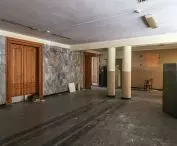
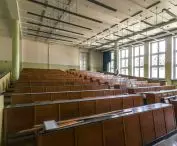
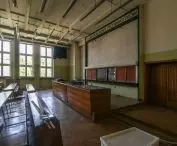
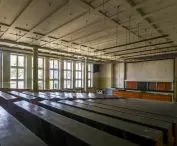
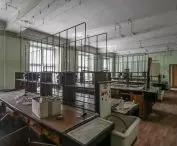
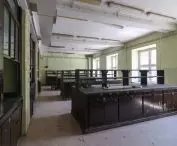
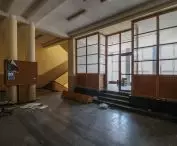

In the Chemistry Department building at the Łódź University of Technology, the first fluorescent lights in Łódź shone overhead, while carefully crafted terrazzo tiles clattered beneath the students’ feet. Today, the modernist building of the Lodz University of Technology at 116 Stefana Żeromskiego Street is being demolished, and its furnishings are being dumped on the street. Despite growing opposition from residents, community activists, and architectural experts, the university administration is continuing the demolition of this modernist—albeit classicizing—building. It is not clear exactly what will be built in its place, let alone how it will be funded. Will the historic preservation officer help save this pioneer of Łódź’s adaptive reuse projects?
Last year, the Łódź University of Technology boasted the opening of Alchemium, a modern building with hundreds of laboratory and teaching stations. At the time, few people knew that its construction would be linked to one of the most controversial decisions in the university’s recent history. The modernist building of the Faculty of Chemistry at the Lodz University of Technology is currently being demolished due to its poor condition and to make way for a new development planned for the site. Today, when Łódź is considered the Polish capital of revitalization and the adaptation of industrial architecture, the demolition of one of the most interesting buildings at the Łódź University of Technology seems like a particular loss:
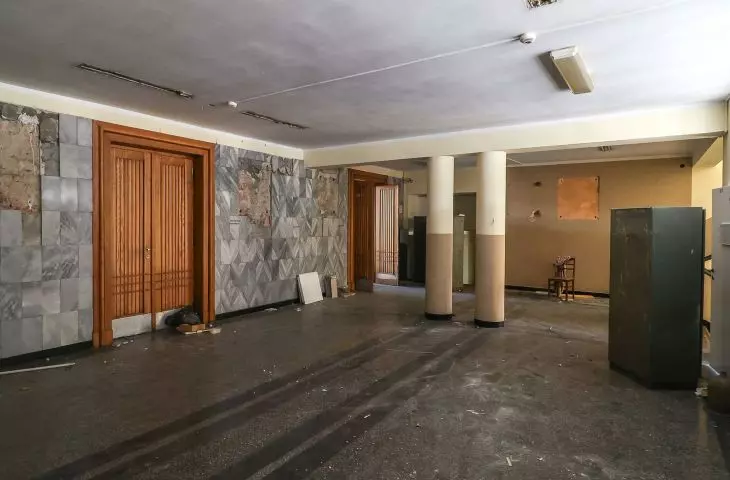
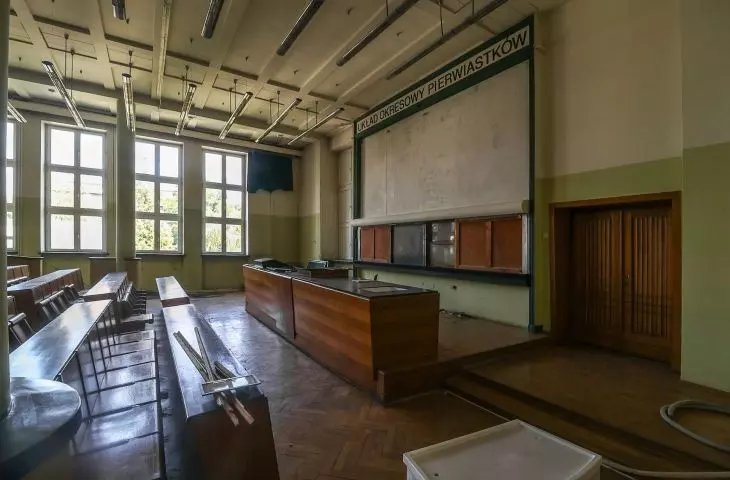
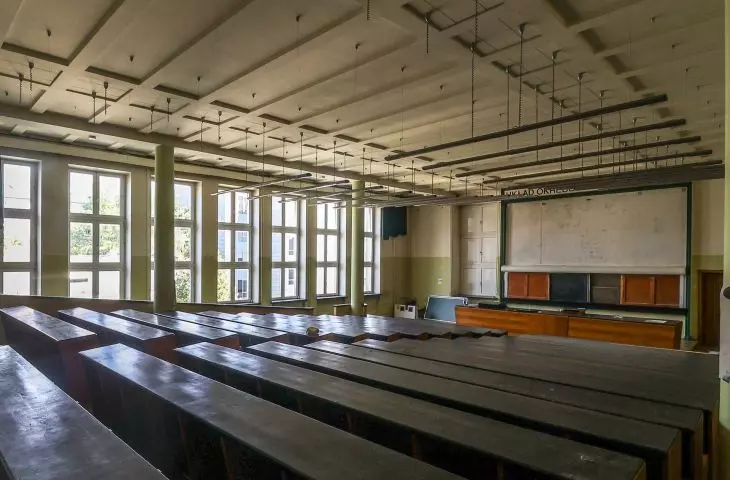
The building of the Faculty of Chemistry at the Lodz University of Technology represents a very small group of modernist buildings constructed in the period immediately following World War II. At the same time, it is an example of adaptive reuse—an approach that prioritizes the reuse of existing structures and their renovation over demolition and the construction of new buildings. This way of thinking is becoming increasingly common in contemporary architecture. The Łódź building was transformed between 1947 and 1949 under the direction of Jan Reda. The building was also innovative in terms of its fixtures—fluorescent lighting was used inside it for the first time in the history of Łódź. Vivid descriptions of the building’s interior design have survived to this day, such as accounts of the work done by the terrazzo artisans. A great deal of effort was put into making the Faculty of Chemistry a building with a “wow factor.” It was also extremely important to the community, as it served the Lodz University of Technology from the late 1940s until last fall. It has won the affection of residents and users alike; many people associate fond memories and sentimental feelings with it. It has social value, not just that associated with the “technical” side of architecture.
— says Maria Nowakowska, an art historian known online as Maria od Detalu.
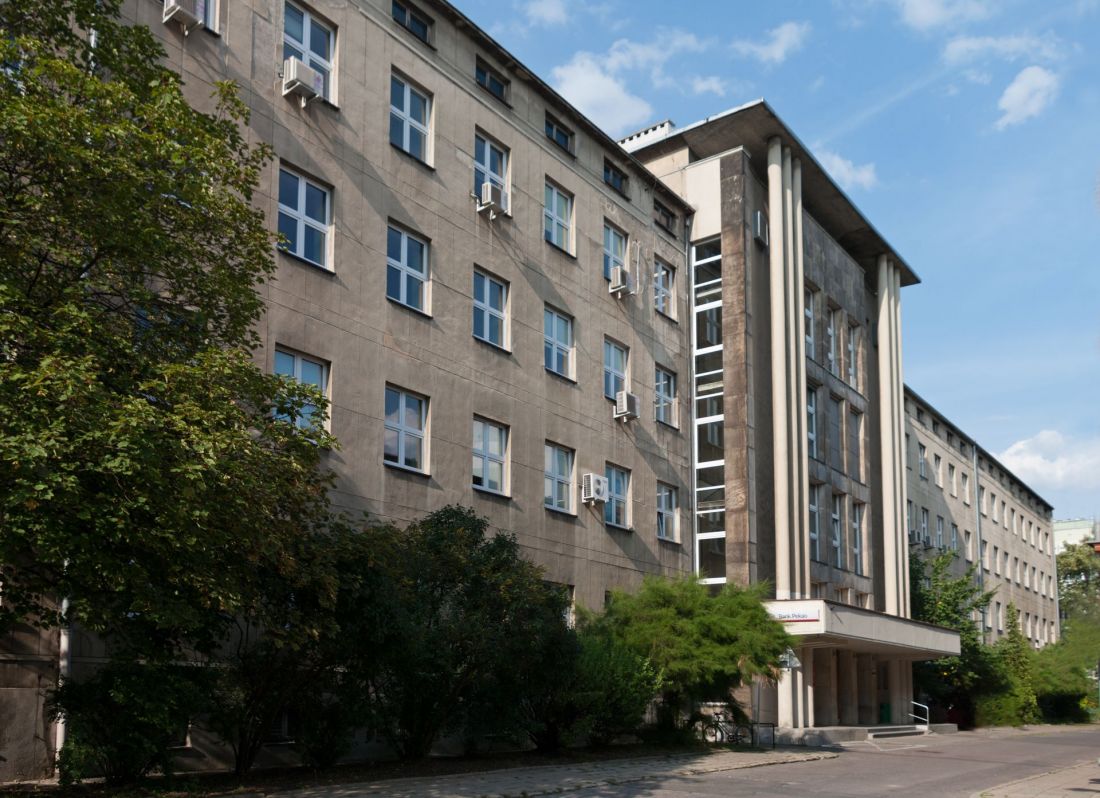
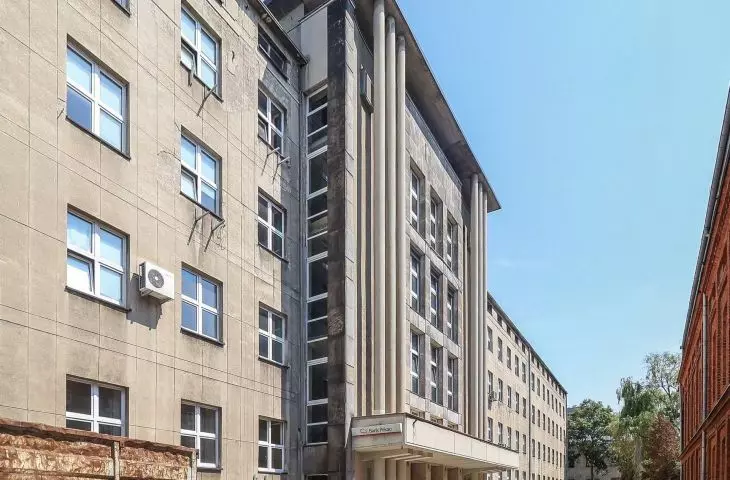
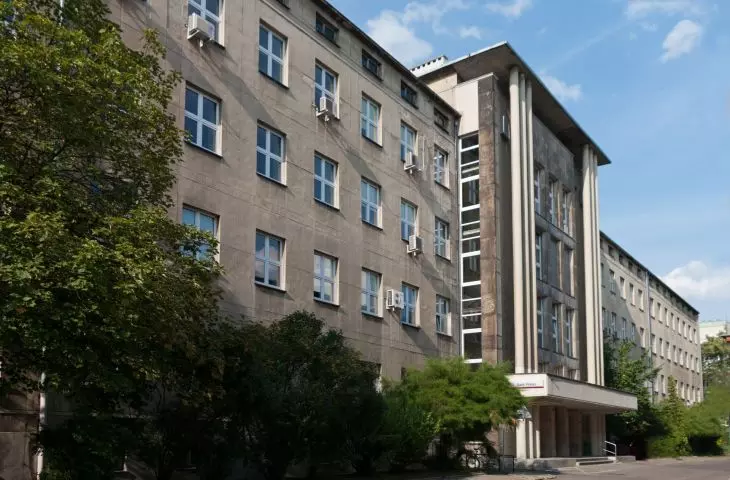
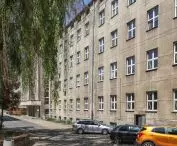
The building of the Faculty of Chemistry at the Łódź University of Technology — renovation design: Jan Reda, 1947–1949
photo: Chrumps © CC BY-SA 4.0 | Wikimedia Commons
The building of the Faculty of Chemistry at the Lodz University of Technology, slated for demolition
The idea of demolishing one of the modernist buildings at the Lodz University of Technology was reportedly still being discussed as late as 2024. According to data from the General Building Supervision Office, an application for a demolition permit for building “A27”—the 1949 Chemistry Department building—was submitted to the City of Łódź on October 10, 2025. On October 29, 2025, a positive decision was issued. At the end of February of this year, the university announced a tender for demolition work, and on May 26, 2026, the winning bidder was selected. From that moment on, the story gained momentum.
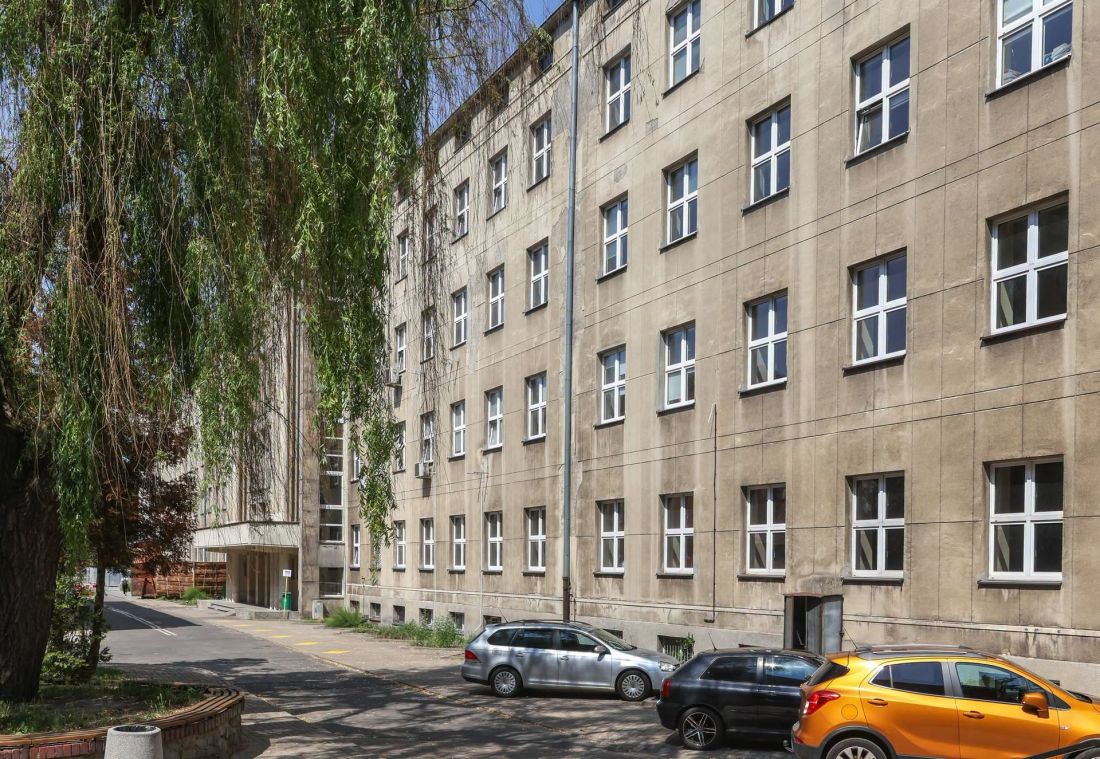
The building of the Faculty of Chemistry at the Lodz University of Technology — renovation design: Jan Reda, 1947–1949
© photo courtesy of Maria Nowakowska
Exactly one month later, the news site TuLodz.pl publicized the Lodz University of Technology’s demolition plans, and Maria Nowakowska—an art historian and architecture advocate known online as Maria od Detalu— quickly took up the cause. Thanks to her efforts—including sending a letter of protest to the Rector of the Lodz University of Technology —a heated online debate erupted over the justification for demolishing the Chemistry Department building on Stefana Żeromskiego Street in Lodz. But why, exactly, is this modernist building on the campus of the Lodz University of Technology slated for demolition?
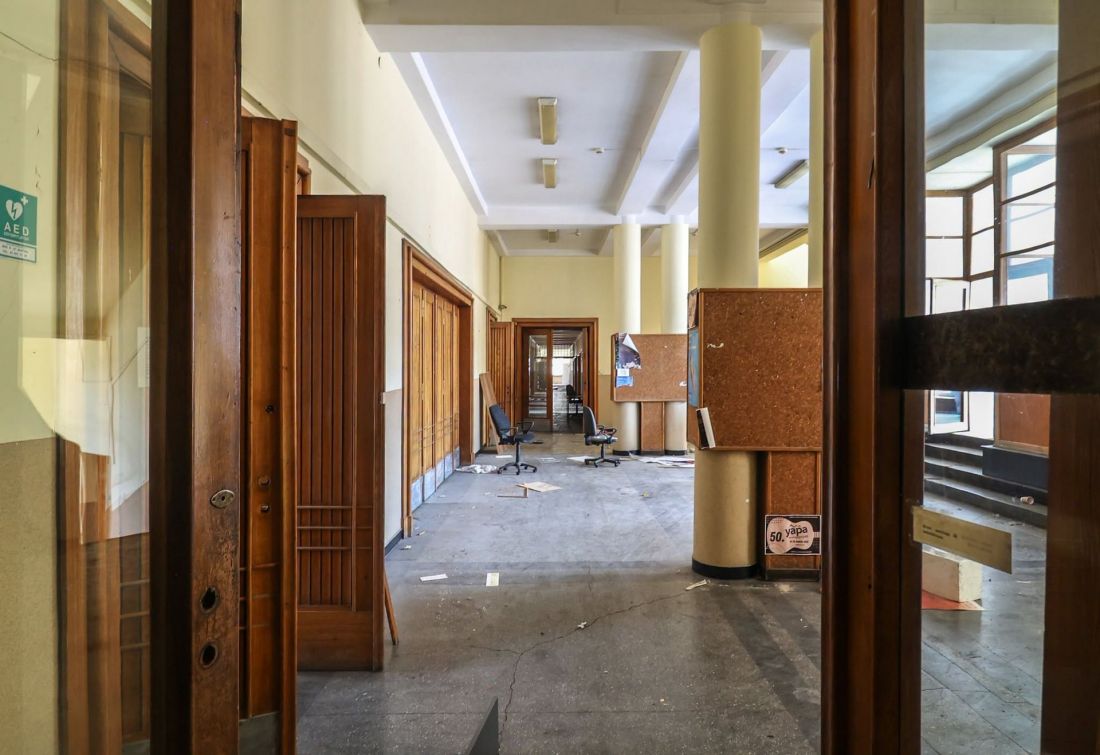
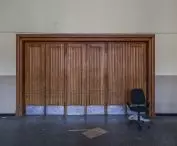
Interiors of the Chemistry Department building at the Lodz University of Technology—renovation design by Jan Reda, 1947–1949
© Photo courtesy of Maria Nowakowska
Is it a limit of technical feasibility or a financial barrier?
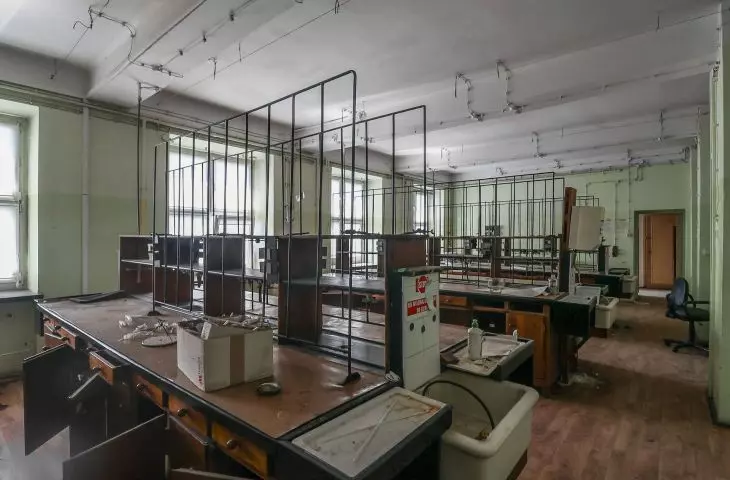
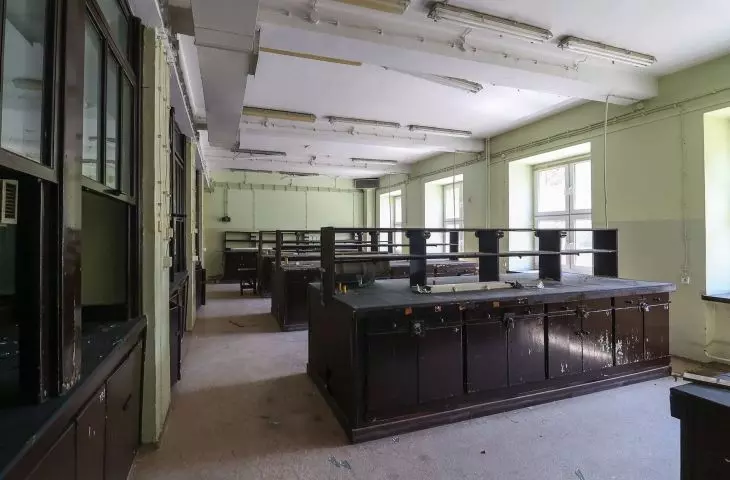
From an interview conducted by Błażej Kronic, editor of the Knews.pl portal, with Prof. Krzysztof Jóźwiek, Rector of the Lodz University of Technology, we learn that the Chemistry Department building has already reached the limit of its “technicalcapacity” and that the entire structure is unsafe for use due to the condition of the building’s framework, as well as, potentially, decades of exposure to chemical reactions—which, after all, are part of the department’s daily routine. The building’s disconnection from the power supply also contributed to the problem ; this occurred after the Faculty of Chemistry at the Lodz University of Technology moved last year to Alchemium, the university’s new building located next door. But what exactly is the condition of the Chemistry Department building? It is not at all easy to obtain specific information:
The authorities at the Lodz University of Technology claim that the Chemistry Department building cannot be modernized or brought up to fire safety or occupational safety standards. I would like to see this in writing, as well as information regarding the ceilings and roofing, so I requested access to the expert reports and calculations on which these conclusions were based. At the beginning of last week, during the first days of the protest, communication with the Łódź University of Technology’s Public Relations Department was quite smooth. The moment I requested access to the documents under the public information access law, contact broke down—they simply stopped responding to my messages. According to the law, the university still has 6 days to send me these documents. The Lodz University of Technology also rejected proposals for a debate on the future of this building and for a community-led inventory. I proposed conducting such an inventory to at least partially assess the condition of the building’s interior furnishings that remained intact until June of this year.
— reports Maria Nowakowska, the initiator of the protest campaign against plans to demolish the building of the Faculty of Chemistry at the Lodz University of Technology.
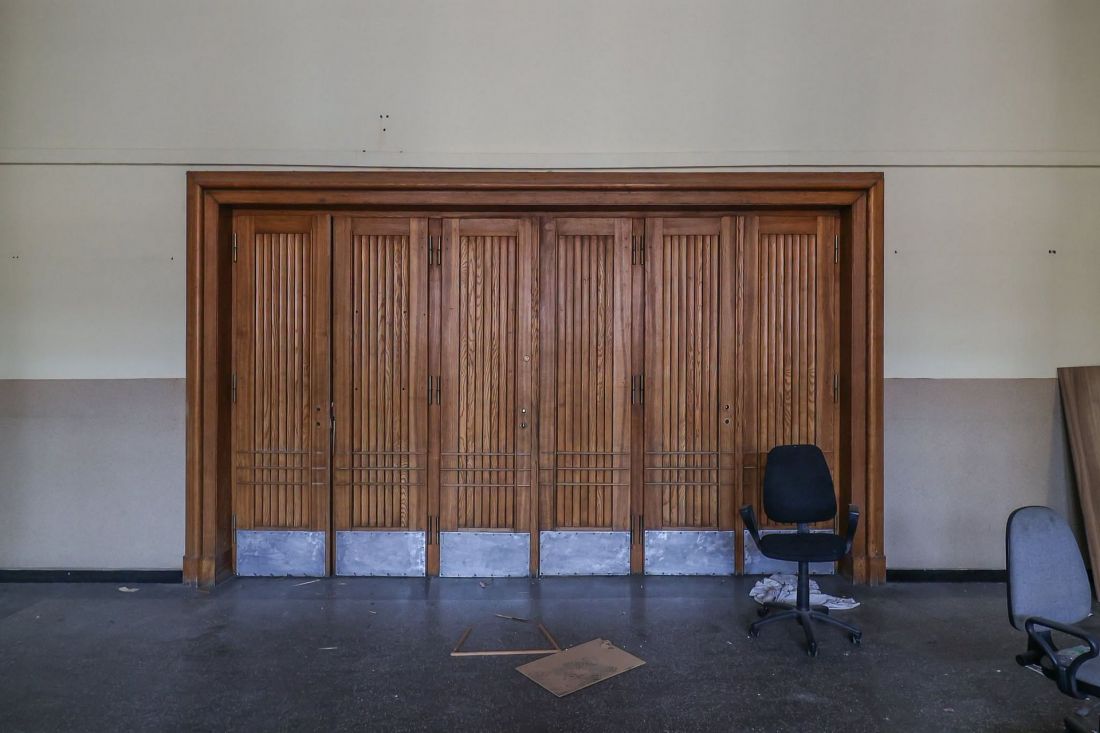
Interiors of the Chemistry Department building at the Lodz University of Technology — renovation design: Jan Reda, 1947–1949
© photo courtesy of Maria Nowakowska
Cost of Adaptation
However, the adaptation of existing buildings is nothing new (as evidenced by the building on Stefana Żeromskiego Street itself, which is, after all, an example of the adaptation of an earlier structure), especially in Łódź, a city full of 19th-century factories whose walls have once again begun to come alive in recent decades. In the case of the Chemistry Department building, however, finances are said to be an insurmountable obstacle. As we read in the aforementioned interview, Prof. Krzysztof Jóźwiek, Rector of the Łódź University of Technology, explains:
I asked for a concept and a cost estimate for a complete renovation. It turned out that the renovation, carried out using fairly sophisticated techniques, would cost two and a half to three times more than constructing a new building with the same usable floor area.
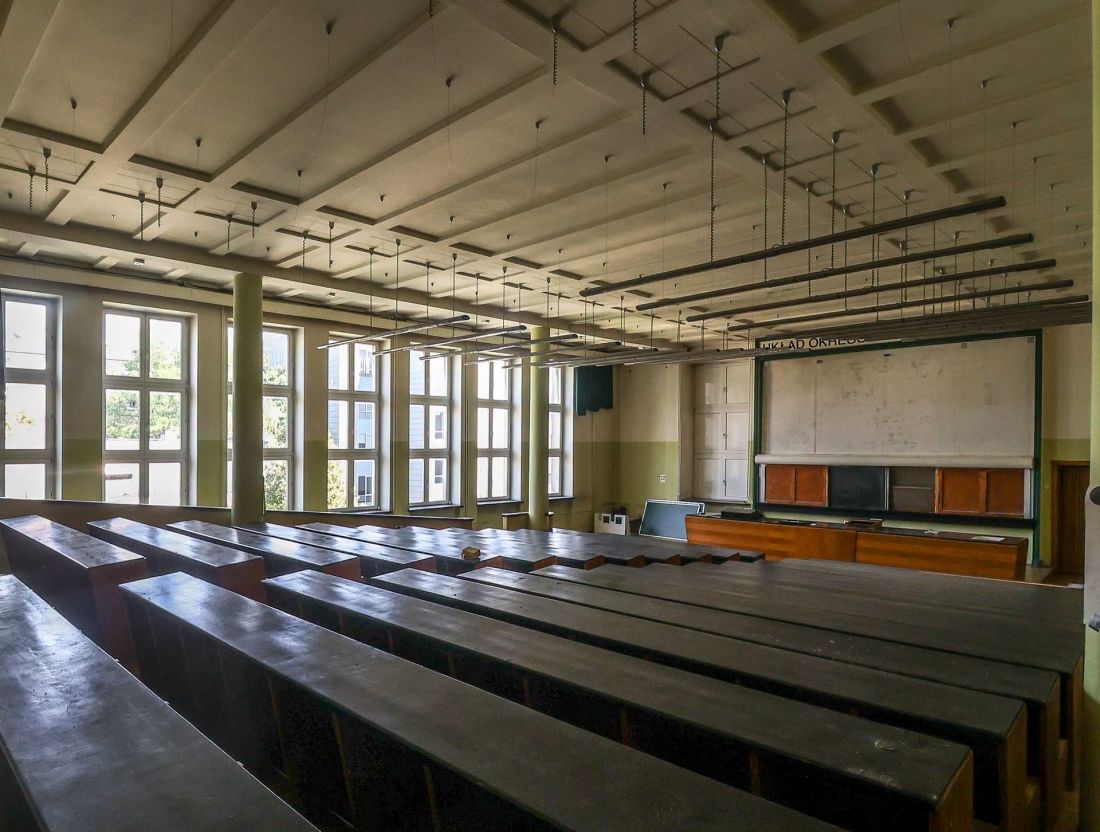
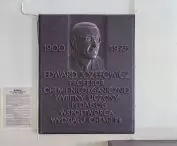
Interiors of the building housing the Faculty of Chemistry at the Lodz University of Technology — renovation design: Jan Reda, 1947–1949
© photo courtesy of Maria Nowakowska
Not everyone agrees with this assertion, and Piotr Biliński, the former City Architect of Łódź, stated in an interview with *Wyborcza* that a compromise solution—involving the preservation of the building’s most distinctive elements— certainly would not cost 200 million zlotys, which, according to estimates by the Rector of the Łódź University of Technology, is needed for a thorough renovation.
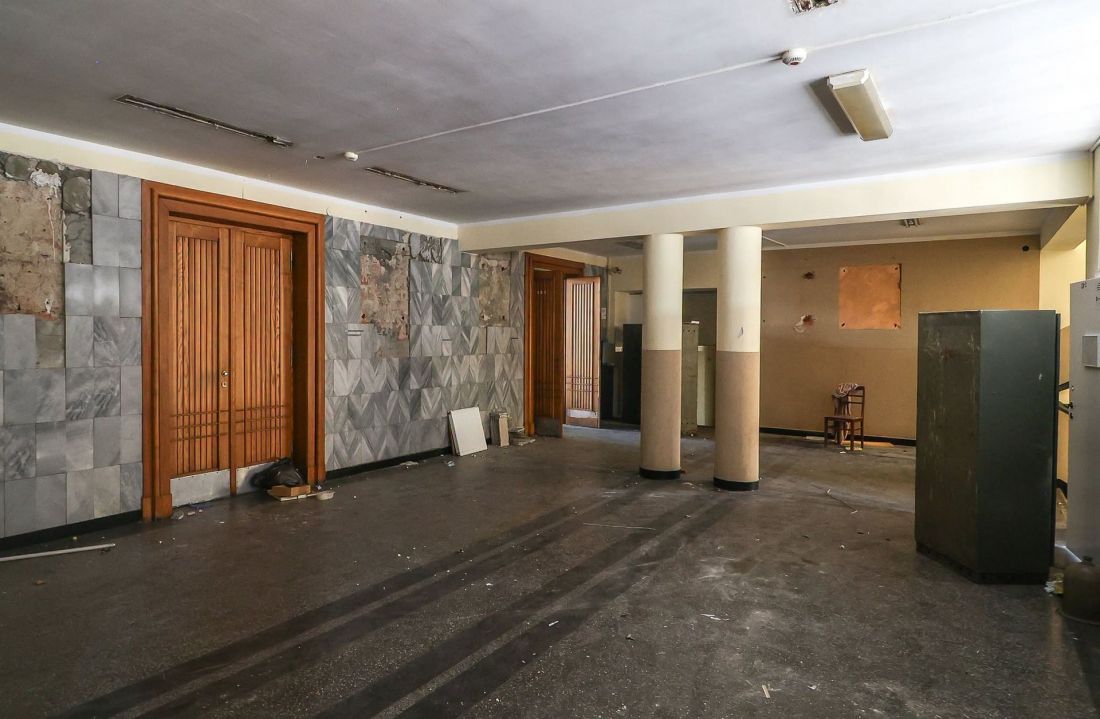
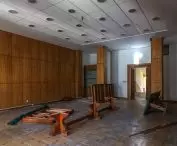
Interiors of the building housing the Faculty of Chemistry at the Łódź University of Technology — renovation design: Jan Reda, 1947–1949
© photo courtesy of Maria Nowakowska
no one knows what, no one knows why
Since the university administration considers the renovation of the Chemistry Department building too expensive, what will the University of Technology build in place of the demolished structure?
In truth, we do not know what is to be built in place of the Chemical Engineering Department building at the University of Technology in Łódź. Last week, I received a response from the university stating that plans are in place to construct a new teaching center there, combined with offices for the university administration. The Łódź University of Technology submitted an application to the Ministry of Science and Higher Education to obtain funding for this project, but as early as Sunday, the university’s rector announced that the project would not receive funding. The university will likely appeal the results of the competition, but the funding allocation has already been exhausted, so there is little chance that the verdict will change. So for now, we’re tearing it down in the name of some great unknown, because we don’t know what’s supposed to go there or how it will be paid for. It seems to me, however, that adapting this building for office use would be much cheaper than demolition, waste disposal, designing a new structure, and its construction—not to mention the carbon footprint.
— says Maria Nowakowska.
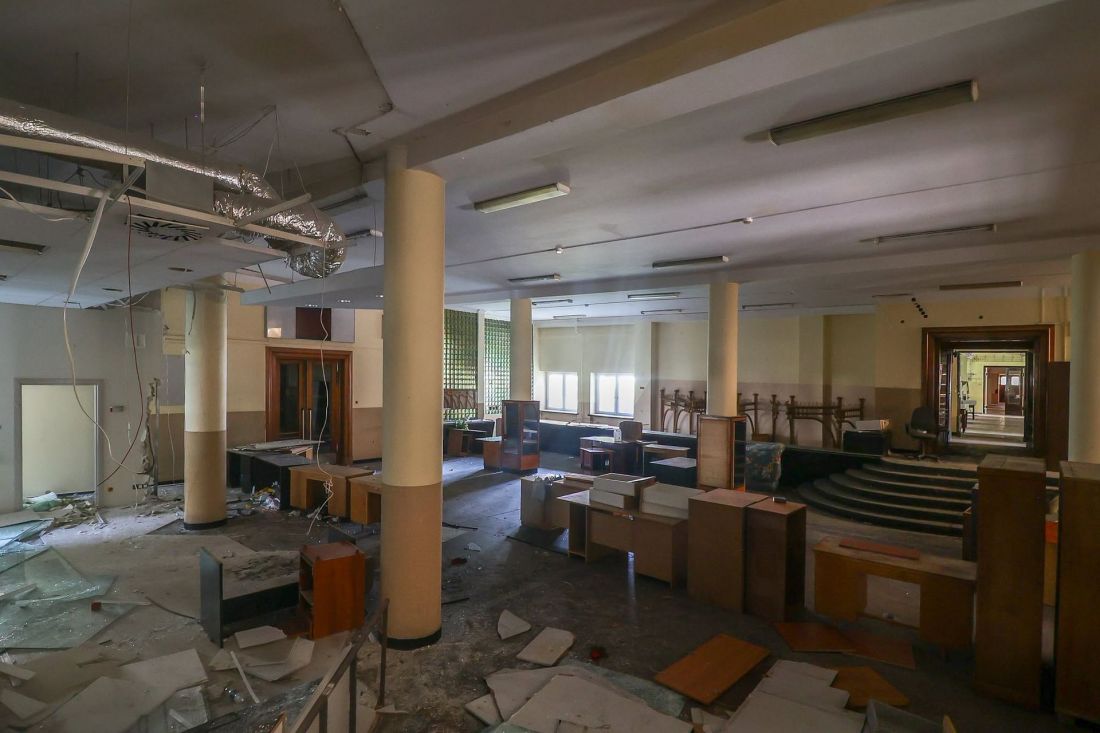
Interiors of the Chemistry Department building at the Łódź University of Technology — renovation design: Jan Reda, 1947–1949
© photo courtesy of Maria Nowakowska
Application for the protection of the Faculty of Chemistry submitted to the historic preservation officer
In addition to requesting access to the expert reports, Maria Nowakowska, together with civic activists from Łódź, has also taken other steps to save the Chemistry Department building in Łódź by appealing to the Łódź Provincial Historic Preservation Officer for assistance:
The application to place the building of the Faculty of Chemistry at the Lodz University of Technology under protection was received by the office on Thursday evening via the e-Doręczenia platform. It was submitted by the “Łódź Cała Naprzód” Association. The association’s president had informed the Łódź Provincial Conservator of Historic Monuments by phone of the intention to file this application, so the office had time to prepare for this step on our part. We submitted the documents relatively quickly because we had received reports from members of the demolition crew who, on Thursday morning [June 2, 2026 — ed.] had entered the building with orders to dispose of everything they could—in short, to chop up the furnishings and throw them into dumpsters. Yesterday, a second application was also submitted, prepared by the Łódź Branch of the Society for the Preservation of Historic Monuments, and at the same time, the National Institute of Architecture and Urban Planning sent a letter to the Provincial Conservator of Monuments in Łódź requesting that the matter be considered on an urgent basis, noting the small number of interiors and buildings of this class from the 1940s that have survived in Poland to this day. Let us remember that the building of the Faculty of Chemistry at the Lodz University of Technology has been on the list of Contemporary Cultural Assets since 2018, so its extraordinary value had already been recognized earlier. At this point, however, we have not received any response from the Provincial Office for the Protection of Monuments in Łódź.
— emphasizes Maria Nowakowska.
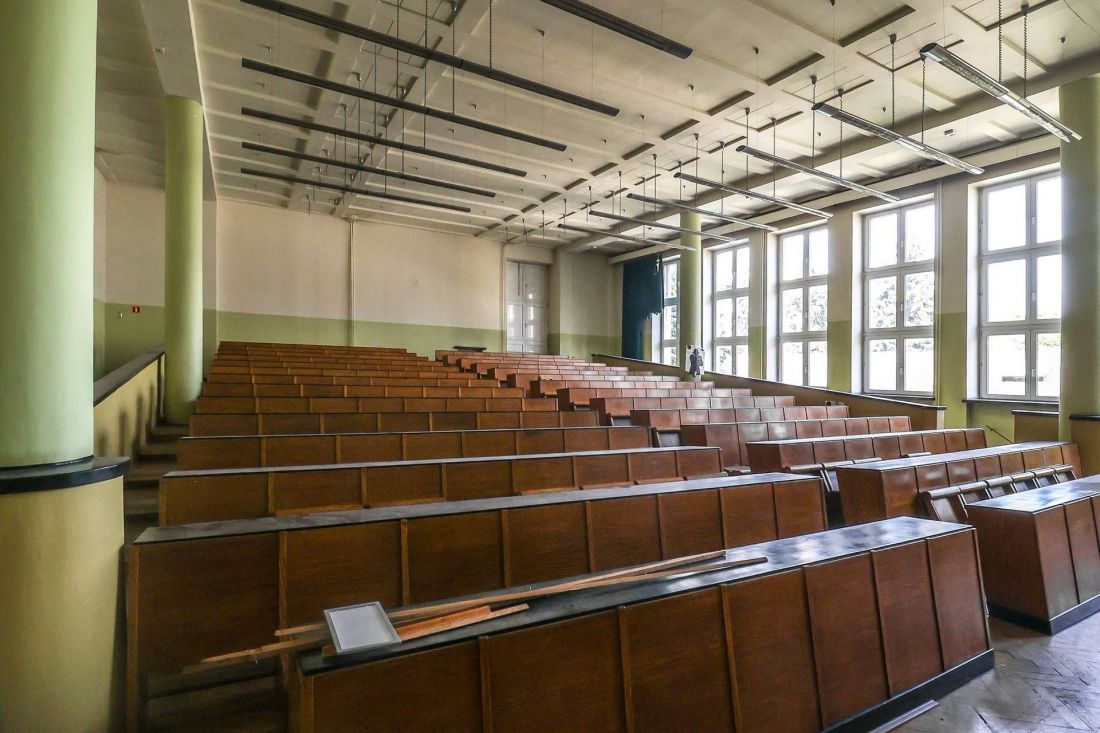
Interiors of the building of the Faculty of Chemistry at the Lodz University of Technology — renovation design: Jan Reda, 1947–1949
© photo courtesy of Maria Nowakowska
Meanwhile, the demolition continues:
Although more than 1,750 people had already signed the protest letter at the time of this article’s publication, the university administration’s actions have their supporters, even among the staff of the Lodz University of Technology themselves.
“When I see all these people so outraged by junk being thrown out of the building, it actually makes me happy—at least I know what’s coming out of it,”
wrote Michał Okraska, an employee of the Institute of Polymer and Dye Technology at the Faculty of Chemistry of the Lodz University of Technology, under one of the posts regarding the demolition.
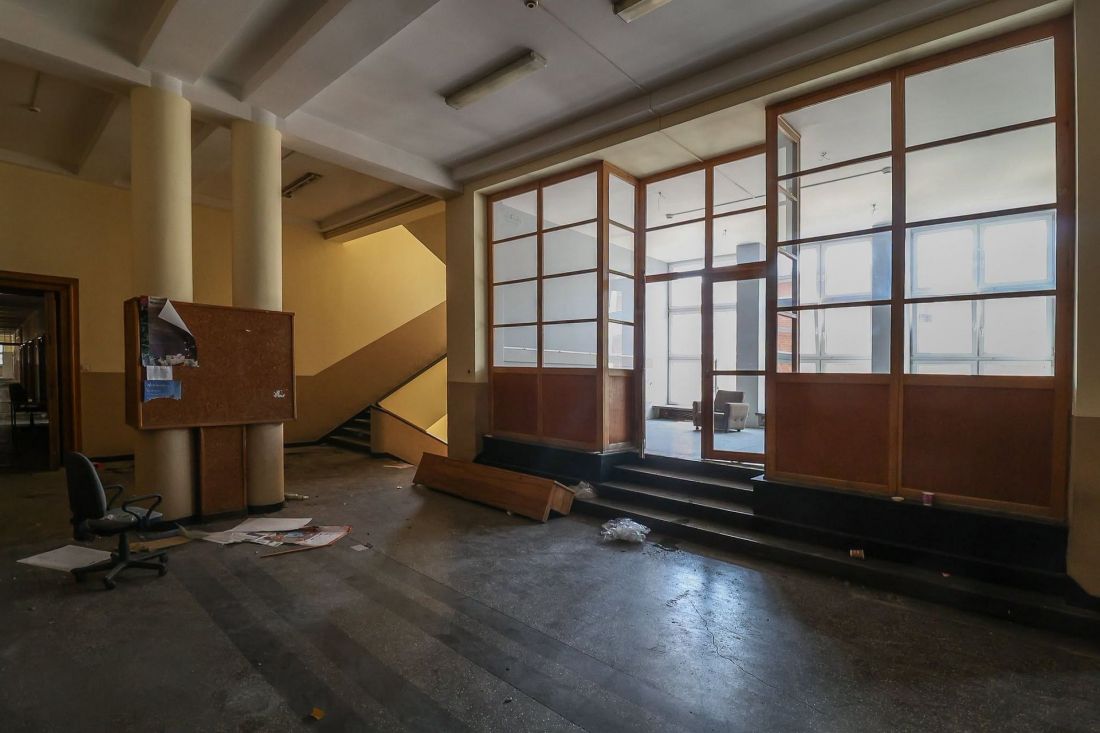
Interiors of the Faculty of Chemistry building at the Lodz University of Technology—renovation design by Jan Reda, 1947–1949
© photo courtesy of Maria Nowakowska
The National Institute of Architecture and Urban Planning in Support of Saving the Faculty of Chemistry
The National Institute of Architecture and Urban Planning does not share these views. Kacper Kępiński, Deputy Director of the NIAiU and author of the aforementioned letter to the Łódź Provincial Office for the Protection of Monuments (WUOZ), points out:
The building, converted between 1947 and 1949 according to a design by Jan Reda from the former Szai Rosenblatt factory, is one of the few examples in Łódź of architecture built in the spirit of postwar, classicizing modernism, during the brief period between the end of the war and the proclamation of Socialist Realism as the dominant style in 1949. The conversion itself was, moreover, the first comprehensive adaptation of factory buildings for new purposes in the city’s history, making it an early and significant example of the concept of adaptive reuse.
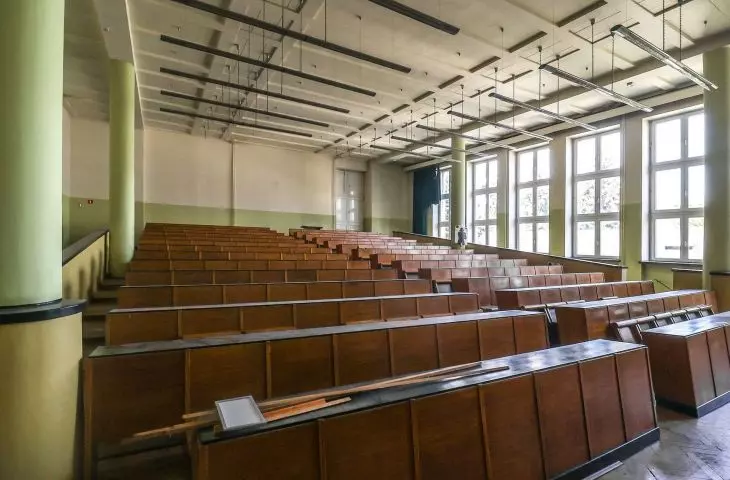
Particularly noteworthy is the degree to which the original interior design and furnishings have been preserved, including the door frames, floors, terrazzo and marble cladding, and the complete furnishings of the auditorium from the late 1940s, including the furniture and the periodic table of elements. Such a coherent, authentic fabric from the early postwar years is a rarity nationwide today.
— as stated in a letter from Kacper Kępiński, Deputy Director of the National Institute of Architecture and Urban Planning, to Anna Michalak, Łódź Provincial Conservator of Monuments.
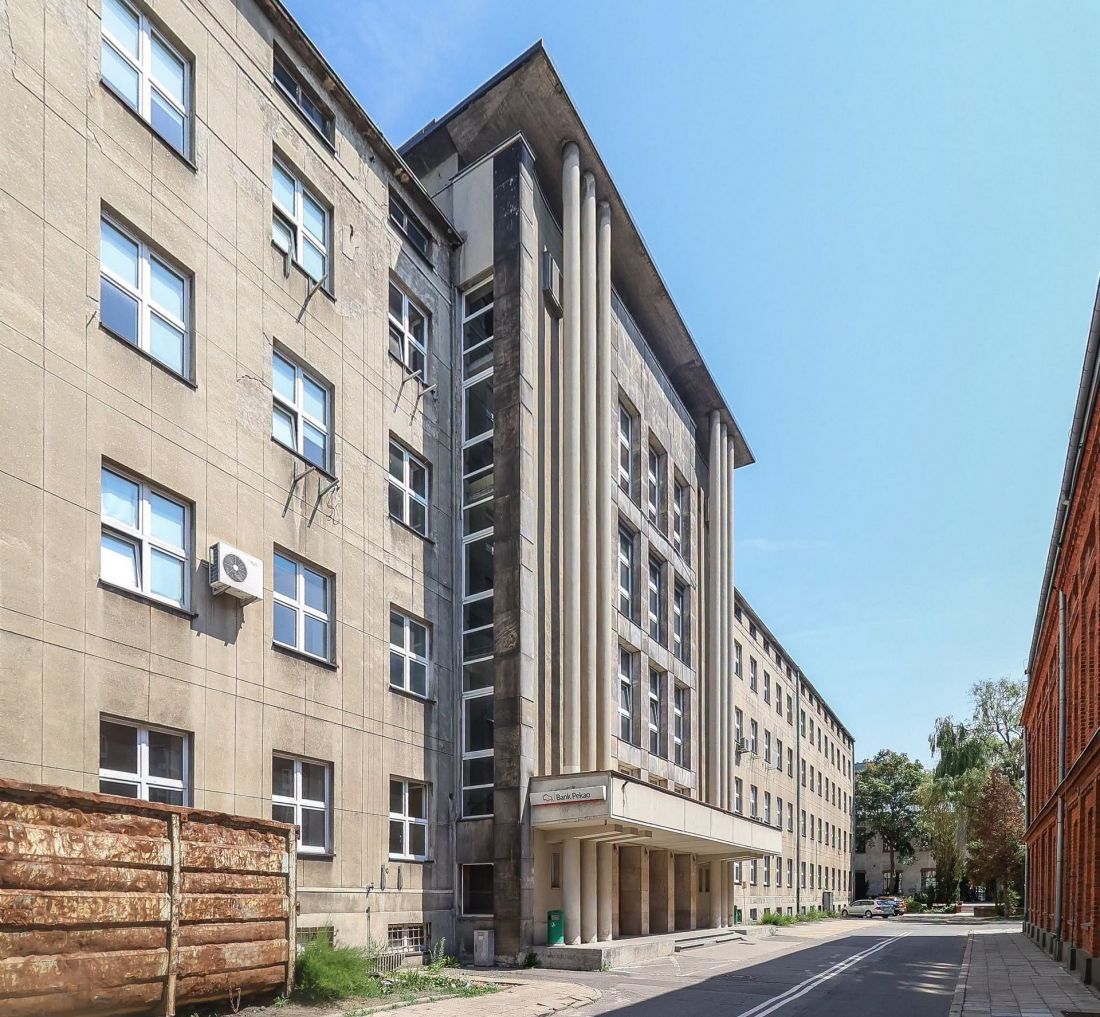
The building of the Faculty of Chemistry at the Łódź University of Technology — renovation design by Jan Reda, 1947–1949
© photo courtesy of Maria Nowakowska
The building of the Faculty of Chemistry at the Łódź University of Technology is also set to be one of the featured subjects in a guidebook being prepared by the National Institute of Architecture and Urban Planning, which will be accompanied by an exhibition held in Hilary Majewski’s tenement house in Łódź. Will the modernist building on Stefana Żeromskiego Street in Łódź survive until the exhibition opening? The decision lies in the hands of the Provincial Conservator of Monuments in Łódź — according to the law, if the procedure to list the building of the Faculty of Chemistry at the Lodz University of Technology begins, all construction and demolition work must be suspended until a final decision is issued. There is little time left, as the demolition is scheduled to last until November 26, 2026.