








The case of the Tarnów villa and the parallel situation around the Krzyszkowski villa in Myslenice show that although we are talking about two different buildings, they share a similar problem: a selective approach to heritage protection and a hollow system susceptible to the suggestions of influential people.
I recently described the story of the Książek Villa in Tarnow, one of the best-preserved examples of post-war modernism in Poland, which saw a public campaign for protection after the family living in the house decided to sell the building. At the same time, in Myslenice, the Krzyszkowski villa did not escape such a fate.
settle in peace
The villa owes its name to Jan Krzyszkowski (owner: Jan Kumala) - a man whose fate could serve as a script for a film about a generation raised in the shadow of wars and great changes. Before he became a teacher and landscape painter, he was a student at Krakow's Academy of Fine Arts. He interrupted his studies when war broke out - on August 17, 1914, he reported to the Polish Legions in Lviv. He ended up in a unit commanded by Jozef Haller, with which he fought in the Carpathian Mountains. During clashes in the harsh conditions of the mountain winter, he suffered severe frostbite. Hospitals in Krakow and Hungary, long months of convalescence and subsequent surgeries - this was the price for his patriotic fervor.
After his recovery, he returned to the university, but history did not allow him to remain in lecture halls for long. In 1917 he was again in the army, and after the Battle of Kaniow he was taken prisoner by the Germans. Camped in Parchim, then Güstrow - he regained his freedom only in February 1919. He returned to Cracow, and shortly thereafter to Myslenice, which became his place on earth.
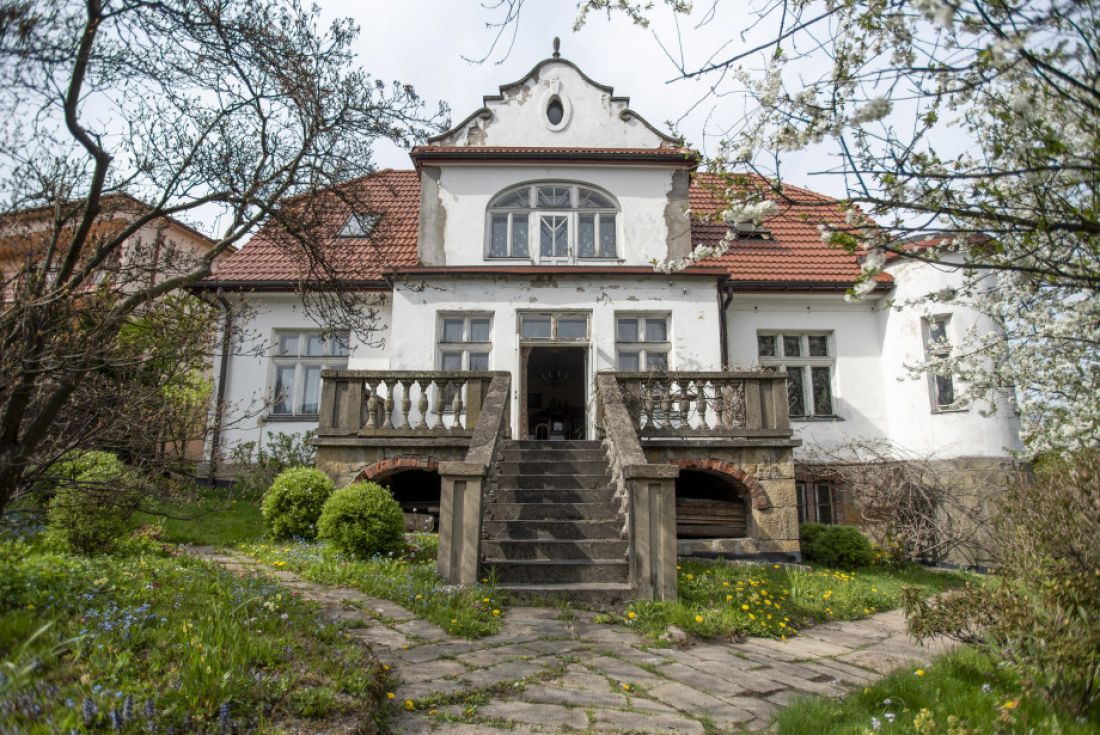
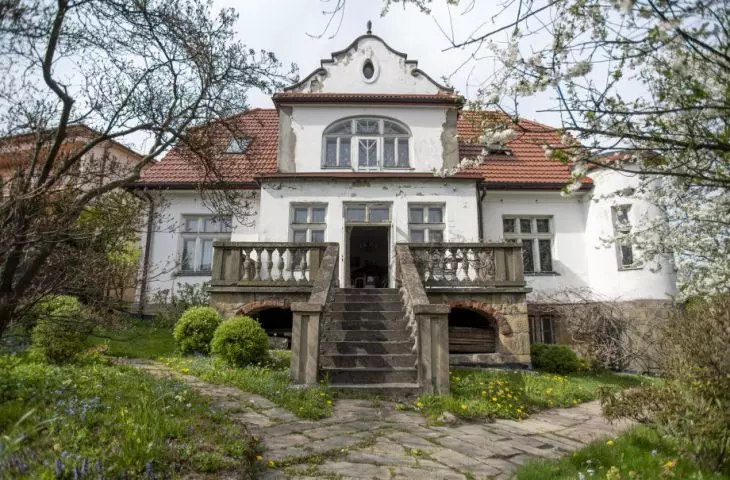
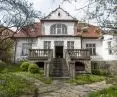
Facade of the Krzyszkowski Villa in Myslenice - View from the garden with characteristic entrance and stairs.
© photos are from the petition site
The following years brought stability to Krzyszkowski. On June 26, 1925, he received a diploma from the Ministry of Religious Denominations and Public Enlightenment, confirming his qualifications to teach drawing in high schools and teachers' seminaries. This was a step that not only strengthened his professional position, but also provided a higher salary and greater financial security. From September 1926 he was already working as a teacher at the Kosciuszko State Gymnasium in Myslenice, and from January 1927 - as a permanent teacher. Until the outbreak of war , he taught not only drawing, but also handwork and calligraphy. He took care of the Boy Scouts, and when a full-time position had to be filled, he was also directed to a public school. His daily life was filled with teaching, painting and the social life of the town. His home in Myslenice, built in the 1930s, quickly became not only a family nest, but also a meeting place for artists and friends.
It was at that time that Myslenice was in its heyday. The interwar period transformed it from a small center into an important summer resort town. The decisive moment was the construction of a dam on the Raba River in 1921, which created a new resort area on Zarabie. When the area officially became a recreational district in 1929, more and more Cracovians chose Myslenice as their summer resting place. More guesthouses and holiday villas appeared in the landscape, often with original and modern forms. Tourist traffic increased even more after 1935, when a new road connecting Myslenice and Krakow was put into service. The suburbs of Lower and Upper Myslenice also developed, first forming their own municipality and then being incorporated into the city.
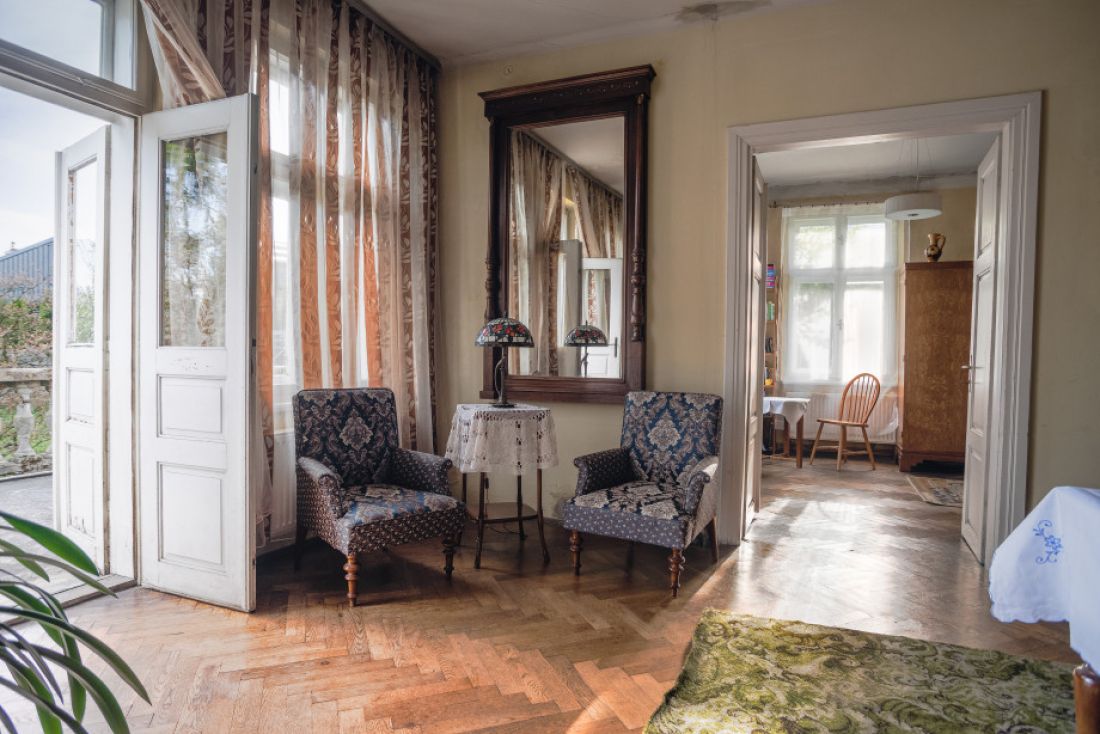
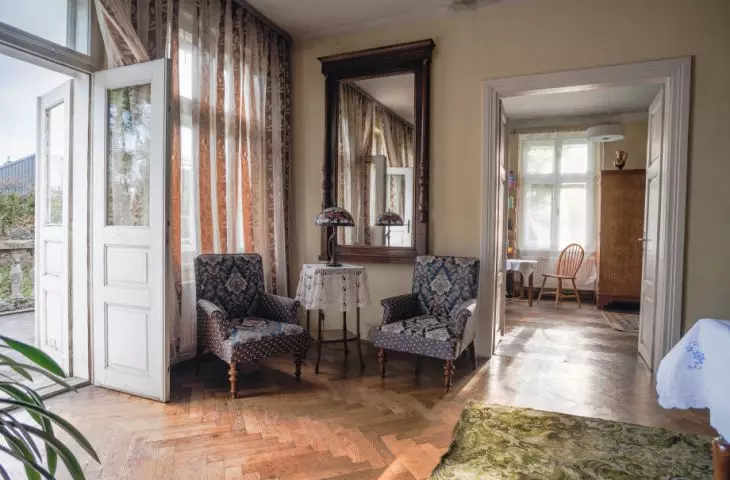
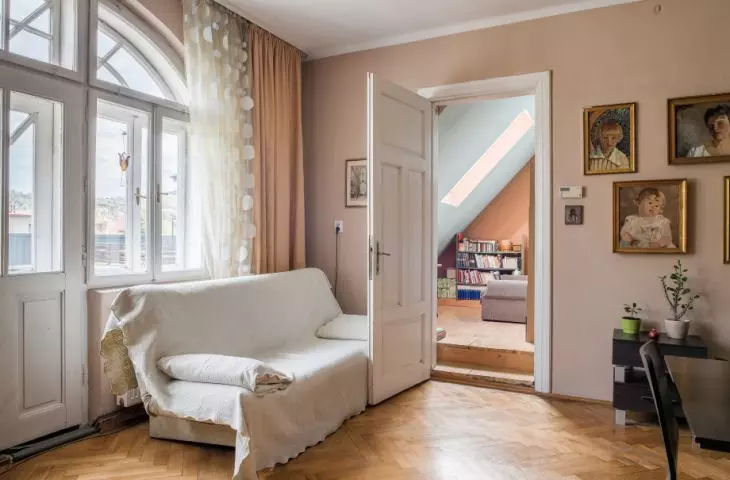
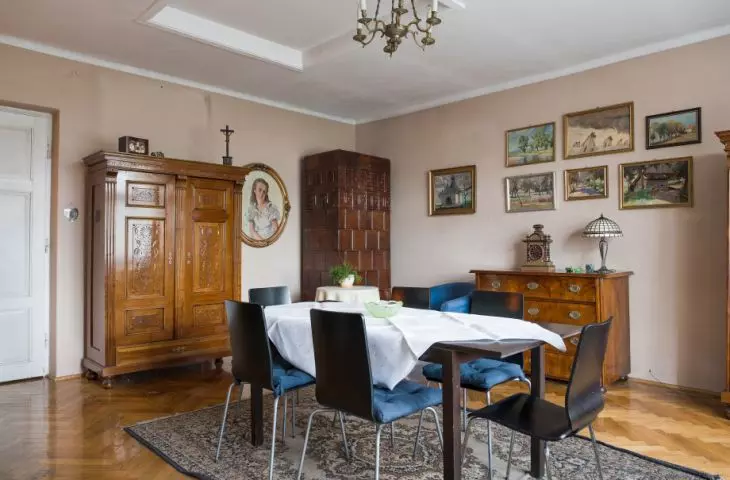
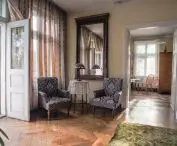
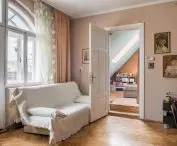
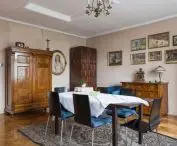
Salon of the Krzyszkowski villa - Interior of the house with preserved original woodwork, furniture and decorative mirror.
© photos are from the petition site
This period of prosperity was interrupted by September 1939. Myslenice found itself in the area of operations of the Krakow Army, and the war, and later the parceling out of landed estates, brought an end to many traditional mansions and residences. Against the backdrop of this turbulent history, the Krzyszkowski villa, built in 1936,[1] appeared as a sign of its founder's ambition, talent and social commitment. For years it was inhabited and maintained by the family. Over time, however, the difficulties of carrying out repairs to the protected building grew.
entry and excerpt
The Krzyszkowski family had already tried to have the villa removed from the municipal register of historical monuments. Why? As Wojciech Spyrka, who heads the Myslenice zoning department, explains, having the property on the registry entails the need for a certified conservator to supervise all construction work. This means additional costs: from using historic window and door woodwork that doesn't meet modern thermal standards, to the need for expensive renovations - often several times more expensive than ordinary construction work. And if this is where you disagree with something in this narrative, then yes, you are right.
Entry in the municipal register is not the same as entry in the register of historical monuments. The municipal register provides administrative protection, which is reflected in the provisions of the local zoning plan and the municipal program for the care of monuments. It does not give the opportunity to apply for national or provincial grants, but opens the way to financial support from the municipal budget. Property owners can also take advantage of tax deductions related to renovation work. The registry can be a preliminary step before entry in the register, which provides broader instruments for protection and financing.
Having a facility listed in the municipal register does not impose as far-reaching obligations as in the case of the registry. The owner must agree on construction work carried out on the exterior of the building, while there is no obligation to subject the entire renovation process to ongoing conservation supervision. There is also no requirement to use materials many times more expensive than standard ones. The owners' obligations are mainly limited to administrative arrangements and apply to work visible in public spaces.
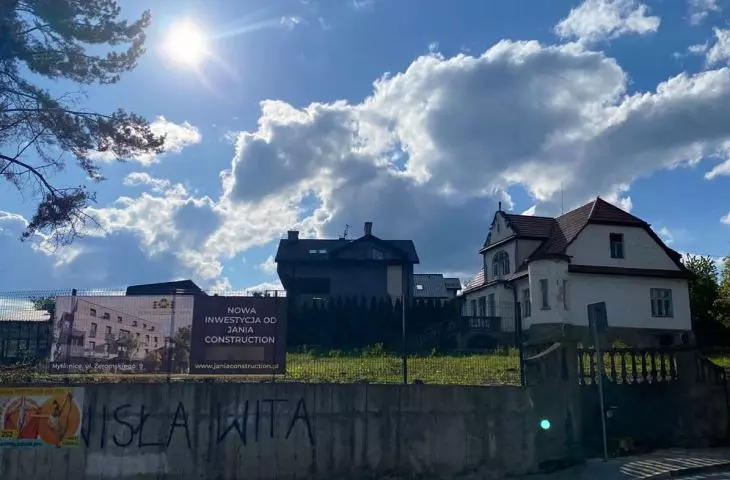
However, the authority did not agree to de-list the building. So the family decided to sell the building. It was acquired by Jania Construction in 2023. Initially, the developer advertised the "Sobieski Residence" project, promising to renovate the villa. On the now-defunct website of the investment, the developer advertised the venture with the slogan: "An address that residents of Myslenice need no introduction. The investment is located in the very center of the city in close proximity to the Myslenice market. Along with the investment, an old historic building, otherwise known as 'Villa of Mr. and Mrs. Krzyszkowski', will be completely restored " [2]".
He later applied to havethe building removed from the register, arguing its poor technical condition. In April 2025, the villa formally ceased to be a monument. The decision to remove it from the register was signed by Myslenice Mayor Jaroslaw Szlachetka (Law and Justice), and was supported by the position of the provincial monument conservator. Jan Kozakowski from the office of the Provincial Office for Historic Preservation explained that the preservationist gave a positive opinion on the exclusion of the building. The justification reads that the exclusion was "due to the lack of care and renovation, which depleted the historic values of the building, and the current technical condition of the building, which, if renovated, excludes the possibility of permanently preserving the original historic substance." This was to be confirmed by an expert report carried out at the developer's request by Dr. Eng. arch. Paulina Łyziak-Dyga, as reported by Gazeta Krakowska.
Social "no"
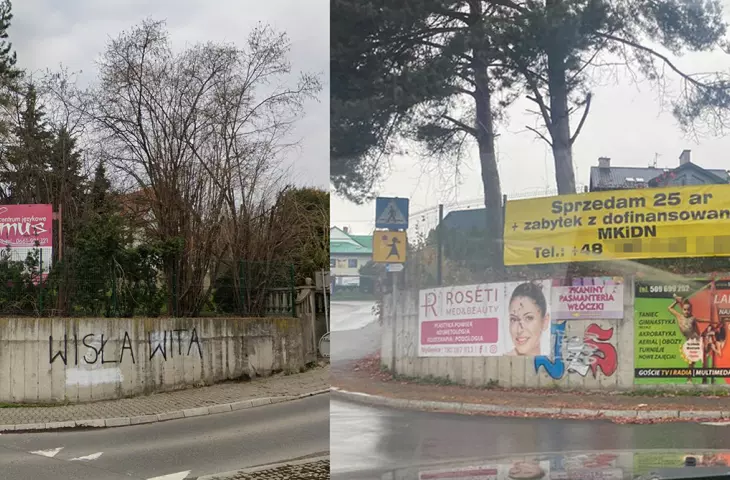
The decision to remove the building from the register opened the way to demolition. Residents began to raise the alarm that the site and the building were being systematically destroyed - trees had disappeared from the site, and the plot had been platted. Residents felt that the villa had been deliberately neglected to justify its poor condition. They decided to fight back. In a short period of time, hundreds of signatures were collected on a petition to stop the demolition procedure of the Krzyszkowski villa, and the protest was publicized by the media. Information also broke through to the public that, as Gazeta Wyborcza described , the company's co-owner is Patryk J., linked in media reports to a militia of Cracovia pseudo-fans.
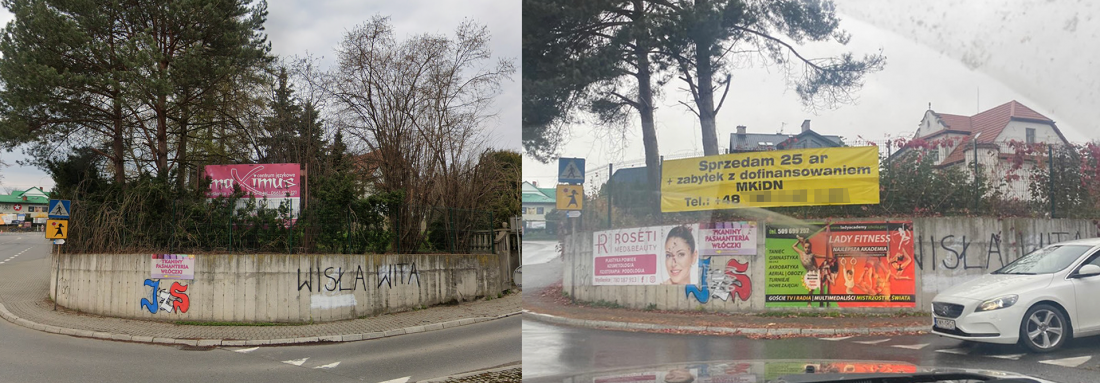
View of the plot, villa and greenery in 2021 and now (August 2025)
Google Maps and photo submitted by a reader
More than 1,600 people signed a petition in defense of the building. The signatories stressed that this is about preserving the city's memory and identity, not just the wall and roof. Public pressure and publicizing the issue brought a result: on August 21, 2025. The Malopolska Provincial Conservator of Monuments initiated the procedure to enter the villa in the provincial register of monuments, according to a report by Radio Krakow. The initiation of the proceedings halted construction work and gives the building a chance for the highest form of protection. Residents breathed a sigh of relief, although it is still unclear who will finance the buyout and renovation.
what the law says
It is worth recalling at this point that the principle of protecting cultural heritage is anchored directly in the Polish Constitution. Article 5 imposes an obligation to guard the national heritage, and Article 73 grants everyone the right to enjoy cultural property.
At the statutory level, the development of these provisions is contained in the Law of July 23, 2003 on the Protection and Care of Monuments. Heritage protection is not merely a declaratory demand, but is a binding principle that should shape administrative decisions, local development strategies and conservation practice. The scope of the obligation to protect is not limited only to objects listed in the register of monuments. It applies to the entirety of state and local government activities, encompassing spatial planning, grant-making and intervention in emergency situations.
argumentum at stanum technicznum
The argument about the poor technical condition of an object is sometimes cited as grounds for removal from the register. However, conservation practice proves that buildings in very poor condition are also saved. In the case of many register objects, only the perimeter walls or fragments of the structure are preserved, and yet they are considered saved. Technical condition should not be an independent justification for abandoning administrative protection in the municipal register. Administrative jurisprudence clearly indicates that the poor state of preservation of an object cannot be treated as a negative premise in itself. The goal of monument protection remains the prevention of its complete destruction. Administrative court rulings confirm that as long as an object retains even minimal historical, artistic or scientific value, it cannot be removed from the register. And in Myslenice this is not the only object, next door to the villa in question stands the Greek House, about which similar doubts arise. The building dates back to the 17th century, and has been falling into disrepair for years despite its entry in the register.
Monuments are part of local identity and can serve a cultural function. We are no longer in the crazy '90s" and '00s" to maintain that decisions to preserve or decommission a monument depend solely on economic criteria. Local governments make decisions on public spending for various purposes, such as modernizing the market, building sports facilities or organizing events.
The history of the Krzyszkowski villa in Myslenice draws attention to a recurring pattern: when there is no systemic protection, saving monuments depends on luck, the involvement of individuals and social initiative. What this villa has in common with its "modernist sister" - the Książek villa in Tarnow - is not only a similar mechanism for threatening heritage, but also a reflection on what we are losing as a society.
We have come to a strange moment: owning a monument (whether private or public) is increasingly becoming a burden that is best disposed of. The best thing to do is to sell it, disclaim responsibility, or spend months looking for an institution or investor to take it over - with no guarantee that someone else, richer, with an army of lawyers and enough resources not to care about either penalties or public opinion, won't step in at a moment's notice.
Magdalena Milert
[1] This date appears in many articles and posts about the building, but I could not find a reliable source to confirm this information.
[2] Information available through the Web Archive portal https://web.archive.org/web/20240808223127/https://janiaconstruction.pl/Oferta/sobieskiego_residence