






We are spending more and more time at the computer or smartphone, both in terms of online work and following current information on the Internet. Among the deluge of these, it is sometimes possible to stumble upon information about events and phenomena of interest, yet quite new to us. I myself accidentally stumbled upon a hitherto unknown activity, balancing on the border of hobby and subculture - cosplay. I became interested in this phenomenon, because, being difficult to clearly classify, it is situated between theater, stage design, functioning somewhere on the margins of the theatrical and visual arts. It is also, it seems to me, a phenomenon characteristic of today's global culture, based on the almost unlimited exchange of information and the functioning of societies in media reality.
Cosplay is an artistic hobby or, rather, a subculture in which people called cosplayers create disguises and impersonate a fictional character, drawing inspiration from various sources. The most popular of these are comic books, especially TV series, feature and animated films, mostly science fiction and fantasy, and video games. The term is a combination of the words costiume, and play, in free Polish translation: a game of disguise. Mentions of dressing up as a favorite movie character appeared as early as 1939 after the first World Science Fiction Convention, a convention held in New York. The name cosplay itself was invented by Japanese Noboyuki Takahashi, who works at Studio Hard, and who attended the World Science Fiction Convention in Los Angeles in 1984 and became fascinated by people impersonating beloved characters with their costumes and behavior.
Cosplay spread very strongly in Japan and then in other Asian countries among young people and, in time, those of older ages. It is now operating in many other countries around the world, and for a few years it has been developing in Poland as well. There are international rallies and competitions where cosplayers present their disguises, the result of months of work and commitment of available resources, including financial. Cosplayers most often create costumes based on graphics or photos from the Internet, trying to replicate the original as closely as possible - the professional work of film costume specialists, set designers, or comic book graphic designers. In addition to costumes, makeup, makeup, even going so far as to wear contact lenses that change eye color, and details - jewelry or other gadgets - are also important.
Cosplay contests are very popular, gathering crowds of fans, and the prizes are increasingly financial. The jury evaluates the conformity of the costume to the original, the variety of techniques, correct execution, as well as stage behavior. For outside observers, cosplay is a fun or specific hobby, while cosplayers themselves take it very seriously. Cosplay becomes a part of their daily life, a source of income, a way of life, to some extent programmatically detached from reality. A certain reference to this subculture can be seen in the highly popular show "Your Face Sounds Familiar," in which lesser-known actors andsingers dressed as actual stage stars, mimic their performances, imitating their image with disguise and costume, and submit themselves to the jury's evaluation, with everyone pretending to participate in the great fun.
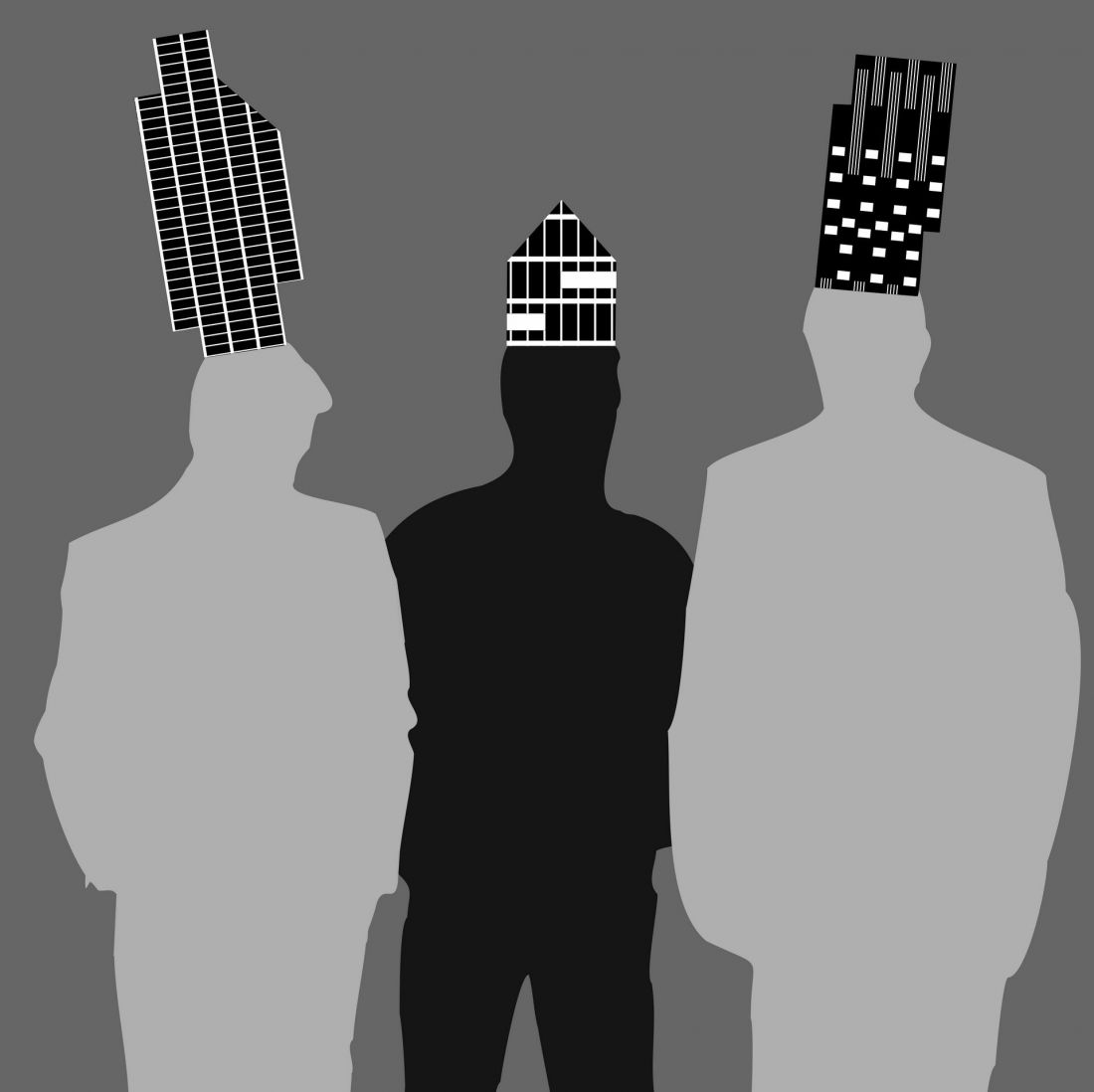
drawing: Piotr Średniawa
your architecture sounds familiar
It seems that this dressing up has nothing to do with our architectural activities. However, the more I became interested in cosplay, searching the Internet, the more associations appeared in my mind, saying that we function in the field of architecture in Poland in a very similar way to the essence of cosplay. The characteristic feature of cosplay is not to invent new costumes and create new media characters, but to recreate and identify as closely as possible with already known and created characters from feature and animated films or stage stars.
Doesn't this remind us of something in our business? Whenever I browse through our architectural magazines and web portals with native creations - both in the form of realizations and projects - I get the feeling that I've seen something almost identical, or very similar, before. If my memory doesn't deceive me, such a reflection was shared by Lukasz Wojciechowski, an architect and theoretician, and it's hard not to agree with it. Some of the associations are obvious, some require a bit more effort and a flip through foreign magazines and web portals. Particularly useful is ArchDaily, which is a veritable mine of originals. As in the case of cosplay, the originals are unfortunately better than their copies, giving the impression of an admittedly industrious but derivative amateur imitation.
Undoubtedly, the budget of this activity is of great importance. Just as in professional cinematography, budgets for sets and costumes are considerably higher than in hobbyist cosplay, the budgets of domestic productions are at least two to three times lower than those of the originals. This results in a difference in technical and material solutions, resulting in an obvious primitivization of native architectural "fakes." The value and intellectual differences are not even worth mentioning. The fact is that in today's globalized world it is increasingly difficult to find fresh and original concepts in art and culture, but it is possible to find them, including in the field of architecture.
It is one thing to be inspired by and fit in with current trends, and another to uncritically copy foreign cultural patterns. Born in Japan, cosplay drew not from its culture, but imitated mainly American cultural patterns without processing them. I have had a similar impression of uncritical drawing from unprocessed cultural patterns for forty years in Polish architecture. The end of the 1970s marked the end of a fairly parallel entry of our architecture into the current of European and world modernism, admittedly limited by economic conditions, but still presenting original work supported by a theoretical foundation. Suffice it to mention Katowice's Spodek, also Katowice's demolished brutalist and ineptly reconstructed as part of a shopping mall, Warsaw's Central Station, somewhat messed up by the recent modernization, Warsaw's demolished Supersam, and in the field of theory, Oskar Hansen's ideas.
This trend was interrupted in the late 1970s and early 1980s. It is difficult to answer whether this was related to violent social and economic upheaval, the isolation of the country from the currents of European culture, but it was during this period that the cosplay phenomenon in our architecture began. The first dressing up in a costume that was not one's own came with the now forgotten fascination of our environment with postmodernism, referring to a tradition that was never defined. The beginning of the decade of the 1990s saw a complete retreat from postmodernism and attempts to dress our architecture in the costume of superficially understood and implanted deconstruction. Later, there was a return to abandoned modernism with willing references (not knowing why) to minimalism, mainly Swiss. Nowadays, we are very superficially dressing up architecture in ecological costumes and inscribing it in the fight against climate change, which is often greenwasching rather than deeper reflection. These successive fashions in disguise, since they can hardly even be called trends, and their quick abandonment result in the fact that their lifespan - like cosplay costumes - is seasonal, they quickly fall into oblivion, and the attention of the environment is focused on waiting for the next disguise.
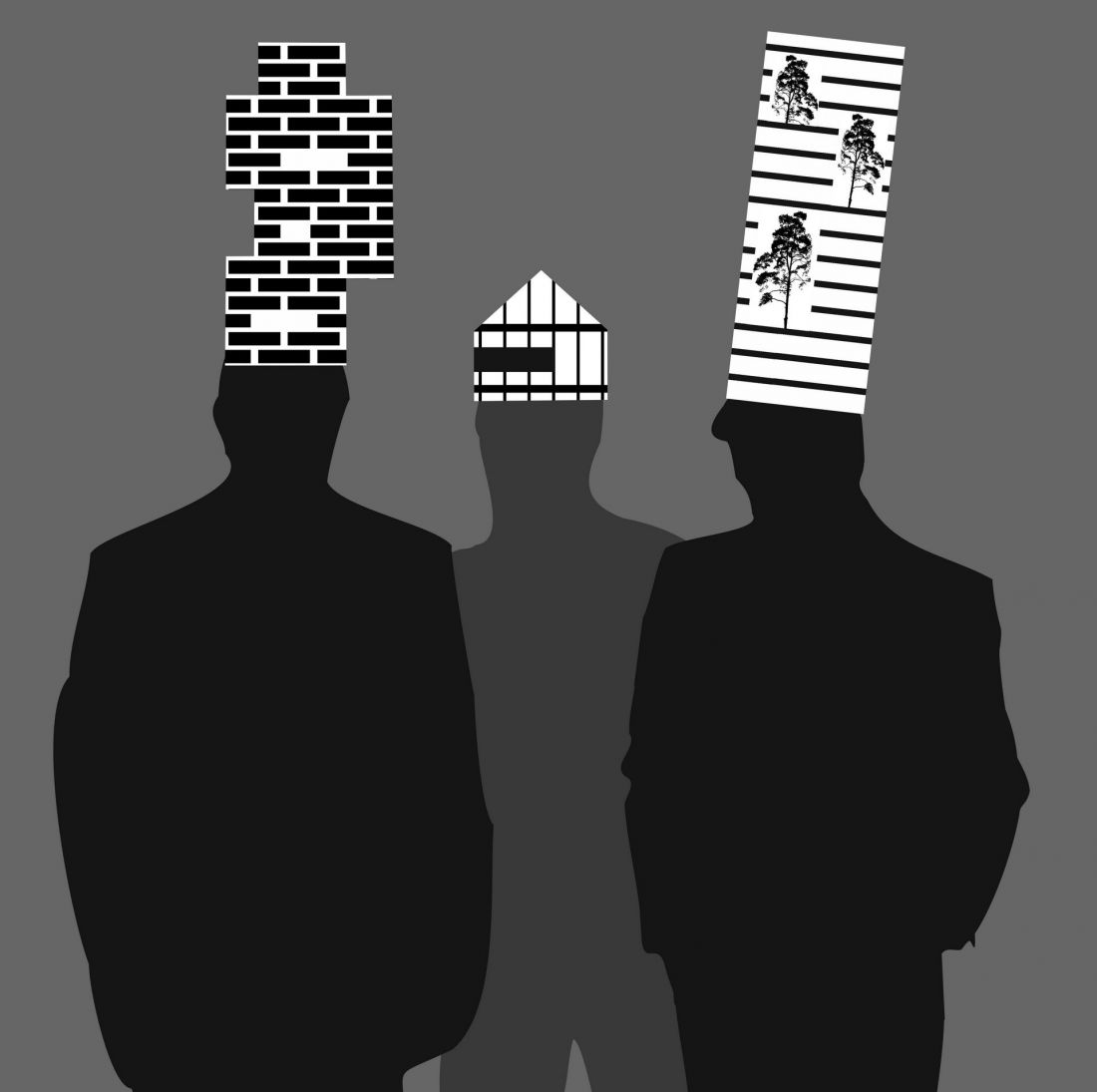
Architecture as cosplay
© Piotr Średniawa
costumed competitions
Having served as a judge in architectural competitions for many years, I was able to observe that the authors of competition entries repeatedly attempted to take a broader view of the competition task described in the terms and conditions, rather than just developing a craft-correct pragmatic answer. These works opened with pictograms or diagrams illustrating the idea that the authors were trying to develop in the design concepts. They very often referred to abstract manipulations of geometry or, much more interestingly, to spatial, cultural or natural contexts. However, these interesting explorations of inspiration, are usually poorly developed or lost in the later stages of the concept and difficult for the competition judges to read.
One wonders why it is so difficult to find and then consistently develop a concept based on accepted inspirations. Why do initial fascinations become so significantly diluted in the design process? One answer is the common phenomenon of dressing up in clothes that are not yours and pretending to be someone else. It is one thing to develop an idea and another to copy it without a deeper understanding. Reviewing the results of our architectural competitions, following the architectural concepts submitted to them, it is impossible to get rid of the association that they resemble cosplay costume contests more than a confrontation of original ideas and intellectual concepts. The winners, on the other hand, have most skillfully adapted some originality to local conditions, winning the recognition of the competition juries, consciously or not quite consciously participating in this game.
It used to be that contests had roles of exchange of views, discussions, not only on the subject of the competition, and this role was more important in addition to the purely instrumental function of selecting the best, or optimal, concept. The formatting and formalization of competitions under the Public Procurement Law has reduced this role to the detriment of creativity and discussion, usually reducing it to resentment lodged against the jury for a wrong choice. Also, the overly strict and detailed provisions of the terms and conditions of competitions, often underestimating the estimated value of the investment, do not encourage creative creations, but the search for a model that can be imported. A similar syndrome is also evident in the theses competing in various contests, which should be of great concern, as it accustoms young apprentices to take shortcuts already at the professional start.
Just like in cosplay or TV shows, all participants in this game of architecture pretend to have a great time and there is no reason to change the rules of the game in the next installments. Architecture is sometimes called, although increasingly rarely, which is to be regretted, the queen of the arts, and it may be worth recalling the royal connotations. In Hans Christian Andersen's fairy tale, a child shouts that the king is naked, and it may happen that some child whispers shyly that it is not a king, but a disguise.