




Autumn and winter expose the limitations of Poland's infrastructure, so it's worth remembering that a safe street is created when it is designed for different users and anticipates seasonal challenges. Shorter and shorter days, frequent autumn precipitation and returning by the side of the road is a horror movie scenario for pedestrians. This is especially true for children.
Designing safe streets means looking at the space from a child's perspective. After all, the youngest users of the city (because that's who children are!) experience space differently from adults. We often forget that streets are the largest public space and are a daily indicator of quality of life: they are the routes between school, a beloved playground, a park, lunch at grandma's, a visit to a friend's house or home.
It is comunicative to say that vehicle-subordinated routes dominate in Poland. It is also obvious to say that this makes parents fear danger. However, little is being done about it, especially thinking about the sprawling suburbs of doe urbanism.
what's happening in less dense housing
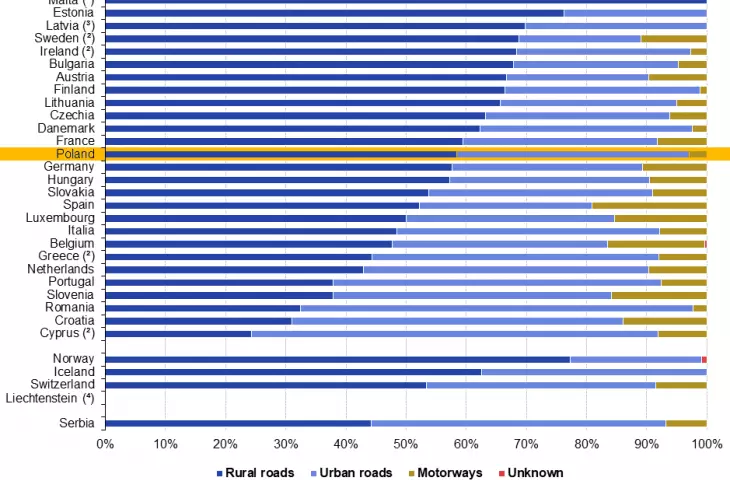
There is growing talk that speeds above 30 km/h should not be allowed on urban streets. However, what about the suburbs? If we look at the data, we see a clear disparity between urban and suburban roads. The greatest danger is not on highways, but on routes that run outside built-up areas. It is there that most fatal accidents occur, as drivers travel at high speeds and the space lacks basic elements to protect pedestrians, such as sidewalks, lighting and safe access to bus stops. At the same time, there is a clear correlation between vehicle speeds and pedestrian fatalities. Despite the fact that Poland has seen one of the largest declines in pedestrian mortality over the past decade, we still have an above-average record. Children have smaller and more fragile bodies, so they are particularly vulnerable to accidents.
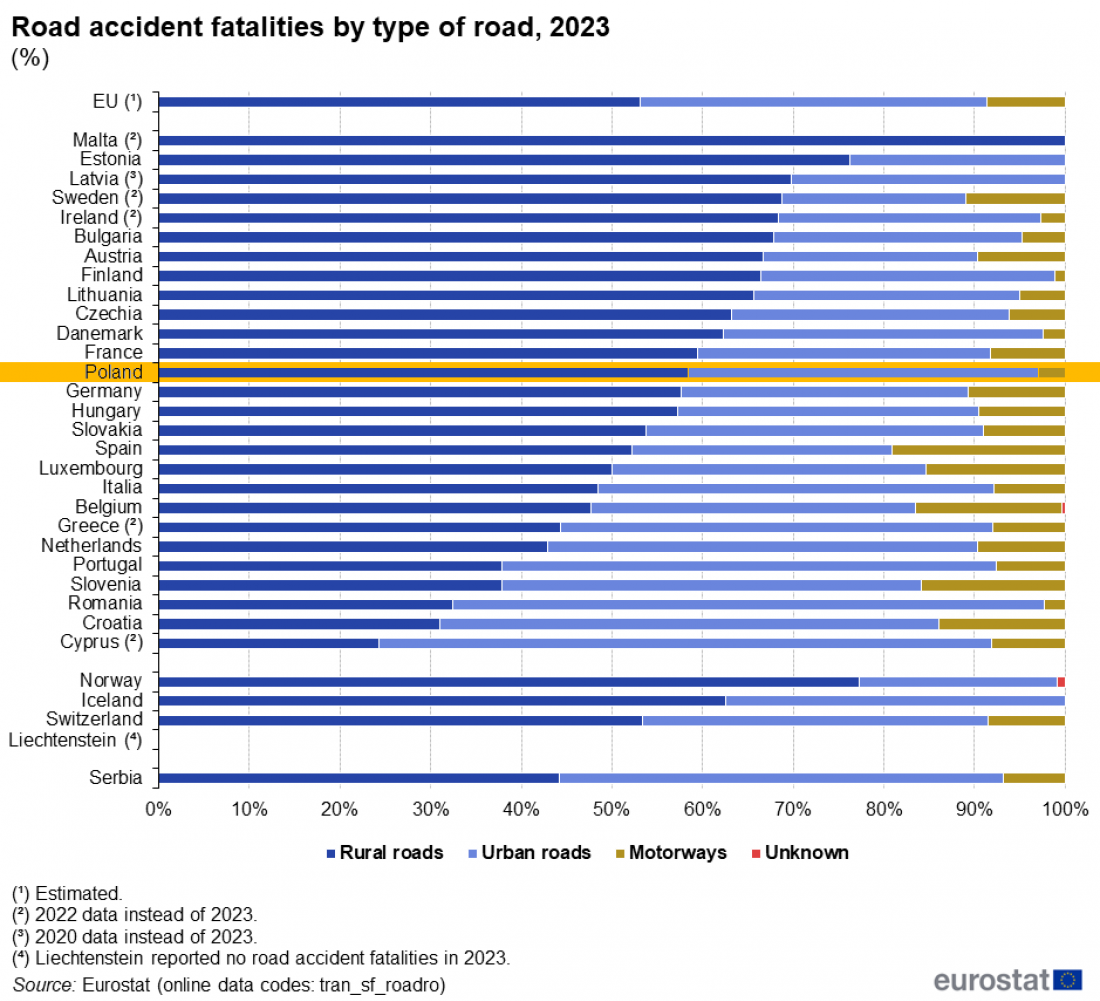
Road accidents by road type
© Eurostat
By law, wearing reflectors is mandatory only for pedestrians traveling after dark, outside built-up areas, not on the sidewalk. In built-up areas, reflectors are recommended but not mandatory. However, the fact that a reflector increases a pedestrian's visibility does not justify the very frequent shifting of responsibility to accident victims. If pedestrian infrastructure does not exist, there is no way to protect yourself, you need to rig yourself with reflectors to be visible in a public place, which is a road. A road that often leads to home.
The built environment can speak
Autumn or winter weather should be taken as a test of design quality. Shorter days, more frequent precipitation that worsens visibility are design guidelines that even dictate care for even lighting or contrasting element markings - especially if you are designing a notorious suburban home. Humans have the right to make mistakes, but the designed environment can guard against the typical ones. Creating spaces, including accesses and accesses, is a responsibility to ensure that such mistakes do not end in tragedy. As much as it begs to be reminded at this point of the Vision Zero design paradigm, which assumes that street design aims to minimize the effects of collisions. Narrowing traffic lanes, introducing speed bumps and clear crosswalks, and reducing speeds near schools can significantly reduce collisions.
The suburban sprawl in Poland and designing child-friendly streets sounds like a mission impossible. New neighborhoods are often built in a patchwork urbanism, with no schools, stores or recreational areas within walking distance, thus generating the need for parents to drive their child. Thus, the circle closes in on us - it's dangerous, everywhere is far away, so I drive my child, thus becoming what I want to protect my child from. Some hope is the amendment of urban planning to curb the emergence of cut-offs. It's also worth thinking about how we will age in such homes. After all, in an aging society, it is the needs of pedestrians that will grow, and it will be necessary (or is it already?) to adjust the infrastructure.
So plan for a dense network of sidewalks and bicycle paths, create service areas within walking distance, and definitely limit speeds on wide streets. If children are to reach schools actively, we can't talk about road sections without a sidewalk. Physically separating the sidewalk from the roadway, supplementing the pedestrian route with benches that also help the grandmothers who so often help take care of them, is creating a safe scenario and teaching independence to the youngest.
Street safety depends on a number of design factors, but few raise as much emotion as lane width. For years, the prevailing belief has been that the wider the lane, the safer the ride. Meanwhile, successive studies have challenged this intuition and indicate that safety does not increase with every additional inch of asphalt. Both very narrow lanes and overly wide lanes lead to an increase in collision risk. The lowest level of risk is reached at widths of about 3.1-3.2 meters, and after exceeding 3.3 meters the risk increases again.
Add that it is in wider lanes that maneuvers are made more abruptly, and drivers drive with less attention. In contrast, with moderate lane widths, it is easier to maintain a stable trajectory and react to sudden situations on the road. This is especially important in the suburbs, where streets have the character of main arteries and pedestrians (especially children) frequently cross them. A wider lane encourages faster driving, reducing the chances of avoiding a collision. It is also worth noting again that wider lanes do not increase the capacity of streets. It's those with moderate lane widths that handle traffic just as efficiently, while leaving space for sidewalks, bicycle paths or additional features to improve the quality of public space. Every inch of road comes at a price, so it's worth giving up space for a place where pedestrians feel safer and cyclists (of whom there has been little discussion here, but who are also very important!) gain stable riding conditions.
how the scenario was designed
In the design of suburbs, we are often limited to our plot of land, while MPZPs or WZki do not see that many of the newly developed neighborhoods were built under the assumption that the existing wide roadway would "handle" the traffic. In practice, this has led to, euphemistically speaking, a reality that is not very conducive to pedestrians, in which we have neither safety nor resident activity. Indeed, the wide lanes reinforce the impression that the street is purely a vehicular transportation corridor, rather than a shared space.
Meanwhile, the student/student route should be designed like a continuity, not a set of cool but unconnected fragments. What does this mean? First and foremost, the need to provide the entire scenario for getting to school: how do we get to the bus stop, how wide a sidewalk do we march on, how do these different sections look after dark, are they lit? Visibility is also a priority - the driver should be able to see the child even before he or she approaches the edge of the sidewalk. Therefore, it is recommended to move parking away from intersections, introduce elevated crosswalks and elements that naturally slow traffic.
If you look at such a scenario it becomes clear that a change in design standards is necessary. Instead of blaming pedestrians, it is worth analyzing particularly dangerous places and redeveloping them. I have a bit of a dream to make heatmaps of hazards, to design for where pedestrians actually move, not where the heavy hand of the designer has drawn the line, so that the budget shows spending on pedestrian infrastructure as well. I also dream to be bolder in testing solutions. For now, for Halloween in our country, you can dress up for Narrowing the Roads, Creating Woonerfs and 30 km/h Zones.
Autumn and winter don't have to mean an avalanche of accidents. When pedestrians become a priority, the elderly and drivers really benefit, as streets become clearer and traffic calms down. A dense network of crosswalks, good lighting and a speed limit make the color of clothing less important.