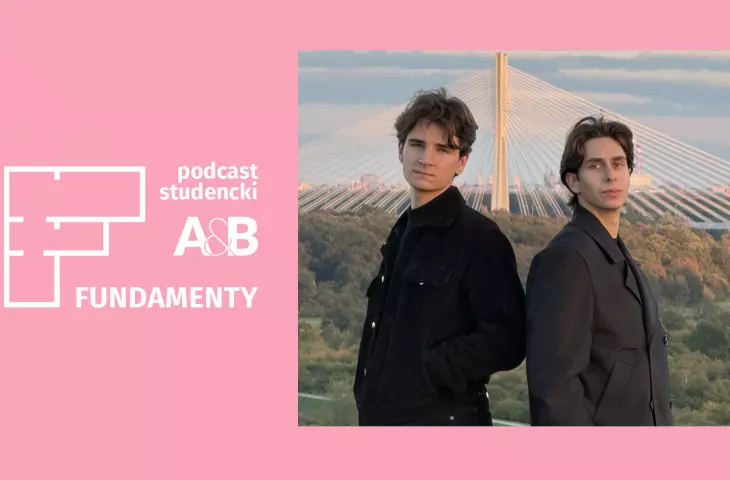

Wojciech Radzieja, Artem Gazhur —"
" podcast #75 from the "Fundamenty" series
This episode and the entire series are also available on SoundCloud and Spotify:


Is studying architecture really as difficult as people generally think? How do people’s perceptions of this field compare to reality, and what can you only learn through your first professional experiences? In the new episode of the “Fundamenty” podcast, Wojciech Radzieja and Artem Gazhur discuss stereotypes associated with studying architecture, their first internships, and the challenges students face.
Between Art and Technology
One of the topics of conversation is the belief that studying architecture means, above all, sleepless nights, an overwhelming workload, and difficulties passing courses. Wojciech Radzieja recalls that he heard similar opinions as early as high school, but his own experiences turned out to be much more positive. Artem Gazhur, in turn, points out the stress associated with starting a new stage of education and the need to tackle tasks that may initially seem difficult, such as designing one’s first building.
The interviewees also examine two extreme perceptions of architecture: as an artistic field or as a discipline dominated by mathematics and physics. In their view, neither of these perspectives fully captures the unique nature of the program. Architecture is primarily about creating space and understanding how buildings function, while drawing, technical subjects, and the natural sciences serve as tools for exploring it from various angles. As the guests emphasize, the diversity of this field allows students to gradually discover the areas that interest them most—from history and construction to design and new technologies.
First Internships and the Reality of the Profession
Wojciech Radzieja and Artem Gazhur gained experience in different areas of design. Wojciech focused primarily on residential and commercial interiors, while Artem ended up at a firm that designs factories. This second experience showed him just how different professional work can be from the assignments completed during his studies. In industrial design, the building’s function is of particular importance, whereas in college, a great deal of attention is also devoted to its form and aesthetics.
The guests also discuss the search for their first internships. One option is to use the recruitment system of the Chamber of Architects of the Republic of Poland; another is to contact firms independently through job portals, LinkedIn, or email. Artem mentions that, in his case, sending applications directly required a great deal of perseverance: out of about 80 messages sent, he received seven replies.
Competition and the Risk of Burnout
An important part of the conversation is the competitiveness present among architecture students. Comparing others’ projects, grades, and skills can motivate personal growth, but it can also lead to a feeling that one’s own work is never good enough. An additional challenge is the subjective nature of project evaluations, which can be analyzed from many different perspectives—both by instructors and by other students.
The interviewees point out that such an environment teaches students to accept criticism, but it can also generate stress and lead to gradual burnout. That is why it is important not to lose sight of one’s own interests in the constant process of comparing oneself to others. Architecture encompasses many specializations and career paths, and not everyone has to be equally good in all areas.
Wojciech Radzieja and Artem Gazhur encourage students to focus, above all, on finding what brings them satisfaction and to nurture their own passions during their studies. Their conversation shows that studying architecture is not only about challenging projects and acquiring technical knowledge, but also a time to discover the diversity of the profession, meet people, and gradually forge your own path in architecture.
Aleksandra Skorupa
Listen to other podcasts
from the “Fundamentals” series
67. Natalia Stateczna on her path to architecture, photography, and the power of good people
68. Internships in Denmark and Finland. Agata Jankowska on working in international architecture firms
69. The Life of a Young Architect: What Architecture School Teaches You
70. Justyna Dmytryk on her internship at Moke Architecten in Amsterdam
71. Petro Vladimirov on his internship at Henning Larsen
72. Martyna Lesisz on the realities of studying architecture
74. Zuzanna Rujna on architecture studies and the Erasmus program in Milan