




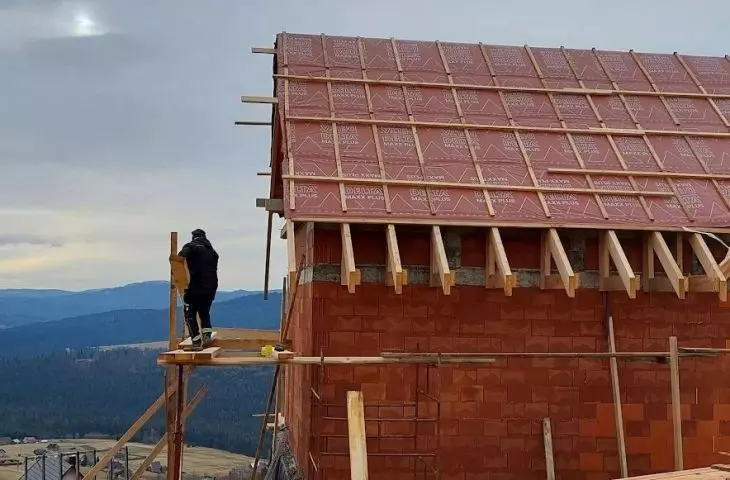

Buildings located in regions with specific climatic conditions are exposed to particularly harsh weather conditions. By the sea, the greatest challenges are strong winds and humid, salty air, while in the mountains, they are snow accumulation, freezing temperatures, and sudden temperature changes. These differences must be taken into account as early as the design phase, when selecting roofing materials, insulation layers, and solutions to ensure the roof’s watertightness. The underlayment plays a particularly important role, as it helps protect structural elements from water, wind, and moisture. However, the durability of a roof is not determined by a single material, but rather by a properly designed and constructed system of all layers, including watertight connection details.
As a part of the building directly exposed to the elements, the roof should be designed with consideration for factors specific to the location, such as strong gusts of wind, sudden temperature changes, or prolonged snowfall. Its purpose is to bear the load while simultaneously protecting the thermal insulation and structural elements from moisture. The design should therefore specify the cross-sections and spacing of the roof truss members, the method of connecting the roof to the rest of the building, the placement of fasteners, and the protection of areas particularly vulnerable to water and wind gusts. These structural solutions are complemented by the proper selection of compatible materials and the maintenance of the continuity of the vapor barrier on the interior side, the thermal insulation, and the underlayment beneath the roof tiles.
The Demanding Coastal Climate
The weather by the sea can change rapidly. Intense sunlight causes the roof surface to heat up significantly, after which rainfall or a cool night leads to its rapid cooling. Particularly high thermal loads can occur under metal roofing, which reacts quickly to temperature changes. Repeated heating and cooling cycles affect the performance of the materials and promote the formation of condensation on the underside of the roofing. For this reason, the design should take into account not only the roof’s watertightness but also the thermal resistance of the layers used and effective ventilation of the space beneath the roofing.
When there are large temperature differences, the stability of the underlayment’s properties and its ability to drain both rainwater and condensation are critical. For this reason, professionals turn to solutions designed, among other things, for use under ventilated metal roofing, where the thermal load on the membrane may be higher than under roof tiles. Such materials should maintain their properties at operating temperatures ranging from -40°C to +100°C and demonstrate resistance to short-term exposure to temperatures up to +150°C. Additionally, waterproofing can be an advantage, as well as integrated adhesive strips on both edges, which allow for the sealing of overlaps. However, the material’s specifications must always be considered in relation to the roof structure, the type of roofing material, and the method of installation for the entire system,” explains Piotr Pytel, technical advisor at Dörken Delta.
In coastal areas, heavy rainfall combined with wind can cause water to penetrate beneath the roofing elements; therefore, the underlayment should form a continuous surface that allows moisture to drain away. Properly designed ventilation is equally important—an unobstructed gap above the membrane helps remove moisture from under the roofing and reduces the duration of moisture exposure to the battens and counter-battens. An additional challenge in coastal regions is salt spray, which can accelerate corrosion of improperly protected metal components. For this reason, the corrosion resistance of fasteners, flashings, gutters, and accessories must be taken into account, as well as the material compatibility of the individual roof components. The membrane alone will not protect the structure if water penetrates through poorly installed flashings or if fasteners weakened by corrosion lose their integrity.
In the mountains: snow, frost, and meltwater
In mountainous regions, a roof may be burdened with snow for long periods, and the weight of the snow varies depending on humidity and compaction. The load is not always distributed evenly—wind creates snowdrifts at roof breaks, dormers, and higher parts of the building. The structure and its connections must be adapted to the conditions specific to the location, and the roof’s shape should minimize areas where snow is likely to accumulate. Measures must also be taken to protect people and lower-lying elements from sudden snow slide-offs.
Weather in the mountains is also highly variable, causing temperature fluctuations that result in the alternating melting and freezing of water. If heat from inside the building escapes through gaps in the vapor barrier or thermal insulation, snow may melt on the warmed sections of the roof and then freeze again near the cooler eaves. The resulting ice jams impede drainage and can force water under the roofing. To mitigate this phenomenon, the following measures are essential: continuous thermal insulation, an airtight layer on the interior side, and a properly ventilated space beneath the roofing.
The underlayment should maintain its performance at low temperatures and effectively drain water from melting snow. Details around flashings, chimneys, and skylights—where more water may accumulate—are also important. “The membrane should be installed without excessive tension, ensuring continuity and systematic sealing of overlaps, joints, and penetration points,” adds Piotr Pytel, technical advisor at Dörken Delta.
The specific characteristics of roof structures by the sea and in the mountains are examples illustrating that each location requires individual solutions. Local weather conditions must always be taken into account; only by correctly assessing the conditions, selecting the appropriate materials, and ensuring watertight details can a roof be created that is prepared for many years of service in variable weather conditions.
For more information, visit the {tag:Manufacturer} website on the A&B portal.