







There are two main types of air-to-water pumps on the market: split and monoblock. Although the principle of their operation is similar, they differ in design, installation method and scope of application. In what situations do they work best and what to pay attention to when choosing one?
What is an air-to-water heat pump and how does it work?
An air-to-water heat pump is a modern heating device that extracts thermal energy from the outside air and transfers it to a building's water system - heating both rooms and domestic hot water.
The air-to-water system works in conjunction with a water heating system - such as underfloor heating, low-temperature radiators or a DHW tank. This makes it possible to heat the entire house evenly and stably, as well as provide thermal comfort at any time of the year. In addition, many models also allow operation in cooling mode in summer, which increases their versatility.
Importantly, this process occurs even when temperatures outside are negative. The average seasonal efficiency ratio SCOP (which depends on the season and outdoor temperatures) usually oscillates around 3.5-4.5, which means that from 1 kWh of electricity the unit can generate 3.5 - 4.5 kWh of heat.
Split and monoblock - differences in construction and installation method.
Although both split and monoblock heat pumps belong to the group of air-to-water units, they differ in the construction of the thermodynamic system and in the way heat is transferred to the building's water system.
Split type heat pump
A split system always consists of two separate units: outdoor and indoor. The outdoor unit houses the key components of the thermodynamic system - the compressor, evaporator and expansion valve - which are responsible for extracting energy from the outside air. The indoor unit houses the condenser (plate heat exchanger), where heat is transferred to the building's water system.
Refrigerant pipes are run between the units, so the installation of a split pump requires the presence of an F-gas certified installer. The advantage of such a solution is, among other things, the possibility of placing the indoor unit in the boiler room or technical room, which provides convenient service access and better protection of hydraulic components.
Monobloc heat pump
With a monobloc, the entire refrigeration system - including the evaporator, compressor, expansion valve and condenser - is housed in a hermetically sealed outdoor unit. There is no need for refrigerant lines running to the inside of the building - water pipes are run into the house instead. This makes the installation of a monobloc pump simpler, faster and does not require F-gas certification, and the risk of refrigeration system leaks is minimized.
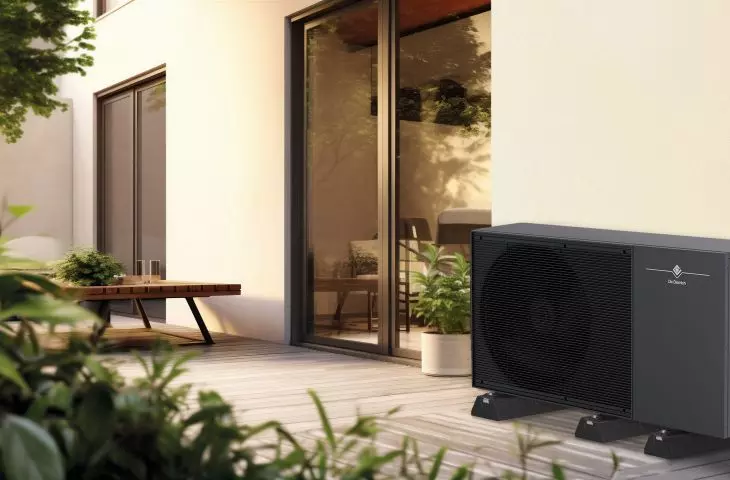
It is worth adding, however, that monoblocks may - but do not have to - be equipped with an indoor unit, whose task is to integrate the system with the home heating system, hot water storage or buffer system. An example of such a solution is the Alezio M R290 model by De Dietrich.
However, it is worth remembering that in a monobloc part of the water system runs outside the building, so it is necessary to properly protect it against freezing, for example, by using glycol or antifreeze valves.
De Dietrich offers high-end appliances of both types: Alezio M R290 as a modern monobloc with natural refrigerant , and Alezio S R32, HPI S and Strateo R32 as advanced split models - with different capacities and configuration options.
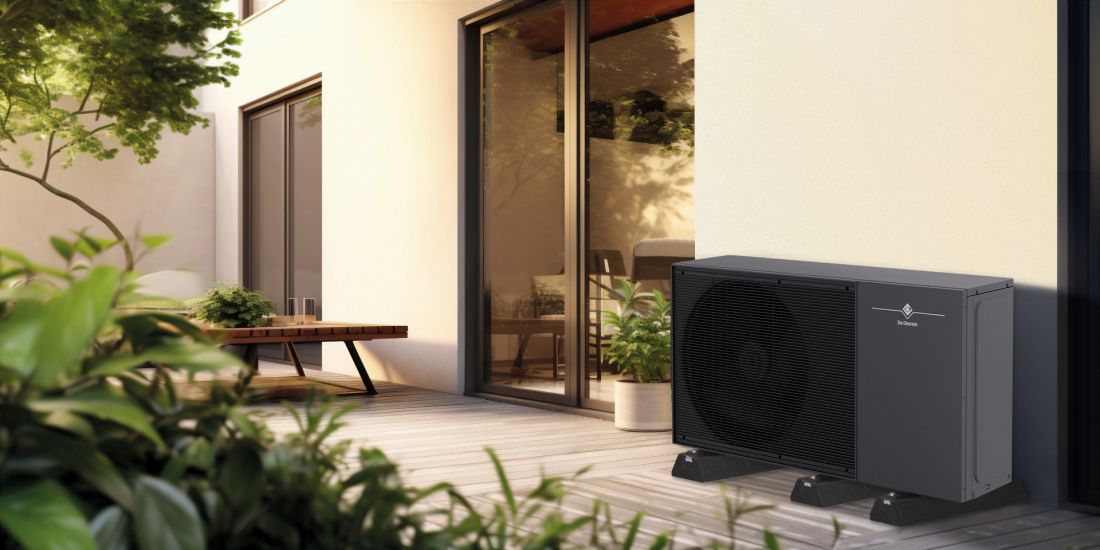
Alezio M Q0041
© De Dietrich
Air-to-water heat pump - investment and operating costs
When planning the purchase and installation of a heat pump, it is important to remember that in addition to the price of the unit itself, installation costs must also be added to the investment costs. Monoblock heat pumps have a structure enclosed in a single external unit, which simplifies installation and reduces its costs - the installer does not need to have F-gas licenses, and the whole procedure goes faster.
Split systems, on the other hand, require a slightly more complex installation - it is necessary to connect two units with refrigeration pipes and perform a leakage test. This type of installation must be carried out by a company with the appropriate authorizations, which can increase the initial cost.
What are the operating costs of heat pumps?
Air-to-water heat pumps - regardless of type - have high energy efficiency, especially in well-insulated homes with low-temperature heating systems.
According to a POBE analysis (June 2025), in a new 150 m² single-family house built to the standard of the "My Heat" program, the annual cost of heating (underfloor heating) and hot water production with an air/water pump is about 2,380 PLN (at the G12w tariff). For comparison - heating with a pellet boiler is an expense of about PLN 3,150, and with an electric boiler even PLN 6,950.
In buildings upgraded to WT 2017 standard, costs are higher, but still competitive - about PLN 3,790 per year for air/water pumps with underfloor heating (G12w tariff), which still places them well below the cost of electric heating or biomass boilers.
However, it should be remembered that the final heating bills depend on:
- insulation of the building,
- electricity tariff,
- the way the installation is operated and the number of household members.
Subsidies - how to reduce the cost of investment?
The cost of buying and installing a heat pump can be reduced thanks to available subsidy programs that promote ecological and energy-efficient heat sources. Investors building a new house or modernizing an existing building can take advantage of such programs as "Clean Air", "My Heat" or local initiatives supporting energy transition.
The "Moje Ciepło" program , aimed at owners of new single-family homes with higher energy standards, allows them to obtain subsidies for air-to-water heat pumps - both split and monoblock types.
The "Clean Air" program, on the other hand, is dedicated to modernization - it allows replacing an old furnace with an environmentally friendly heat source. De Dietrich heat pumps , such as Alezio M R290, Alezio S R32, Strateo R32 or HPI S, meet the energy efficiency requirements required by the programs and can be easily submitted for subsidies. It's also worth remembering that professional installers and authorized De Dietrich partners often offer assistance in preparing the application, which increases the chance of a successful application and speeds up the entire investment process.
Source: https://portpc.pl/analiza-pobe-pompy-ciepla-nadal-liderem-taniego-i-czystego-ogrzewania-budynkow/
For more information, visit the company's DE DIETRICH | BDR THERMEA POLAND Sp. z o.o. page on the A&B portal.