




#Architectural Education in Poland_Architecture Departments
Where can you study architecture in Poland? Which university should you choose? We asked students and recent graduates of Polish universities about what studying this field is like—what works, what poses a challenge, and what could be improved. Mikołaj Hewelt told us what it’s like to study at the Sopot Academy of Applied Sciences.
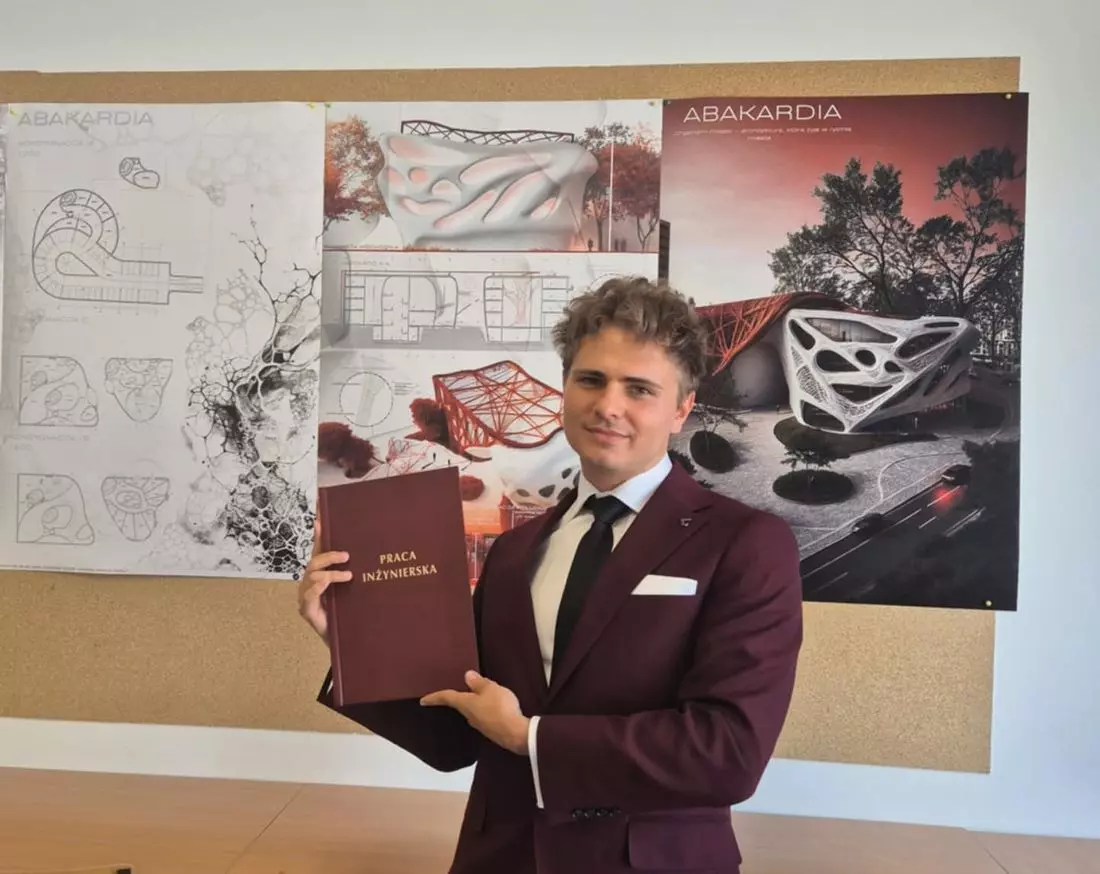
Mikołaj HEWELT— architecture student at the Sopot Academy of Applied Sciences. What interests him most about architecture are people and the relationships that help one thrive in this field. He naively believes that Polish architecture can still be good—out of the same need that makes him love Polish art: from Fangor and Beksiński, through Abakanowicz and Kantor, to Łempicka. For him, architecture is part of a larger, international, and inclusive creative family.
Everyone who begins studying architecture carries the thought somewhere in the back of their mind that maybe one day they’ll design like Zaha Hadid, Santiago Calatrava, or Antoni Gaudí. Not because they want to copy their forms, but because architecture always sounds like a promise of uniqueness at the beginning .
The reality of college, however, quickly brings us back down to earth. Architecture in college very quickly lays bare the ego—usually just when we’re most attached to it. And that’s a good thing, because it’s only after this lesson that we begin to work more freely. We do serious, responsible work, but this industry has a surprising amount of theatricality to it—it’s worth being able to see that before taking it too seriously. Before you start thinking about grand gestures, you have to learn to accept revisions, refine things that seemed finished, and repeatedly confront the fact that a project is a process, not a revelation. This experience can be painful, but it’s also incredibly formative.
And this is precisely where it’s worth noting: this isn’t a text about me. It’s rather a text about what allows architecture to survive at all, especially when visions diverge from reality. I’m studying architecture at the Sopot Academy of Applied Sciences, and I quickly realized that the strength of this program isn’t determined by the names in the textbooks or the courses I’ve passed. It’s determined by the people who are navigating the same chaos alongside you. Iga has an extraordinary ability to organize her thoughts when a project is in complete disarray. Maja brings a calmness that can defuse even the most stressful revision. Natalia shows up exactly when everything starts to fall apart, and Weronika reminds us that one failed version doesn’t ruin the whole journey.
Studying architecture together is a constant balancing act between ambition and exhaustion. Projects take shape amid conversations, laughter, and mutual support—often more important than yet another line drawn to scale. It is precisely in these relationships that the true value of these studies lies.
Architecture in college is often portrayed as a world of standards, dimensions, and deadlines. In practice, however, it is people who form the backbone of the entire process. Without them, even the best design would never make it to the completion stage. And perhaps this is what architecture studies teach above all else— that before you begin building forms, youmust learn to build relationships.
Mikołaj HEWELT
more: A&B 2/2026 – Education,
download free e-issues of A&B