





"Once upon a time in the American desert, where the sand parched feet at noon and the night sky shone with thousands of stars, a mighty man wished to erect a city unlike any other. He gave it the name Telos, which in ancient speech meant "higher purpose." He wanted it to be a place where people live in harmony, share the gifts of the earth and enjoy justice."
- This is probably how Marc Lore imagines the story of his city. After all, this multi-billionaire has dreamed of creating something that supposedly hasn't existed until now - a city of the future. He also painstakingly wraps his story in the myth of the American dream. We live in a world of fairy tales and stories, the spinning of which now steals and fuels marketing.
Lore announced the intention and willingness to take on the project in September 2021. From the beginning, it aroused interest, after all, it's not every day that you hear about someone wanting to put up a huge city from scratch, and in such a short period of time. The ambitious vision is for Telos to be inhabited by 5 million people as early as 2050, on an area of about 150,000 acres (equivalent to 600 km²), with the first 50,000 settling as early as 2030. Admittedly, in 2025 further the whole project exists only on paper, with no indicated location, but rest assured, all press materials maintain that the first residents could move in as early as five years²-³.
Where to create such an investment? From an economic perspective, of course, the best place is where land is cheap. Initially, the vast wilderness of the US Southwest (Nevada, Utah, Arizona, Texas) was considered, but sometimes the Appalachian region was also mentioned.
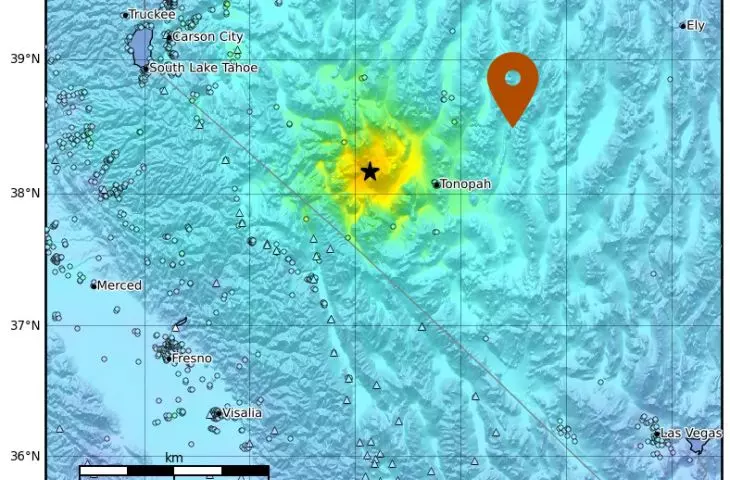
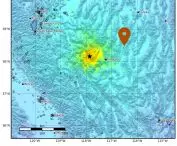
For what it's worth, on the website of the designer, Bjarke Ingels Group, which describes the Telos project, we can find a pin located in east-central Nevada, roughly between Las Vegas and Ely. Nowhere else can we find information about this location.
The area of east-central Nevada, indicated on the BIG map, lies in one of the driest regions in North America. Most of the land is owned by federal agencies. Local towns such as Ely, Eureka and Tonopah base their existence on mining. There are disputes over the exploitation of raw materials, especially gold and lithium, including the impact on the environment (including unique plant species) and the... availability of ground water. Not without reason. The region has an arid climate and limited surface water resources, so the primary source of water remains groundwater. It is what supports local agriculture, livestock, natural habitats and communities in the area.
Aquifer basins have seen systematic declines in water levels over the past decades. The causes are both natural factors, such as prolonged droughts, and human activities, including (shock!) water use for mining and agriculture. Studies indicate that the depletion of groundwater resources is ongoing and is becoming an increasing challenge to water supply, ecosystem protection and sustaining local livelihoods. Official government communiqués emphasize the need for careful management and monitoring of water levels to limit the serious or even irreversible effects of declining groundwater levels and their impact on the ecosystems that depend on these resources in such a dry environment. As if that weren't enough, the region is simultaneously grappling with a warming climate, extended fire seasons and smog, as well as seismic activity - an earthquake of magnitude 6.5 was recorded less than 100 kilometers from the designated location in 2020.
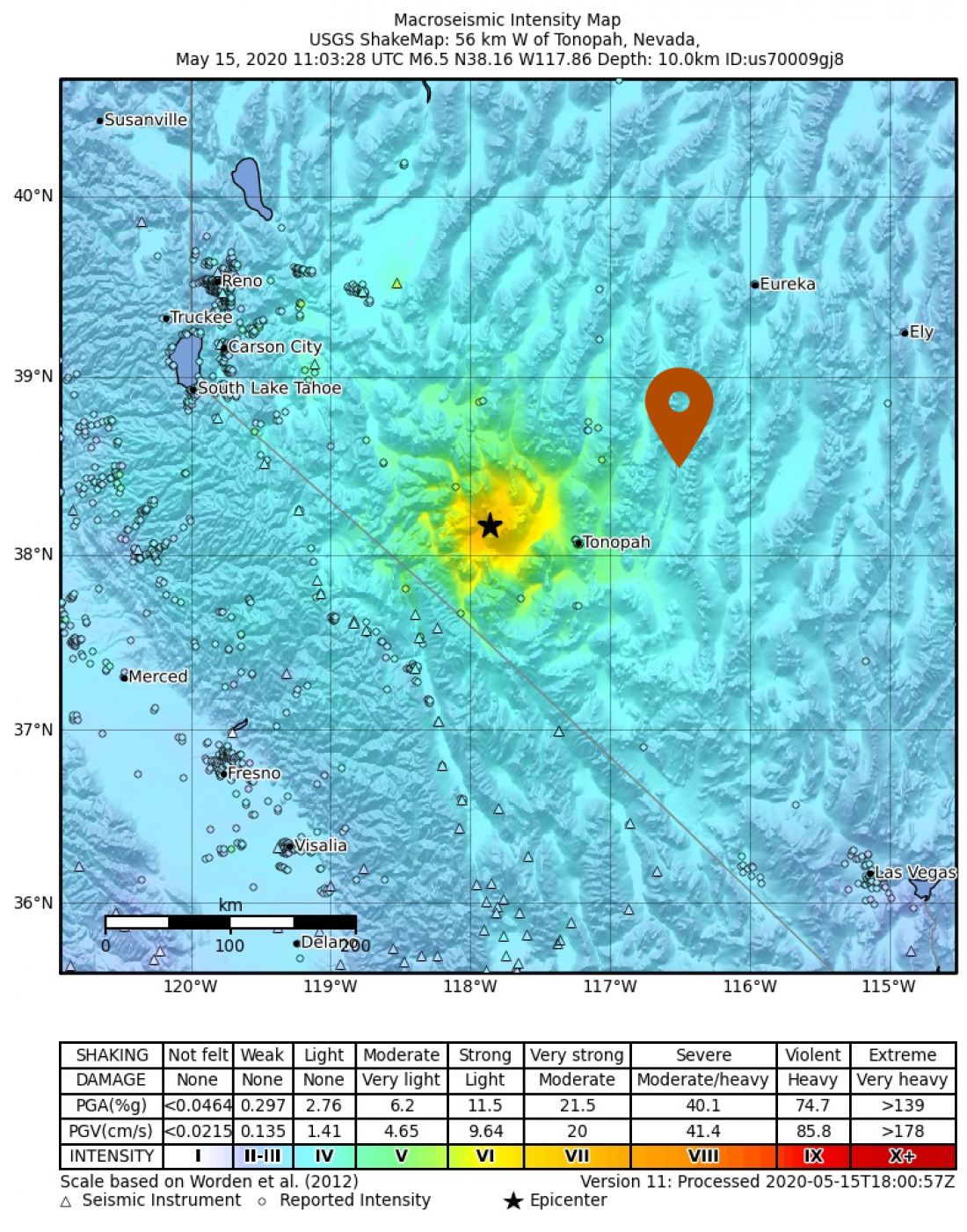
Nevada - Telosa location against 2020 earthquake - The May 15, 2020 Nevada earthquake intensity map shows the area of the planned Telosa (location from the BIG website) against the region's seismic hazards.
USGS | © earthquakes.utah.gov
promises of a city of the future
One may wonder why the name for such a project. Telos sounds rather enigmatic. However, as befits a real city, it must have strong and decent roots. So the name comes from the Greek (for how else!) telos meaning "higher goal." Well, yes, aspirations.
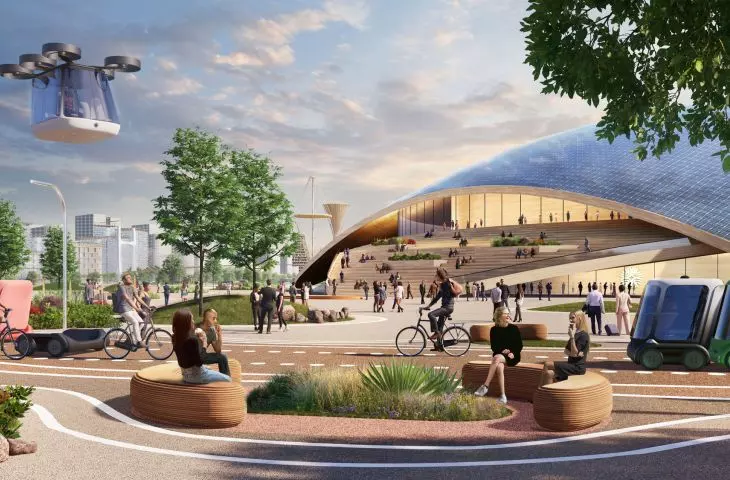
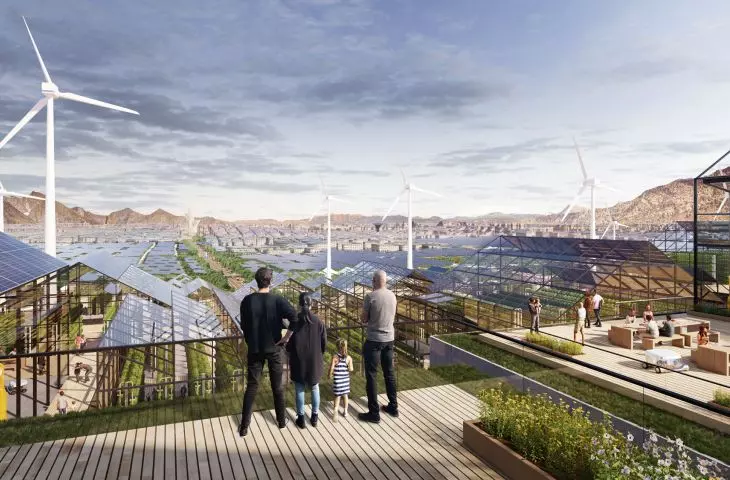
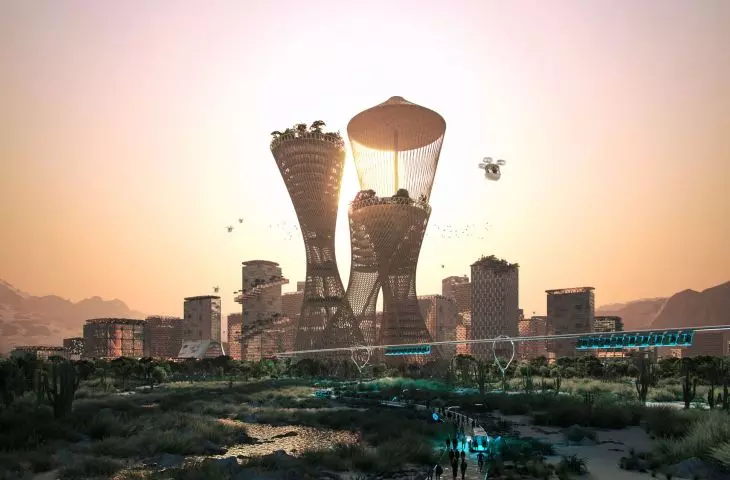
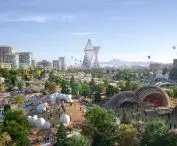
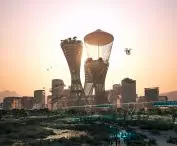
The creators of Telos promise a metropolis like never before (have we accidentally heard that somewhere before?). Promises include a human and nature-friendly space - the city "establishes a global standard for urban living, develops human potential and becomes a model for future generations." Promotional materials emphasize that energy is to come exclusively from renewable sources, and water will be stored and reused multiple times through retention and recycling systems. Urban planning is to be based on the concept of a15-minutecity: schools, workplaces and services will be close enough that commuting by foot, bicycle or autonomous electric vehicle will take no more than a quarter of an hour. A futuristic tower with vertical aeroponic farms, water tanks and photovoltaic panels has been placed in the center, all bathed in greenery. Lore also promises free education, healthcare and recreational infrastructure, open to all regardless of income.
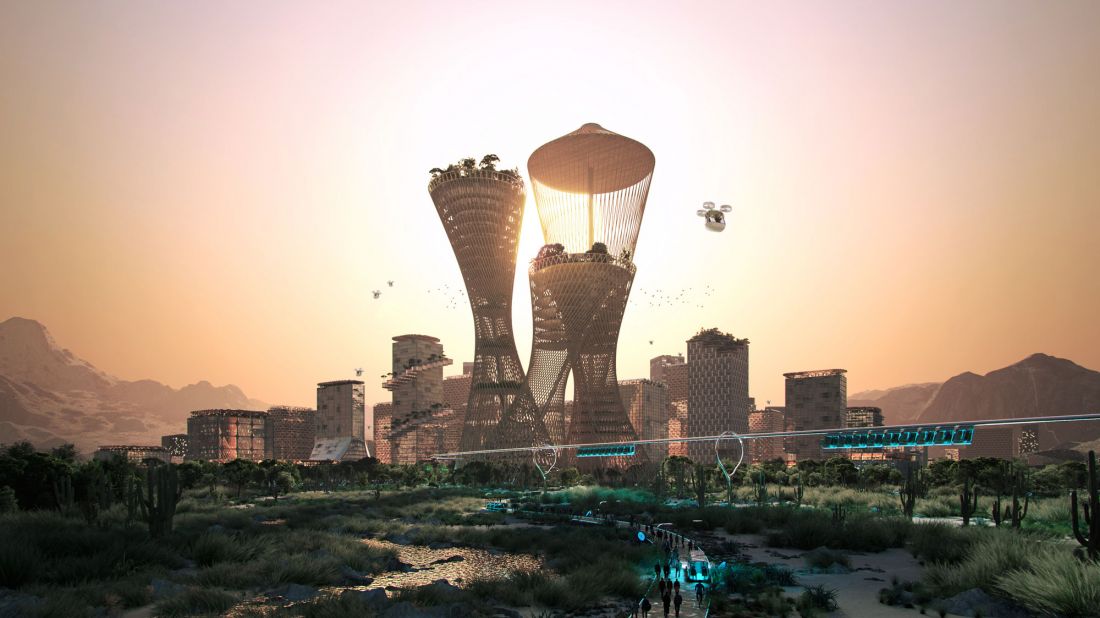
Telosa - the iconic tower of the city of the future - Telosa's distinctive tower, inspired by nature, is to become a symbol of a metropolis built in the desert.
Telosa, City Images | © cityoftelosa.com
The new city is also to be a "living laboratory of technology." There are visions of autonomous vehicles, logistics warehouses invisible to the eyes, high-speed "sky rail"(Sky Tram) and micro-grid infrastructure. One guess is that this is meant to show that high standards of living can be combined with climate neutrality, while developing cutting-edge architecture, energy and transportation solutions.
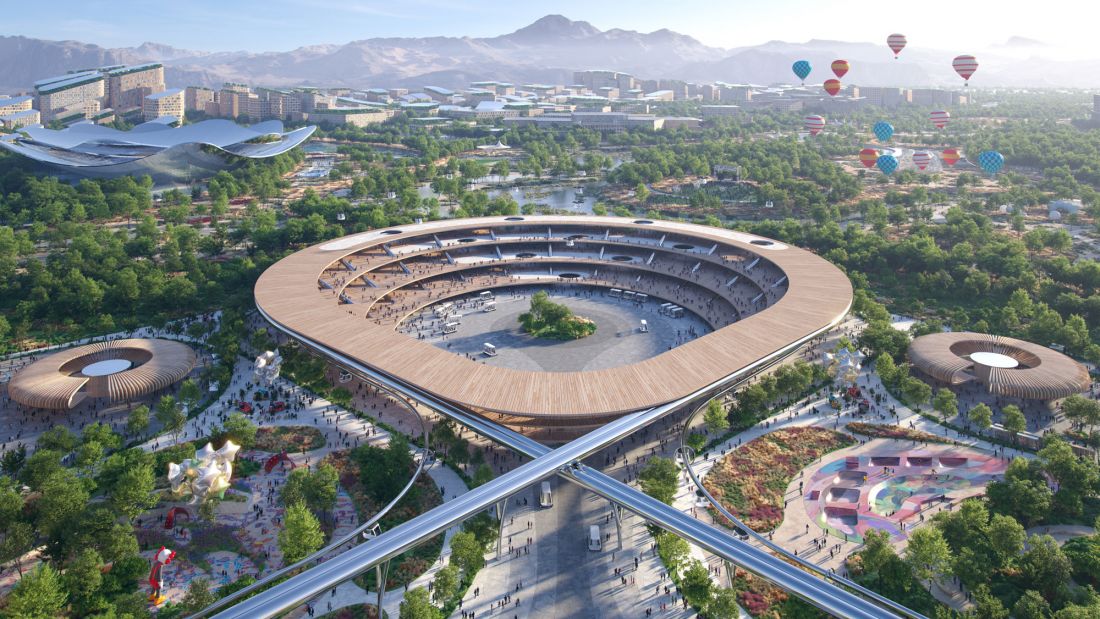
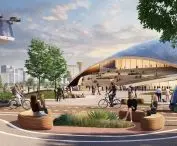
Telosa Mobility Hub - a modern transportation hub - Telosa's Mobility Hub project involves the integration of autonomous transportation, pedestrians and green spaces.
Telosa, City Images | © cityoftelosa.com
It may also be worth mentioning that a selection of Telosa's first "settlers", selected from the submitted applications, is to take place. It is to be conducted so that they form a diverse community, not only in terms of race or culture, but also in terms of occupation and worldview. Perhaps selection doesn't sound so much like an "invitation" to settle here, but what else to call literally selecting future residents?
"Equitism" protocol
One of the pillars of the project is Marc Lore's original idea called Equitism, which derives from the thought of 19th-century economist Henry George (georgism), the belief that people should have a right to goods produced by their own labor. In Lore's interpretation, land becomes the property of the municipal foundation, so there is no private ownership of land. Residents can only buy and sell property erected on the land. The increase in the value of the land, resulting from the city's development, feeds into a common fund dedicated to public services - from schools and hospitals to transportation and green spaces. Lease revenues and profits from the increase in land value support social and environmental infrastructure, and residents share only a portion of the increase in property value when they sell, with the rest going back into the common pool. This arrangement is intended to counteract the concentration of capital in the hands of landowners or speculators and reduce wealth inequality, as the benefits generated by the land are distributed to all residents.
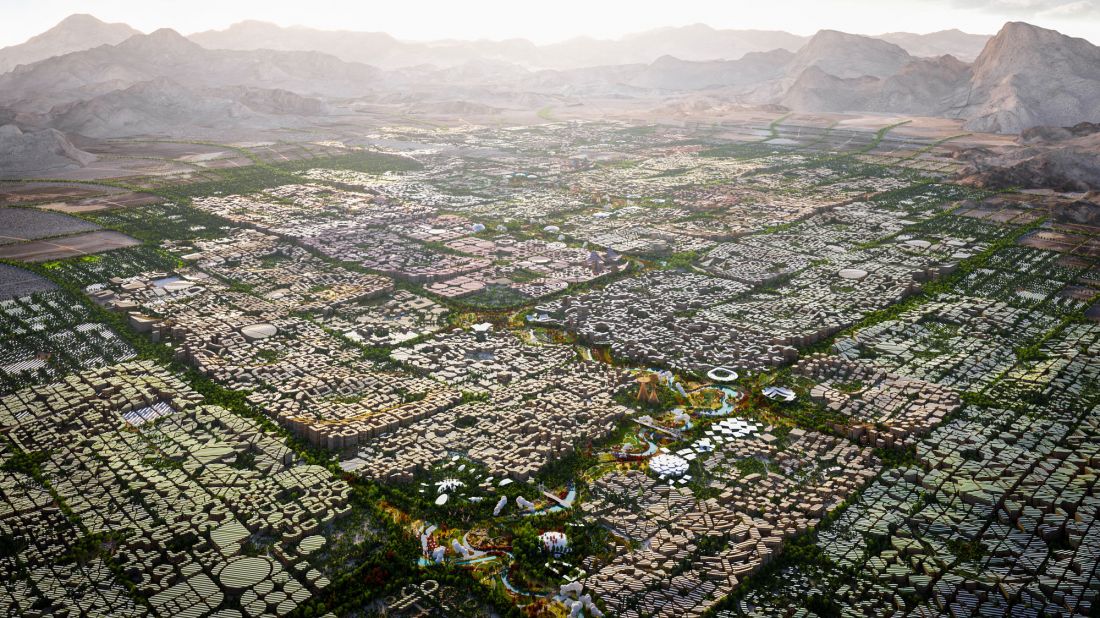
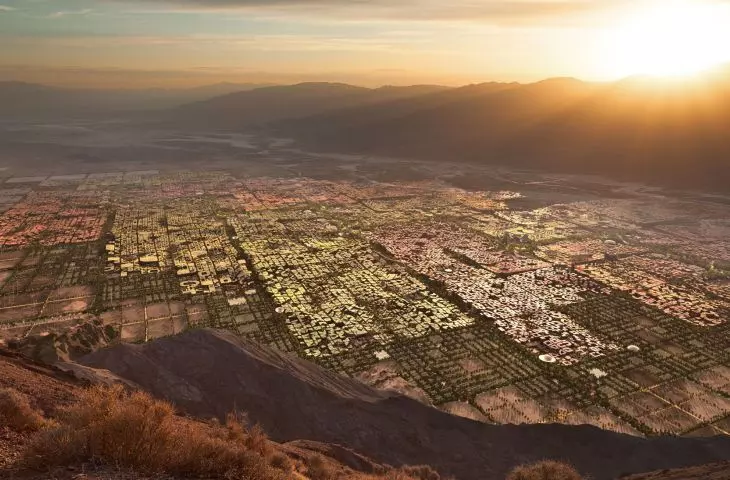
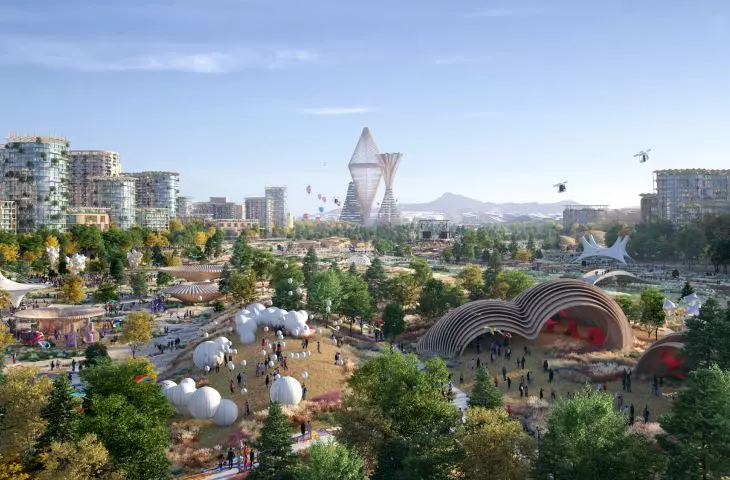
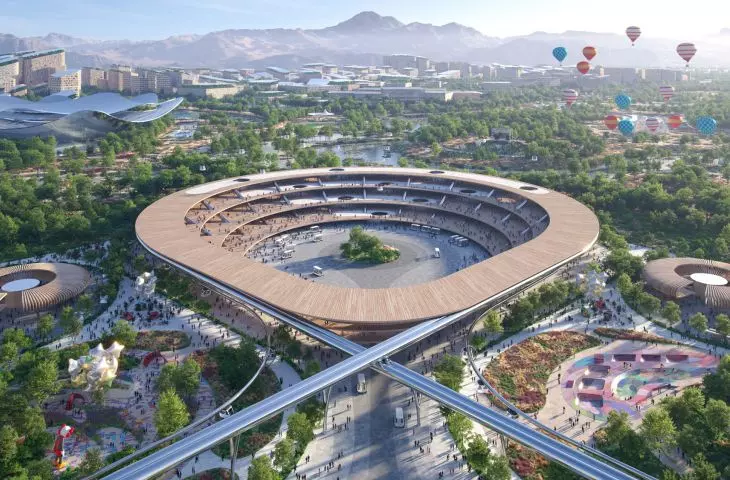
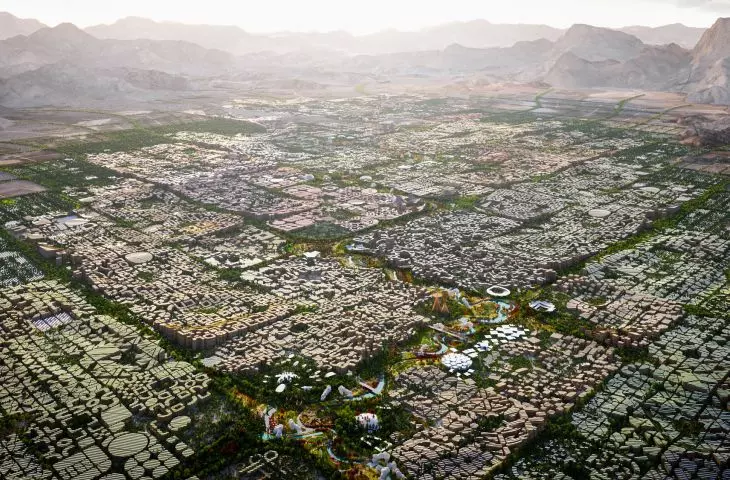
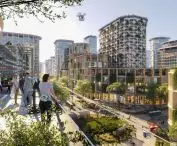
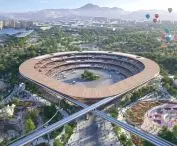
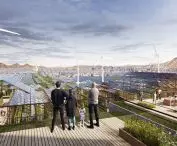
Telosa - aerial view of the city center - Telosa's aerial panorama shows an urban plan with green spaces and futuristic buildings.
Telosa, City Images | © cityoftelosa.com
The idea of Equitism, combined with new technologies, is to create an alternative to classical capitalism. Lore argues that a prosperous Telosa could thus contribute tens of billions of dollars each year to common causes. The city's official website announces the introduction of a city charter, the establishment of a representative council and the implementation of a participatory budget, although these documents are only conceptual for now.
However, there are numerous difficulties associated with the implementation of such a model. It requires a huge initial outlay, as the purchase of large tracts of land by investors and philanthropists, and their subsequent transfer to a city foundation, means that massive capital must be raised. Implementing such a far-reaching change may also face legal and political obstacles. Property rights are deeply rooted in the U.S. Constitution(Bill of Rights), including interpretations of the Fourth Amendment, protect individual rights to property. Interfering with this system would require a change in the law or a very creative workaround, and would probably meet with institutional opposition. Although it would probably depend on who is currently steering the legislature.
tight schedule
Plans call for a three-phase expansion: phase I (around 2030, or as early as five years from now) for a population of 50,000, phase II with expansion to 1-1.5 million people around 2040, and phase III with a target population of 5 million by mid-century³. The entire development is expected to cost up to $400 billion.
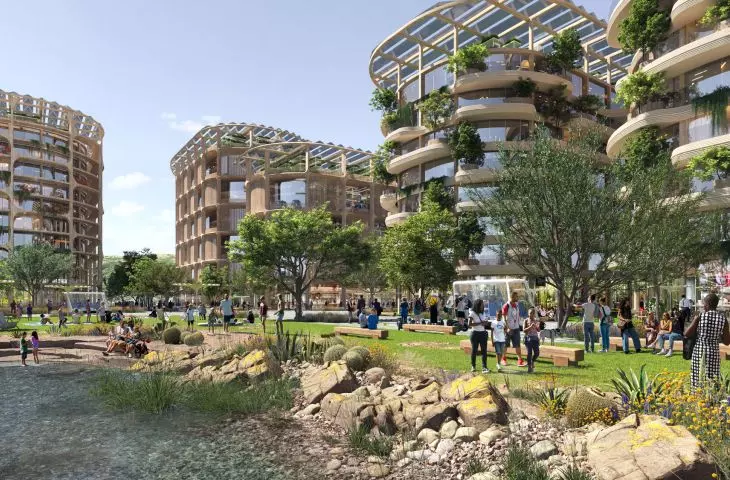
Visualizations show the place as brilliantly planned, with wooden architecture filled with greenery. Only... it's further building in the desert. In such a climate, water is the most precious resource - creating a new city in a place where it is scarce forces expensive desalination or import of this water and requires huge infrastructure and political arrangements¹. We know that it is already a huge problem to obtain water, what about when an entire city is created in such a place.
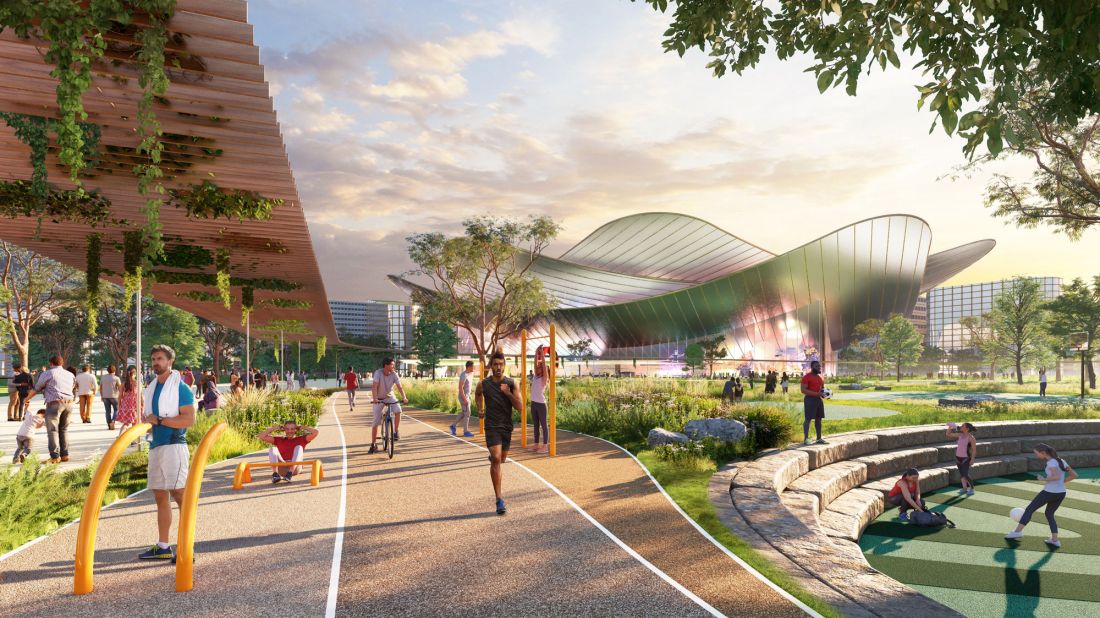
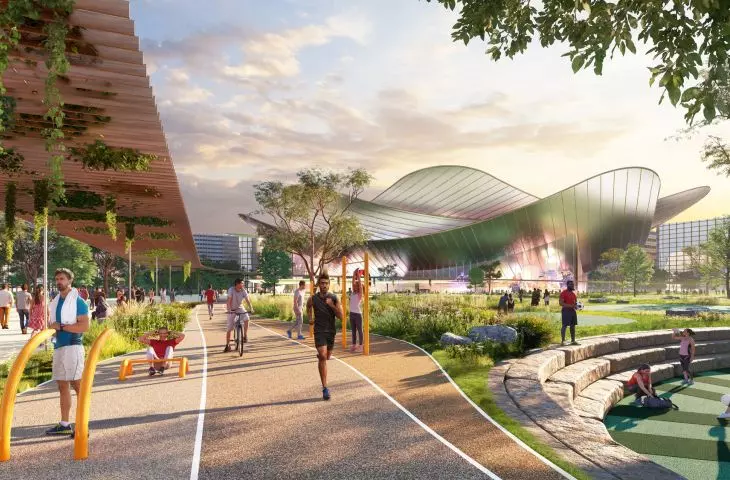
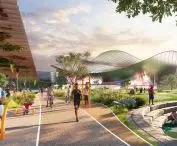
Sports Village in Telos - sports and recreation in the city of the future - The Telos Sports Complex combines modern facilities with green recreational areas.
Telos, City Images | © cityoftelosa.com
In an article on the subject, researcher Sharon B. Megdal, director of the University of Arizona's Water Resources Research Center, said that providinga reliable water supply for Telosa will be difficult. The alternative seawater desalination idea, meanwhile, has a high carbon footprint and generates a brine disposal problem (I write this as a Vietnamese by birth!).
In the case of Telos, these issues are presented as an issue that can be solved with a few equations, but leaving out a certain unknown - quite specific political and hydrological constraints. At the same time, this does not interfere with the declaration regarding the closure of the water cycle, and this with the projected drought crisis on the Colorado River, the closest to the site.
And the city is not only what can be seen - after all, the bulk of the infrastructure is invisible. It's not hard to think that the size of the project will generate huge emissions related to the production of buildings, roads and all the rest, but also the transformation of the environment. We are talking about establishing a city on the root, without an inch of any civilization.
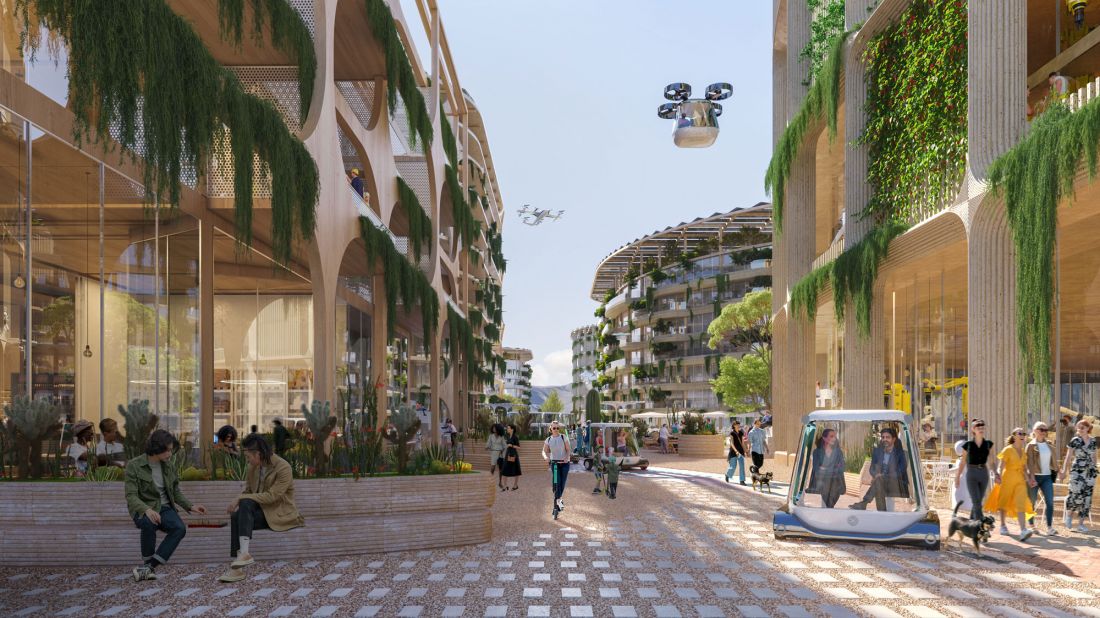
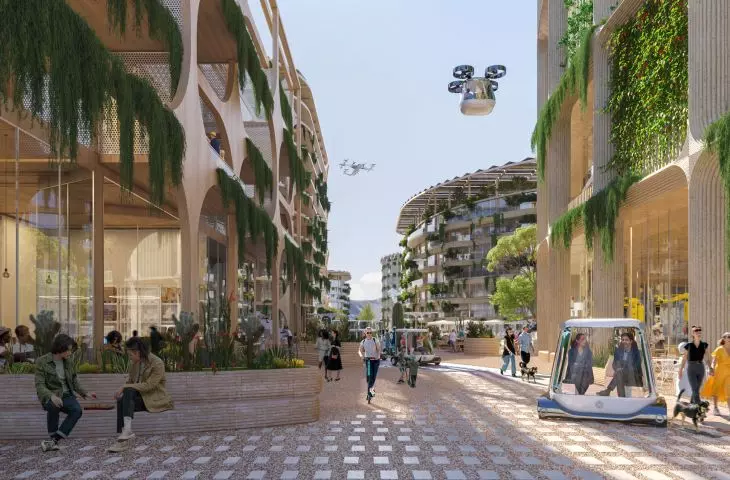
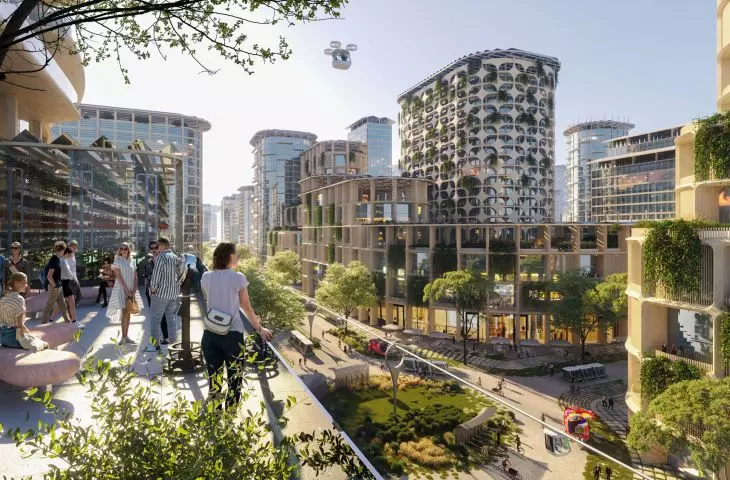
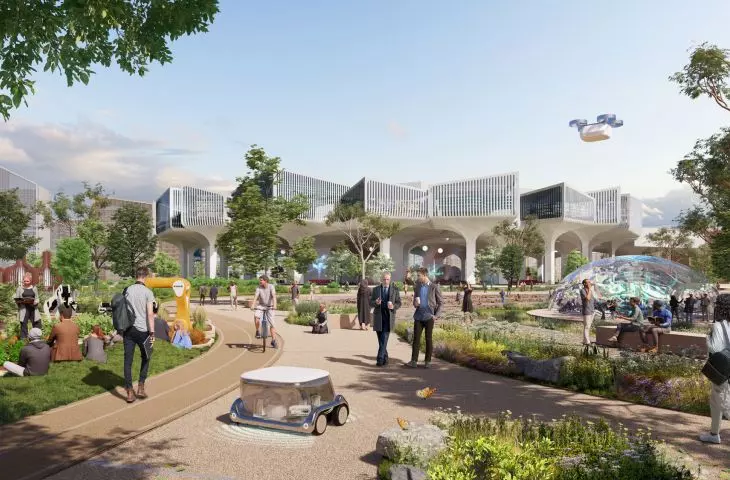
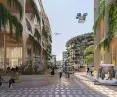
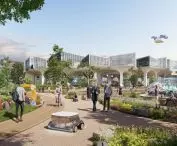
Telosa Shared Street - a shared street for pedestrians and autonomous vehicles - A visualization of a street in Telosa shows green buildings, pedestrians, cyclists and modern autonomous vehicles.
Telosa, City Images | © cityoftelosa.com
In marketing, as in a fairy tale - it's much easier to talk about operational neutrality than to actually count its huge carbon footprint resulting from overall construction. Take, for example, Abu Dhabi's notorious Masdar, which finally abandoned its dreams and declarations of being a zero-emission and zero-waste city when confronting reality proved too costly⁵.
The myth of the "greenest city"
The enthusiastic slogan that Telos will be "the greenest city on earth" should raise skepticism. Building a multimillion-dollar agglomeration in a desert landscape requires not only better technology, a more sophisticated engineering approach to construction on this kind of land, but most importantly (again!) access to water and water rights.
Historically, attempts to create new cities or utopian communities (from Brasilia to smaller projects) have often failed. Take, for example, the experimental desert city of Arcosanti, Arizona, established in the 1970s. It was created as the "World's First Prototype of Arcology," a combination of the words and meanings of architecture and ecology. It was meant to offer an alternative to urban sprawl and was designed with 5,000 residents in mind. Today, it has only about 70 people (some say as few as 50). The project, started by Paolo Soleri, is admittedly still an experimental urban laboratory, but also largely simply a tourist attraction. The main reasons for the failure of the original goals are the incompatibility of Soleri's vision with practical execution, labor-intensive construction methods, and conflicts and restrictions that hinder expansion.
The aforementioned Masdar project in the United Arab Emirates, which was promoted as arguably as magnificent as Telos, technologically saturated, climate-neutral and car-free, simply turned into a more conventional, slightly more low-carbon neighborhood over time.
One can see in this a pattern of "green accounting," in which the first energy bill is skipped in favor of the promise of future savings. It encourages the implementation of renewable energy sources or energy efficiency upgrades by prioritizing anticipated future gains over initial costs[1].
hedonistic ecology
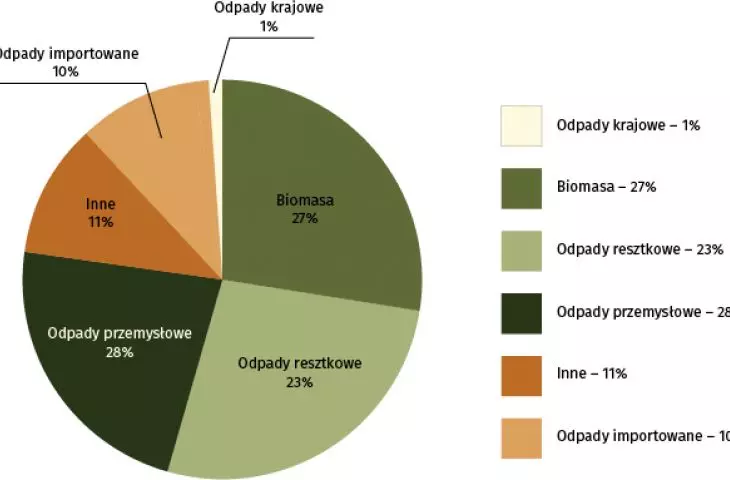
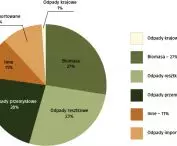
Let's take another look at the Bjarke Ingels Group's portfolio of projects - one recent development, the CopenHill waste incinerator in Copenhagen, which features a ski slope on its roof, is presented in promotional materials as an attractive combination of recreation and clean energy. However, a report by Zero Waste Europe argues that the installation is oversized. They portray the facility critically, describing it as a controversial project that contradicts zero waste principles. From the outset, it calls Copenhill a "Danish failure" and a "technical and financial fiasco," pointing out that the plant relies on burning waste, including plastic, which creates carbon emissions and contradicts climate goals. The ski slope has made the plant unnecessarily large, and the fact that Copenhageners don't produce enough waste means the plant has to import waste, especially from the UK, thereby exacerbating environmental and financial problems. Zero Waste Europe notes that incineration at Copenhill increases CO2 emissions and contradicts the city's climate ambitions and zero waste strategy.
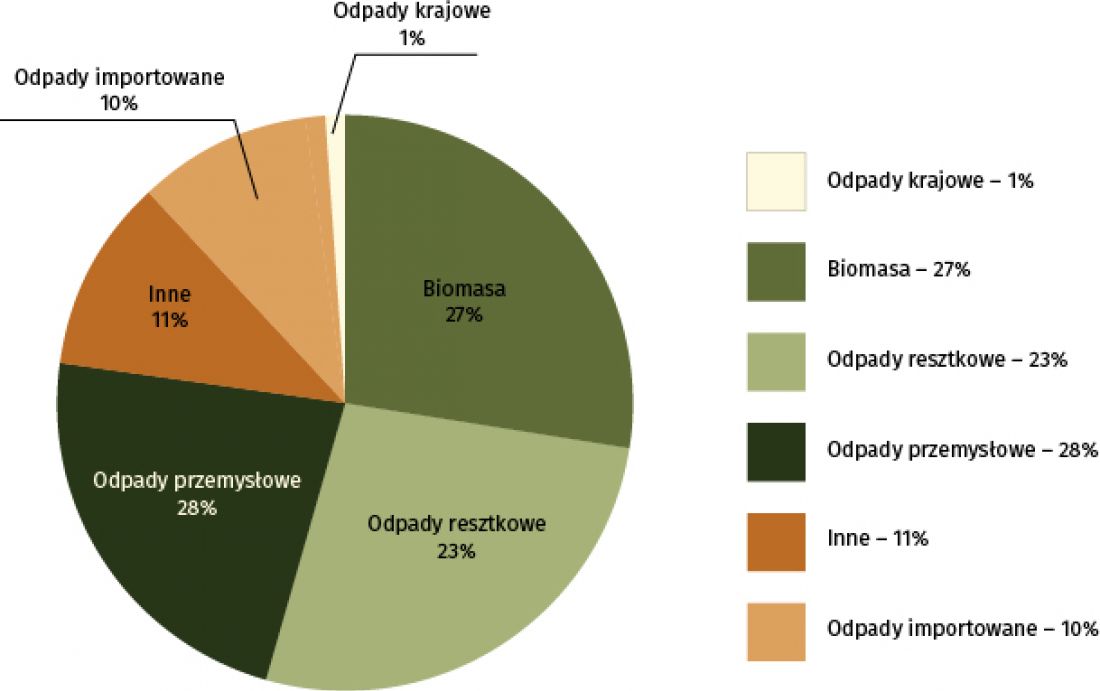
Copenhill - Waste structure in combustion - The pie chart shows the share of biomass, industrial, residual and imported waste in combustion at Copenhill's Copenhill CHP plant in Copenhagen.
Compiled from IEA Bioenergy, Task 36 | © ieabioenergy.com
Telosa makes eager use of images inspired by a narrative in the genre of promoting "pleasant ecology." Critics, however, speak of aesthetic greenwashing: spectacular attractions obscure problematic infrastructure and years of dependence on trash burning.
something about resident participation
BIG is keen to emphasize community participation in its projects. A flagship example is the Superkilen park in Copenhagen's Nørrebro neighborhood, which brings together objects from dozens of cultures. However, researchers Deniz Balık Lökçe and Gökhan Balık show that Superkilen is primarily an instrument for creating the city's image, reproduced in the media as a colorful installation, rather than a true community space. The authors point out that the park was created as a form of marketing - a "photo-friendly installation" - and that the mass production of photos highlighting multiculturalism does not reflect real community relations. As a result, the project functions more as a visual identity than an element of multicultural co-creation of the city. Repeating this example as evidence of authentic participation is therefore a logical fallacy.
pragmatic utopia
Bjarke Ingels calls his design philosophy a "pragmatic utopia," in which architecture is meant to act as a mediator between conflicting political, social and economic interests. He has a belief that architectural designs can integrate diverse groups and offer a vision for an optimistic transformation of reality. Ingels strives to bring stakeholders with radically different views and expectations into the design process, and then bind these tensions together in the form of spectacular ideas designed to provide a sense of consensus and arrive at a common goal. However, it is increasingly pointed out that such a strategy is simply opportunism. Instead of openly confronting problematic orders, the rhetoric of compromise is used, while providing showy and often exaggerated spatial forms.
To put it bluntly, accepting projects regardless of conditions (including political ones) even involves accepting orders under questionable conditions, and the slogan of "improving the system" becomes a convenient justification for cooperation.
marketing versus reality
In the Telosa renders we see only pedestrians, bicycles (recall, in the desert!) and autonomous electric vehicles - combustion cars are to be banned. Telosa became a high-profile media topic long before construction began. Editors have managed to describe it as both a "green Las Vegas" and a "billionaire's vanity project."
Obviously, an extensive PR campaign is attracting the attention of investors and potential residents, even though logically we should sense the enormous problematic nature of such projects. Take, for example, the recent high-profile The Line at NEOM project. Marketing ahead of specifics is a planned halo effect. In a documentary released by the Discovery Channel (!), architects including Thom Mayne and Peter Cook (!) describe The Line as a new vision of urbanism, outright calling it "the new Babylon" or "the most extraordinary work of the early 21st century." The idea itself - a linear megastructure stretching 170 kilometers - is presented as a response to the crisis of previous forms of urbanization. The narrative builds an aura of uniqueness, emphasizing the supposed boldness and experimentation that are supposed to distinguish the project.
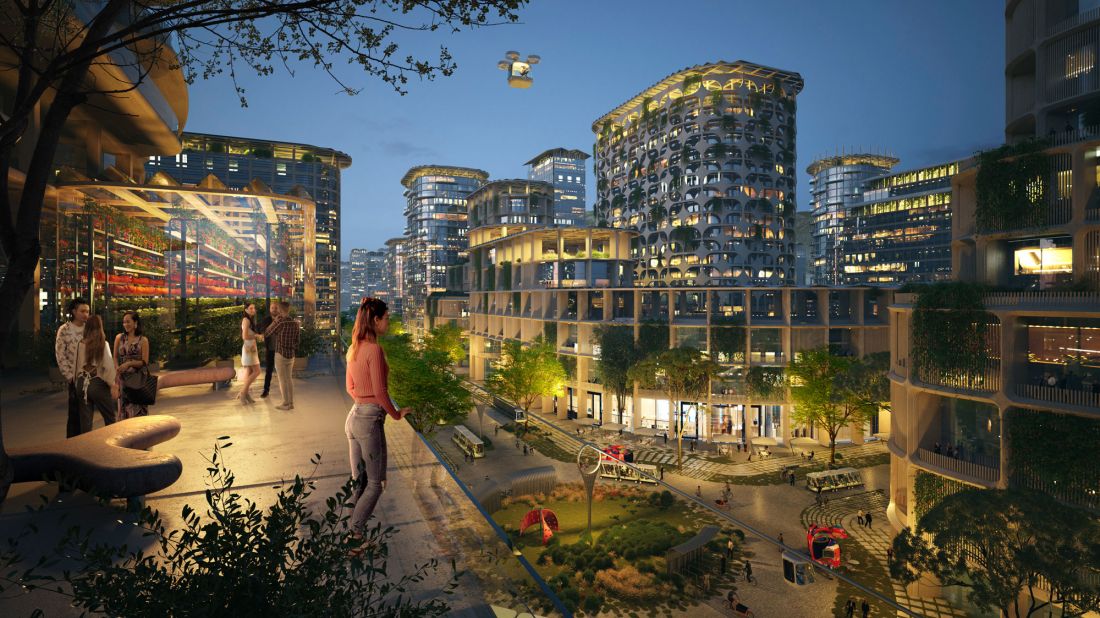
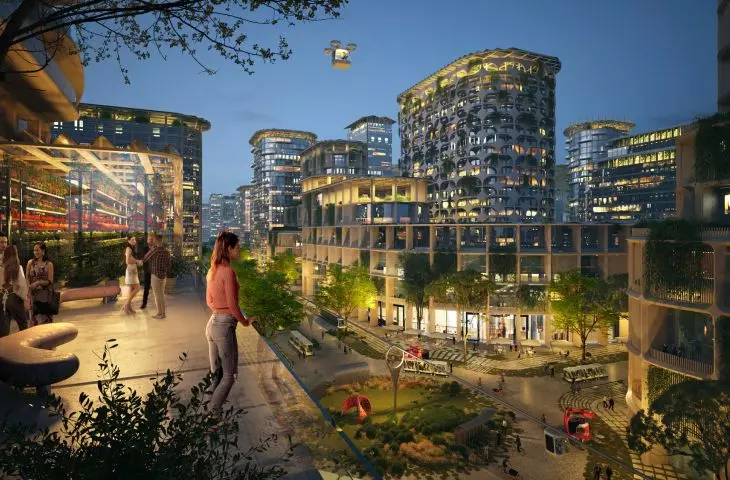
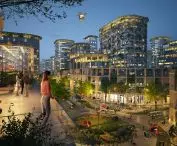
Telosa at night - visualizing the city of the future - A view of Telosa at night shows futuristic buildings, illuminations and the life of residents in an ecological city.
Telosa, City Images | © cityoftelosa.com
The story seems incredible, it's a fairy tale, after all, behind the scenes of which there is serious controversy - not only is it being built amid a lack of transparency in the paperwork, but human rights organizations have already managed to report forced evictions and death sentences for those who opposed the construction. Some architectural firms, while appearing in the project's documentation, have managed to (rightly) withdraw from it. Fundamental questions also relate to the feasibility of the concept, the quality of life in such an extremely planned structure and, of course, the ethical aspects. There's no denying that this is the kind of project where the media narrative twists reality, makes fisticuffs and powders fundamental problems with a very thin layer.
However, let's return to Telos. Here, fortunately, there is no talk of displacement, but the picture created in this narrative does not cover a number of fundamental problems like the logistics of the region. Without a regional strategy, this city can only provide local benefits, a postcard shot of a beautiful utopia, while the carbon footprint will cleverly be transferred beyond its borders. Such a broad concept should consider the full range of emissions, including supply chains and building materials.
How to free Telos from illusion
In the face of the climate crisis, the best city is the one that already exists. It would have been much more responsible for Marc Lore, as an investor, to focus on urban revitalization instead of imagining a city from nothing in the desert. Leveraging the existing infrastructure, social networks and urban fabric provides an opportunity to change, revitalize and rebuild the existing foundations in a way that can produce immediate and significant results.
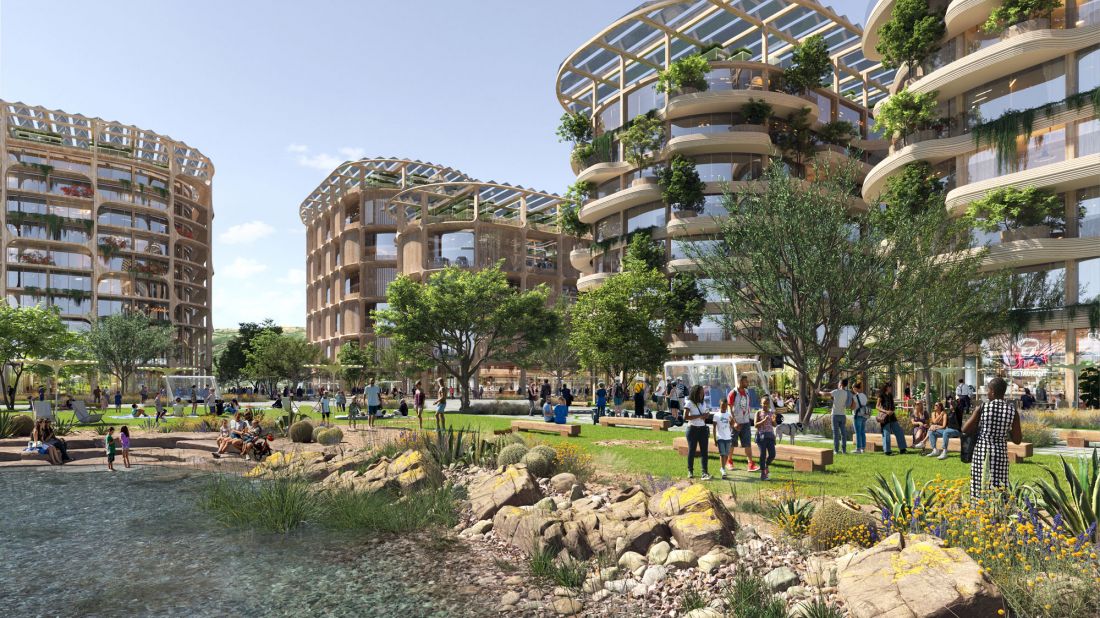
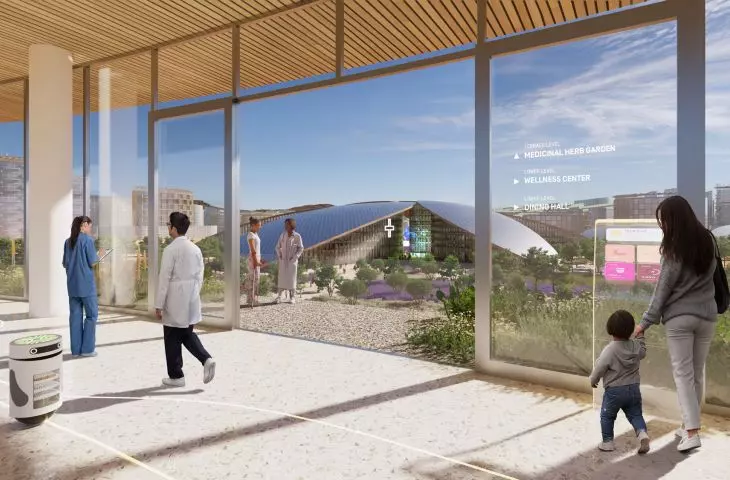
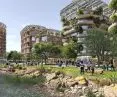
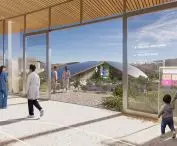
Telosa - Green streets and nature-friendly architecture - Telosa's modern development combines urban living with lush vegetation and access to recreational public spaces.
Telosa, City Images | © cityoftelosa.com
Building from scratch in a desert not only consumes vast resources, but also ignores the simple fact that some urban fabric - let's even give the flagship Detroit - already exists and can be transformed. Declining cities, with their underutilized land and infrastructure, offer tremendous opportunities, as opposed to creating an entirely new, imagined and idyllic reality in the most crumbling landscape. The desert is the worst possible terrain for such experiments: the scale of the undertaking, the interference with ecosystems, the scarcity of water and the enormous cost of sustaining life make it an exercise in denial. Development is not about creating yet another money-burning spectacle, but about constantly working to give existing cities new life.
Magdalena Milert
[1] Green accounting itself is a normally functioning accounting system that takes into account environmental costs and benefits, enabling organizations to quantify and reduce their carbon footprint and achieve future savings through energy efficiency, carbon trading and resource use. https://seea.un.org/ecosystem-accounting