






The growing infrastructure of artificial intelligence has not only a digital, but also a very material dimension. Giant data centers require huge amounts of energy and water, leading to local tensions and global questions about the future of natural resources.
Imagine the dragon of Wawel Castle who swallowed a sheep filled with sulfur, as in the legend. He was very thirsty. So he sat down by the Vistula River and drank, drank, drank... until he burst. Nowadays we have some such dragons, who are equally thirsty, but so far they do not burst. At most, they turn out to drink the water of local residents. By the way, they also need some energy and space in the plot. These dragons are much more contemporary, full of smart-gadgets, fully digital, for the 21st century. Most are afraid to mess with them. They draw on their strength, power and agency, a bit like the Sun King creating his Palace of Versailles.
One such dragon has located itself on a level, swampy and floodplain in northeastern Louisiana. The dragon-palace is becoming increasingly famous. It is owned by one of today's largest companies - Meta. And what exactly are such dragons? Data centers. It was in agricultural Louisiana that it was decided to locate Meta's centers. They will be nine buildings worth $10 billion, with a development area of more than 37 acres.
uncontrolled growth
In 2023, global demand for data center power reached 60 GW. Is that a lot? Well, you could say it's equivalent to nearly 29 times San Francisco's annual energy consumption, the equivalent of 14 Mumbai's demand, or about 2.1 times the projected peak power of the entire country in 2024[1]. Just a decade ago, a 30 MW data center was considered a major undertaking. Today, facilities much larger (on average, almost 7 times), with much more powerful capacity - even 200 MW - are becoming the standard. The scale of investment is constantly growing.
Forecasts indicate that in 2023-2030 this demand will continue to increase. On average by about 20 percent per year, reaching up to 219 GW, and in some scenarios capturing the rapid growth of the AI market, these values could reach up to 300 GW. In short, this would mean an almost fivefold increase relative to 2023. At the forefront of the change are, of course, facilities tailored to the needs of artificial intelligence. They are the ones that are growing at an outstandingly fast rate - about 33 percent per year. By 2030, they are expected to account for as much as 70 percent of total infrastructure capacity.
Hyperion's scale
The aforementioned Meta project - Hyperion, as it will be called, will surpass Disneyland in development area and Chopin Airport in plot size. On a parcel of land measuring approximately 910 hectares
View this post on Instagram
will be built in the first stage, a colossus that is expected to consume up to 1.2 GW of energy - enough to power some 750,000 American (and therefore larger than Polish) households. Thus, it is on track to become the first data lab to launch such a supercluster with a capacity of more than 1 GW.
Thus, it would confirm an assumption from a recent report by Semianalysis, a semiconductor and artificial intelligence research firm. According to Zuckerberg, the scale of Hyperion is on par with Manhattan. At full load, the facility is expected to consume up to 5 gigawatts (GW) of electricity, equivalent to a quarter of New York State's peak electricity demand.
To meet such a huge demand for electricity, Entergy - Louisiana's energy supplier - is putting up three state-of-the-art gas-fired power plants. The total capacity of the new power units is expected to be 2.26 gigawatts, enough to power several major cities. Added to this is a gigantic transmission infrastructure: eight high-voltage lines, new transformer stations and a 500 kilowatt line stretching some 160 kilometers. Its construction will cost more than $1 billion. The Met has pledged to cover the costs of operating these power plants for 15 years. However, a dispute is growing around the project.
View this post on Instagram
Thisis because Entergy wants to spread the cost of building the power plant over its customers, thus putting the financial burden on them. Should Meta suddenly decide for some reason to scale back its operations or withdraw from the venture altogether, residents would be left with an infrastructure that requires repayment of maintenance for decades. Expansion and modernization of the network is necessary, however, because the current network as it stands is already overloaded, and massive power consumption by the data center could all but guarantee notorious blackouts.
With all this, however, Meta also pledges to invest in renewable energy sources, as well as support for carbon capture technologies. These measures are intended to "balance Hyperion's environmental impact" and ensure compliance with the announced goal of carbon neutrality by 2030.
no, no water in the technological desert
Not by energy alone, however, does such a technological dragon live. As befits a Wawelian eater, it has a great thirst. The scale of water consumption needed to cool servers is striking. In an agricultural region, therefore, there is a legitimate worry about the availability of fresh water not only for residents, but also for farmers. The locality where Hyperionis to stand - Richland Parish - is an important agricultural area, known for its fertile soils, favorable climate and large production of cotton, soybeans and rice. These are branches of agriculture known for their need for water. It's also worth noting that the local economy, identity or even culture of the region is strongly tied to agriculture, based largely on family-owned operations and local agricultural enterprises.
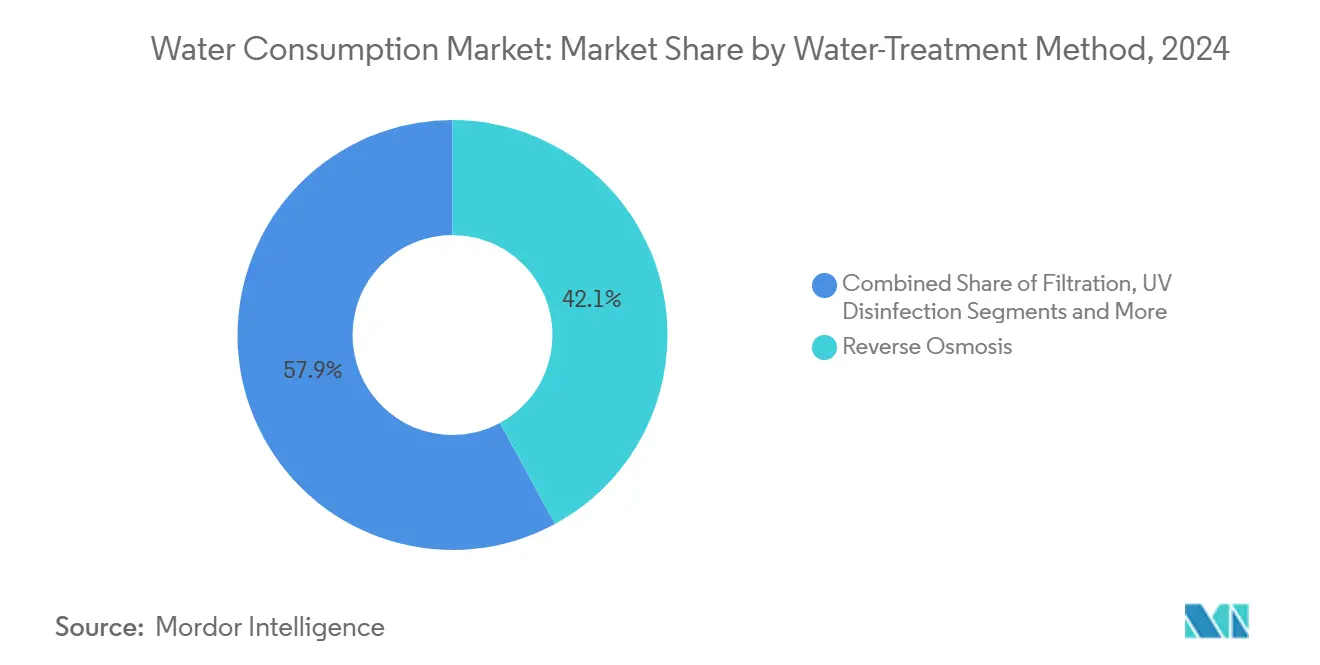
"Water consumption market: market share by water treatment method, 2024" - Source: Mordor Intelligence, licensed under CC BY 4.0
Water has become one of the most valuable resources in today's digital economy. In 2023, data centers consumed about 560 billion liters of water globally, and forecasts say this figure could reach 1,200 billion by 2030[6]. Much of this growth is fueled by the development of artificial intelligence. Training the GPT-3 model alone required about 700,000 liters of fresh water - enough for nearly 12,000 showers. According to estimates, by 2027 the AI sector will be consuming as much as 6.6 billion liters per year. That's like taking the entire annual water needs of Denmark or half of the UK.
One can therefore applaud the authors of academic publications who have unanimously warned of the huge water footprint of such digital infrastructure.
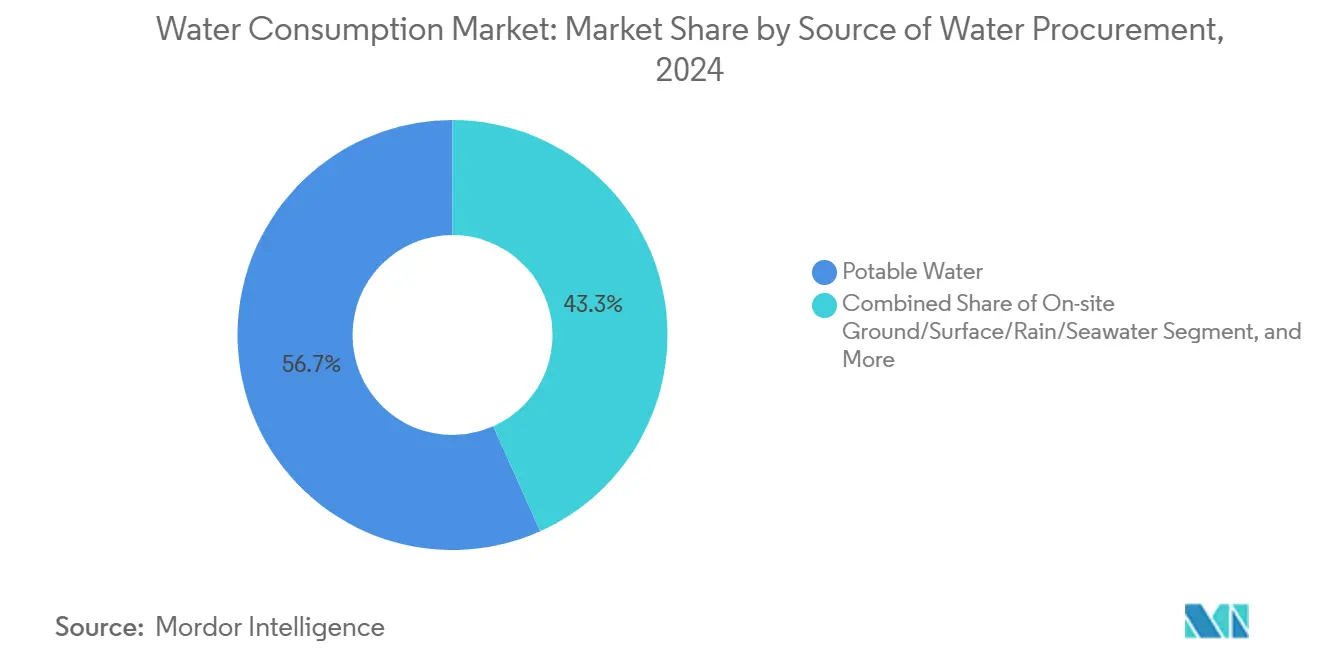
"Water consumption market: market share by source of water extraction, 2024." - Source: Mordor Intelligence, licensed under CC BY 4.0
The scale of the problem is particularly evident for the largest computing campuses. One large data center can consume as much as 19 million liters per day, or about 6.8 billion liters per year. Such an amount would be enough to meet the needs of a city with as many as 50,000 residents.
The International Energy Agency warns that data center water consumption could double by the end of this decade, A major factor in this acceleration is the growing demand for artificial intelligence services, including generative language models. Not surprisingly, there is growing talk of a growing "water footprint" of digital infrastructure.
The problem takes on a particularly serious dimension in drought-stricken regions. I've already mentioned agricultural Richland Parish, but places with strained relations between residents and server owners are many. In Brazil, in the city of Caucaia, where a computing center was planned, as much as 80 percent of the abstracted water used for cooling during such a process would evaporate. In turn, this would greatly exacerbate shortages in the region.
View this post on Instagram
As Bloomberg reports , in Santiago, Chile, Google's project projected consumption of 378.5 million liters per year. After protests by local organization Mosacat, lawsuits won and court decisions taken, the company had to change its cooling system (to air).
In the United States, about 40 percent of data centers are located in regions with high or extreme water shortages, such as the Colorado River basin. Potable water, which is rarely recycled, is used there every day. In Virginia, where the largest number of such facilities are concentrated, regulations are beginning to be introduced to require reporting of water use.
Similar tensions exist in Europe. In the Aragon region of Spain, Amazon has been approved to take 755,720 cubic meters of water per year (the equivalent of irrigating 233 hectares of corn crops). Farmers are concerned that the development will deprive them of access to needed water.
In Memphis, Tennessee, the xAI supercomputer was initially expected to use more than 18.9 million liters of water per day at a site where residents are already struggling with supply quality issues. After the massive criticism that fell on the project, consideration was given to changing the system to use recycled water.
IT arms race
The artificial intelligence industry is racing against time to secure suitable locations, sufficient water and electricity for its implementations. There are currently about 11,800 data centers in operation worldwide, with more than 5,000 of them located in the United States alone (as of April 2025).
The largest market players - the so-called hyperscalers - often buy hundreds or even thousands of acres to realize their campuses. They are less and less likely to choose plots close to cities, while more and more often investments are landing in suburban or even peripheral areas, where on the one hand it is easier to secure space for future expansion, but on the other hand there are serious problems with access to water.
Hyperion is one of a number of AI facilities announced in the United States. The Met's other investment, Prometheus in Ohio, is expected to be the first multi-gigawatt data center. According to Zuckerberg's announcement, it will launch in 2026 and cover an area the size of about 59 square kilometers. Amazon, Google and Microsoft are committing between $75 billion and $100 billion each in 2025 alone to build new computing campuses. OpenAI, on the other hand, has announced plans to create a massive complex in Texas that is expected to be the largest project of its kind in the world. The scale of the projects makes the US energy system face an unprecedented challenge. Department of Energy estimates indicate that electricity demand from data centers could triple by 2028, reaching as much as 12 percent of the country's total electricity consumption.
It is hyperscalers that are responsible for the vast majority of the growing demand for infrastructure adapted to artificial intelligence. These include cloud providers such as Amazon Web Services, Google Cloud and Microsoft Azure. They have vast resources that allow them to both train their own generative models and offer computing space for models created by others - an example is ChatGPT from OpenAI hosted on Microsoft's infrastructure. Most enterprises today use off-the-shelf AI models, sometimes just adapting them to their needs. As the technology grows and becomes more commonplace, however, more and more companies may reach out to create and train their own models based on internal data. Thus, the need for hosting infrastructure will naturally increase. Currently, one can point to some 40 projects in various stages of development, including those of Amazon, Microsoft and even (or perhaps especially) the U.S. Department of Energy. The huge energy demand of these facilities is a serious challenge to energy stability and security.
Not only are energy requirements growing, but so are data storage needs. Global data center capacity is expected to increase from 10.1 to 21 zettabytes between 2023 and 2027. This means building more facilities and supplying them with huge amounts of energy, as generative AI systems alone can consume from 300 to more than 500 megawatts. So we have a double increase - both in storage capacity and energy power. Data not only has to be stored, but also processed. And this simultaneously requires more and more space, more and more powerful power sources and more and more advanced infrastructure.
The decision by Louisiana authorities to agree to build Hyperion as well as three new gas-fired power plants specifically for the project was seen as setting a new standard. In practice, this means that other places can follow this model, there will be a precedent.
Magdalena Milert
[1] Poplawski, T. (2025). Long-Term Forecast of Peak Power Demand for Poland... Energies, 18(13). Accessed on: 25.08.2025, https://www.mdpi.com/1996-1073/18/13/3472
[5] DataCenterFrontier. (2025, July 16). Ownership and Power Challenges in Meta's Hyperion and Prometheus Data Centers. Accessed on: 25.08.2025, https://www.datacenterfrontier.com/hyperscale/article/55310441/ownership-and-power-challenges-in-metas-hyperion-and-prometheus-data-centers