






The Tytano Foundation is an organization well known to many residents of Krakow - primarily from Dolne Młyny, which has become part of the city's identity, but also from other initiatives, such as planting trees on private properties in Krakow or activities carried out in cooperation with the city's cultural institutions. Those who are not familiar with the Tytano Foundation may also come across the effects of its activities without even realizing it. One of the projects that influences the shape of Krakow's urban fabric is the Scattered Gallery, which has just enriched the city with a new development.
Construction is a process that is synonymous with a certain potential - reversing the action of time on the architectural fabric, creating new opportunities or increasing the quality of urban space. However, before residents know its effects, it proceeds in secret, hidden behind scaffolding, covered with a sheet or separated by a fence. Although the buildings are eye-catching once completed, the construction period is not without its impact on urban aesthetics. Fences around construction sites, while necessary, do not look inviting, and the whole construction action can last for years. This is not helped by the eagerness of some investors, covering the buildings under construction with advertisements, not always in compliance with the current landscape resolution.

Płotal "Welcome is the beginning of a relationship" at the Scattered Gallery - Zofia Paloma Hyjek, author of the fence
© Tytano Foundation
But what if paintings appeared on scaffolding, fences or facades of buildings being erected or awaiting renovation? This was the idea of those associated with the Tytano Foundation, who together with the Jan Matejko Academy of Fine Arts in Krakow and the Polish Association of Developers last year inaugurated the Scattered Gallery.

Płotal on Kalwaryjska Street in Krakow, Marcin Czaja
© Tytano Foundation
Scattered Gallery in Krakow
Scattered Gallery is an entity that presents the art of young artists in urban space. It does not have its own headquarters, nor a single curator, but the recipients of the works created through it can be all residents and visitors to Krakow:
Scattered Gallery has two main goals: to democratize access to art and to promote and support the careers of emerging artists. We believe, art should be easily accessible-not everyone has the time and opportunity to visit cultural institutions-it should be present in the everyday space of the city, visible to everyone. We want colorful, artistic interventions to break the monotony of urban grayness and make the residents' daily commute to work, school or walking more pleasant.
- Judyta Jastrzebska of the Tytano Foundation writes.
The whole project is being carried out with the close cooperation of several entities - the Tytano Foundation, the Krakow branch of the Polish Association of Developer Companies and the Jan Matejko Academy of Fine Arts in Krakow. The designs of the works to be implemented are determined through a competition, with a jury consisting of representatives of the project partners and the investors involved. They are the final piece of this puzzle, providing locations for the new paintings.

Plotal "Welcome is the beginning of a relationship" in the Scattered Gallery
© Tytano Foundation
art in the city
Unlike other street art galleries that exhibit in urban spaces, Scattered Gallery does not have permanent displays. So can one predict where the next painting intervention will appear?
Where the patron decides, or what spaces happen to be available. Art should go out to people and be present in their everyday surroundings. Currently, our first partners have become investors building in Krakow, so the works most often appear on the fences of their investments. However, we are not limited to locations near construction sites, we are open to cooperation with patrons from various industries who have spaces where art can be created.
- Judyta Jastrzebska explains.
This does not mean, however, that the works created as part of the activities of Scattered Gallery can be located anywhere:
The spaces where we carry out our artistic activities belong to the patrons who support the project at a given location. We also care about good visibility of the artistic realization, so we choose locations along busy streets and near important transportation hubs. The installation on Wita Stwosza Street is highly visible from the train, sidewalk, bike path, as well as the street.
- Judyta Jastrzebska adds.

Plotal "Greeting is the beginning of a relationship" at the Scattered Gallery
© Tytano Foundation
Płotal to welcome
The new Płotal, as this is the name of the compositions placed on, usually wooden, fences separating buildings, was created on Wita Stwosza Street, where the buildings comprising the WITA complex, jointly erected by ECHO and Archicom, are currently under construction. The WITA estate, located between the Rakowicki Cemetery and the Home Army Museum, which will draw on the architecture of abandoned Austrian barracks, is slowly taking shape. Along with its walls, wooden barriers are also growing, fencing off the construction site.

Plotal "Welcome is the beginning of a relationship" in the Scattered Gallery
© Tytano Foundation
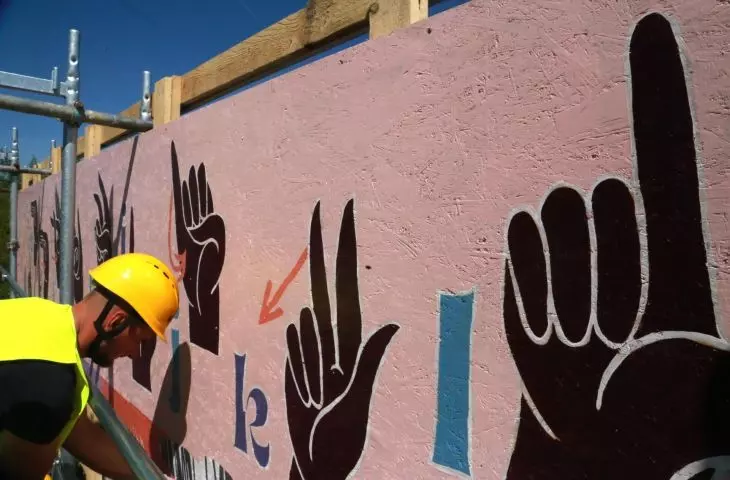
Seeing an opportunity for action, Scattered Gallery, together with ECHO and Archicom, organized the "Welcome is the beginning of relationships" competition to design a fence to decorate the scaffolding around the project under construction. The winning work by Zofia Hyjek is already visible - it is a composition in a form similar to a comic book, in which the most important role is played by simple, everyday interactions. Its protagonists are characters in mundane but extremely important situations for building relationships - greeting each other, embracing or spending time together.
When I found out that the work was to be outdoors and that it was a mural competition, I thought this was something I was very interested in. Although the traditional art gallery, especially for those who have a degree in painting, can be taken as a goal in their work, it involves a certain rigidity and formality. For me, it is much more natural to work in an urban space, where art does not exalt itself, but rather coexists with people who can feel comfortable looking at it. I would like the mural to arouse sympathy in the viewers, so that they can look at the work and feel that they understand it, that it is something logical, and additionally carrying a positive message
- summarizes the work on the project by the artist, Zofia Hyjek.
According to Scattered Gallery, the work was created for three weeks in the artist's private studio, and then installed at the destination. Curious stories about the essence of everyday interactions await at Wita Stwosza Street!

Płotal on Kalwaryjska Street in Krakow, Marcin Czaja
© Tytano Foundation
Polychromes in the Podgórze district
Płotals painted as part of the activities of the Scattered Gallery were also created in other locations. One of them decorated fences and scaffolding securing the renovation of a tenement house on Kalwaryjska Street. There, the fences were decorated with compositions designed by Marcin Czaja, an assistant at the Academy of Fine Arts in Cracow.
The idea behind the project is to use unique bas-reliefs and ornaments present in the space of Podgórze and Krakow. These bas-reliefs are most often found on the facades of tenements just above the main entrances, but also, as in the case of the deer with two bodies on Brodzińskiego Street, in the corners of buildings. I tried to make the compilation of motifs I found evoke a way of composing a frieze, the content of which would be a kind of interpretation of the architectural and artistic essence of Podgórze.
- Marcin Czaja said, describing the composition.
The overshadowed construction is the "Old Podgórze" project of the Fracthon Group, involving the revitalization of a corner building from 1899, designed by Stanislaw Serkowski, architect of several Podgórze buildings, including the Crystal Villa at 30 Lwowska Street.

Płotal on Kalwaryjska Street in Krakow, Marcin Czaja
© Tytano Foundation
back to the roots
The Scattered Gallery also organized a competition called "Snapshots from the Cultural and Social Life of the Famous Cigar Factory" to design a fence at the site where the history of the Tytano Foundation began - on Dolnych Młynów Street. At the site of the former Cigar and Tobacco Factory, a residential and commercial complex by NOHO Investment is currently under construction. The fences covering the construction site were to be covered with paintings alluding to the history of the now-defunct "cigar factory," realized according to the winning design by Konrad Iwanowski and Lukasz Majerowski.

Płotal "Welcome is the beginning of a relationship" at the Scattered Gallery - Zofia Paloma Hyjek, author of the fence
© Tytano Foundation
for the benefit of all
A mural, or in the case of the Scattered Gallery, rather a "płotal," are a recipe for many problems - a blank wall, a facade waiting to be finished or scaffolding around a construction site can only benefit from the presence of such compositions. And along with them the city. In many places, murals, which were planned as a temporary "patch" for a breach in urban space, are becoming its full-fledged elements, valued by residents, building the identity of the place. An example? The "Nothing Twice" mural on the blind wall of a tenement house at 28 Karmelicka Street, opening onto the space of the Wislawa Szymborska Park and commemorating the 100th anniversary of the Polish Nobel Prize winner's birth. The interventions of the Scattered Gallery play a similar role:
Our activities have a positive impact on the image of the city - they make it more open, creative and friendly, including for tourists. Art in public space can build local identity, strengthen social ties and create points of common reference for residents of different neighborhoods, raise socially important issues. The works appear mainly on the fences of construction sites, which often become part of the urban landscape for months or years - we see them as a great opportunity to show art in unusual places and to improve the aesthetics of public space. Thanks to the Scattered Gallery, the investors themselves can also participate in the process of shaping the cultural character of the city and better dialogue with the local community.
- Judyta Jastrzebska concludes.