






The city does not exclude by resolution alone. It excludes by bylaw, local plan, administrative decision and the language of "spatial order." In a Krakow conversation about the effects of anti-LGBTQ+ resolutions, we ask how the law - including that enshrined in cultural parks, display rules and assembly procedures - shapes the real accessibility of public space. Talk as part of the Mile widzianx - queering the city project .

Kacper Kępiński: We are meeting as part of a series of conversations on queering the city, i.e. who is welcome in the space of Polish cities and how architecture and urban policies can respond to the needs of people belonging to minorities, including the LGBTQ+ community. In previous meetings, we talked about transarchitecture and the rights of transgender people in public buildings, and about creating safe spaces for groups excluded from public space. This conversation is about the legal dimension - how local laws and local government decisions can exclude LGBTQ+ people from city spaces and public institutions, but also how this can be counteracted. The starting point is the so-called anti-LGBTQ+ resolutions and the actions of Hate Atlas that led to their invalidation. So I would like to start with a question to Kamil: how was the Hate Atlas born, what were its origins and what was the immediate impetus for its creation? Did you plan a nationwide action from the beginning, or was the answer a specific resolution that became a flashpoint?
Kamil Maczuga (Atlas of Hate): As far as the Hate Atlas is concerned, our activities began around the middle of 2019, maybe even a little earlier. On March 26, the first anti-LGBTQ+ resolution was passed, and then the avalanche started. These pieces of legislation were passed en masse and were part of a larger anti-LGBTQ+ narrative. It even happened in the Lublin province that the then governor rewarded councilors for passing such resolutions. There were four of us forming Atlas - me, Pawel and Kuba from Rzeszow, and Paulina from Kielce. We all come from regions that have adopted such resolutions, so the motivations were often very individual. I can say for myself that I became very heavily involved when my hometown municipality planned to adopt such a resolution, because I knew what life was like there and that there was already no help available to a young LGBTQ+ person. And there were more declarations to come. We all had an internal need to respond.
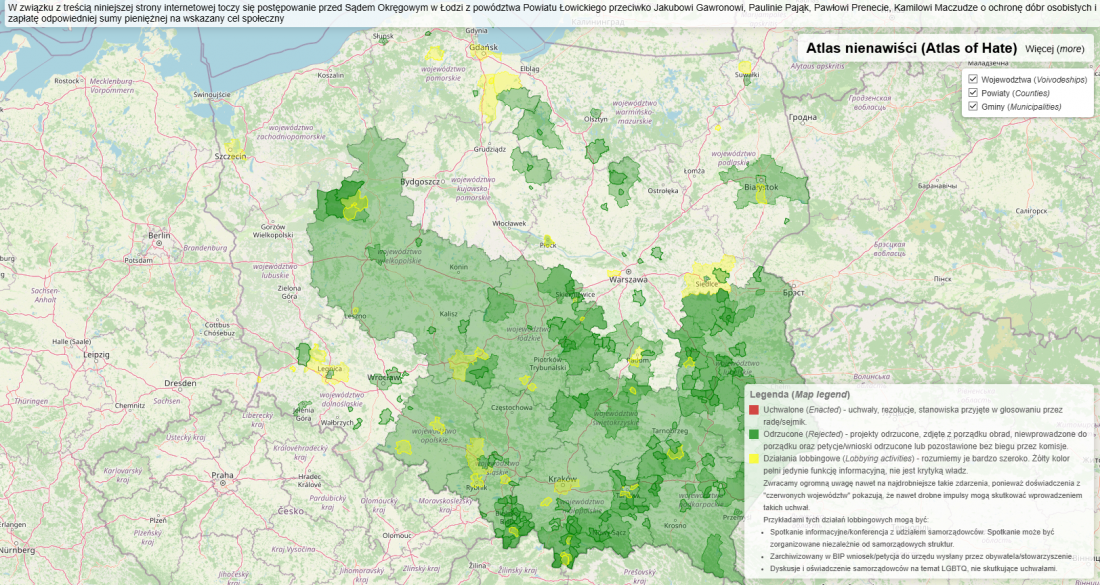
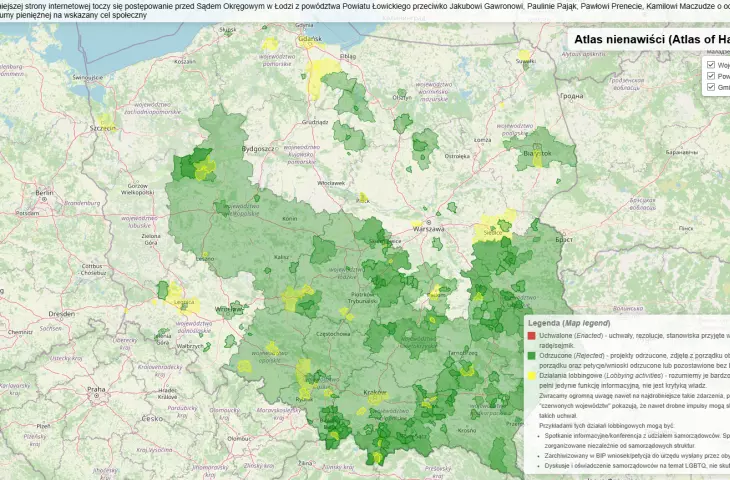
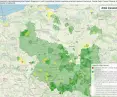
Hate Atlas website
© Atlas of Hate
Often, however, we found out about these resolutions too late, that is, only after they had already been passed. We wanted to create a place where we would know earlier, and be able to monitor all the activities of local governments, the various attempts, petitions and initiatives to adopt similar resolutions. It was also about creating tools where we could pass on the know-how to local communities and give them the opportunity to react. Above all, we wanted to capture the scale of the phenomenon. At the peak of such declarations were, on the one hand, resolutions explicitly expressing opposition to so-called LGBTQ+ ideology, and in our Atlas there are also resolutions that were not explicitly called anti-LGBTQ+. They were called Local Government Family Rights Charters, but they contained provisions saying, for example, that they undermined the constitutional identity of marriage as a union between a man and a woman. We all knew they were about LGBTQ+ people, although it wasn't explicitly written in the name, which made them - in quotes - safer. At first it was simply an Excel list. Later, when we met with politicians, we found that it wasn't enough. We wanted to show the scale visually as well, in the form of a map. And this map helped illustrate that at its peak, a third of Poland was covered by these anti-LGBTQ+ zones.
exclusion map: when the law starts to work spatially
Kacper Kepinski: From your perspective, Peter, as a lawyer - when did these resolutions, whether explicitly anti-LGBTQ+ or Local Government Family Rights Charters, stop being a political statement and become a real legal instrument? When did they start to change something, become a tool and a real problem, introducing inequality in the ability to use public space, since we are talking mainly about institutions?
Piotr Baran (legal counsel): In my experience, basically immediately, the moment such resolutions were adopted in a given local government, it had a so-called chilling effect. I work and live in Krakow, and I worked as an attorney with the local Equality.org Foundation on these resolutions, and I encountered situations in which we wanted to hold a meeting in a municipal or county town in Malopolska. The moment such a resolution was passed, the municipal public library or other entity would cancel the reservation of space for such a meeting. Thus, in my opinion, the effect was immediate. Not immediate in the sense that the resolutions did not create a new legal situation obliging municipal bodies or subordinate units to behave in a certain way. However, if the municipality council, mayor or county board supported such a resolution, the subordinate units of the authorities complied with this intention. In my experience, the very clear intention of the local resolution maker made a difference in organizing meetings or events.
chilling effect: institutions, schools, local daily life
Kacper Kepinski: The intention was clear, but what specific mechanisms did these resolutions introduce? What specter of consequences caused a chilling effect? Was it just the mere fact that the topic came up and the fear of losing funds, or did they actually introduce specific sanctions in case of violation of the resolution?
Piotr Baran: The resolutions themselves did not introduce explicit consequences in local law. This was one of the arguments used in the courts when defending them. It was argued that they were merely a form of declaration or opinion expressed by the local government, and that they did not cause direct changes in the legal status or in the rights and obligations of residents. Thus, it has been argued, they are not illegal. From the point of view of changing local laws, they did not introduce sanctions. On the other hand, from the point of view of the functioning of local communities, they acted as a form of soft intimidation and discouraged institutions from taking action, such as renting space for meetings. This effect was felt immediately.
Kacper Kępinski: And from your perspective as an activist, a person who has direct contact with the residents of these regions and with people associated with Atlas - how did these resolutions really change the functioning of institutions, schools or cultural institutions? How did they affect not only the social climate, but also the caution against initiatives coming from outside? How did they affect the people living in these cities?
Kamil Maczuga: Complementing what we talked about earlier in terms of the chilling effect - listening to the debates surrounding the adoption of these resolutions, I remember a situation in which teachers and school directors were invited to speak out. The councilors threatened that "LGBTQ+ will enter schools and demoralize children." When asked directly if such situations had occurred, teachers and principals answered that they had not. But the very fact of such questioning could freeze any subsequent attempts to take any equality measures. It should also be noted that the local government units that adopted these resolutions had a certain social background. They were mostly conservative regions with a strongly heteronormative social infrastructure. I am also speaking here based on my own experience. At my school, there was no place where I, as a young gay person, could get information or support. When someone finds out about their orientation and has no one to talk to about it, there is a lack of reliable knowledge. The Internet exists, but it doesn't always give reliable information. In schools, materials suggesting that homosexuality can be "cured" with conversion therapy have been shown during VET classes. In smaller towns, important social centers are often churches, where a narrative hostile to LGBTQ+ people also appears.
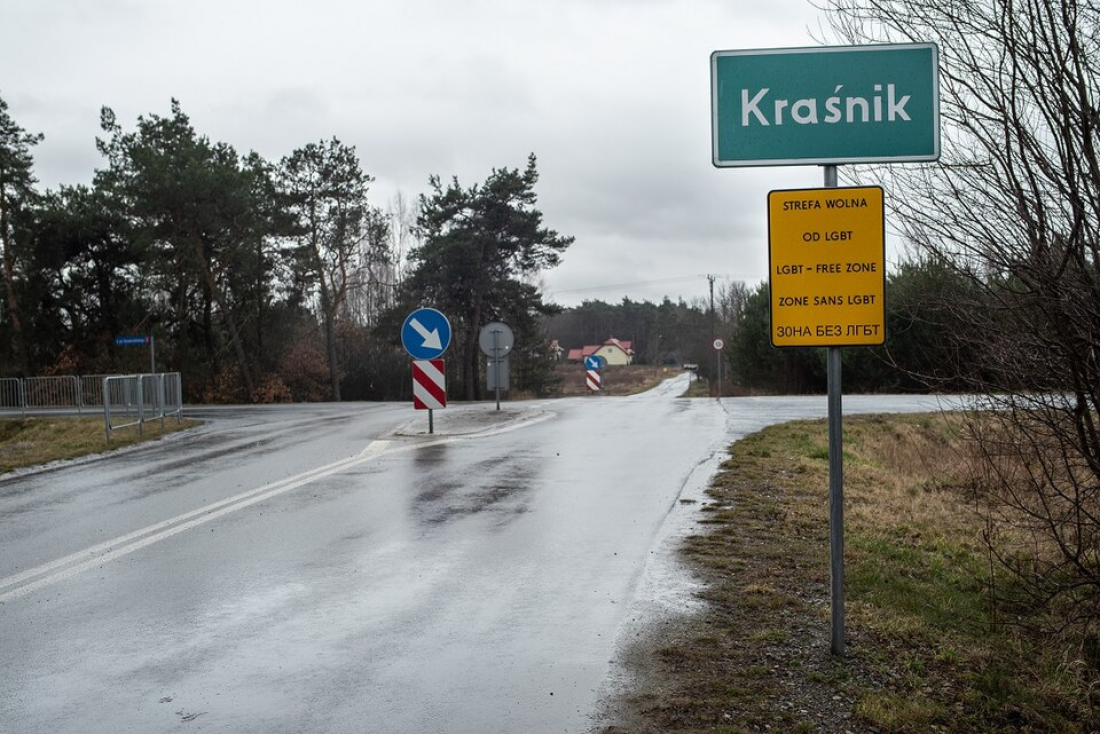
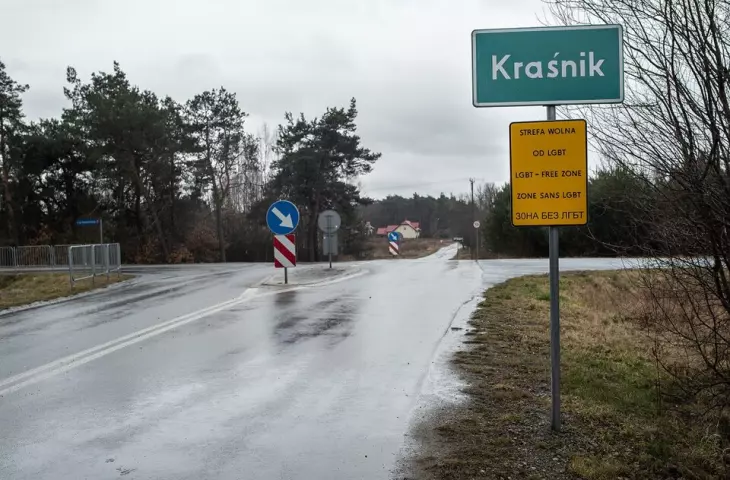
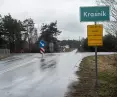
A plaque at the entrance to Krasnik placed as part of Bart Staszewski's campaign
© Bart Staszewski
On top of that, there is a situation where public authorities take a position that explicitly says that LGBTQ+ people are not welcome. There is also an aspect that we didn't initially think of. After the resolution was passed, articles appeared in the local media, and the community commented on them. A young non-heteronormative person saw a local newspaper article on Facebook and read unfriendly comments from her relatives or schoolmates. She had to face it. We are often talking about unlettered people who function in small communities. The effects of this are difficult to measure. However, I have reached out to two studies attempting to describe this. The first, prepared by the Campaign Against Homophobia, looked at the psychological situation of LGBTQ+ people across Poland, and compared people living in areas covered by the resolutions with those who did not live in such areas. The results showed a worse psychological state and a much higher incidence of suicidal thoughts among those in the resolution regions.
Piotr Baran: There is also a study by Pawel Adrian and Jan Gromecki that analyzed activity based on IP addresses in different locations. It showed that after such resolutions were passed, job search traffic increased in larger urban centers or in countries that were more LGBTQ+ friendly. The migration balance also changed - more young people began to leave.
Competence of local government: ideology or transgression of the law
Kacper Kepinski: You mentioned earlier that one of the defenses was the claim that the resolutions are symbolic. Can local governments adopt such resolutions at all? Is it their responsibility to do so? Did it have a legal basis? We recently had the case of a resolution on the coronation of Jesus as king in one municipality, which was repealed as not being the municipality's own task. Do worldview issues fall within the tasks of a municipality, and how did local governments justify adopting such resolutions?
Piotr Baran: This is a very good question. It was the first and basic argument we used in court cases. The Law on Municipal, District and Provincial Self-Government defines the tasks of local government units. Issuing decisions of an ideological nature does not fall within these tasks. The courts in all cases agreed with us and declared the resolutions invalid due to the lack of a legal basis. This was a formal argument. However, the resolutions were also illegal for other reasons, primarily because they violated the principle of non-discrimination. It is worth recalling the historical context. In 2018, after local elections, the Law and Justice party was in power in many regions of southeastern Poland. The problem was that only certain public entities could challenge such resolutions. As citizens, we had to find a body authorized to file a complaint. This was the role played by the then Ombudsman Adam Bodnar. He challenged the resolutions, and public benefit organizations joined the proceedings.
We also pointed out violations of the principle of non-discrimination. There were two types of resolutions: explicitly anti-LGBTQ+, the content of which directly concerned LGBTQ+ people, and the more veiled Local Government Family Rights Charters, prepared by Ordo Iuris lawyers, written so as not to explicitly identify a specific group. The courts, however, found that their content directly discriminated against LGBTQ+ people. Local governments argued that the resolutions targeted "LGBTQ+ ideology," not people. However, court rulings indicated that there is no such thing as "LGBTQ+ ideology," just as there is no "heteronormative ideology," and that, in practice, the provisions refer to specific people. Consequently, the courts found that the prohibition on discrimination was violated in these cases.
Financial pressure as a tool to defend rights
Kacper Kepinski: We know that none of these resolutions is functioning anymore. On the other hand, what was the end of these cases? Were they won by you and legally invalidated, or did the local governments withdraw on their own?
Piotr Baran: The situation was such that the Ombudsman, due to limited possibilities, was not able to challenge all the resolutions, so he challenged some of them in various regions of Poland - including the Lubelskie, Silesian, Malopolskie and Łódzkie provinces. We waited for the courts to decide, and in all these cases the resolutions were invalidated. The position of the European Union was also very helpful. The European Parliament passed a resolution calling on the European Commission to check whether municipalities receiving EU funding discriminate against their residents. In the case of local governments whose resolutions were not challenged by the Ombudsman, under the influence of judgments handed down in other cases, as well as pressure from EU institutions and the threat of losing EU funding, they began to withdraw from those resolutions.
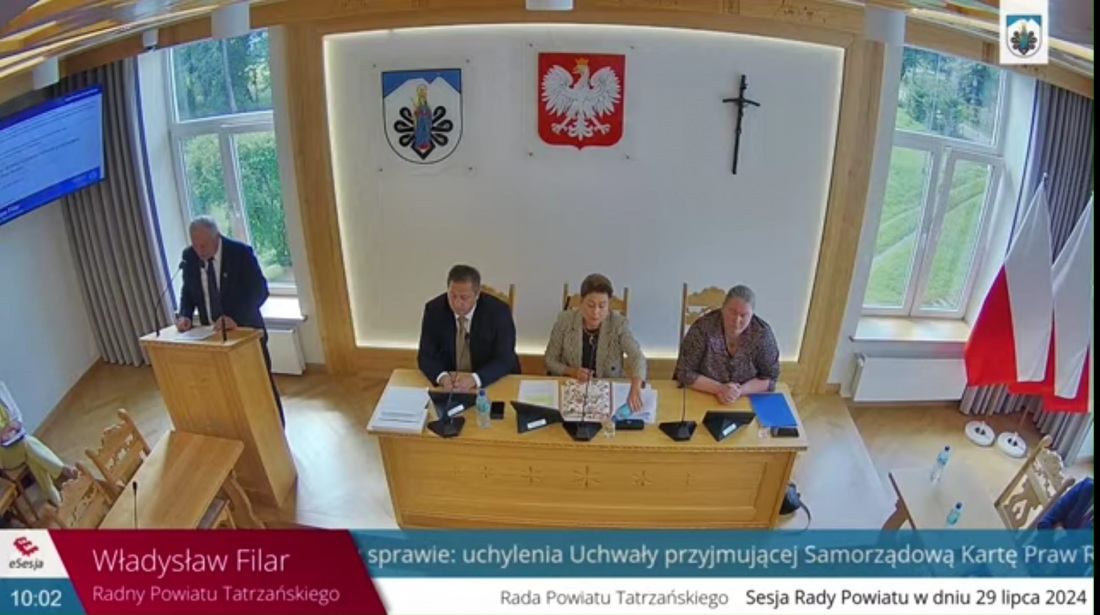
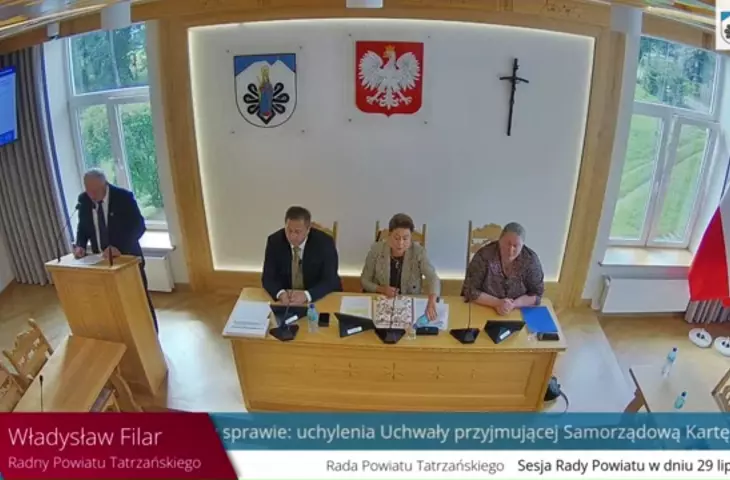
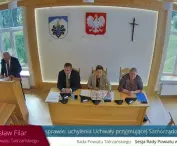
The Tatra district, after a heated discussion, repealed the ordoiuris SKPR, by a ratio of 10 to 8 votes
Source: streaming session of the District Council
Kacper Kepinski: And as Atlas, did you monitor what happened afterwards where these resolutions were introduced? Was the cancellation of the resolution the end of the discussion? Did local governments try to revisit the issue through a different route, or was it that with the next election the situation was reversed and an attempt was made to repair the damage done?
Kamil Maczuga: No. There was never any attempt to repair the damage that was done. If we're talking about the situation of withdrawal of resolutions, it was rather not revisited, because it was a final decision. Local governments were often very resistant in their decisions. When the European Parliament resolution came up, they tried to defend themselves, saying: "We are only talking about ideology." There were also situations in which seven local governments sued us for violating their personal rights by including them in the Atlas. In the end, all these cases ended with the withdrawal of the lawsuits, but it is difficult to speak of goodwill.
Kacper Kępiński: And are you as Atlas still active and continuing to work together, or was it a project focused solely on this particular case?
Kamil Maczuga: It was a project focused on a specific case. We have spent the last six years largely in the courts, defending ourselves. We were present at the subsequent hearings and appeals, because Ordo Iuris did not let up and always filed appeals. We won all the cases, but the amount of energy, stress and work, including that of our pro bono lawyers, was enormous. In practice, we had no space to conduct other activities. There were also times when the whole case ended in unpleasantness at work for some of us. In a sense, we consider the topic closed, although we are still waiting for one more settlement.
Regulations, orders, soft exclusion
Kacper Kepinski: Now that we have closed the topic of Atlas and resolutions, it is worth saying that this is not the only tool with which governments, local governments, politicians or space managers can influence the presence of specific groups. We also have many private public spaces. How can regulations on the use of space or administrative decisions indirectly or directly limit the presence of specific groups, their expression or symbols in space? Do you see specific mechanisms or threats beyond resolutions that can be introduced at the level of space management?
Piotr Baran: It seems to me that the primary tool would be internal bylaws. They are not subject to judicial review as easily as local government resolutions, and can apply to any institution - a school, public library or other entity. We are not currently aware of bylaws that would explicitly exclude the expression of LGBTQ+ people, but such a threat exists because the reality and political climate is changing. Elections are approaching, and a change in the political climate could open the floodgates for such actions. Of course, a legal battle is possible, but that still means reacting to actions taken with ill will.
Kacper Kepinski: I understand that bylaws are not subject to as much scrutiny as resolutions. Can they be challenged at all? And what is the situation with non-public institutions?
Piotr Baran: This can be compared to the situation with crosses hanging in public institutions. Without entering into the worldview discussion itself, in practice it depends on the will of the person in charge of the entity. If the mayor or mayor decides that certain symbols are to be hung in the office, then that's what happens. The only legal avenue that comes to mind is an action for infringement of personal rights. In such a situation, an individual person who has been subjected to a bylaw or order excluding his expression could take legal action. However, this would be an individual case.
Kacper Kepinski: You mentioned pressure related to European funds and European Parliament resolutions. Were other alliances formed? Were there local governments that wanted to show that they were open-minded and in some way - even if not with a formal resolution - supported the activities you were conducting?
Piotr Baran: Yes, in general, there were many alliances formed during our activities, especially in 2019-2021, when this solicitation was most intense. These alliances were very valuable to us. The European Union adopted three resolutions, the last of which proclaimed the European Union as a zone of freedom for LGBTQ+ people, as a clear counter to the narrative coming from some Polish local governments. This was important for us, because the timing was not optimistic - there were unfriendly signals coming from many quarters, including during Andrzej Duda's presidential campaign, which also included elements of this viciousness. On the other hand, there were many organizations, institutions and politicians - including international ones - who supported local LGBTQ+ organizations and came to the Equality Marches in Poland.
Kamil Maczuga: There were also actions by partner cities. Some foreign cities tried to put pressure on their Polish twin cities to withdraw from the resolutions. If they didn't, it happened that partnerships were broken. Micro-grants to the regions covered by the resolutions were suspended. The Subcarpathian region lost access to some eight million euros in Norwegian funds. All these alliances put pressure on politicians and local government officials, but for us it was just as important to have support and a sense of hope at the time.
Assembly ban: visibility control infrastructure
Kacper Kepinski: Another mechanism for restricting rights, including expression and presence in public space, is the banning of public assemblies. This tool is sometimes used in different cases - it applies to marches organized by the far right, as well as the Equality Marches. We have a history of banning the Equality March in Poznan, and more recently the banning of a march in Budapest. How can technical decisions about formal issues, notification deadlines or the status of cyclical events be used to restrict such gatherings? Have we had similar attempts to ban Equality Marches in Poland since Poznań? And what signal does the ban in Budapest send? In your opinion, would a similar ban be possible in Poland today?
Piotr Baran: In Hungary, two laws were passed that struck at the rights of LGBTQ+ people. The last one, on assemblies, was passed last year and provides for fines and even imprisonment not only for organizers, but also for participants. This directly hits any person who would like to take part in such a march. In Poland, the situation is different. Nowadays, such bans occur less frequently, but as recently as ten or fifteen years ago, local governments repeatedly banned Equality Marches. The problem is time pressure - you have to appeal quickly to the court and win the case so that the march can take place. Even if the court overturns the ban, information about this does not always get through to the public and some people may remain in the belief that the march will not take place. Fortunately, Poland does not currently have laws like those in Hungary that would allow criminal consequences to be drawn against participants in Equality Marches.
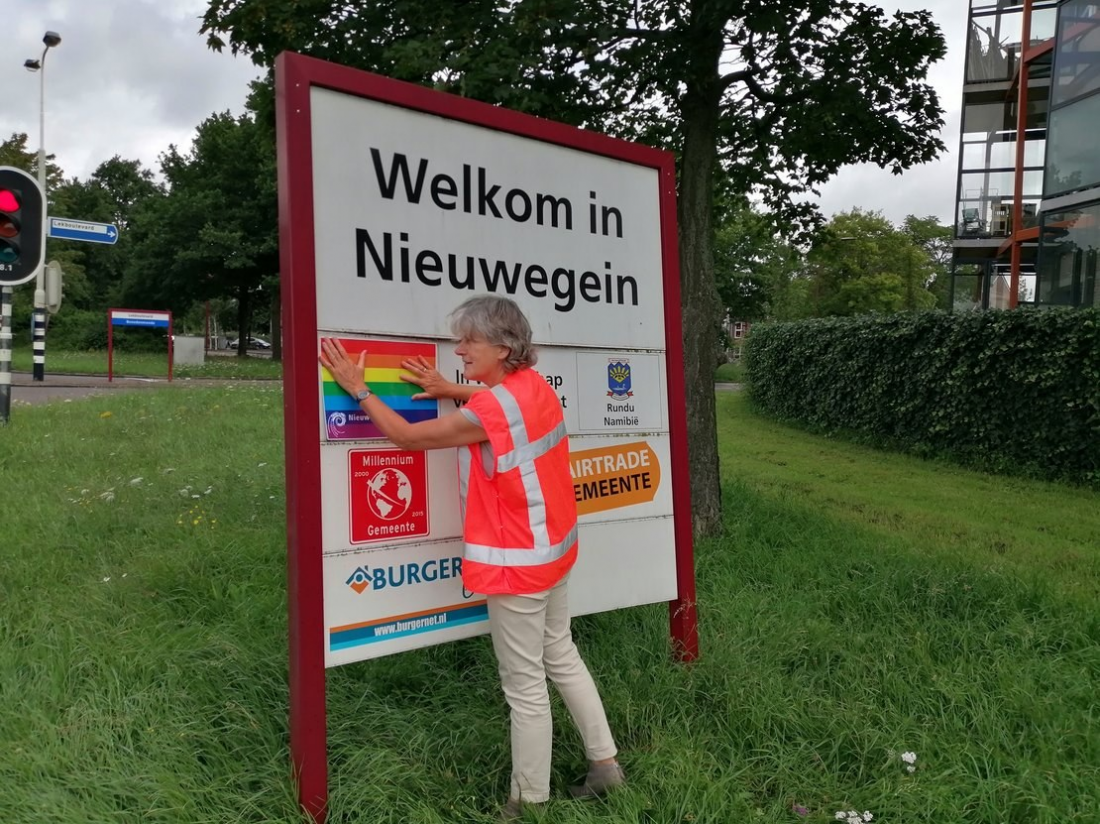
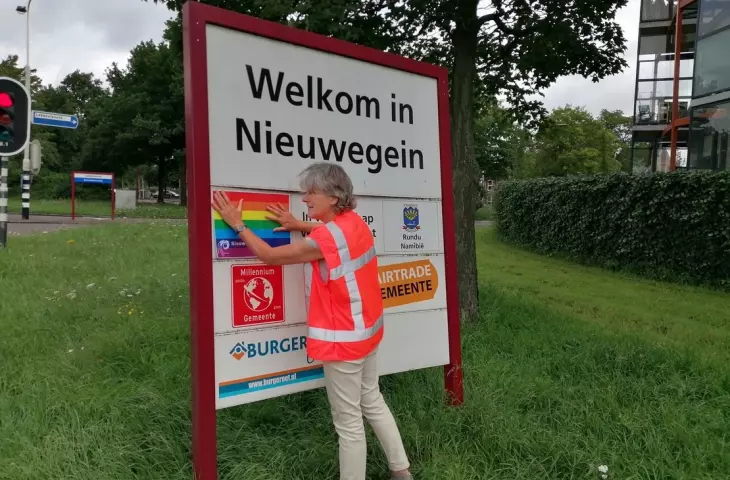
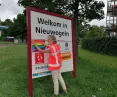
Nieuwegein, pictured, Councilwoman Maria Schouten seals Pulawy with a rainbow on the twin cities board
© Bart Staszewski / FB: Atlas of Hate
Kamil Maczuga: We can't quite say that there were no attempts to introduce such solutions. When we started working on the Atlas, we had a concern that local resolutions might be part of a broader strategy - that first there would be local government positions, and then there would be an attempt to adopt similar solutions at the national level. There was such an attempt in the form of the "Stop Pedophilia" project, which in practice focused on banning Equality Marches. In 2004-2005, in Poznan and Warsaw, city presidents banned Equality Marches. At the time, we did not yet have enough experience or strong allies to respond effectively. At the time of the subsequent crackdown, around 2019, bans appeared in Kielce, Bialystok, Rzeszow, Nowy Sacz and Gniezno, among others. They were argued on security grounds. This time, the social situation was different, and the Ombudsman played a key role, effectively carrying out the appeal procedures and in each case managing to meet the deadlines and repeal the bans. I don't know if the current Ombudsman would have behaved in the same way. As for Hungary, in Budapest the parade was banned, but one of the marches was held in an alternative format. In contrast, in the smaller center, Pécs, a march was held late last year despite the ban. The organizer now faces a penalty of up to a year in prison. We are talking about a member state of the European Union. In Poland, pressure from the European Union has helped to halt the vilification, while in Hungary it remains ineffective.
spatial order as a filter of expression
Kacper Kepinski: We often talk about technical arguments: security, procedures, failure to report on time, competing events and so on. However, there is a whole set of tools that operate with the technical language of order. I am thinking of regulations on urban planning or cultural parks, for example. These are tools that very much regulate the visual language we can use in space - either permanently or temporarily. We have restrictions on the display of specific materials, symbols and elements in these spaces. Do you see a risk in these tools that, even if they are motivated by a concern for heritage, order and order, they may restrict the rights of minorities who simply don't fit into the mainstream understanding of order?
Piotr Baran: I think so, except that I can say from my experience that I have not yet received information or requests to act in such a situation. Definitely anti-LGBTQ+ resolutions were number one. On the other hand, I see the space here in this context you mentioned, and it seems to me that everything depends on the authorities in a given place. That is: who we elect and who governs in a given area has a very high degree of autonomy in shaping such rules. There are also issues related to advertising and regulations for putting up posters or banners on the walls of buildings. For now, I would leave this as a smaller issue. To answer your question: I definitely see room for discrimination here.
Kamil Maczuga: I have a similar opinion. I think it's possible, but you need the will to do it - it can't be done by accident. The only thing I can think of as a situational example showing that bad will is needed here is the case with the Stonewall monument. President Trump's administration decided to remove the flag, citing that the flagpoles belong to the government and that only U.S. flags can be on government flagpoles, and if there are others, it must be the official position of the government. The rainbow flag is not the government's position. This shows that it takes ill will, because this place is historic and important to queer history in the United States, and yet such a decision was made.
Kacper Kepinski: What instruments do we have to safeguard the interests of minorities in public spaces and public institutions, especially at the local government level? Are there tools to not only support in crisis situations, but in the long term to secure the possibility of being and expressing oneself?
Piotr Baran: From my lot, I will mention that there is an Equality Council in Cracow, and I know that it is involved on a daily basis in making sure that the situations we are talking about do not occur. On the other hand, I think it's a bit like with any activism and looking after the interests of the local community: if someone wants to, they should get involved. We have no way to rule out in advance certain activities that may occur. It all depends on the political climate, what is happening in a particular place and time, who is in power, what knowledge they have and what kind of will they have - good or bad. On the legal side, we can try to act, but usually these are follow-up actions: something happens and then we go to court to declare nullity or to seek protection of personal rights. Up front, we don't have too many legal instruments to protect our interests.
Kamil Maczuga: I also wanted to say that Krakow is doing quite well. There is the Equal Treatment Council, which, admittedly, is awaiting a new term this year, but it represents different communities and different groups. It's an advisory body that serves the city. We also have an attorney for equal treatment. Such inclusive policies are important. We also have tools such as public consultations, and we can participate in projects and consultations, but we need to take an interest.
Are rights sustainable? systemic safeguards and their fragility
Kacper Kepinski: What do you think is currently the biggest threat to the equal right to presence and use of public spaces in the coming years? Is there an equivalent of anti-LGBTQ+ resolutions today that you're thinking of that might work in some communities?
Piotr Baran: From my point of view as a citizen, the biggest threat is that in our country there is basically no Constitutional Court. It was an extremely important body whose job was to uphold our rights. Today we have a situation in which there are serious doubts about the correctness of the selection of some judges and the election of the president of the Court, and the body itself is staffed by judges closely associated with one political option. In the event of a change of power as a result of elections, we, as citizens, do not have the protection that the Court could provide. In practice, whatever the majority in the Sejm adopts and the president signs becomes law. In short: the biggest threat is the lack of a body tasked with upholding our rights as citizens.
Kamil Maczuga: I have a similar opinion, although I haven't reached that far into the Court. It seems to me that we lack a law to protect us. Our rights are not permanent, they are not empowered. Even if those currently in power decide to grant us some rights, they can easily be revoked in the next term of another government. Similarly, the tools we have in Krakow - such as the Equal Treatment Council - can be revoked or withdrawn when the political climate changes. Our laws are not fortified enough to be immune to political change. Times are difficult, there is a lot of uncertainty about the future. In the European Union there is the Charter of Fundamental Rights, a fundamental document. What ultimately convinced local government units to withdraw from the resolutions was not the argument that it was wrong, but money: linking the principle of non-discrimination to EU funds. Funds cannot go to municipalities that discriminate. This is a safeguard of sorts, but we keep hearing narratives about the need to leave the European Union. For now, making funding contingent on non-discrimination is important to us, and at the local government level, it seems to me that they are unlikely to return to their previous strategies any time soon.

Mileianx - queering the city
© Kacper Kepinski
Piotr Baran - legal counselor, practicing since 2019. He has represented organizations working for the rights of LGBTQ+ people in proceedings before administrative courts concerning the annulment of so-called anti-LGBT resolutions. He also handles judicial gender determination cases. Fan of bicycle tours, history and good food.
Kamil Maczuga - co-founder of Atlas of Hate and supporting member of the Equality Signs Federation. Participated in the work on the European Parliament resolution on discrimination against LGBTQ+ people and hate speech in the public sphere. Activist, financier and cyclist.
Chairing:
Kacper Kępiński - architect, architecture critic, curator of architectural exhibitions. Deputy director of the National Institute of Architecture and Urbanism.