




"Aleksander Franta, in a satirical drawing of bitter meaning, dreamed of a patron of Polish architecture and urban planning, of the arrival in Poland of an Archimuzon who would watch over domestic architecture. It seems that this Muse has been skirting our country by a wide margin lately, or, as Franta signed the drawing, she has temporarily gone to sleep..."
contemptuous haughtiness
When we visit European museums, full of magnificent works from the past - sculptures , paintings, handicrafts - whether it is France, Spain, Italy, the Netherlands or Poland, we are overwhelmed with admiration for the old masters and their achievements. The question arises whether today, as a modern civilization, we would be able to create such magnificent works? We try to inquire and guess what their creators wanted to convey to their contemporaries and future viewers? What were they looking for, what was troubling them?
Why do these works evoke in us only mindless admiration and do not force us to reflect more deeply? Their message is so multifaceted and sometimes even mysterious that it requires long contemplation, rather than "passing" another museum collection in a tourist rush. We feel, however, that what really connects us to the past is the uninterrupted march of culture and art that has always accompanied us, despite the fact that we have locked it away in museums as if in luxurious prisons.
Similar feelings accompany us when we commune with great historical architecture, which cannot be trapped in museum halls. Great Gothic cathedrals, medieval castles, Renaissance palaces, Baroque churches with their decorations, historic buildings of cities and towns somehow intimidate us, make us lower our voices and slow down our daily rhythm of life, almost feeling subconsciously an obligation to respect both them and their creators. We forget that they did not come to us from distant outer space, but are the creations of people similar to us, our ancestors. It is worth remembering that they are not just noble monuments, but that they were organic contemporaries of reality at the time. We are amazed by the technical achievements of the time, but most of all by the motivation for the realization of these works and the search for the elusive beauty, so variously defined.
Visiting Cracow's Market Square and Wawel Castle, Sandomierz, located on the Vistula River, the castle in Malbork, the abbey in Krzeszów or the fairy-tale palace in Moszna in the Opole region, we have no doubt that we are surrounded by outstanding architecture and none of its components is accidental, nor are there any elements whose questionable aesthetics or lack thereof would cause dissonance. In addition to admiration for this architecture, we sense the distance of its sublimity, and perhaps contempt for modernity and its questionable culture. It's hardly surprising, since it has outlived many generations and found them appreciation and admiration, meanwhile contemporary architecture already looks terrible after a few years and many relatively young buildings are aging shoddily. It is very doubtful whether the architecture being built today will be appreciated by future generations, or whether it will be demolished without regret in the future and the proverbial stone on stone will not be left behind.
contempt of modernity
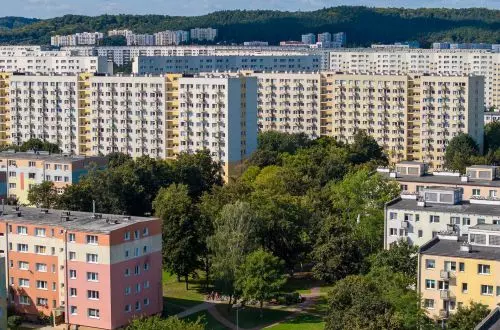
We feel this dissonance especially strongly when, leaving the historic centers of cities, we wander through more remote neighborhoods to the nightmare of our suburbs. Visible here, as if in geological boreholes, are layers and processes showing the gradual degeneration of space.
Over the past thirty years, we have considered urban planning to be a redundant and unnecessarily burdensome field, effectively eliminating it from the shaping of urban space. It is even symbolic that the concept of urban planning has no official formal reference in our country, displaced by urban planning, which has little to do with shaping space. Also in the current Law on Planning and Spatial Development, urban planning is defined as an archaic delineation of functional zones that in practice does not shape urban structures and layouts.
Since we have done away with urban planning, which is burdensome to our realities, it is time to deal with architecture. The catalog of buildings that, by definition, do not bear the attributes of architecture, despite the fact that they account for a significant, if not the main amount of realized volume, is gradually expanding. By definition, these include gas stations, overpasses, bridges and highway and expressway infrastructure, but are justified by their inclusion, according to the recently deceased French cultural anthropologist Marc Augé, as "not places" functioning in a timeless eternal present, replacing the cultural continuity and linearity typical of European culture. The suburbs have been overtaken by workshops, warehouses and various objects with the beauty of shoeboxes. To this category of "non-architecture" has been reduced the expansion of networked single-story grocery and fast food pavilions flooding vacant and haphazard spaces among existing buildings. It can be considered that the relatively small scale is not yet threatening, but their number already raises concern.
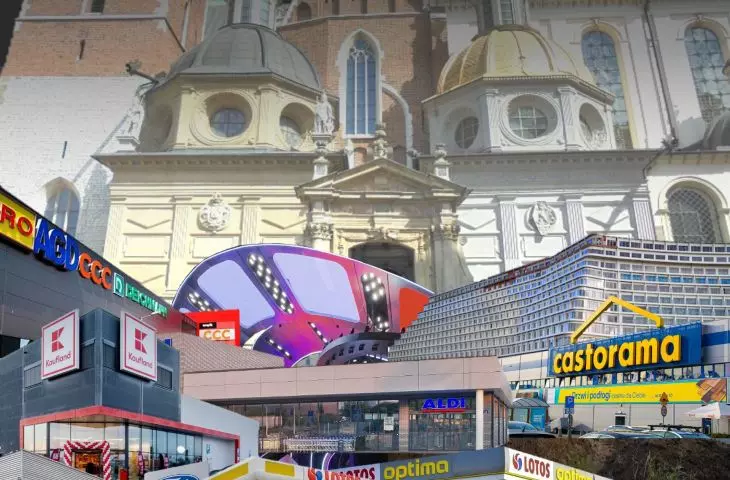
Also, the large cubic volumes of the shopping malls realized mainly in the suburbs, despite the scenery pretending to be sophisticated interior design, and being only superficial decoration, can hardly be counted as architecture. Large-scale tin logistics warehouses, which are increasingly an organic part of the landscape of farmlands and pastures, present a similar grandeur, as they are fondly erected in these areas. Glass boxes and boxes of office buildings, dubiously inviting to work in their interiors leased by corporations, balance on the border. Gradually, residential development is also being pushed out of the category of architecture, replaced by pat-development and crawling among the roads, meadows and fields with single-family housing. The picture is completed by the pastelosis, concretization of public spaces and the chaos of uncontrolled billboards and advertising posters assuming gargantuan proportions when located on building facades. It's hardly surprising that great historical architecture looks at our achievements with pity and contempt.
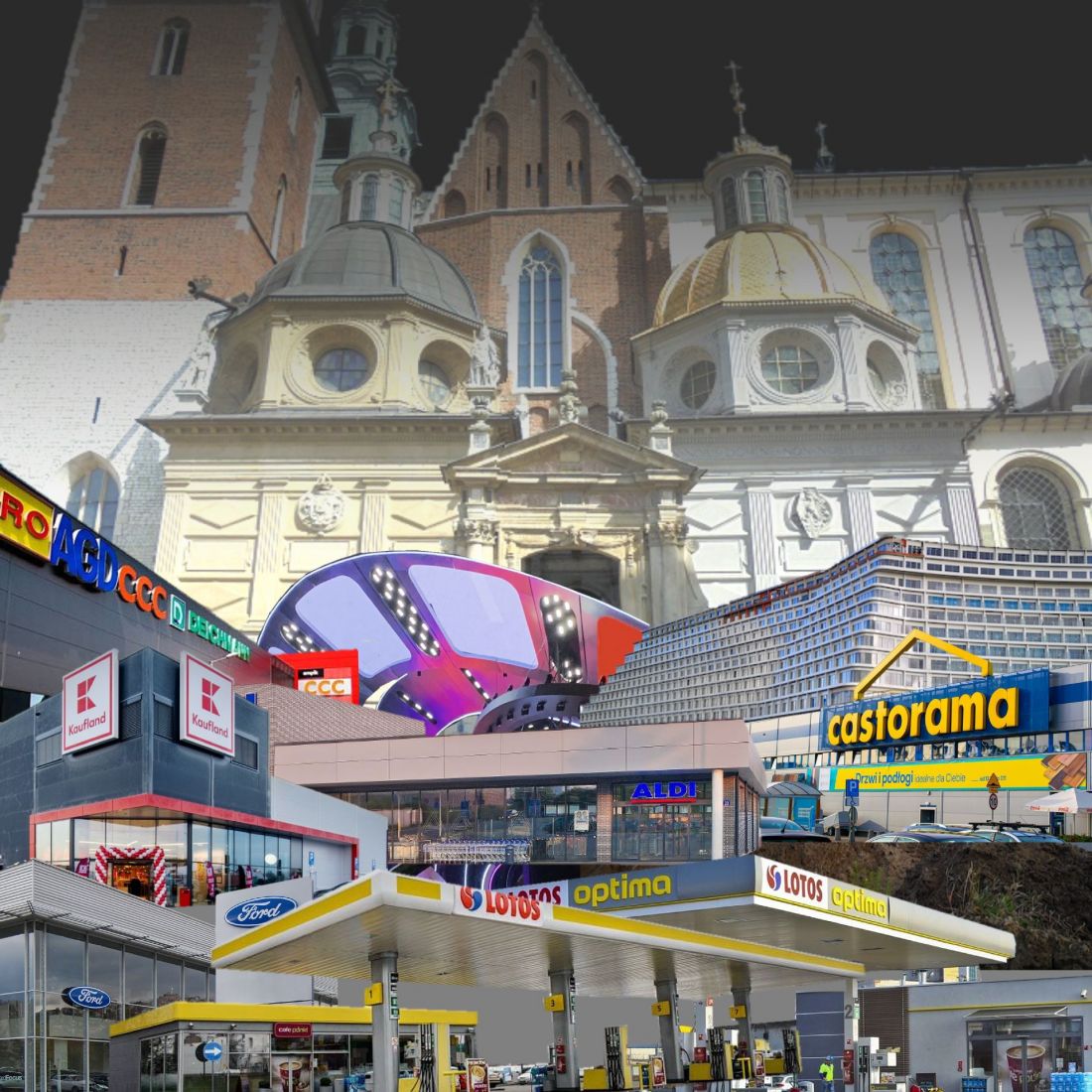
About contempt... Toward the architecture of the past, the present and ourselves
© Piotr Średniawa
This disrespect for native space is gradually spreading to the entire country, and especially - and this is particularly painful - to its most picturesque regions. Monstrous hotels devastating beautiful landscapes are springing up in the Beskids, Karkonosze, Masuria and coastal dunes, while Podhale is covered like a cancerous growth by chaotic buildings spilling over valleys and hills. This, in turn, is our modern disdain for irretrievably lost natural assets. We also disrespect modernist buildings, such as the ruthlessly demolished Warsaw Supersam or Katowice train station, whose late creators we knew personally. This modernist architecture, which is more than fifty years old, probably also already looks down on current achievements with disdain. This syndrome was evident in a drastic way on New Year's Eve, when the elegant Spodek in Katowice looked on with embarrassment at its noisy, parrot-like, flashing ledes and lasers pretentious sister, which was the widely publicized stage for the New Year's concert erected by Polish Television. This disrespect, indeed contempt, is also manifested in the remodeling - without a shadow of embarrassment or reflection - of buildings created by other architects.
mechanisms of contempt
For a dozen years or so, something bad has been happening to our space. There are mechanisms and forces at work in it over which we have lost control despite the flawed but democratic transition. After all, we as architects would like to be able to influence the shape of cities, their spaces, and the conditions and manner in which its residents live. In our relatively young democracy, every office or public entity acts according to the will of the group of people who are currently in power and the lobbyists who are always around. These actions are usually met, unfortunately, with indifference from the people who, paradoxically, elected these authorities and rather serve to create connections and perpetuate power. It is therefore unlikely, and in principle impossible, to expect change from the middle of the power structures and that subordinate authorities will work independently, creating spaces and policies that serve the residents. In view of the financial weaknesses of cities and municipalities, limiting investment opportunities, we are left with expectations from the private sector. This one, ostensibly operating under conditions of supply and demand, should meet the expectations of residents, so that they are willing to buy or use their spatial products. However, this is not the case, at least in our country, where we have experienced a shortage of retail and service space and continue to face a shortage of housing and office space. In such a situation, private capital, aided by foreign corporations, seeks to maximize profit and rapid depreciation.
Both of these forces are shaping the processes influencing the shape of our space as it is, dispelling hopes for its rapid improvement. Also, legal regulations and their establishment regarding space are subservient to these conditions. The shape of cities is implied by the privatization of spatial policy with its fragmentation, devoid of a longer strategy. Through the space shaped in this way shines not only contempt for the landscape and architecture, but above all for the people, fellow residents condemned to live and use the objects and spaces in question. It is also, unfortunately, contempt for themselves.
contempt for culture
The late, prominent architect Aleksander Franta, in a satirical drawing of bitter meaning , dreamed of a patron of Polish architecture and urban planning, the arrival of Archimuzon, who would watch over domestic architecture. It seems that this Muse has been skirting our country by a wide margin lately, or, as Franta signed the drawing, has temporarily gone to sleep. It is interesting, by the way, that in ancient Greece the nine Muses patronized history, poetry, tragedy, comedy, music, astronomy, while architecture, the cradle of European architecture, was not patronized by any of them. Perhaps the builders of the time felt that in realizing such magnificent buildings, they did not need a heavenly patroness, and that talent and comprehensive knowledge were enough? But these skills, while necessary, were not enough; the word and concept of culture were crucial. Without getting into a somewhat sterile quibble about whether architecture is art or engineering, or perhaps a synthesis of the two, it is both undoubtedly an element of culture, both tangible and intangible, derived from antiquity. Culture, as in ancient Greece, is essential to the harmonious functioning of the modern city and society. Without culture as the main paradigm, any urban development is impoverished and incomplete, even crippled. A modern city should weave together tradition, history, local identity and contemporary cultural discourse, of which architecture is a very important element. It seems that as a society, elites, authorities and we architects have forgotten about this regularity, or we consciously ignore it and do not want to either shape it or participate in it. Entangled in the conditions described, we have become one of the links in a system over whose operation we have no influence. Also in our professional discourse we are reluctant to take up the thread of culture, despite the lofty declarations in our statutes. If we want to build respect for our profession in society, but also respect for ourselves, then in addition to legal, formal regulations, standards of practice, the key word is culture. Financial issues, building regulations, energy intensity calculations, struggles with officials will be forgotten rather quickly. The only thing that will remain of our activities is culture. If it is missing, there will be nothing left but worthless construction, and we will only be professionals performing design services soullessly without respect, despising ourselves.
Piotr Średniawa
Chairman of the Council of the Silesian Chamber of Architects, member of the WKUA and MKUA in Katowice, since 2003 he has run, with Barbara Średniawa, the Office of Studies and Projects in Gliwice