





The Mile widzianx - queering the city project was a series of debates carried out in late 2025 and early 2026 in Warsaw, Kielce and Krakow. Meetings were held in public institutions and cultural spaces related to architecture and design - including. in Warsaw's ZODIAK Warsaw Architecture Pavilion, the Institute of Design in Kielce and Krakow - and took the form of moderated conversations involving female designers, researchers, activists and representatives of the administration.

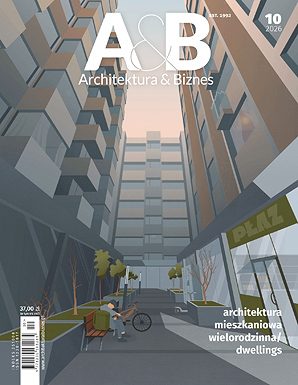
The editorial board of Architecture & Business was a media partner of the series, in the pages of which extensive reports and studies summarizing the successive threads of the project were published.
Participants in the meetings included Lidia Klein, Aleksandra Wasilkowska, Otalia Lysakowska, Dominika Janicka, Mateusz Sulwiński, Mateusz Jaskot, Piotr Buśko and representatives of local government administration. The talks were moderated by Kacper Kepinski. Each event focused on a different aspect of the relationship between architecture and the LGBTQ+ experience: from visibility and symbols in public space, to safe spaces, to urban planning and legal frameworks.
the city is not neutral
The starting point for the entire series was the thesis that space is not transparent. For some users, the city remains a neutral infrastructure of everyday life, while for others it is a space that requires constant vigilance and negotiation of its own presence. Where and on what terms one can be visiblenx not only results from individual decisions, but from urban layouts, provisions of local plans, bylaws, practices of institutions and social norms inscribed in architecture.
symbols vs. real security
One of the first topics was the role of symbols - including the rainbow flag - in public space. The discussion showed that symbolic presence does not always translate into a sense of security. Gestures of solidarity matter, but without systemic changes - in design, space management and local law - they remain insufficient.
transarchitecture as a perspective
The theme of transarchitecture has become an attempt to reformulate the very language of design. The idea is not to create a separate "architecture for minorities," but to take a critical look at the norms embedded in the discipline: who is the default user of a building? what living scenarios are considered standard? what bodies and identities are considered in the design of public, residential or institutional spaces?
Queering the city in this approach means shifting the focus - from designing for an imagined majority to designing for real diversity.
the city in paragraphs
An important part of the debates was an analysis of the legal framework. City planning, landscape resolutions, regulations for the use of space or administrative decisions have a direct impact on who can hold events, display symbols or use common space, and how. The neutrality of regulations is sometimes apparent - the law co-creates the order of visibility.
The project showed that inclusivity is not only an architectural task, but also a legislative and institutional one.
safe space as a spatial decision
Discussions of safe spaces emphasized that safety is not just a symbolic category. It is the result of specific design decisions: the way entrances are shaped, the relationship with the street, the organization of transition zones, lighting or the legibility of the functional layout. Architecture can either enhance users' sense of control and agency - or limit it.
shared space as a process
Mileianx - queering the city has not yielded a single definition of an inclusive city. Rather, it became a platform for critical reflection on how architecture, urban planning and law co-create conditions of presence. The project showed that the question "whose city is it?" is not just about symbols, but about structure - plans, standards, procedures and everyday design practices.
Queering the city turned out to be a process: one that requires the cooperation of architects, activists, officials and cultural institutions. A process that does not end with the last debate, but demands further changes in the way we think about shared space.