




The history of architecture is largely based on a catalog of practices, solutions and details transmitted and developed over time. A deep analysis of tradition allowed masters to reinterpret and creatively break the canon. Modernism, with its greater emphasis on intuition and creation in isolation from tradition, most likely contributed to the expanded ego of the architect as we know it today, which does not positively affect the condition of the profession.
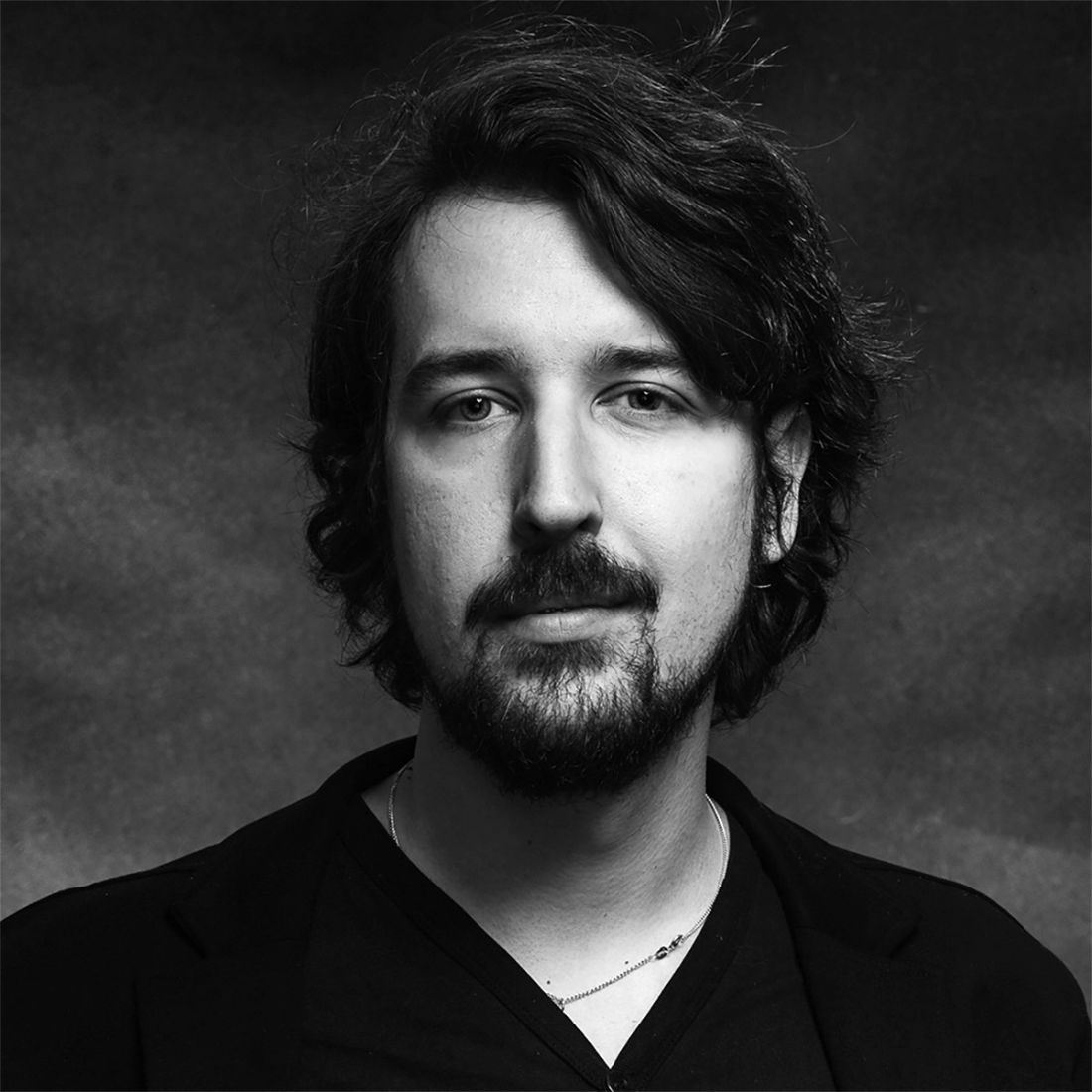
Piotr KAMIŃSKI - Born in Poznań, architect, studied at Nottingham Trent University (NTU, UK), and at the Faculty of Architecture and Urban Planning at the University of Arts in Poznań (UAP, PL). In 2025, he defended his doctoral thesis on urban planning and smart cities at the Silesian University of Technology. He gained professional experience working in both Polish and foreign architectural studios. Since 2017, he has been a planning expert for the World Bank (The World Bank, worldbank.org). Architect exploring multi-layered structure in architecture, both at the scale of a person, a building, and the organization of a city. Since 2016, he has co-founded the studio Value Added.
There is, however, a light at the end of the tunnel, a digital ignition spark. Trying to tame the basic building block of today's information age - data - can help. By relying on the interpretation of large data sets in both urban and architectural design, we have a chance to once again move closer to the rational side of construction while maintaining the creative spark. In the context of the coming artificial intelligence, or in the words of DeepMind co-founder Mustafa Suleyman, an epochal wave, this path appears not only as an enticing development opportunity, but also as a necessary survival strategy. In a world where algorithms assess the profitability of investments faster than an architect can open ArchiCAD, ignoring data is professional suicide.
Engineering, defined by MIT's Prof. Jonathan Gruber as designing the optimal solution for limited resources, fits perfectly into the problems of architectural and urban planning. The depth of our work is hidden somewhere on the surface of this definition, to paraphrase Italo Calvino. One thing is certain: it is difficult to optimize solutions without hard data to which we can refer. Relying only on personal experience and intuition, we risk a lot, open ourselves to hard criticism, and cease to be reliable. In the long term, we are relegated to a lower priority when budgeting for investments, because we can't mathematically prove our point. As a result, our market value declines, a diagnosis all too familiar to us all.
Mario Carpo, a professor at Bartlett University College in London, in "The Second Digital Turn" (2017) predicts that the next step is for architects to move into the role of data coaches and system facilitators. Architecture is poised to become predictive. Even as a first step, data-driven design represents an opportunity to rebuild the position of the rational engineer architect. Data-driven design, from inventory using point clouds, to GIS site analysis, to design using BIM holistic information modeling, to documentation automation, is much more than streamlined design. It boils it down to a spectrum of creative, multi-layered and rational optimization, not just on the level of cost-cutting. It gives us arguments and teaches us the first step of working with data, necessary to find our way with the coming AI changes. Going back to the survivalist comparison - data-driven design allows us to look for hidden potential, agile response to change, environmentally responsible optimization of resources, and better understanding of context and social voice. Its utility increases with scale, in proportion to available data, and is a strategy for almost any design scale.
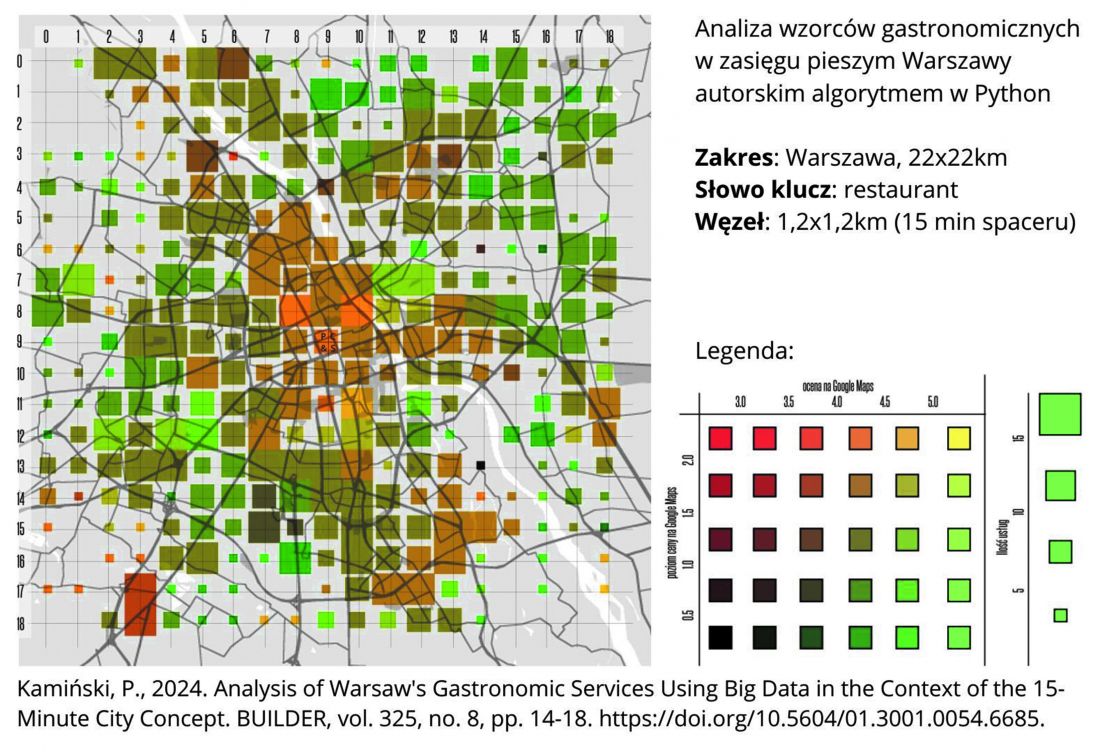
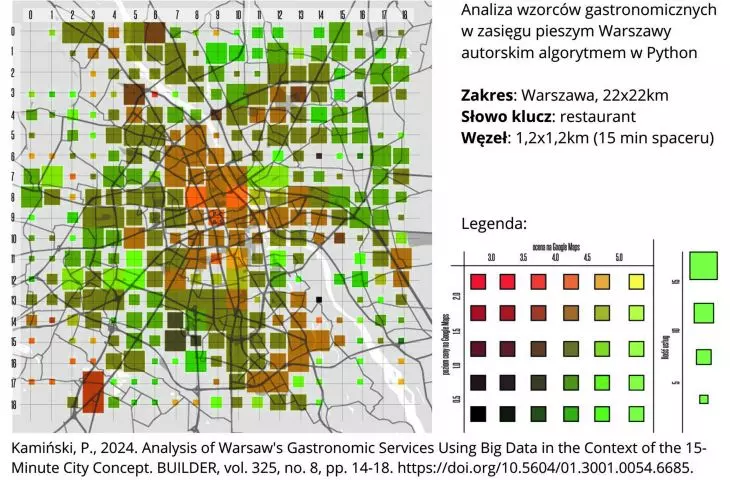
Analysis of dining patterns in the pedestrian reach of Warsaw made with Piotr Kaminski's proprietary algorithm
© Piotr Kaminski
So why don't we follow this path? It may be a hard pill to swallow, but we often lack humility. We talk about the mysterious depths of the creative process, but more often it looks like an intellectual smokescreen, protecting us from numerical accountability. We hide behind the immeasurable nature of the creative process and the apparent depth of our holistic knowledge, but we are afraid of direct mathematical confrontation with rational engineering. We like to state that an architect is at the same time a designer, a lawyer, a psychologist and a businessman, but who among us distinguishes ius naturale from ius positivum, Jungian psychoanalysis from Lacan's concepts, and is aware of the full principles of Lean methodology according to the Six Sigma Black Belt standard? Our extensive non-architectural knowledge is often superficial to say the least. Studios that outsource legal services or marketing gain a logical competitive advantage. Handing over some of the work to specialists is simply rational, as is measuring the performance of our studios, our buildings, and learning from that data.
Our mentality of modernist omniscient designers is rooted in the 20th century. The 21st century began as the age of information, and may soon evolve into the age of artificial intelligence. That's why our next foreign language should be scripting and prompting languages, and we should learn new data processing tools with more vigor than browsing architectural journals. If we sleep through this moment of change, we risk remaining niche, second-rate relics of the 20th century order. Like Geoffroy Tory, the great artist transcribing manuscripts in the post-Gutenberg era.
What is left for us not to be left behind? Explore tools, accept change, adapt flexibly and, above all, exchange knowledge. The fields of exploitation of technology and data-driven design are many: from design (generative optimization of plan and form, materials used, construction), to analytical (assisted formal-legal analysis, GIS, Isovis), organizational (automation of documentation, presentation, visualization), to financial (tracking and analysis of working hours, optimization of time, real financial data of the company). We don't have to break down open doors, we just need everyone to focus on one thing and pass the knowledge on. Each process optimization brings us closer to rational engineering, and combined with the next can have a positively logarithmic effect.
The U40 generation has both analog work skills, critical thinking and digital freedom. This is an ideal position to realize the potential of the inevitable change. We will not lose ourselves in tools, we will use them to support our skills, heuristics that simplify repetitive activities rather than depth of thought, reduce friction and increase efficiency without compromising creativity and quality.
If we face the tide together, we will come out of this change stronger, better, our work will become more enjoyable and satisfying. Perhaps, too, through rationality and data-driven optimization, it will grow in price. So let's read the signals of the coming change, learn the lessons and challenge our decisions in light of the data. This is the first step. Let's get our act together and exchange knowledge as part of the U40 architectural think-tank. This is not only a chance to survive, but also an opportunity to create standards for the next twenty-five years of work.
Piotr KAMIŃSKI
more: A&B 10/2025 - U40 - the business of the young architect,
download free e-publications of A&B