









As children find it harder and harder to maintain attention, and glowing smartphone screens win out over the real world, you may have to wonder if urban planning is facing a new challenge.
You've probably noticed that the digital world strives to keep your attention. Short videos reign supreme on social media, we quickly scroll through content on various platforms and expect instant analysis. And the kids? The average teenager can focus on a single screen activity for just 47 seconds, according to a study by Gloria Mark of the University of California, Irvine. The results of PISA surveys of 15-year-olds in OECD countries show that students' performance in reading and math is clearly declining. In Poland, the decline was about 5 percent between 2018 and 2022, offsetting the gradual increase recorded in the previous decade.
Researchers point out that this trend is influenced by both the pandemic and the increasing number of hours spent in front of screens. Students who spend five or more hours a day doing so are performing significantly worse on tests. Psychologists also note a weakening of executive functions such as planning, impulse control, working memory and cognitive flexibility. Teachers put it bluntly: it's becoming increasingly difficult to hold students' attention, and long texts make them discouraged.
Since the city is a reflection of society, values and needs, what then will change in space? Are traditionally designed cities able to meet the needs of the digital natives generation? Is it becoming necessary to adapt public spaces to the new lifestyle and stimulus processing of young people? What could it look like?
Imagine a city that blindly followed the trend of digitalization. Building facades have turned into giant displays, sidewalks lead between rows of interactive advertising panels displaying ads dedicated to you, and monitors have been installed in every bench of a neighborhood square. Incidentally, such solutions are already making their way into cities - in the form of so-called smart solar benches. Equipped with screens, charging points, Bluetooth speakers and wireless internet, they are increasingly becoming part of the urban landscape. Some have integrated advertising systems or humidifiers.
View this post on Instagram
The benches are designed to attract users' attention and keep them in a constant digital presence mode. So maybe the vision of such a city also includes home playgrounds as virtual simulators where children are in VR goggles and connect with their peers?
And what if the answer to the question of how to design a city friendly to increasingly unfocused children does not lie in further increasing the number of screens in the space? It seems that we need solutions that help regain attention, encourage contact with other people and with nature, and create conditions for real rest from digital overload. Urban planners are therefore faced with the task of creating spaces that not only respond to the challenges of modernity, but also mitigate their effects. Places of everyday life - streets, squares, plazas, schools - must become spaces that wisely and responsibly support the development of young residents. So it's thoughtful environmental design that just reduces the impact of digital distractions, encourages movement, provides a sense of security and allows contact with nature. There is another important theme in this story of the city of the future: inclusivity. Children from different backgrounds and cultures should feel that the city is also for them - open, accessible and inviting to actively use the space.
How does urban space support or inhibit cognitive and social development?
The environment in which children grow up shapes their cognitive abilitiesand social behavior. The lack of free daily outdoor activity increasingly leads to a weakening of so-called executive functions, i.e. skills related to planning, impulse control, working memory and flexibility of thought¹. Psychologists stress that it is unstructured play - especially in a varied outdoor environment - that best develops these competencies. Play that requires creative imagination, discovery and experimentation improves concentration and self-control. Studies have shown that children concentrate and inhibit their impulses better after outdoor play than after indoor activities.
Changes in the lifestyles of today's children, however, limit access to these experiences. Excessive time spent in front of screens is associated with poorer performance in cognitive and executive functions, and the lack of opportunities for free play outside reduces opportunities to develop social competencies such as cooperation, negotiation and conflict resolution. Reduced spontaneous peer interaction increases the risk of feeling isolated, and consequently promotes an increase in anxiety problems and reduced psychological well-being.
With more and more hours spent in front of screens, children are moving outdoors less and less, and this quickly translates into health problems. More than half of Europe's youngest residents do not meet the recommendations of the World Health Organization, which recommends at least an hour of moderate or intense activity a day. As a result, the risk of obesity, diabetes and chronic diseases is increasing, and lack of exercise is becoming one of the most serious challenges of modern cities.

How to increase physical activity? Recommendations of the Chief Sanitary Inspectorate - Infographic from the Chief Sanitary Inspectorate showing recommendations for increasing physical activity - from daily walks to strength and cardio exercises.
Chief Sanitary Inspectorate | © GIS
Urban environments can exacerbate or mitigate this problem. Creating spaces that support children's development includes designing places that foster creative play, but there is an equal need for secluded places for tranquility: gardens, nooks or reading rooms where children can take a break from excess stimuli.
It is becoming necessary to think about "active design" of space: creating friendly playgrounds, sports fields, green squares, as well as convenient walking and bicycle paths. Where there are green areas and places for shared recreation in the neighborhood, children are more likely to spend time on the move.
why is access to greenery the only right way?
Contact with nature and free outdoor activities are of great importance for the physical, mental and social health of the youngest children. The presence of parks and green spaces near where they live increases the chances that children will spend time outdoors, play with their peers and enjoy natural movement. Such activities reduce the risk of obesity, improve mental health and promote social bonding. Lack of contact with nature deprives children of experiences that stimulate curiosity, teach independent exploration and allow for a moment of tranquility in an environment other than concrete buildings.
Projects that integrate greenery and play areas into the urban fabric are becoming the answer to this problem. Equally important is becoming the creation of interesting and diverse places that will hold the attention of the youngest for more than a few minutes. Introducing natural yet stimulating elements - such as trees, water, stones or sand - gives children space for creative, unlimited play and becomes a viable competitor to digital screens. Ensuring that all children have easy access to safe, attractive outdoor spaces is the foundation of a healthy childhood in the city.
Cars vs. children - how to change priorities in cities?
Today's cities are still heavily influenced by infrastructure constructed for cars. This urban legacy means limited freedom of movement and increased risks on the road for the youngest. Parents often refuse to let their child walk alone or walk to school - because of concerns about safety at crosswalks or the lack of safe walking paths. As a result, children are more likely to be transported by car and spend more minutes on the road browsing content on their phones.
The lack of space for independent movement undermines daily physical activity and interferes with building a sense of independence.
Fact, there is more and more talk about school streets, reducing vehicular traffic - this happens to come up with many topics: fighting smog, concreting, traffic safety. But this solution is effective here as well. Pontevedra in Spain, for example, has been implementing peatonalización, or converting streets into pedestrian zones with traffic calming, since 1999. The entry of cars was restricted and traffic was calmed to 10-30 km/h. As a result, 65% of trips in the center are made on foot, and children can walk freely without fear. Such a strategy has brought the city numerous accolades - including an award from the European Road Safety Commission.
Oslo has introduced a Vision Zero policy - the complete elimination of fatal traffic accidents. In 2019, the Norwegian capital recorded zero fatalities among pedestrians and cyclists, including children. A big impact was made by shutting down car traffic near schools, building safe sidewalks and bike lanes, eliminating parking spaces and calming traffic in the city center. This made it possible to transform the streets into a safe and friendly space for the youngest traffic users.
cities of the future for children - children for cities of the future
Planning cities for children is, in fact, planning for everyone. The needs of the youngest reveal problems that affect adults as well: digital stimulus overload, lack of traffic, dangerous streets or limited access to nature. Each of these factors overlaps, compounding the effects - the lack of safe places to play causes children to spend more time at screens, which in turn worsens their concentration and affects their health.
The good news is that we know what changes we need, and changes that serve children improve the quality of life for entire communities. A city with safe bike paths, parks in every neighborhood, clean air and friendly public spaces becomes healthier and more comfortable for everyone. The biggest task remains adapting these solutions to the realities of the 21st century, so that they counteract the effects of digital overload and support children in regaining focus, moving, playing and learning.
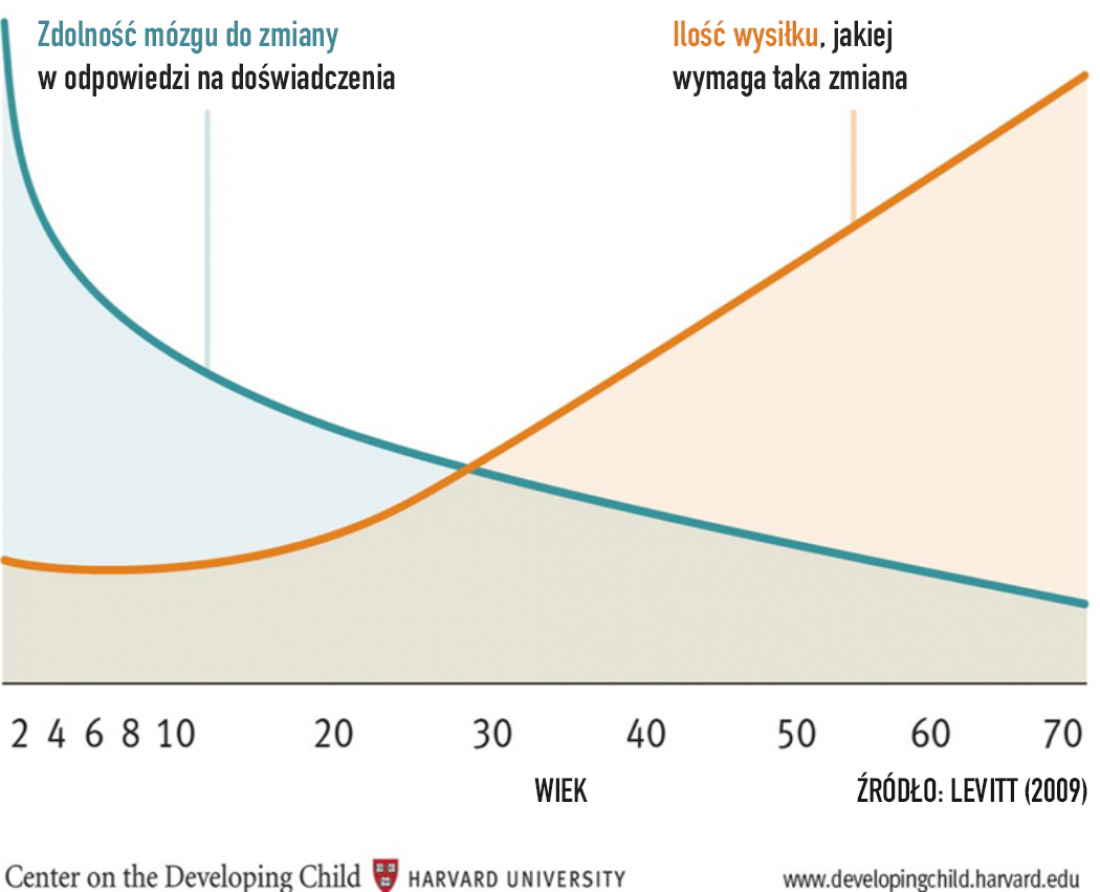
How does the brain's ability to learn and the effort required to change change over the course of a lifetime? - A graph showing the relationship between the brain's ability to adapt and the amount of effort needed to change at different stages of life. Data compiled from research by Levitt (2009) - Center on the Developing Child, Harvard University.
Center on the Developing Child, Harvard University | © Levitt (2009)
Today's children will become tomorrow's adults who will shape the direction of development. The cities we design now will shape them - their health, social relationships and even the way they look at the world.