



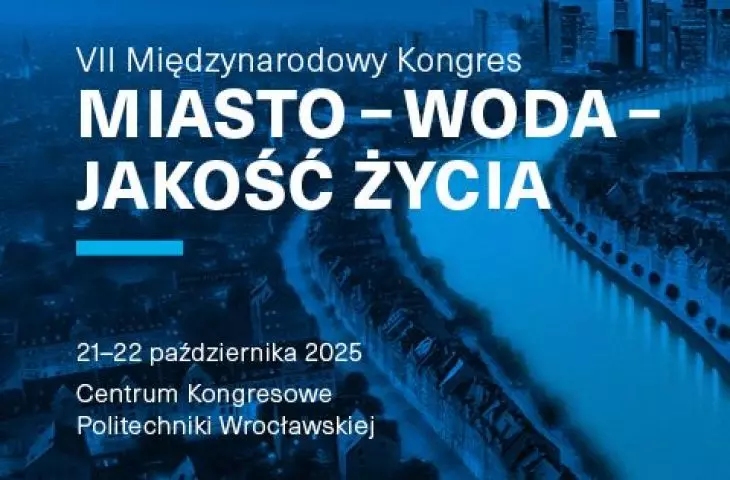


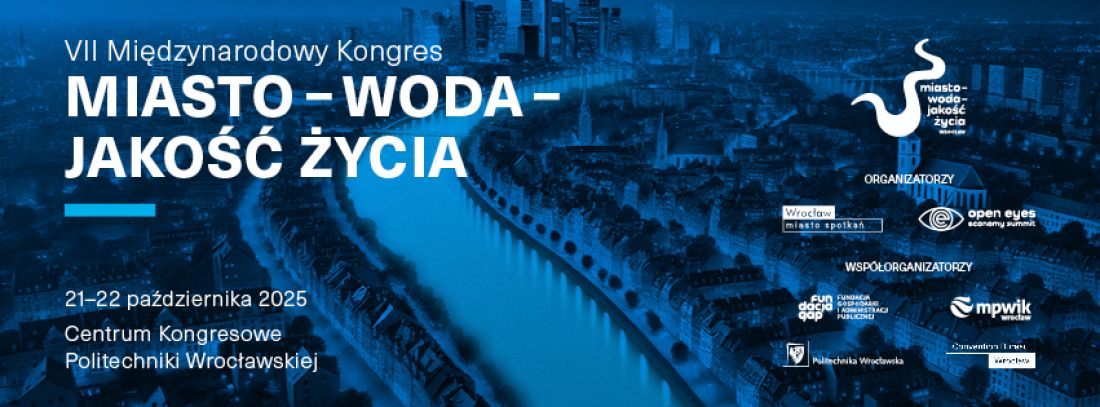
In just a few days, Wrocław will become a space for discussion on the relationship between the city and water and their impact on the quality of life. For the seventh time, the International Congress "City - Water - Quality of Life," organized by Open Eyes Economy and the City of Wroclaw, will focus on the relationship that occurs between water and urban environments and seek ways to deal with their negative effects, especially a year after another flood.
On October 22, during the second day of the congress, Paula Hanasz, an advisor to the Minister of Climate and Environment whose doctorate at the Australian National University (ANU) focused on international conflicts and cooperation on shared water resources, will speak about ways to manage water from the perspective of the state of Victoria in Australia.
For A&B, she talks about where we are in the process of taking care of our climate and what is the biggest problem in urban water management
Ola Kloc: You are an expert in water security - please tell us more about what you do on a daily basis, in what situations is your knowledge used?
Paula Hanasz: For a water expert, i spend very little of my day dealing with water! And even though my PhD was about the governance of international rivers, i would say i am really an expert in how to prevent "zero sum" outcomes and maximise "positive sum outcomes" from shared but finite natural resources. In other words, how can we manage our environment better so that everyone wins and nobody loses. There are definitely ways to maximise social wellbeing and economic prosperity while reducing vulnerability to future shocks from a changing climate, all while minimising pressure on the environment. We just have to learn how to do more with less, and water is great to help us focus on what is truly important - there is no substitute for water, we all need it every day, and if we can solve some of our water problems, a lot of other complex challenges facing our society, economy and environment today will also be partially addressed. That is what i spend my days thinking about - how can we make small changes in many different parts of our economy to makes the whole system of water governance more efficient, sustainable, and fair.
Ola Kloc: You are an advisor to the Ministry of Climate and Environment on issues related to climate action - where are we today in the process of taking care of our climate? What challenges lie ahead, and what can we already be proud of?
Paula Hanasz: Polish people are really beginning to understand the connection between the environment and public health and also national security. This is important because these are values that transcend political divisions; everyone can agree that we want our children and grandchildren to have healthy, long lives in a safe and prosperous society. And that means we all need to work together now to reduce all forms of air pollution - something Poland is already doing very well and should be proud of - as well as rebuilding healthy soils that retain water and nutrients. I think the traditional wisdom of managing agricultural land in harmony with forests and waterways has been a bit lost but i am also seeing a resurgence in this type of ecosystems thinking.
Ola Kloc: In your research career, you have worked on water resources management in India, Nepal, Bhutan and Bangladesh, and in Australia you led a team implementing climate change mitigation and adaptation initiatives in the water sector. From this international perspective, how do you assess the Polish water-urban relationship?
Paula Hanasz: From my perspective, the biggest problem for Poland in terms of urban water management is one of imagination. Poland does not perceive itself as a water-scarce country and therefore does little for water retention and water efficiency at a scale required to tackle the challenges of a changing climate. Moreover, water is understood - especially in cities - as a danger - the 1997 floods left a big mark on the public imagination. Obviously i'm not suggesting that flood preparedness, mitigation, and recovery are not important - we should all know by now that we will be seeing an increasing frequency and intensity of flash floods as the climate continues to change. But adapting to this new reality can also be seen by Polish cities as an opportunity to increase quality of life for citizens. For example, investing in blue-green infrastructure such as storm-water gardens not only provides water retention benefits but can also work to mitigate the urban heat island effect. Another thing i would like to see more of in Polish cities is greater uptake of recycled water, for example for watering public green spaces.
Ola Kloc: The Water-City-Quality of Life Congress, of which you will be a speaker, will largely focus on issues related to flooding, including the infrastructure to protect us from it. What lessons do we have to learn on this issue?
Paula Hanasz: At the congress, i provide three lessons i learned from delivering on the Water Cycle Climate Change Adaptation Action Plan 2022-2026 in the state of Victoria, Australia. The first lesson is that the water sector should not be seen as separate from other "systems" such as the natural environment, the built environment, and primary production. The second lesson is that climate change adaptation should be understood as a risk and resilience function - like crisis management - rather than an environmental sustainability function. And third, education is not enough; governments and communities must be in constant multi-way dialogue with each other, and collaborate on the urban water security plans and flood risk mitigation and recovery strategies that will affect us all.
Ola Kloc: Thank you for the interview.
Ola Kloc
© organizers archive
The 7th International Congress "City - Water - Quality of Life" will be held at the Congress Center of the Wrocław University of Technology on October 21 and 22 . The event is divided into thematic sessions: One year after the flood, Strengthening the safety of the use of flood control infrastructure, Not just a textbook - creative ways to teach about water and climate, Psychosocial consequences of flooding, Challenges of financing nature restoration, Nexus - how to manage sustainable development?, City and catchment area and "Everything flows. Metaphors as evidence of the importance of water.
The event will be held in a hybrid format - stationary and online, registration is required.