





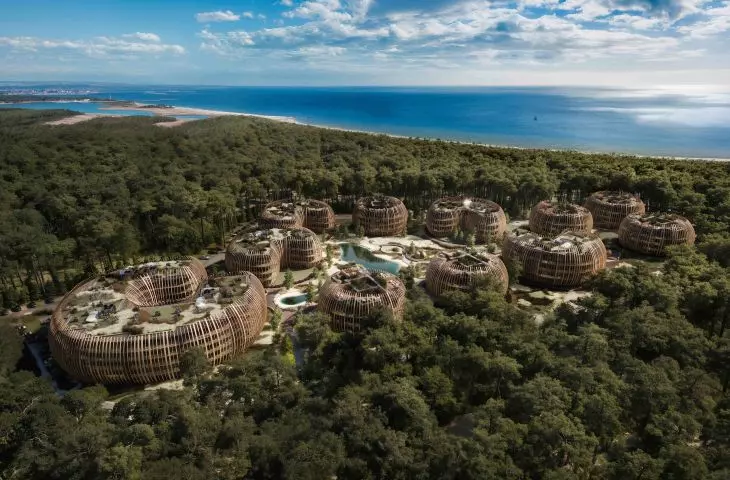
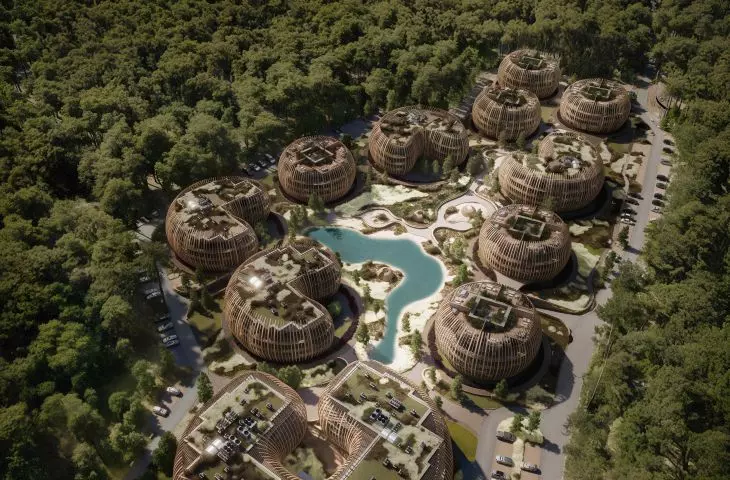
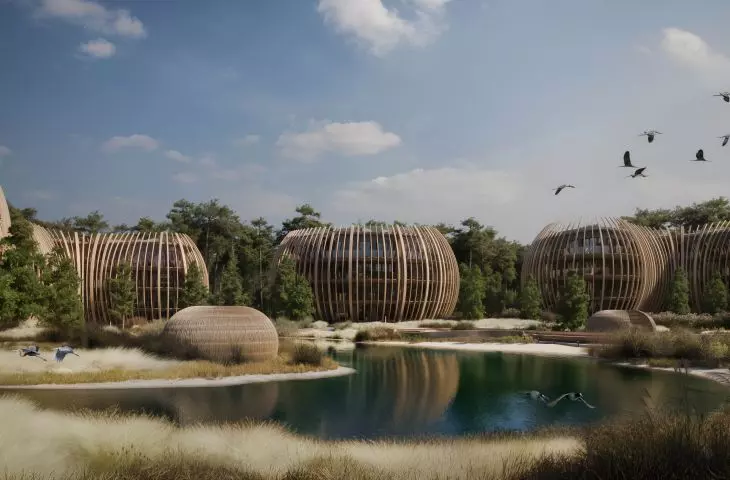

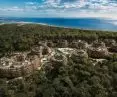
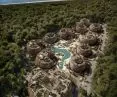
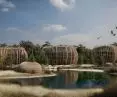


Building in the middle of a green enclave - an investment even the most "eco" - is, according to Professor Jan Marcin Węsławski, a marine ecologist, an inappropriate solution in such a place. Silva Maris on Sobieszewska Island has resonated because of its unusual architectural form. Lumps of buildings inspired by birds' nests set the project apart from other developments on the Polish seaside. However, experts are concerned about the impact on nature preserves and the increase in tourist pressure.
In April, developer Dekpol presented the Silva Maris project: nine buildings with as many as 500 investment apartments and a hotel (we wrote in detail about this project here). The complex is being built on the Sobieszewska Island in Gdansk near the valuable nature reserve "Ptasi Raj", just half a kilometer from the sea. In its promotional materials, Dekpol assures that "the space between the buildings will be largely given over to local nature, introducing new dunes, coastal grasses and pine trees, thus preserving the biological continuity of the area." The project has resonated, mainly due to its unprecedented form: the buildings are reminiscent of birds' nests. Due to its proximity to the sea and reserves, the project is sure to attract investors.
increase in developer pressure
But there is also the other side of the coin: there is no shortage of concerns about the loss of the island's climate and the consequences for the environment. Residents of Sobieszewo Island have been objecting to the increasing investment pressure for some time now. Last year, more than 5,000 people signed a petition addressed to the mayor of Gdansk to protect the unique character of Sobieszewska Island.
We note the tremendous pace of intensive development of the Island, in which developers will reap the benefits, while residents and lovers of the Island will pay the price. (...) Sobieszewska Island is a unique natural area of special ecological and landscape value, including two nature reserves: 'Bird Paradise' and 'Mewia Łacha'," wrote the authors of the petition.
They added that overdevelopment poses a serious threat to these areas, leading to the degradation of animal and bird habitats and the disturbance of wild species, but also a significant deterioration in the quality of life of local residents.
We asked experts about the possible consequences of the construction of a large apartment and hotel complex on Sobieszewska Island. Prof. Jan Marcin Węsławski, a marine ecologist, stresses that measurable losses in the functioning of the Baltic ecosystem, habitats, biodiversity of the sea such an investment will not cause. This is assuming that the investor will take care of such issues as efficient sewage disposal and treatment, not exceeding noise standards, etc.
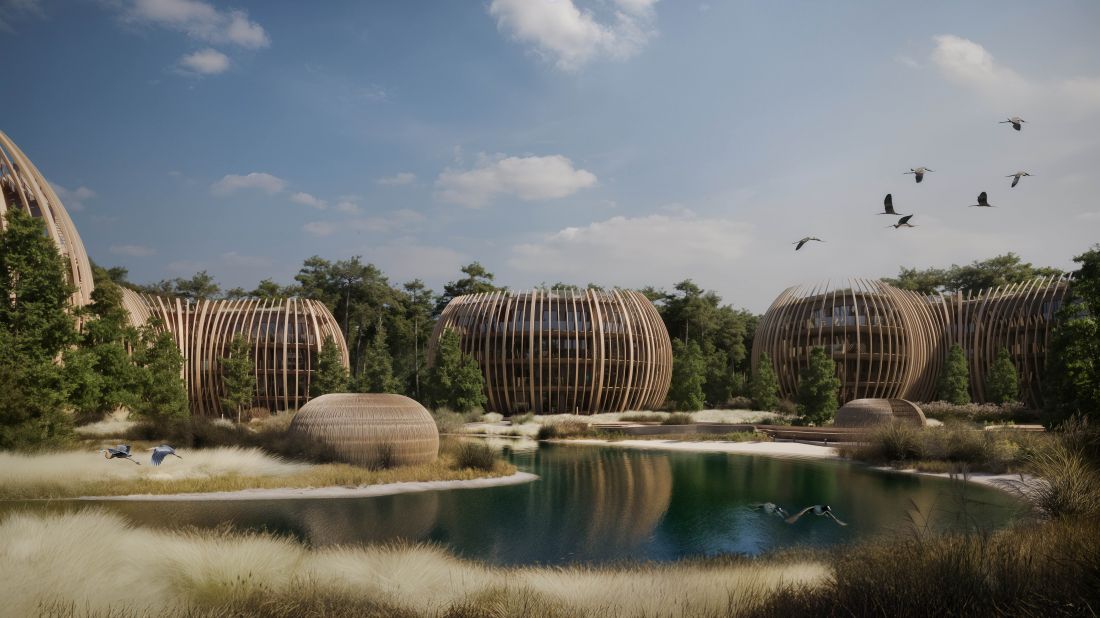
The space between the buildings has been largely given back to local nature, introducing new dunes, seaside grasses and pine trees, thanks to which the biological continuity of the area has been preserved, Dekpol argues.
mat. Dekpol
Prof. Węsławski: "Building in the middle of a green enclave is wrong."
On the other hand, this is not the way to assess environmental impact. This place, Sobieszewska Island, once occupied by the military, lies in the immediate vicinity of one of Poland's most important bird sanctuaries with its largely preserved almost natural shoreline and coastal forest. Building a settlement - even the most "eco" one - in the middle of this green enclave is simply wrong and inappropriate, as such a complex with roads and infrastructure will turn the area into a satellite town and become a suburb, the scientist says.
In his view, it's analogous to considering whether nature will be harmed by putting a hotel on top of Giewont.
It won't harm it directly, because there is very poor life there apart from the rocky growths, and there will be a beautiful view from the hotel. But cramming infrastructure into a semi-natural area that is very rare in our country is a primitive push by developers for profit, which will not be justified by the most beautiful architectural form. It is necessary to build on the immediate outskirts of existing settlements, and especially from the seashore you need to stay away, also keeping in mind that sea level rise is no joke, nothing will stop it, so this investment has a chance of surviving for about 100 years at most.
According to Prof. Węsławski, the argument that there was a military site there is not helpful, "because acutely abandoned military sites regenerate very well on their own, and provide a natural starting point for habitat restoration."
"A large complex will increase anthroporesis."
Ornithologist Mikolaj Koss is concerned that the investment could harm the nature of Sobieszewo Island.
Building such a large complex will attract more people, so it will increase anthropopressure on the Bird Paradise Reserve and partially also the Gull's Lacha Reserve at the mouth of the Vistula Crossing into the Gulf of Gdansk, says Mikolaj Koss.
And he adds that both reserves are important refuges for breeding protected waterbird species. The area is also home to nesting sites for the white-tailed eagle, which is under zonal protection. The ornithologist is concerned that activities associated with the project could affect the breeding success of this species. The two reserves also serve an important function for, among other things, migratory birds that breed in the far north, including Siberia, and use the reserves as stopover sites where they can rest and feed before the next stages of their migration.
Increased human presence can cause birds to be frightened in these places. Unfortunately, overdevelopment of tourist infrastructure is affecting the entire coastline. Until now, Sobieszewo Island has been a natural gem, essentially free of extensive development. The fact that the buildings in the new development will be shaped like birds' nests has nothing to do with the protection of nesting species on Sobieszewska Island," believes Mikolaj Koss.
More visitors are a threat to nature
Dr. Szymon Bzoma, an ornithologist and president of the KULING Waterbirds Research Group, explains that the problem of the reserves on Sobieszewska Island is the increase in visitors.
The construction of the bridge to Sobieszewska Island has resulted in a greater influx of people, especially at a time when birds are vulnerable to crowding. The investment has also opened the way for developers to pursue further development. Unfortunately, the growing number of people interested in staying on the island poses a threat to nature. Already today, about 3 percent of visitors to the Bird Paradise Reserve break prohibitions and enter the reserve.
The expert points out that this is a higher percentage than in other protected places.
If the number of visitors increases, even with the same percentage of violators, the scale of the problem will be many times greater. Exceeding a certain level of tourist traffic could seriously limit the natural values of Sobieszewo Island - one of the most interesting places on the coast - especially when it comes to birds.
According to Szymon Bzoma, institutional nature protection often does not provide good answers to real threats.
This is a problem not only in Poland, but throughout the European Union. It is increasingly being claimed that areas of natural value are disappearing at an alarming rate, and wild animals have less and less room to live, says Szymon Bzoma.
And he adds that if we want to effectively protect nature, we must first determine what is actually valuable. As he points out, in theory, this is what the environmental impact assessment procedure serves, which should identify natural values and indicate appropriate conservation measures.
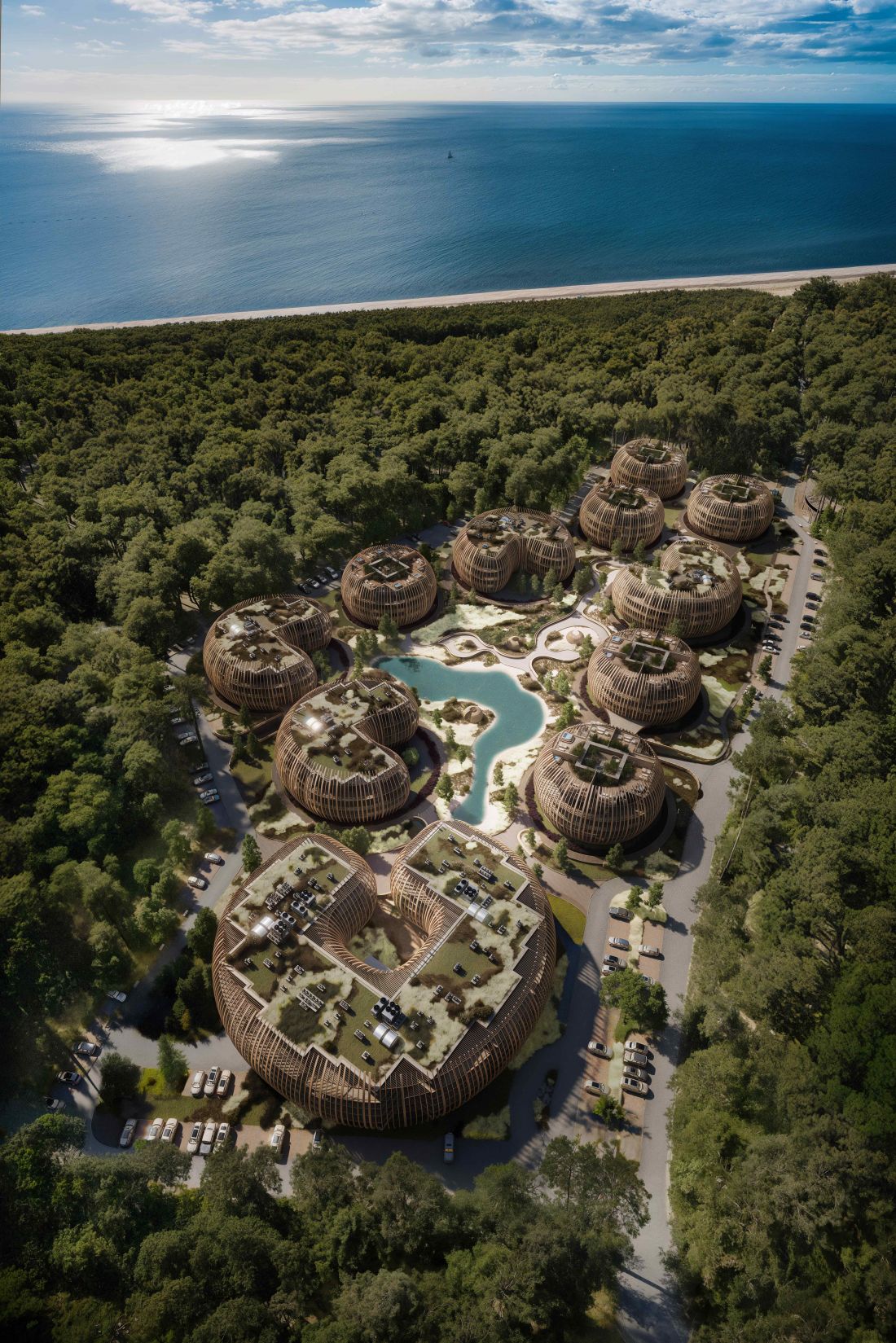
The grand project is to be implemented in stages, with the investment starting as early as the second quarter of 2026 and ending in the first quarter of 2028.
mat. Dekpol
In practice, the system does not always work as it should. The investor, of course, is obliged to conduct analyses, but often studies are done and it is written that there will be no impact, the expert says.
developer takes the floor
In response to our request for comment, Dekpol points out that the developer "from the beginning had in mind that the implementation of the project in such a nature-sensitive location requires detailed analysis and planning of measures to limit the impact of the investment."
That's why even before the start of the project, extensive field research and environmental analyses were conducted. They covered not only the number of visitors, but also their behavior, directions of movement, intensity of use of paths, beaches and potential impact on the most valuable habitats. As a result, we have a detailed model of the investment's impact and know which areas require special protection," Dekpol writes in response to AiB.
The company adds that it plans, among other things, to clearly delineate the main traffic routes and limit the dispersion of traffic through the naturally valuable areas, as well as to limit the possibility of free movement through the most valuable habitats, especially within the Messinian Spit.
The environmental decision for the Silva Maris project was issued in 2023. It set out conditions to minimize the impact of the investment on nature. These include:
- fencing and marking nearby forest areas as nature conservation areas,
- limiting tree cutting to a minimum, and conducting it outside the bird breeding season (unless the absence of breeding is confirmed by an ornithologist),
- nature supervision (ornithological and general) throughout the project. According to Dekpol, an environmental consultant with the appropriate knowledge and background will be hired before construction work begins to advise the team on the project, so that "the work is carried out with respect for nature."
- infrastructural solutions to enable animal migration (e.g., crossings for amphibians and small mammals, appropriate fencing),
- special solutions at glazed facades to reduce collisions for birds.
Pending effective protection of Sobeshevskaya Island
Why - despite its location in the vicinity of nature reserves - did the Mayor of the City of Gdansk - when issuing the environmental decision - decide that there was no need to conduct an environmental impact assessment for this investment?
Of key importance in this matter was the position of the Regional Director of Environmental Protection in Gdansk, who, after analyzing the documentation, decided that there was no need for such an assessment. Following this position, the city, as the issuing authority, also did not impose such an obligation, reports Jędrzej Sieliwończyk of the Municipal Office in Gdansk.
Szymon Bzoma believes that for more effective protection of the valuable areas of the Sobieszewska Island, the decision of the local government is needed first of all.
Since residents and tourists are getting new infrastructure-like a bridge or a hotel-some restrictions to protect nature are also necessary, such as limiting entry or restricting access to the most valuable sites. The problem is that many people see such restrictions as an attack on existing freedom," says Szymon Bzoma.