




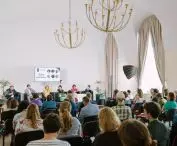
Cities have real tools to influence local food systems. Local governments run schools, kindergartens, nurseries and childcare facilities. They manage markets, business premises and some of the land where direct trade, community gardens and urban farms can thrive. They can also organize public procurement so that food going to institutions strengthens local producers and shorter supply routes. The 2nd Cities for Food Sovereignty Congress will focus on how to translate these competencies into concrete solutions: stable venues for sales, cooperation with farmers, better logistics and access to good, fresh food for residents.
The 2nd "Cities for Food Sovereignty" Congress will be held on June 17-18, 2026 in Krakow. The first day is scheduled for the Wielopolski Palace of the Cracow City Hall at All Saints' Square 3-4, while the second day will include a study visit to a marketplace and a workshop at the Krzysztofory Palace at 35 Market Square.
The event brings together local governments, farmers and agriculturalists, people involved in trade, distribution and processing, academics, community organizations and entrepreneurs. The common theme will be the development of local food systems, i.e. arrangements of production, sales and consumption that strengthen the links between a city and its agricultural hinterland. In practice, this means talking about markets, vegetable markets, wholesale markets, procurement, school cafeterias, soil, warehouses, logistics and local contingency plans.
The Congress program includes four panels: "Work Ethos | Pride in Working with Food," "Bioregions | Production and Regeneration," "Trust | From Infrastructure to Relationships," and "Security | Sovereign Eatest."
The panel "Work Ethos | Pride in Working with Food" will focus on occupations present at various stages of the food supply chain. The starting point will be the work of the male and female farmer and the situation of those who take over family farms or start farming, markets or processing operations. The panel will take up the topic of economic stability, social recognition of working with the land and the role of the city as a market. An important theme will be markets, vegetable markets and market halls as places where local farms build recognition and direct relationships with customers.
The panel "Bioregions | Production and Regeneration" will focus on the bioregion as an area of food production and the shared responsibility of the city and region for local resources. The point of reference will be the urban food zone of Krakow and Malopolska. This is the area where the needs of the metropolis, the potential of farms, planning decisions and the state of the environment meet. At the center of the conversation will be soil as the basis of food production. The panel will also cover soil regeneration, farmland protection, the microbiome, urban planning and new professional specializations at the urban-rural interface.
The panel "Trust | From Infrastructure to Relationships" will address mechanisms that organize local trade and strengthen the credibility of producers. The starting point will be the relationship between farmers and consumers, direct sales, markets, local vegetable gardens and cooperatives. Participants will also discuss certifications, regional labels and quality systems. A separate topic will be infrastructure: wholesalers, warehouses and logistics, without which local food is limited in its ability to reach residents, stores, restaurants and public institutions on a regular basis.
The panel "Security | Sovereign Eatest" will focus on food security as part of the resilience of the state and local communities. The conversation will cover domestic food production, processing, storage and distribution in situations of market disruptions, climate crises and military threats. A special focus will be on infrastructure: wholesale markets, local warehouses, distribution networks and entities with state participation. The panel will also show the importance of cooperation between government, local governments and producers in maintaining the continuity of the food supply.
The second day of the Congress will be practical. Participants will take part in a study visit to a marketplace and a workshop on Modular Urban Food Policy. The goal of the work will be to develop a document that will help local governments create their own food policies, tailored to local conditions. Such a document can organize actions on markets, procurement, food education, working with farmers, protecting urban food zones and reducing food waste.
Congress is responding to the need for a stronger link between urban policy and agriculture and the local food market. Good food in the city starts before the store and before the cafeteria: on the farm, in the field, in the orchard, in the warehouse, in the wholesale market, in the marketplace and in the purchasing decisions of public institutions. Therefore, the conversation about food sovereignty is simultaneously about producers, local governments and residents. At stake is a system in which Polish and regional food has stable sales channels, and cities build their security together with their surrounding agricultural areas.
Registration and a detailed program of the Congress are available at: miastadlazywnosci.pl