





The Local Land-Use Plan adopted in 2002 for the green areas known as Pola (Łąki) Oborskie in the village of Obory, in the municipality of Konstancin-Jeziorna, called for the construction of a golf course on the majority of the area. However, it is now 2026, and (fortunately) the priorities have changed.
The Oborskie Meadows, or Oborskie Fields, are former floodplains of the Vistula River, an area located within the boundaries of the Konstancin-Jeziorna municipality near Warsaw, right next to the Łęgi Oborskie Nature Reserve. Both areas were once part of a riverside landscape system; the local waters helped maintain marshy conditions in parts of the terrain and led to the formation of peat bogs and mudflats.
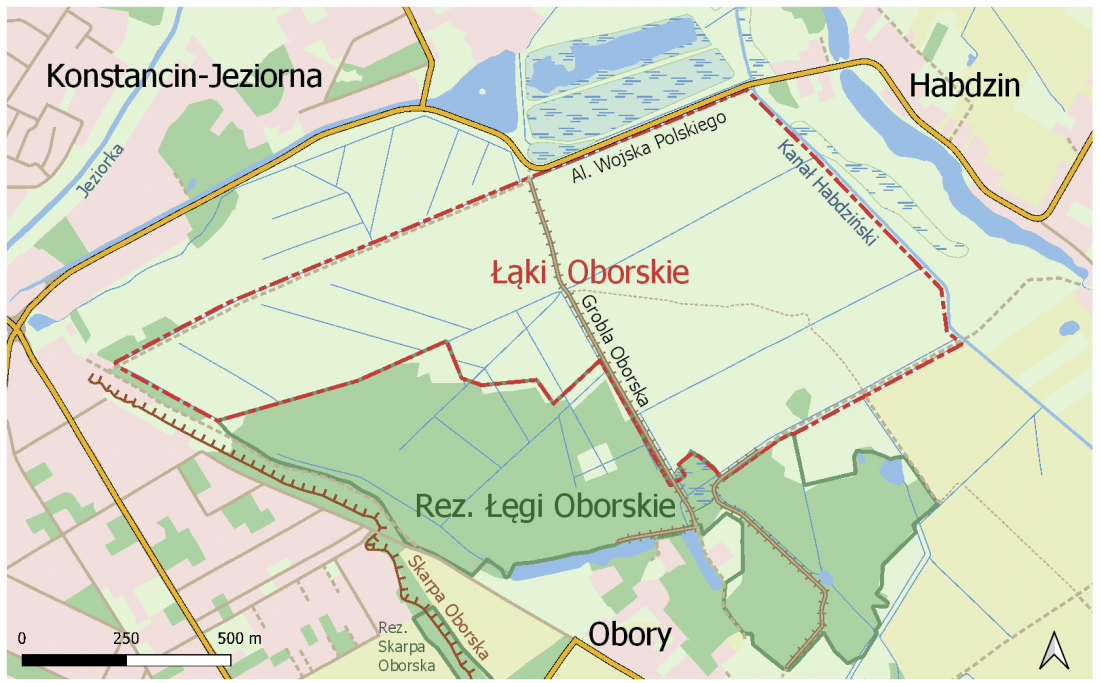
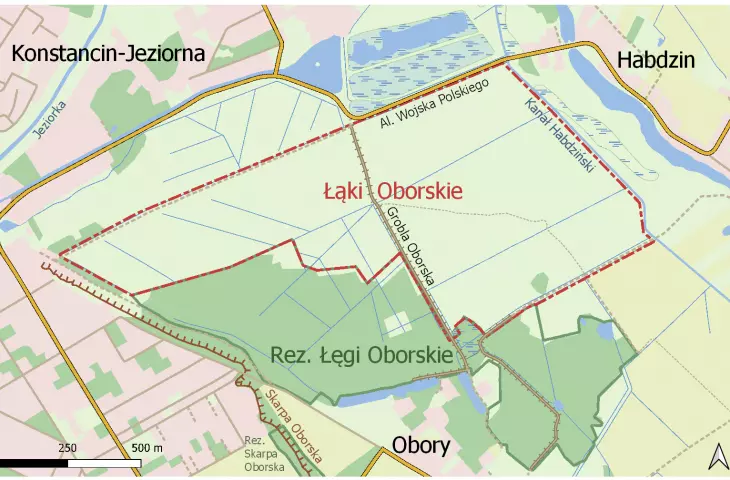
Łąki Oborskie, schematic map
© Dariusz Kowalczyk (partially using data from the topographic features database [BDOT10k] of the Main Office of Geodesy and Cartography) | Wikimedia Commons © CC BY-SA 4.0
However, these ecosystems ceased to function fully after the construction of flood embankments and a network of drainage ditches—meadows formed on part of the peat bog and in the floodplains. The Oborskie Meadows, covering an area of nearly 90 hectares, may—according to the provisions of the Local Spatial Development Plan—be largely designated for a golf course, residential development, and landscaped green spaces.
“We’ve cut ourselves off from nature and natural phenomena. It seemed that a swamp wasn’t an urban issue: the modern city promised sterility, predictability, and durability—in other words, everything that a swamp was completely unassociated with,”
— said Małgorzata Kuciewicz of the CENTRALA Project Group
in an interview . Mazovia, meaning “the land of swamps.”
in a web of interdependencies
In the fall of 2023, experts from the Wetland Conservation Center (comprising: Wiktor Kotowski [project coordination, report editing], Dorota Giriat [geology, geomorphology, soil conditions], Izabela Jaszczuk [phytosociology, sosology], Jarosław Suchożerbski [hydrology]) published a report in which they examined the meadows from an ecohydrological perspective and assessed the conditions for the nature reserve’s functioning in relation to the potential for development in its immediate vicinity. This relationship is extremely important—the ecohydrological connection between the meadows and the Łęgi Oborskie Nature Reserve means that the future of the reserve’s ecosystems depends on the water conditions in the Oborskie Meadows.
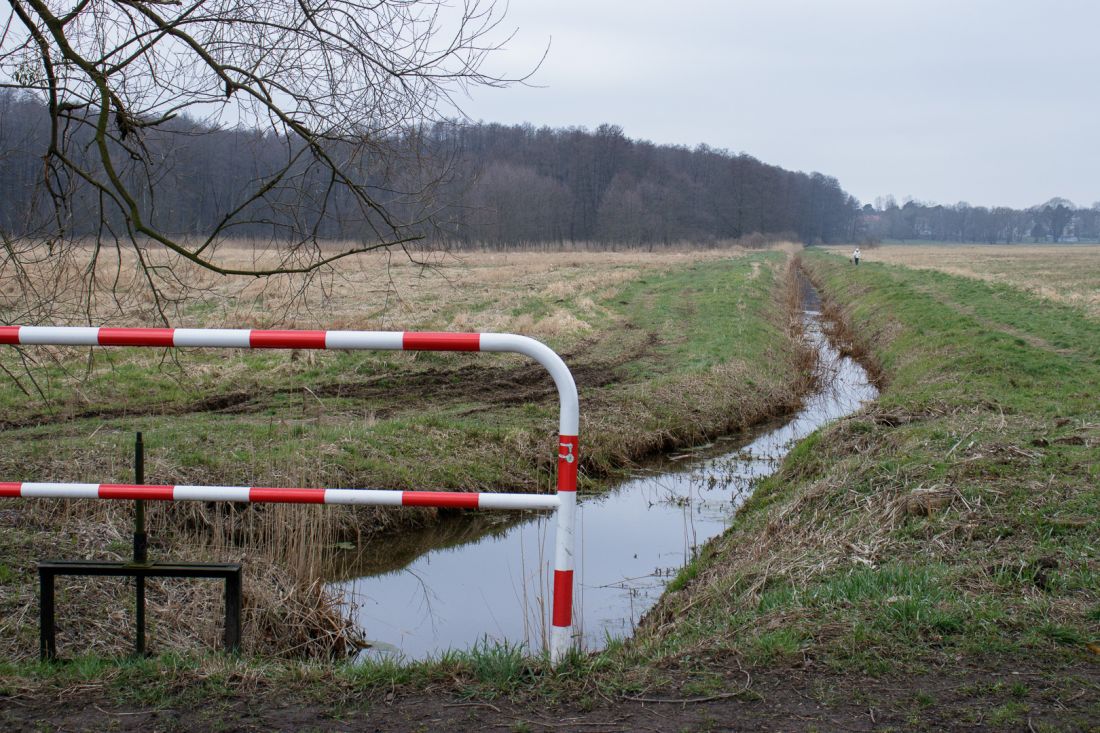
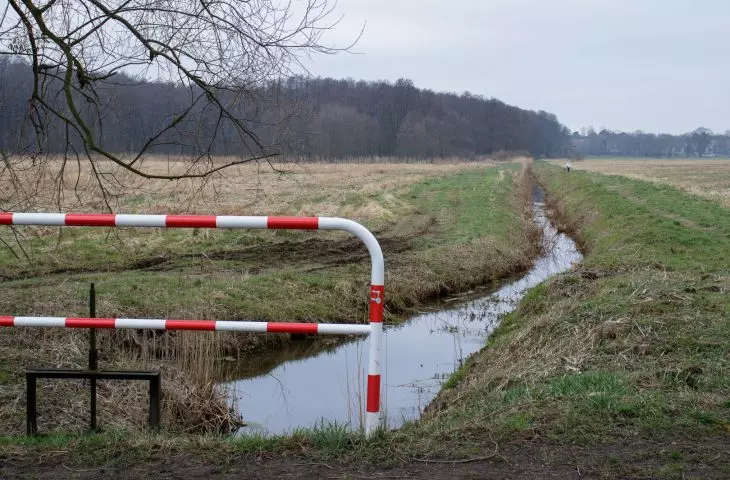
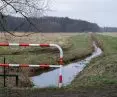
The Oborskie Meadows, a drainage ditch, and in the background on the left, the Łęgi Oborskie Nature Reserve; view from the dike toward the west
photo: Dariusz Kowalczyk | Wikimedia Commons © CC BY-SA 4.0
To maintain the reserve’s functions, it is necessary to limit water outflow from this area and ensure a water level close to ground level. Only such conditions will halt further peat decomposition, support the presence of specific marsh plants, and limit the ongoing expansion of invasive species
— the report states.
Researchers have shown that the construction of a golf course would result in the destruction of existing meadow ecosystems and, consequently, the elimination of rare and protected plant and animal species, as well as natural habitats. On the other hand, allowing residential development would necessitate the drainage of the land.
a return to wetlands
The authors of the report proposed an alternative scenario for this area—the creation of a nature--cultural park that would combine the restoration of the natural functions of wetland ecosystems with the development of recreation, nature education, and historical education, as well as local adaptation to climate change through a significant increase in water retention. They citedthe London Wetland Centre as an inspiration.
The concept of a nature-and-culture park calls for restoring, as much as possible, the original ecohydrological connections within the analyzed area, so as to ensure the most sustainable possible wetland conditions within the reserve by maintaining high water levels in the Oborskie Meadows as well. We propose creating a nature park here that would showcase the marshy landscape of the Vistula River’s ancient valley (while preserving the view of the Vistula Valley) and the culture of the Olęders to the residents of Konstancin and visitors alike. Within the area covered by peat soils, the meadows could undergo partial renaturalization by filling in drainage ditches and locally removing a shallow layer of degraded organic soil (murszu), in order to restore wetland processes and groundwater recharge. Additionally, the system of floodplains could be supported by diverting water from the Jeziorka riverbed. The shallow floodplains created in this way would very quickly become feeding and nesting grounds for numerous species of waterfowl and marsh birds, making them an undeniable attraction for ornithologists and nature-loving tourists. A system of footbridges, platforms, and observation towers would allow visitors to observe nature, and the area around the historic dike and the sandy elevations among the meadows could accommodate small, nature-friendly structures resembling an open-air museum—a living museum
— as stated in the report.
Wetlands instead of a golf course? Exactly! Why is this a good idea?
Today we know how important the thermodynamic properties of wetlands are, what a vital role they play in cooling the city, and how they influence the microclimate. We’re seeing a return to thinking about how to make the city more water-permeable, how to restore hydrographic systems in oxbow lakes, and how to create recreational areas along them
— said Małgorzata Kuciewicz of the CENTRALA Project Group in an interview with A&B.
Wetlands are carbon sinks: over millennia, including in Warsaw, organic matter has decomposed and accumulated. As a result, large reserves of carbon dioxide have built up there, which would be released if the wetlands were drained. Moreover, every wetland helps prevent the city from overheating. The thermal inertia of the marshy soil warms the cool night air, creating updrafts, while during the day, surface evaporation cools the overheated air. Not only that, but marsh habitats are extremely diverse, rich in species of toads and other amphibians and reptiles that require the greatest protection today
— added Simone de Iacobis of CENTRALI.
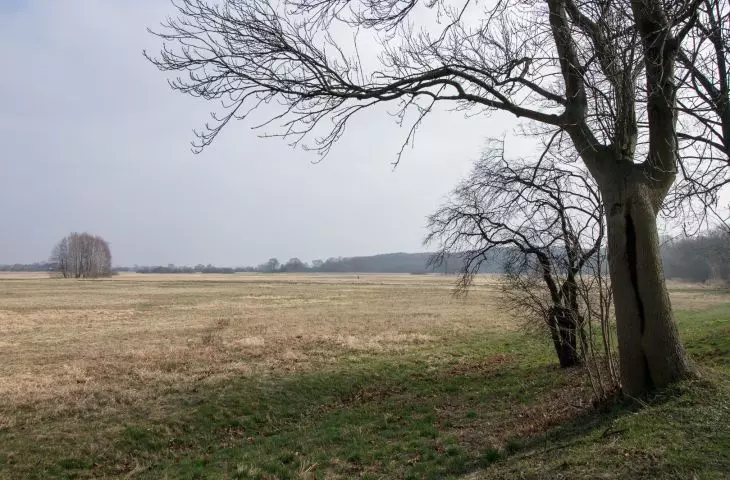
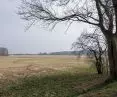
Oborskie Meadows, a drainage ditch; in the background on the left, the Łęgi Oborskie Nature Reserve; view from the dike toward the west
photo: Dariusz Kowalczyk | Wikimedia Commons © CC BY-SA 4.0
In January 2026, the City Council of the Konstancin-Jeziorna municipality secured funding for conceptual and preparatory work on the wetland nature and cultural park project, in accordance with the recommendations of the aforementioned report, and recently — on June 16 — Michał Wiśniewski, the municipality’s mayor, signed a contract for the development of a conceptual design for the park. This task was entrusted to the Archigrest studio—Marcin Maraszko and Maciej Kaufman—who will be supported in this process by landscape architects from the TopoScape studio—Justyna Dziedziejko and Magdalena Wnęk. The collaboration between these teams bodes well; after all, they are the ones behind the award-winning designs for Park Akcji “Burza” and Żerański Park in Warsaw! The design team will also include Prof. Jarosław Suchożebrski, a specialist in hydrotechnology and co-author of the report, as well as ornithologist Łukasz Poławski, with Prof. Wiktor Kotowski and Magdalena Zadrąg overseeing the work. The final study is to be submitted to the municipality by the end of September 2026.