







"We have come to exist in a difficult environment". - writes the author of "Hotel Earth." A few dozen pages earlier, however, we read that our world is an "omnivorous, staggeringly beautiful, and superabundant" and even "the best possible place." Contrary to appearances, there is no paradox in this juxtaposition, for as the youngest geological force, the human species shapes its environment, both on the macro and micro scales, without looking at the consequences for the planet and ourselves, confined to poorly designed cities and dwellings. But can we do something to "live and live well" in spite of it all? Jo Jurga talks about designing for the senses of smell and touch, nature illiteracy and the dictatorship of the square meter.
 Dr. Joanna Jurga - space designer, researcher and educator. She specializes in design focused on a sense of security, with a particular focus on living in isolation. In her work, she likes to address issues of synaesthetic design and neuroarchitecture. Analog astronaut and two-time commander of space mission simulations at the Lunares Mobile Research Station. Co-founder of the startup KOTA, a system that optimizes living spaces with AI. She is the author of the podcast #BEZZER and the books "Noise Shack" and "Hotel Earth." Loves winter, scuba dives on held breath and compulsively reads books.
Przemek Ciępka: Your book is about our planet as an environment in which we have to live. The words you used to title it are probably not coincidental. Why is the Earth a hotel in your story?
Jo Jurga: I believe that we are guests on planet Earth. She can do just fine without us, we can't necessarily do without her. Standing with one foot in the space industry, I can say with certainty that there is no other place to which we could "move out" in the coming years, we currently know of no other world in which we could live so comfortably, to which we are so well adapted.
The hotel is also because we are only temporarily in it. We are terminal as individuals and as a species, and we behave as if we want to blow up the foundations on which we live. We have lost the ability to look at things in the long term. Take, for example, the phrase "climate catastrophe." - we've been hearing it non-stop for a dozen, if not several decades, but de facto we don't think about it at all on a daily basis. Every day we get up, brush our teeth and go to work, and in the meantime a tsunami hits a distant part of the world or a species goes extinct. We blithely function in our bubble, forgetting how fragile the ecosystem we live in is.
Przemek Ciępka: Our senses help us navigate this ecosystem. Which ones are most relevant when it comes to our well-being in a designed environment?
Jo Jurga: It has been said that since the mid-19th century we have been living in a world of oculocentrism, in which the dictatorship of the eye reigns. However, sight is not the only sense that determines how we feel in a given space. If we find ourselves in a beautiful interior that has thousands of social media likes, but there are very bad acoustics, uncomfortable temperatures, too much or too little humidity, or harsh, glaring light that only looks good in a photo, we won't feel comfortable there at all. In recent decades, architecture has grown to become a sculpture in the field. We photograph architecture without people - I myself have met architects who claim that users destroy their designs or disrupt order by rearranging elements. This is not what architecture is about!
The function of architecture is to give us a roof over our heads and decent living conditions, aesthetics is only a secondary quality. Meanwhile, today it is more important whether an interior looks nice than whether it is safe and whether we feel comfortable in it. This causes a great many problems, including health problems - many of us live in buildings that are poorly designed and inadequately maintained, have too little space or insufficient sunlight. And yet we know well how to avoid designing such spaces.
Przemek Ciępka: Designing "for the eye" seems quite obvious in its assumptions. How do you create spaces that will serve the other senses?
Jo Jurga: Design for people, not for Instagram, folders or albums. We all like to sit on chairs of a particular height - if they are too low, we are uncomfortable, when they are too high, we start to hunch over. Silence helps us concentrate, we don't like the sound of cars speeding down the street coming into the apartment. We like to see sunlight and greenery. These are preferences common to us as representatives of the human species.
Unfortunately, we live in a dictatorship of cubic and square meter, where it's all about money, and this causes no one to care about real needs. Investors conform to the norms as much as they can, they don't go beyond even a centimeter. In such a reality, the action of the senses ceases to be taken into account during design.
Przemek Ciępka: The role of the sense of touch, for example, is overlooked. What do the stimuli we receive through our skin tell us about our environment?
Jo Jurga: When you slide your foot out from under a warm quilt in the morning, you don't have to open your eyes to know that you've put your foot on wood and not ceramic tile. When you sit down on a chair, you can tell if it's comfortable and you're able to sit on it for eight hours at work, or if it's a fast food chair that's designed to make you last only fifteen minutes, and then unseat you and leave. Often the beautiful chairs we see in design museums are unsuitable for sitting because they were designed as a symbol of their time, leaving ergonomics aside.
The sense of touch is a sense we cannot live without. Moreover, most of the so-called new senses have been extracted from it. Today we know that we have more than the five senses that Aristotle wrote about with Plato two thousand years ago. Humans have a whole sensory apparatus, which also includes balance, thermoreception, deep sensation or pain perception. Their responses also affect whether we feel comfortable in a given interior.
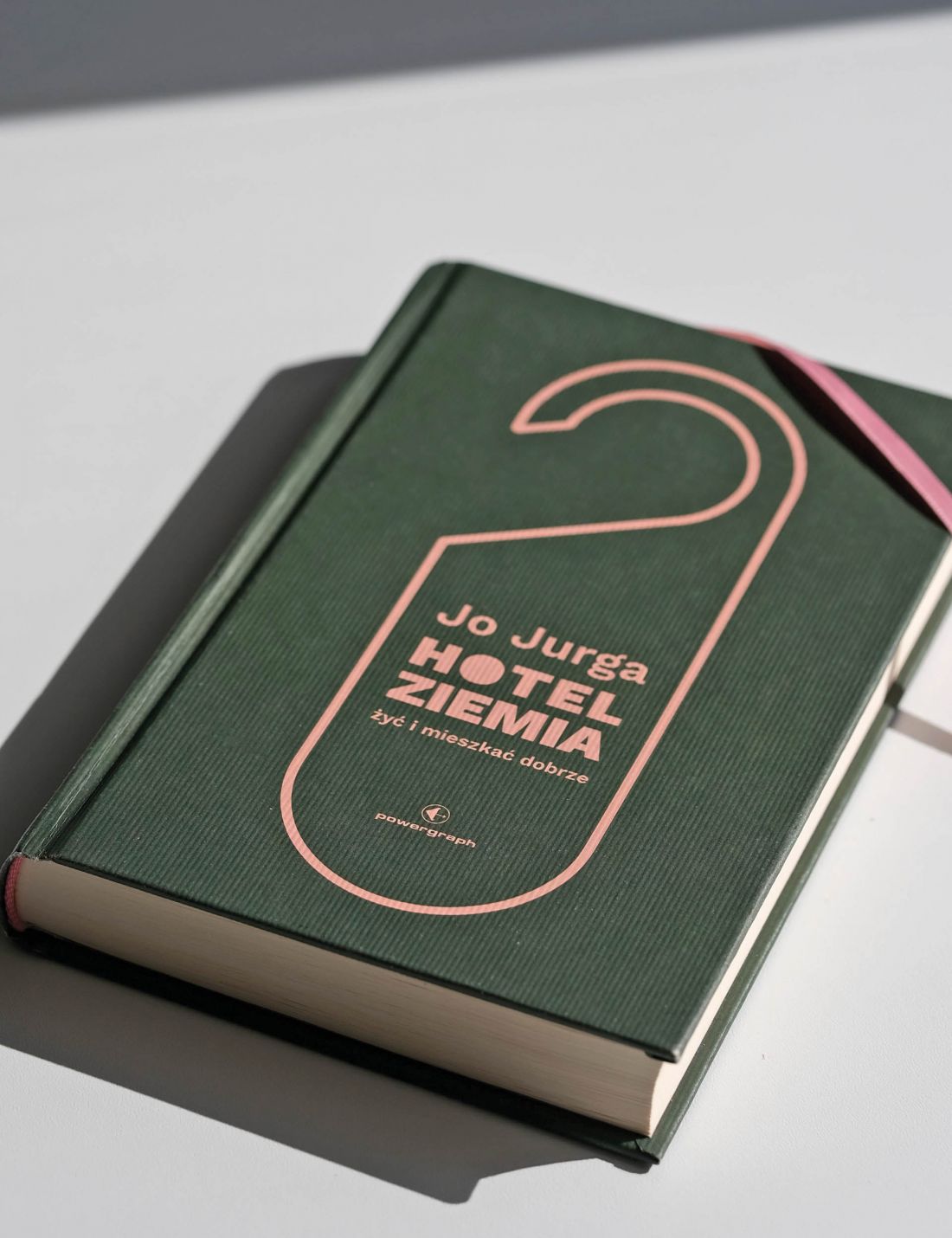
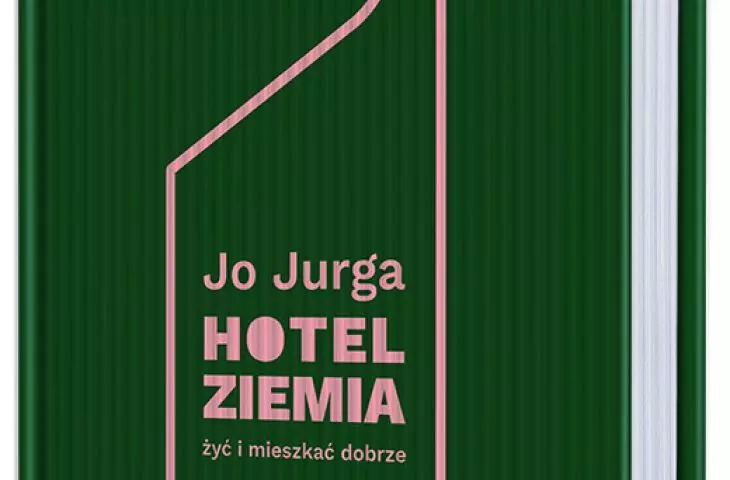
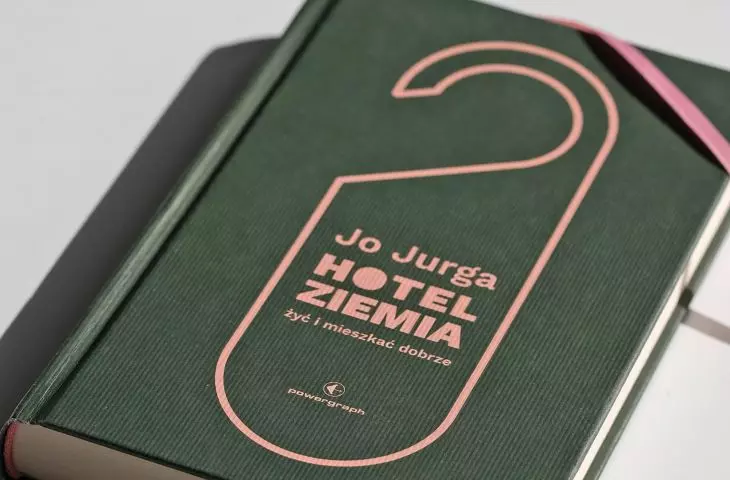
Dr. Jo Jurga, "Hotel Earth. Living and Dwelling Well"
cover proj: Jan Kosik, published by Powergraph
Przemek Ciępka: What role, then, does the sense of smell play in our perception of space?
Jo Jurga: First of all, it informs us about the quality of the air. There must be a terrible situation outside the window for you to notice smog rising in the atmosphere. But all you have to do is pull the air to your nose and you can already sense that it is heavily polluted. By the way, we also assess air quality indoors, and it is worsened by unserviced fans, clogged vents or leaking pipes that cause moisture. You're unlikely to see a fungus when trying to buy an apartment in an old building, but you'll certainly smell it. The sense of smell is our most primal sense, so if the smell of mold triggers atavistic reactions in us, we know it's not a safe place.
Przemek Ciępka: Do we live better in big metropolises or smaller towns?
Jo Jurga: It depends on the individual person, of course, but from the point of view of evolutionary biology, as a species that originated in the savannah, we do better in small cities. In small towns, we know our "herds," we are surrounded by human-scale architecture, behind which we can see the horizon. However, since we are animals with a highly developed psychology, some of us prefer to be able to get lost in the city and enjoy the promises of success it offers, even if they are very tired of the noise or cramped conditions. It's a matter of upbringing and how much we are able to disassociate from our biological needs.
Przemek Ciępka: On the cover of your book you ask the question, "Why did city builders thousands of years ago understand the harmony of the world better than we do today?" What is it that doesn't work in modern cities?
Jo Jurga: What doesn't work is the result of capitalism. I would love to have a better answer, but in a world where every square inch has a value, greenery, air quality or living comfort no longer matter. I once had a poignant meeting with Polish developers. I asked them then: who among you would like to live in your own development? It turned out that no one. It's not that they don't know how to build, no one in Poland knows construction law as well as developers. When you look at the industrial estates built in the late 19th and early 20th centuries, or just before the outbreak of World War II, you will find that they are better designed than some of today's developers. And, after all, their authors did not use the Athens Charter and did not have a modern science base. I wish that when we buy an apartment, we would get two rooms with a fitted kitchen, bathroom, windows, balcony and wooden floor, as it was before the war.
Przemek Ciępka: Large swaths of cities are being developed by developers, who, however, move within established rules. These, in turn, are not infrequently developed in a way that leads to a loss of spatial order. How does being in such a chaotic space affect us?
Jo Jurga: The human brain evolved about 70, 80 thousand years ago, and it hasn't physically changed since then. It is identical to the times when people ran with spears on the savannah. Our ancestors lived in an environment that was rather constant - they saw their tribe or their neighbors' tribe, the sun appearing and disappearing behind the horizon, or a buffalo running between the trees. Today, getting off at the Metro Centrum station in Warsaw, we see dozens of large-format advertisements hanging on buildings that lack consistency of elevation and preserved building lines. We pass hundreds of traffic signs, traffic lights and neon signs, and on top of that we hold a phone in our hand, which serves us second-rate stimuli. Our brains don't have enough processing power to effectively find our way through this world. As a result, we have lost spatial orientation - while another skyscraper emerges from behind one, our brain keeps looking for the horizon and that buffalo running against it. When we started using navigation, we stopped thinking about space, because it changes in front of our eyes so quickly that we can't encode it. The average bread eater gets lost on the way to work without a voice on the phone saying "turn left in 300 meters." What's more, even if we've finally grown up to the fact that we need more greenery, the lack of an overall urban plan, consistency of elevations, preservation of building lines or responsible thinking about lighting make our cities far more tiresome than they could be if all these things were taken care of.
Przemek Ciępka: In the book you often use the term "nature illiteracy". What does it consist of and where does it come from?
Jo Jurga: In drastic cases, some of us spend 92 to 94 percent of our time in enclosed spaces. We leave the house, get into a car in an underground garage and leave the car in the same underground garage before entering the office. In the UK, a study found that 75 percent of children spend less than an hour a day outdoors. This is appalling, especially when one realizes that within the European Union every prisoner is guaranteed a minimum of one hour a day in a walker to maintain mental and physical health. The Convention on Human Rights protects people who are serving a criminal sentence, while free people do not protect the basic right of their brains to be outside. We did not evolve to live in enclosed spaces. As a result, we are unfamiliar with trees and other plants that surround us - names such as mugwort, plantain and burdock tell us little, and are at best associated with the Witcher and the brewing of magical decoctions. What's more, nature illiteracy is not only about animals and plants - we can't recognize the stars, as most of us have no way of seeing the night sky unless we go at least 30 or 50 kilometers outside the city.
That's not all: people are afraid of forests. When I was opening my doctoral dissertation in 2017, one professor told me that no normal person would stay alone in the woods at night at the moment, because there "harm can happen." In fact, the only harm that could happen to us in the forest would be caused by humans, because no wild animal, as long as it is not sick, would go near a human, who is, after all, its primary threat. We don't understand nature; it scares us, and as a result, the level of nature illiteracy in society is increasing. I think that if one were to go out on the street and ask passersby what the waves have to do with the phases of the moon, most would look at us with faces saying non comprende. Connecting with nature, knowing about nature's cycles is something we are already very far away from, yet we ourselves are not evolving as fast as our way of life is evolving.
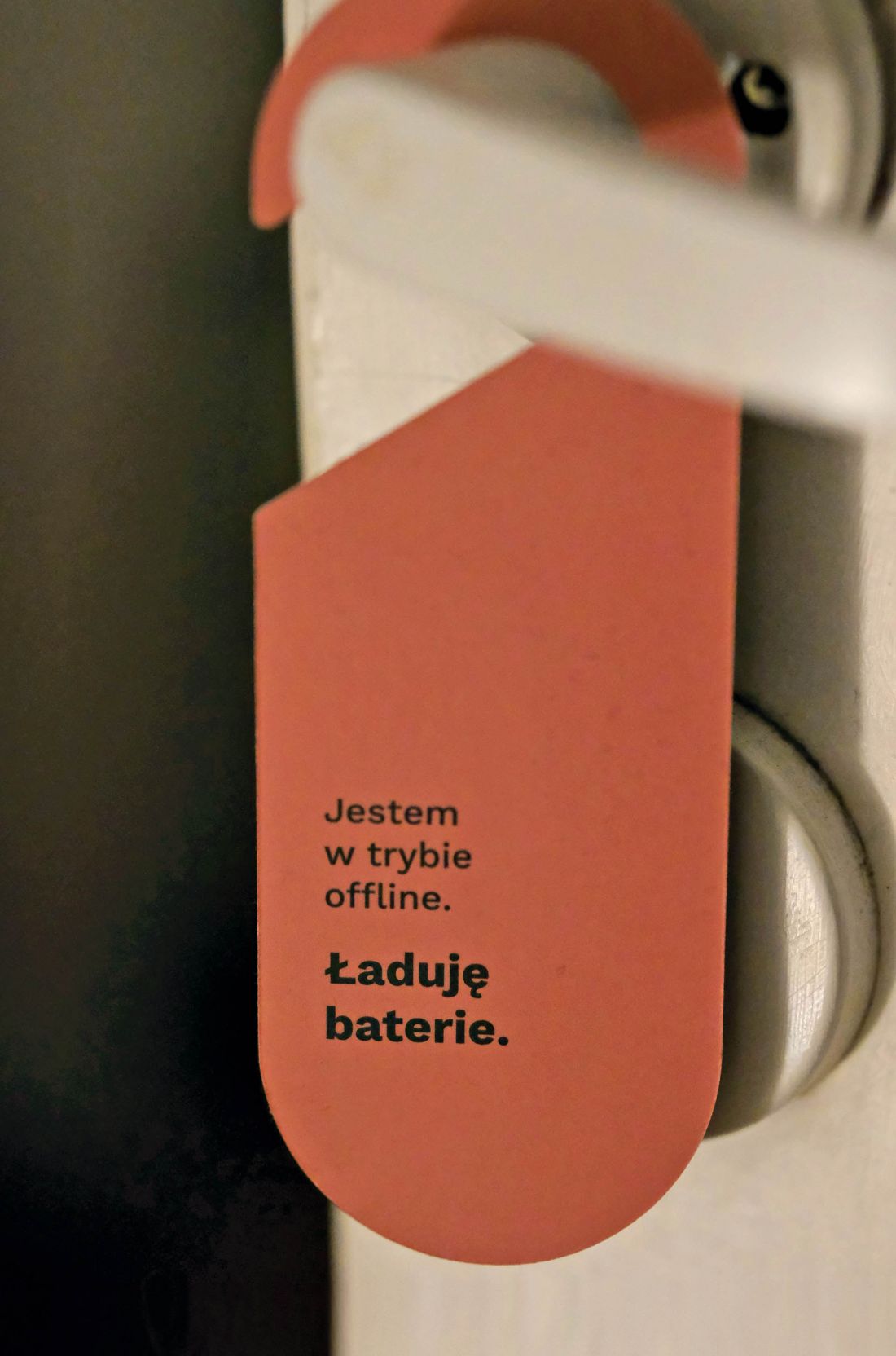
Dr. Jo Jurga, "Hotel Earth. Living and Living Well"
cover proj: Jan Kosik, published by Powergraph
Przemek Ciępka: Listening to what you are saying and with the content of your book in mind, I get the impression that you approach technology with a certain distance. Am I right?
Jo Jurga: Although I have never been a techno-optimist, I would come off as a hypocrite if I claimed that I don't use technology. What's more, I co-founded a technology startup. With technology it's like with a hammer or an axe - whether I chop off someone's hand with it or prepare wood for myself to light in the fireplace is my choice. Thanks to technology, we build rockets that fly around the moon, we have magnetic resonances or vaccines that protect us from diseases. For some reason, however, we are not smarter because of it, and I suspect we are even getting worse. Technologies allow us to do wonderful things, and we are increasingly using them to kill, stupefy and make gigantic amounts of money.
Przemek Ciępka: How can we improve this state of affairs?
Jo Jurga: What I find lacking in the approach to technology is the foresight and responsibility that should lie with lawmakers. I'm very sad that our legislators are on the short leash of big tech companies and can't introduce legislation to protect children from the influence of social media or to limit how our data is used. It's great to be able to do many things faster with language models, but has anyone done their homework with children and adults on how to use these tools responsibly, or their weaknesses, such as the occurrence of hallucinations?
Przemek Ciępka: We often hear that technologies distance us from each other. How do we create spaces that allow us to get closer again?
Jo Jurga: There are several ways of doing things, and one of them is designing communal spaces. For my generation, such a space was the arbor. It served a fantastic social function; whenever children came home from school or kindergarten, they would gather right on the whisker. We used the space between the blocks, which was much more plentiful than in modern housing estates. Many modernist estates have retained this spaciousness between buildings to this day, which is why many people choose such architecture. Of course, such an environment requires benches, places where children can play or urban gyms.
At the same time, this infrastructure must be accessible. The bench should not only be pretty, but also adapted to the needs of people with limited mobility; people walking with a cane, with a leg in a cast or in advanced pregnancy, because not everyone gets up from benches using only their hips. Playgrounds or outdoor gyms should be shaded by trees or sails, and indoor spaces should be inclusive and democratic, equipped with toilets and economically accessible, with coffee for 5, not 15 or 25 zlotys. Most of us really long for contact with other people, but we don't really have where or how to meet them - after all, how many times a week can we go to Starbucks or another chain, paying 25 zloty for coffee?
Przemek Ciępka: These various needs you're talking about sometimes conflict with each other. How to live together and not go crazy?
Jo Jurga: The solution is a social contract. If the children have their own room or other space in the house, there are rules in those 5, 10 or 15 square meters that allow them to scream louder, jump around, leave toys on the floor. If we have a person on the spectrum at home who reacts badly to loud noises, we arrange a quiet space where no one will speak in a raised tone, and a knock or light signal will be in effect before entering. Of course, there are places - for example, the kitchen or living room - where the noise level will be higher, but then there is always the possibility of returning to the mute tent or another quiet place.
The common space and the rules that apply to it must be created democratically - sit down together and talk about your expectations. This way, everyone is bound by the same rules of the game, and everyone also has the opportunity to appeal against them. It's not that only kids break the rules; parents passionately say one thing and do another. In many homes where there is a "piggy bank for swearing," it quickly becomes apparent that it is the adults who throw the most money into it. Of course, there are always compromises, but as much as our apartment's square footage allows, we should try to create corners that meet individual needs and work out together the rules for functioning where we need to share space.
Przemek Ciępka: The square meters of our apartments often don't allow for much. In your book there is a chapter on micro-space arrangement. Aren't you worried that it could be another incentive for pat-developers wanting to sell us the smallest possible apartments?
Jo Jurga: I'm an idealist, but I'm aware of the conditions many people live in. Although regulations say that an apartment cannot be less than 25 square meters, micro-apartments are still being built, and at the same time they don't exist from today. Many of us used to live in dormitories, in the past for some people the whole world was a servant's apartment, which was 3, 4 square meters. There are very many ways to live, and there are people who live in vans or caravans by choice. There are also older people who decide to sell their multi-room apartments to save money for retirement, and move into those 30 or even 20 meters, because that's just enough for them.
Unfortunately, the perfect world does not exist and some of us live, have lived or will live in such a small space. Realizing that such an apartment must have ventilation, a separate bathroom and kitchenette, and that we need a properly landscaped space that will allow us to store our belongings, is extremely important, because it weighs on the quality of our lives in the perspective of the next dozen or more years. Even if you decide to make such a move at age sixty-five, if you're a woman, you'll be living in that apartment for another twenty.
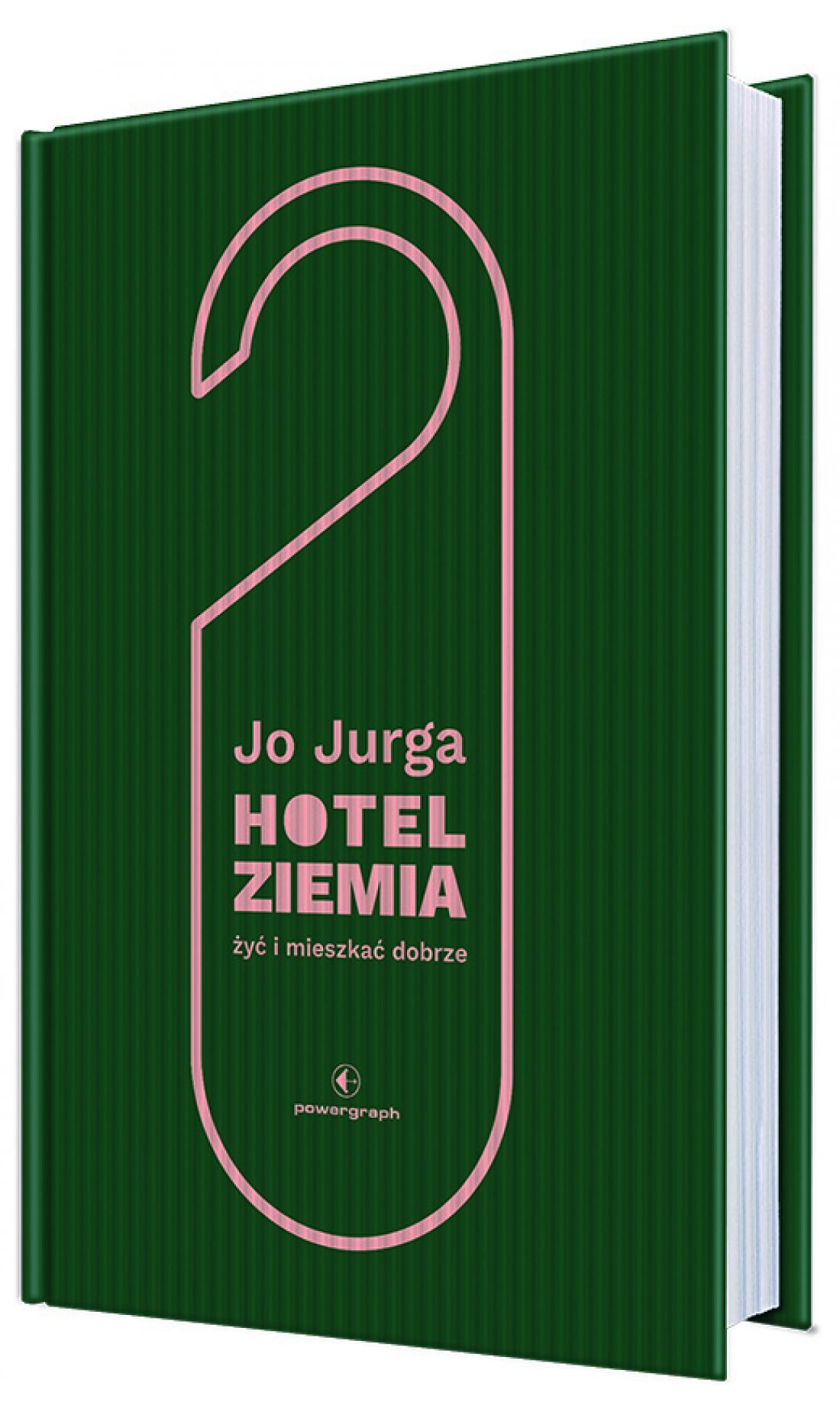
Dr. Jo Jurga, "Hotel Earth. Living and Living Well"
cover proj: Jan Kosik, published by Powergraph
Przemek Ciępka: It would be great if a minimalist lifestyle was always just a matter of choice, rather than a necessity.
Jo Jurga: Victor Papanek wrote that we buy things we don't need, with money we don't have, to impress people we don't like. The quote is from the 1970s, but it has never been more relevant than now. I once consulted for a family of four who were considering building a house, unable to fit into a 120-square-meter apartment. I rode in there "on a broomstick" and immediately recommended that they first try to organize their space, if not on their own, then with a coach who would methodically help them determine what was useful and what was not, what was an heirloom, and what contents of their closets they didn't even know about. After a six-month process of organizing the apartment themselves, they came to the conclusion that they didn't need to build a house at all.
Przemek Ciępka: How can we fight this rush to own more and more things?
Jo Jurga: It's primarily a matter of education, we have a lot of homework to do in this matter, which is very difficult in a reality that constantly convinces us that we need to buy something. We should learn from kindergarten that we don't need things that are new, only things that we can repair or that have a story worth passing on to the next person. Out of respect for Hotel Earth, we should refrain from constantly buying new items.
Przemek Ciępka: You wrote your doctoral thesis on the sense of comfort in isolation spaces using space stations as an example, and you are still working in this field today. Did the experiences you gathered while researching this area influence your thinking about Hotel Earth?
Jo Jurga: When an astronaut flies into orbit, he or she can take private belongings with them to fit into a shoebox-sized container. It's an interesting exercise - to think about what we would take with us to go on through life if our possessions were limited to just such a space. As for my personal experience, eighteen moves have made me realize how little stuff I need. I've also learned that it makes sense to choose very durable items. They cost more, of course, but I know they will stay with me for a long time. Out of respect for Hotel Earth, but also for craftsmanship or material.
I'm also in favor of owning things that are well suited to our needs. If you're buying a new table, sit at it and see if you'll want to keep your hands on it while eating dinner with your family or while working or reading a book. If you need armrests in your chair, find one, and if you prefer to sit in a huff, see if you can fit your legs under a table of a given height. Statistically, we spend more time buying a car than an apartment. I'm a tinkerer and I love cars, but most of us don't spend all day and night in vehicles. I feel that we live at such a pace that we don't give ourselves time to think about what we like and what we really need.
Przemek Ciępka: Then what else - besides education and a moment to breathe for reflection - do we need in order to, according to the subtitle of your book, "live and live well"?
Jo Jurga: To these two things I would add realizing the role that community plays. We should think more about others - if I love to listen to heavy metal at 10 pm when I get home from work, I do it with headphones, because above me a child may be sleeping and the downstairs neighbor getting up for duty at 6 am. If the birds living in a nearby tree are nesting in my yard and I find that I need to get rid of the tree, I should take into account that these animals will lose their habitat, and I and my neighbors will lose shade. We need to think more about the other, where the other is human and non-human.
Przemek Ciępka: Thank you for the interview.
interviewed: {tag:AuthorA&B}
Read more: A&B 4/2026 - Architect of the city,
download free e-publications of A&B