



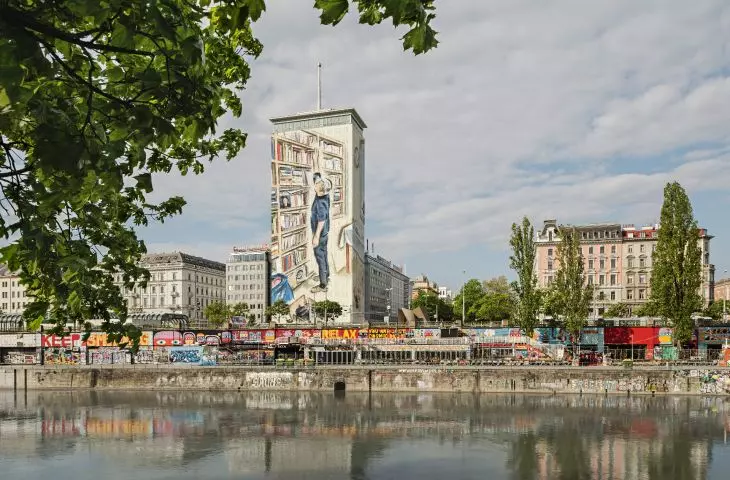
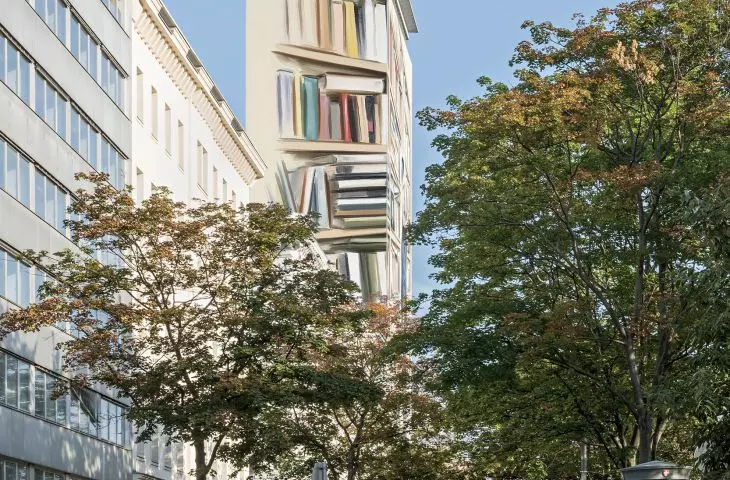
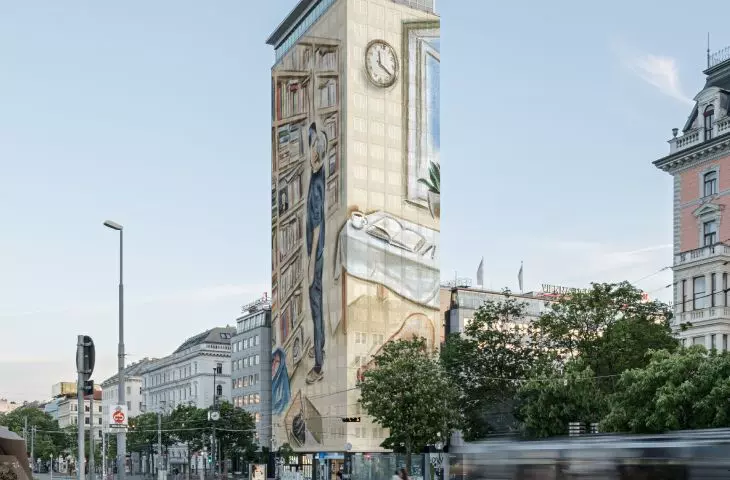
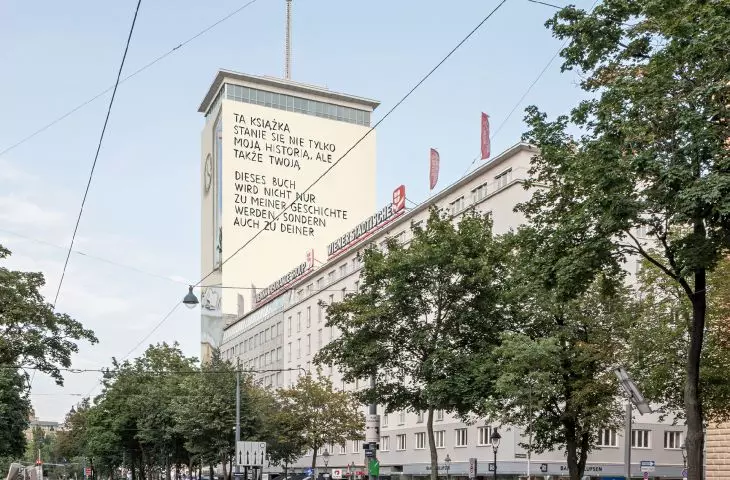

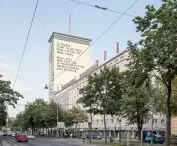

The twenty-three-story tall skyscraper located on Vienna's Ring was built in the 1950s to a design by Erich Boltenstern. It houses the headquarters of an insurance group, which marks the building's presence in the city in an unusual way - since 2006 it has given it over to artists, who literally wrap it in art. This year, for the first time, the facades of the Ringturm office building were overshadowed by the work of Polish artist Marcin Maciejowski, a painter and longtime member of the Krakow-based Ładnie group. He proposed a rather intimate scene under the title "Linking Tales". Looking at the object, one gets the feeling that we are peeping at someone in the privacy of his home library: a man is reaching for a book that lies on one of the top shelves; we don't know what the book is, but we learn that it will soon become part of our history as well (an inscription in German and Polish is part of the work: "This book will become not only my story, but also yours"). We talk to Marcin Maciejowski about the search for harmony and the technical challenges of a giant stretcher bar.
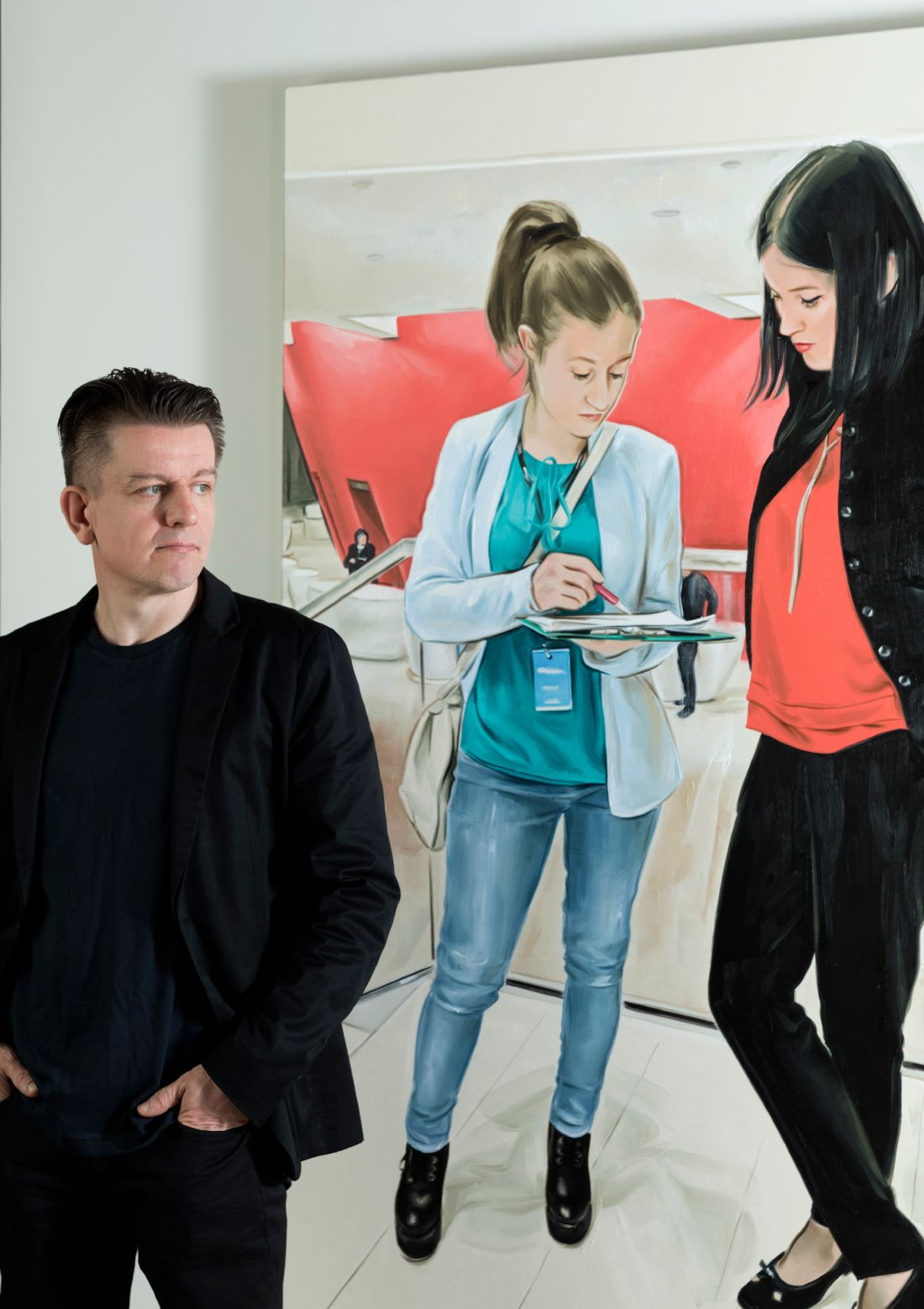
Marcin MACIEJOWSKI - Polish painter and illustrator. Graduate of the Faculty of Graphic Arts at the Academy of Fine Arts in Cracow, also studied at the Faculty of Architecture at the Cracow University of Technology. A long-time member of the Cracow group Ładnie (together with Marek Firk, Józef Tomczyk, Rafał Bujnowski and Wilhelm Sasnal) and a contributor to the weekly "Przekrój". His works can be found in the collections of the Center for Contemporary Art Ujazdowski Castle and the National Museum in Cracow, among others. Winner of the "Polityka" Passport. His solo exhibitions have been seen in London, Vienna and Los Angeles, among others.
Ola Kloc: You are the first Polish artist to wrap the Ringturm skyscraper in Vienna. How did this collaboration come about?
Marcin Maciejowski: I have been strongly connected with Vienna for many years. After Krakow, where I live, it's probably the second closest city to me. I have been cooperating with galleries in Austria for years. My works are present here in private and public collections thanks to gallerists, so it's quite natural for me to do an artistic action right in Vienna. However, this project, which we poetically titled "Linking Tales," is very unique: both by its location in the center of Vienna, and by its scale. I was really pleased when, as one of several Polish artists, I was invited to present my own idea for the packaging of the Ringturm skyscraper.
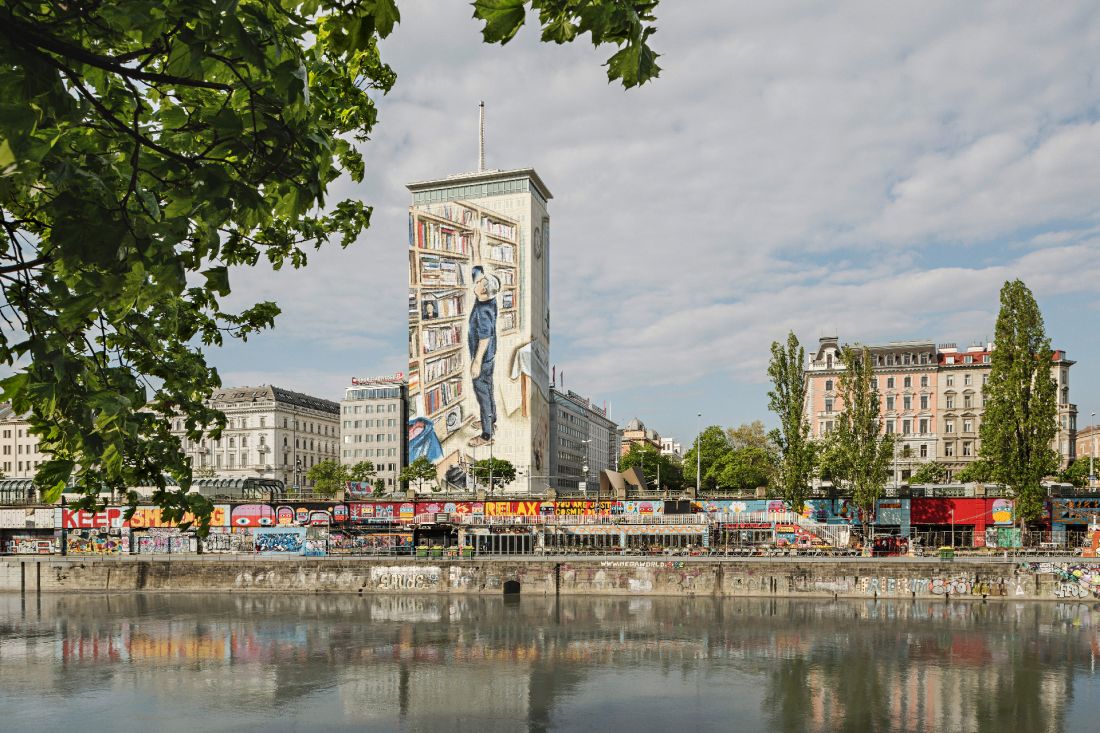
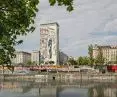
"Linking Tales" - Visualizations of artistic packaging by Marcin Maciejowski on the Ringturm skyscraper, the headquarters of the Vienna Insurance Group (Wiener Städtische Versicherungsverein).
© Hertha Hurnaus | Wiener Städtische Versicherungsverein
Ola Kloc: So it was a competition?
Marcin Maciejowski: Yes, I guess you could say that. A small, closed competition. In situations like this, I tend not to invent something new to order, I am mainly inspired by my own current interests. And since I was working with Marcin Świetlicki at the time on drawings for his volume of poetry "But what do you mean?", I very naturally transferred the themes of the book, the library, the reader and common stories to the Ringturm. I made a small model of the building and began to "try on" a painting with a person in the library, which I had painted a few months earlier for an exhibition in London. I was pleased with the result. In Vienna, this concept also appealed and the decision was made to implement it.
Ola Kloc: What happened next?
Marcin Maciejowski: We began to elaborate and develop the concept in detail, because the shape of the building is demanding and transferring the painting from a 2D plane to the packaging of a multi-walled skyscraper requires thought. I painted new images with the theme of the home library and when the work was very, very advanced the COVID-19 pandemic broke out. The world came to a standstill. The project was suspended, as were hundreds of others at the time.
Ola Kloc: You were probably disappointed.
Marcin Maciejowski: Probably so, although I don't remember it today. That time was a difficult experience for all of us. Cancelled events, concerts, exhibitions, projects, well, and remote work. A matter strongly related to Ringturm's packaging, because it's a project that has not only a visual aspect, but also an ecological one: it lowers the temperature in the building's offices and thus seeks to reduce the use of energy-intensive air conditioning. Only that during the pandemic the offices stood empty and this aspect of the project lost its meaning.
Ola Kloc: The project waited as long as five years to be implemented?
Marcin Maciejowski: Actually, yes. What pleases me is that the passing of time has not made my concept obsolete. What's more, this lying in wait has done it good, and confirmed for myself that this visual choice is good for the urban space.
Ola Kloc: What are you most satisfied with?
Marcin Maciejowski: From the harmony in which this project remains with the city. I have just published an artist's book with my drawings with the Wawel Royal Castle, and one of its chapters is titled "In Search of Harmony." Harmony may not be the most popular issue in contemporary art, but it is extremely important to me. I am really looking for harmony, such forms that lead to visual order. Order helps to focus, relax, ponder, calm down, and I believe that in this Ringturm packaging design you can find such qualities. I wanted consistency with the environment. I didn't want to visually attack, shock or distract. My work is something to accompany the residents of the city, not stalk them. Visually, although scaled down, the image fits into the surrounding architecture, and viewed from a further perspective, into the fabric of the city.
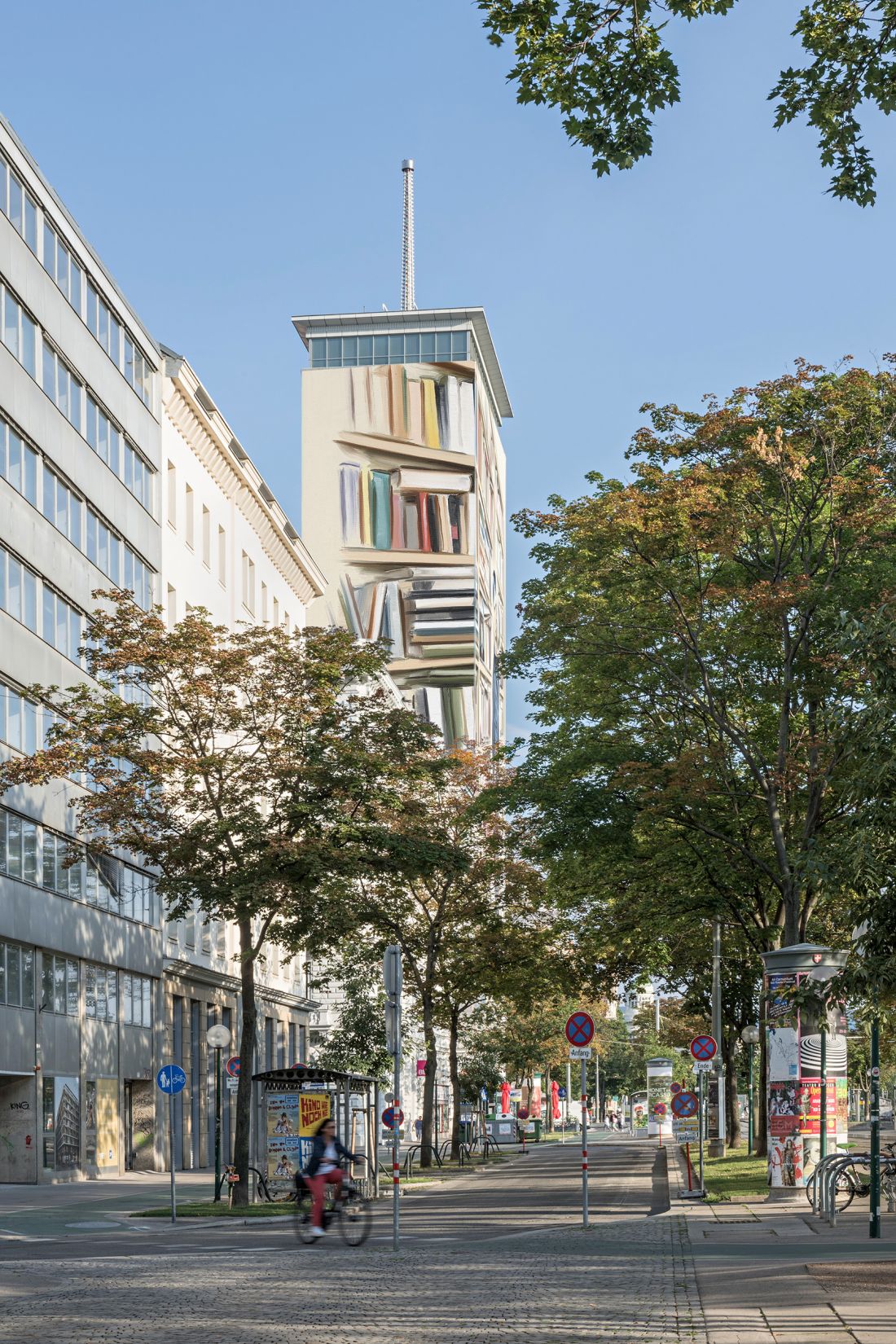
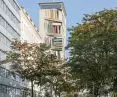
"Linking Tales" - visuals of artistic packaging by Marcin Maciejowski on the Ringturm skyscraper, headquarters of the Vienna Insurance Group (Wiener Städtische Versicherungsverein).
© Hertha Hurnaus | Wiener Städtische Versicherungsverein
Ola Kloc: Before you graduated from the Academy of Fine Arts, you studied architecture at the Cracow University of Technology for three years. Does that influence your visual thinking today?
Marcin Maciejowski: Of course. For example, with this project: I intuitively chose an image whose representation brings new divisions to the facade of the building. The library, the lines of the shelves, the rhythm of the books stacked on these shelves - all this replaces these divisions of the facade, which were hidden. The color scheme was important; I think it also corresponds well with the city. All this harmoniously intermingles, complements each other. It is not invasive or intrusive, it does not scream for attention. Such an effect and such a presence of the artist or architect in the city space corresponds to my approach to art and architecture.
Ola Kloc: Why did you specifically set your sights on a giant home library?
Marcin Maciejowski: Because I like books! But also, as I mentioned, it stemmed from my interests at the time. I was working on a book and my thoughts orbited around it, drawings for a volume of poetry were created, we discussed it with the publisher. The scene I transferred to the Ringturm in "Linking Tales" is a scene from my life, it's also a universal scene: a colleague reaches for a book from his library, wants to show something from his collection, wants to share a book, a reflection. This is our very natural, human need - to share interests, to pass on ideas. The scaling of the home library in "Linking Tales" is also intentional. I found it interesting to "pull" the private scene from inside the building to the outside, to the public facade. The library is also an important place for any person who is connected to culture and creativity, and the book is a symbolic, multi-dimensional object. Everyone can add their own story to this scene. This is such an open visual thought.
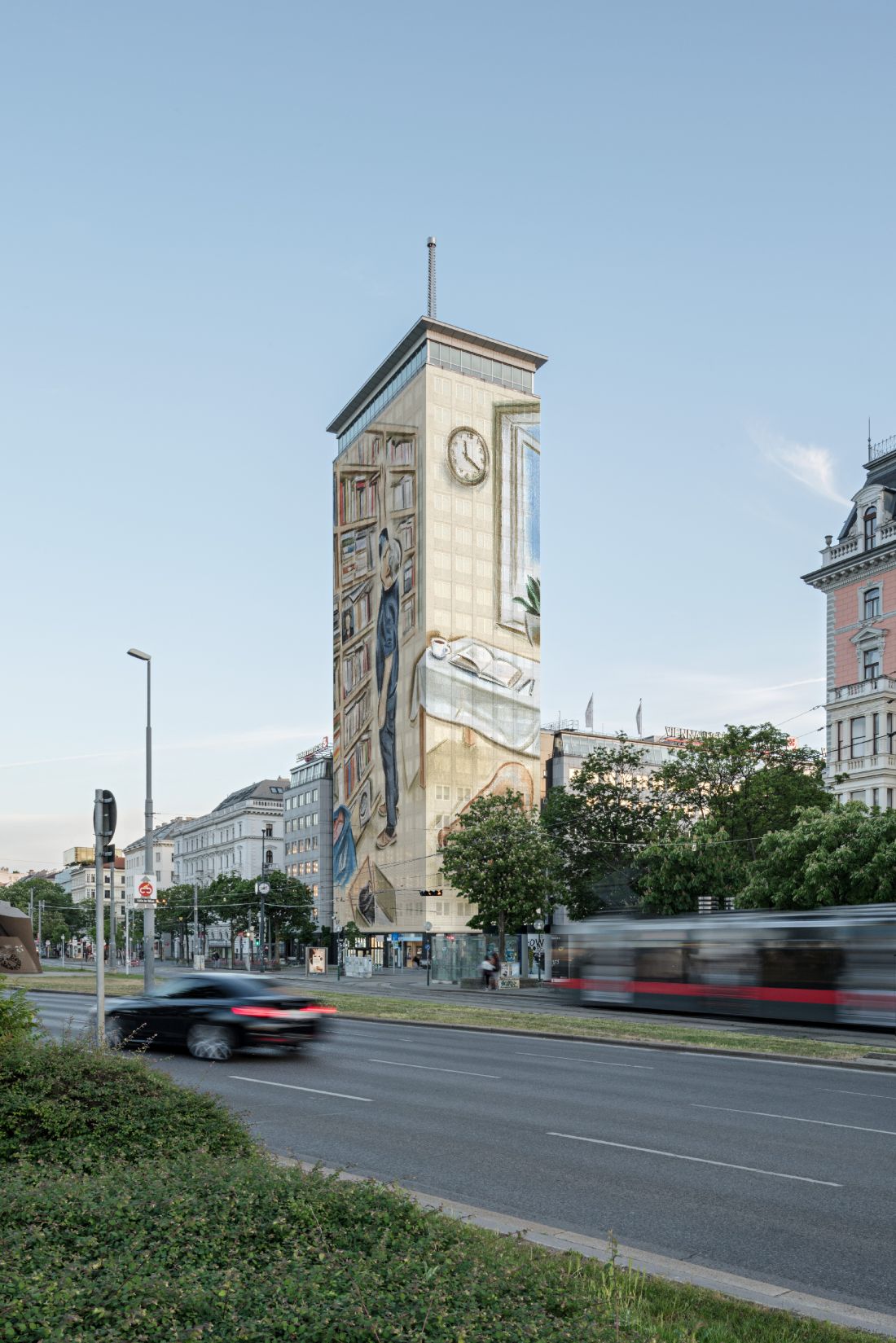
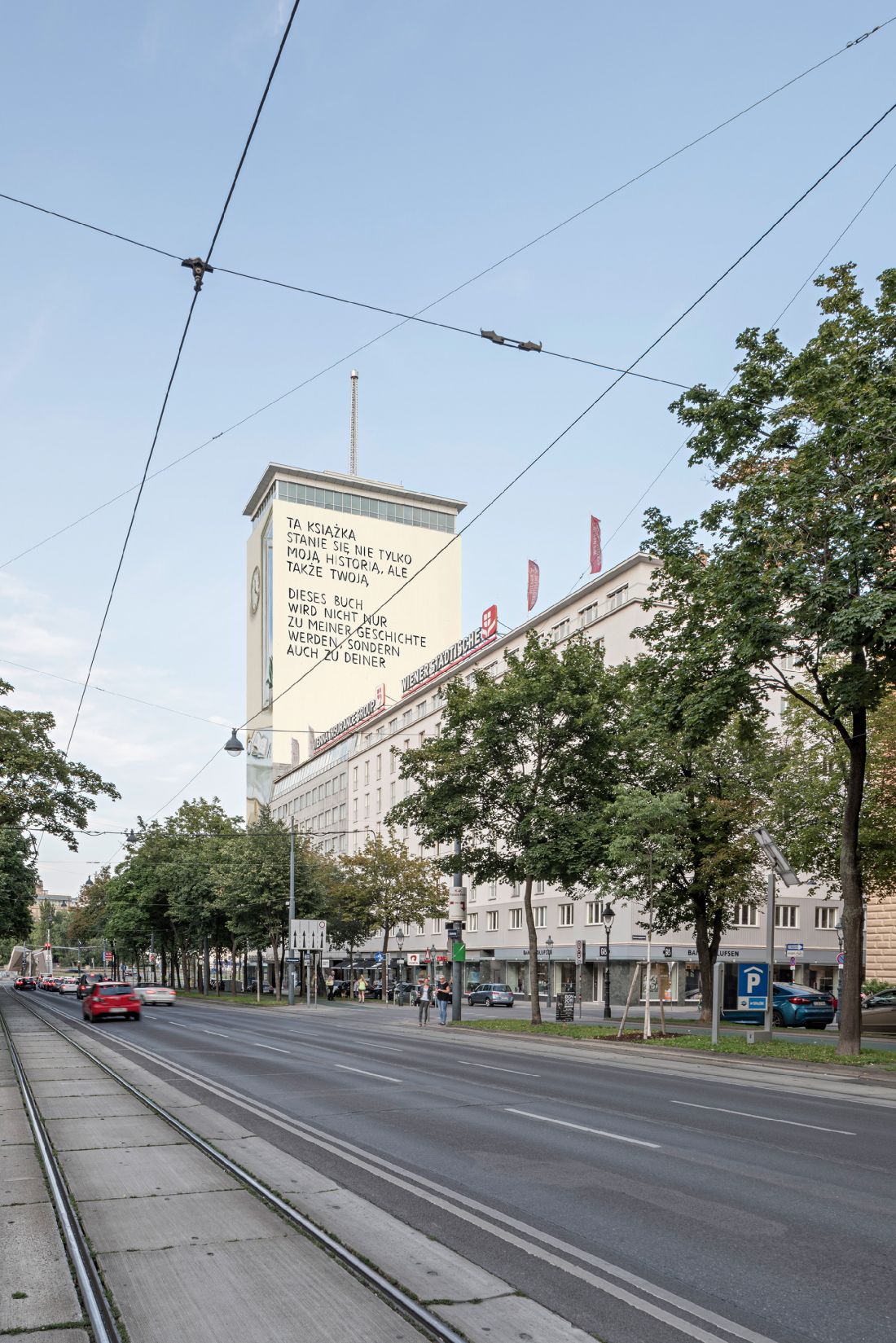
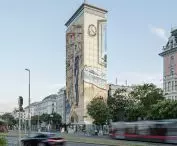
"Linking Tales" - Visuals of artistic packaging by Marcin Maciejowski on the Ringturm skyscraper, the headquarters of the insurance group in Vienna (Wiener Städtische Versicherungsverein).
© Hertha Hurnaus | Wiener Städtische Versicherungsverein
Ola Kloc: The shell with which the office building was wrapped covers an area of 4,000 square meters. What technical challenges are involved in preparing a job of this scale? What was the production process like?
Marcin Maciejowski: Yes, it's a large composition, I joke that it's probably the largest painting by a Polish painter in the world. It's great to get such a stretcher, especially since the strictly technical challenges I didn't have to deal with myself. The coating covers an area of 4,000 square meters and consists of 30 strips of printed mesh with a width of up to three meters, or almost 90 meters in total, and the length of such a strip is up to 63 meters. This mesh will later be recycled, which is important for such a scale of undertaking, I know that some of the material will be used to make bags, for example. The packaging of the Ringturm skyscraper was developed by specialists in various fields, and the life cycle of this project was carefully considered.
Ola Kloc: Thank you for the interview.
interviewed by: Ola Kloc
more: A&B 7-8/2025 - HOUSES: investor + architect,
download free e-publications of A&B