
Development ties is a concept that includes not only metropolises, but also medium-sized agglomerations such as Grudziądz, Elbląg and even smaller county towns. The idea is to create a flexible form of cooperation between a central city and its surroundings - municipalities or municipalities and counties. The Law on Sustainable Development of Cities puts systemic issues in order, and also increases the efficiency of spending public funds by local governments, says Prof. Jakub Szlachetko.
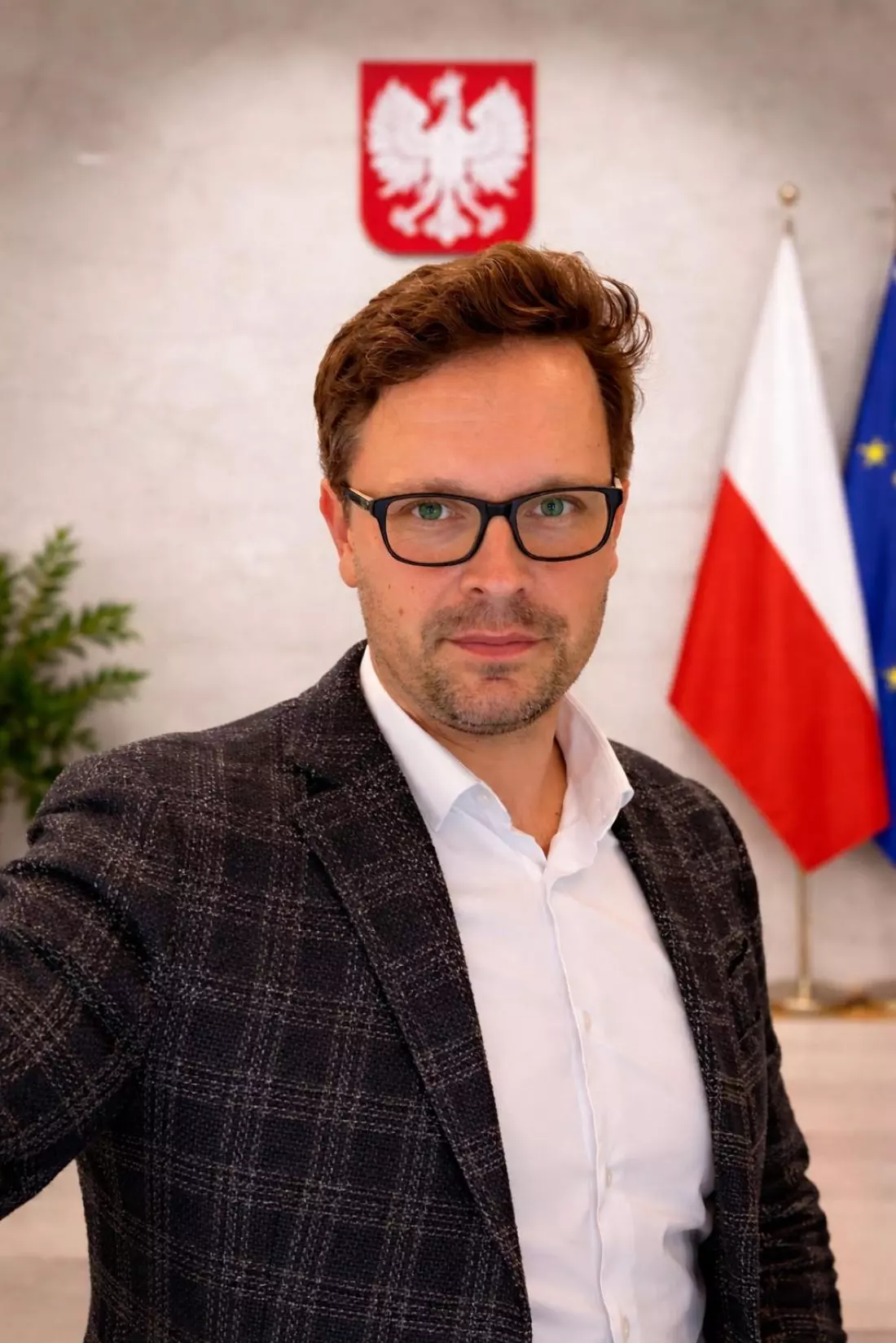
Jakub SZLACHETKO - Professor at the University of Gdansk, chairman of the Council of the Metropolitan Institute, managing director and attorney at the firm: Szlachetko Konsulting, member of the expert team responsible for preparing the draft law on sustainable development of cities.
Ewa Karendys: Will the Polish Development Strategy to 2035 not end up like many such documents - in bureaucratic drawers?
Jakub Szlachetko: Indeed, we have a huge number of strategic documents in Poland at various levels, which are overworked, too voluminous and linger in drawers. In this case, however, we are talking about a nationwide document that has to connect many threads and policies. Perhaps its volume is not conducive to analysis, but nevertheless I hope it will have efficiency.
Of course, everything depends on the administration that will execute it. The Law on Sustainable Urban Development, which I co-wrote for the Minister of Funds and Regional Policy, is intended, at least to some extent, to give the strategy real power to act - especially in the context of polycentric national development - so that urban centers and their functional areas will have a system and structure that are suited to the challenges of modern times.
Ewa Karendys: Polycentric development - or what kind of development?
Jakub Szlachetko: Poland is fortunate that its spatial structure is based on a fairly evenly dispersed settlement, so the key premise of the strategy - the development of the country's polycentric development nodes - is fully justified. We have a network of large centers - metropolitan and agglomeration centers - as well as smaller cities that perform various functions in the national settlement network. They are in different situations, but what they have in common is that their administrative, social, economic or cultural functions go beyond administrative boundaries, affect their direct and sometimes indirect neighbors, so they need to be supported, and for this we need legal regulation. The strategy is based on the correct assumption that this polycentric structure needs to be maintained - strengthening the large, thriving centers, but also taking care of the smaller cities so that they do not lose their importance.
Ewa Karendys: The strategy is an opportunity for cities?
Jakub Szlachetko: A chance to strengthen local governments in a thoughtful way, to sort out issues of development, strategic planning, localization of investments, public transportation, education. It won't cure the whole system, but it will significantly strengthen the self-government of functional areas and its efficiency. Besides, the Law on Sustainable Urban Development not only organizes systemic issues, but also increases the efficiency of local governments' spending of public funds. And this, after all, in our geopolitical situation, in the context of hybrid war and the need to finance armaments, is of great importance.
Ewa Karendys: The Law on Sustainable Development of Cities - the enactment of which is also one of the measures enshrined in the strategy - proposes various categories of forms of local government cooperation tailored to certain types of so-called central cities. Development unions are particularly relevant. But we already have municipal unions or a metropolitan union in Silesia. It's easy to get lost in this.
Jakub Szlachetko: In 2015, the Sejm passed a law on metropolitan unions, but the Law and Justice government did not issue a regulation that would allow such unions to actually be established. It wasn't until 2017 that a law on metropolitan unions in the Silesian Voivodeship was passed - and that's how the first, and so far the only, metropolis in Poland was created,the Upper Silesian-Zagłębi Metropolis (GZM). Other cities later tried to draft their own metropolitan bills, but to no avail. There were more than a dozen attempts. Only the Gdańsk-Gdynia-Sopot Metropolitan Area(OMGGS) achieved relative success, as a draft law on a metropolitan association in the Pomeranian Voivodeship is being processed by the Council of Ministers. These two areas - GZM and OMGGS - are special because of their polycentric nature.
However, I would like to emphasize that the Sustainable Cities Act is not a metropolitan law - it is a law about cities in the functional sense, about urban organisms beyond the borders of the central city, the core of the area. The law - and I'm very pleased about this - therefore recognizes a far greater number of urban functional areas - currently eighty-two - than metropolitan areas, of which there are only a few or a dozen. This needs to resonate strongly. Development unions is a broader concept - it includes not only metropolitan areas, but also medium-sized agglomerations, such as Grudziądz, Elbląg and even smaller county towns. The idea is to create a flexible form of cooperation between the central city and its surroundings - municipalities or boroughs and counties.
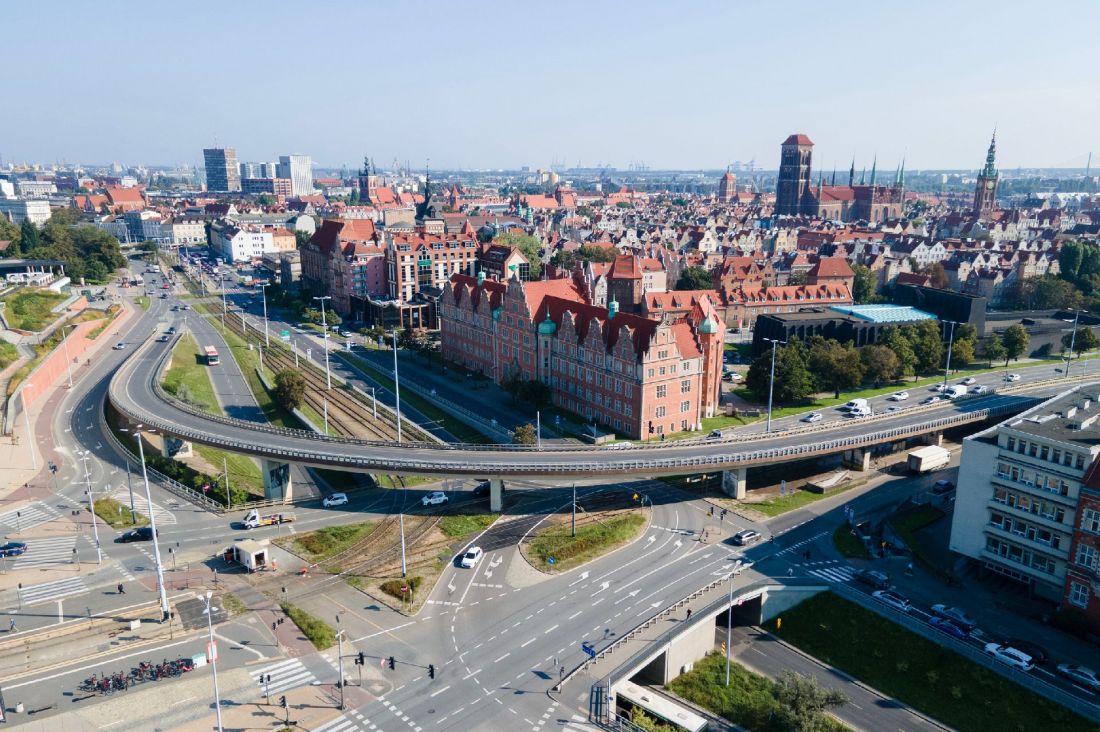
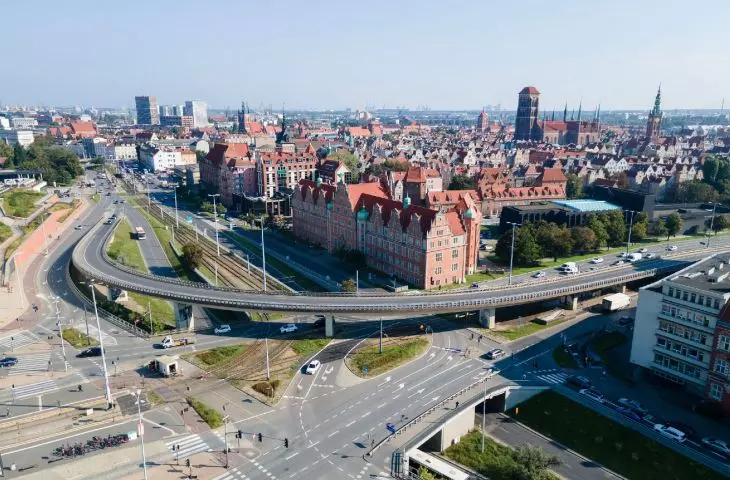
Gdansk
Photo: Piotr Wittman | Gdansk.pl
Ewa Karendys: So such a union could be formed, for example, by Chojnice or Starogard Gdański?
Jakub Szlachetko: Yes. A development association will be able to establish both Krakow, Poznań or Wrocław, as well as Grudziądz, Elbląg, Słupsk or Chojnice. This is a form of cooperation between a central city and its functional area.
Ewa Karendys: What will local governments gain in practice from the establishment of a development association?
Jakub Szlachetko: I think the public debate will talk most about financial resources, but for me the systemic issues are equally important, so I will start with them.
Municipal associations operating in Poland have many structural flaws and legal limitations - they usually perform a single task (organization of transportation, waste management or maintenance of cleanliness and order in the municipality), as a rule they cannot enact local laws, their ability to issue administrative decisions is questioned, and the way they are managed is sometimes extremely ossified, as is the financial mechanism.
Ewa Karendys: Development associations will be something much more advanced?
Jakub Szlachetko: That's right. The bill grows out of constructive criticism of municipal and metropolitan unions. Development unions will be multi-purpose by design, with mandatory performance of their own tasks, and they will also be able to perform delegated tasks. The law's provisions on the internal organization, the mode of operation of the bodies or the rules for adopting resolutions are framework, so they will be detailed in the statutes - which means making the principle of self-government units' independence more realistic. This will make it possible to tailor the union's system to local challenges and needs.
Ewa Karendys: What specific tasks will be mandatory for development unions?
Jakub Szlachetko: The association will obligatorily perform its own tasks, for the financing of which it will receive statutorily assured funds. These tasks are several.
First, as is clear from the assumptions and title of the law, the development association will have to deal with development planning for the association's area . This task includes, among other things, the need to adopt a supra-local development strategy, as well as to manage European Union funds under the cohesion policy. The association will be treated as an instrument of territorial development under European Union law.
Second, the union will have competencies in the area of environmental protection and climate change adaptation.
Thirdly, it will coordinate the directions of educational development, especially in the field of secondary schools, technical or trade schools. This task, strongly emphasized by local government officials, is a very real need.
Fourth, and very importantly, the association will be an integrator and coordinator of public mass transport, including the adoption of a plan for sustainable development of public mass transport common to the area of the association. This is the minimum competence. In executing the transport plan, it will have further options: from introducing an integrated fare and ticket zone to taking over all transport tasks for direct execution. The flexible transportation integration model was a very important part of the legislative work. Fifth, the union will be involved in urban mobility development, including the drafting of a Sustainable Urban Mobility Development Plan (so-called SUMP). And sixth, the promotion of the union and its members.
The union, as it matures institutionally, may also take over further tasks from municipalities and counties. These are so-called entrusted tasks. Each union will be able to perform other entrusted tasks, depending on local conditions and needs. At the same time, the entrusted tasks will be financed by municipalities and counties as part of their annual contribution. So we are projecting a snowball effect - a small structure will grow over time and with the growth of trust, because municipalities and counties will see interest in it, including fiscal.
Ewa Karendys: Won't this lead to excessive bureaucracy? Some places already have unions or joint transportation companies.
Jakub Szlachetko: No - and for several reasons. First of all, metropolitan unions will function in the areas of the GZM and OMGGS, so development unions will not be able to be established there. The law is definitive and precise. It encourages the consolidation of structures operating in a given area. A development association will be able - in a statutorily defined procedure - to take over tasks, competencies, assets and resources from other municipal associations that operate in the same area. The association will then expand its activity by entering new domains, such as municipal management. The development association will be able to act as a shared service center, a social service center or a purchasing group - for all municipalities and counties, as well as their organizational units. I could list these flexible instruments and mechanisms for a long time.
Ewa Karendys: And what about the residents? Will they feel the differencein their daily lives?
Jakub Szlachetko: For residents, this institution will probably be hardly noticeable. It is a technical solution to improve the institutional and financial efficiency of municipalities and counties. The resident does not know the legal or financial arcana of the functioning of public institutions, what matters to him is the effect. The most noticeable result is expected to appear in transportation: an integrated system, a single fare, a common ticket, better coordination. But let me stress: no law will work properly without goodwill and administration. We can create a great law, but if it is not properly implemented, it will not work.
Ewa Karendys: Let's go back to the issue of spatial governance. Can development unions make a real difference in reducing urban sprawl and better urban planning?
Jakub Szlachetko: I am in favor of strong empowerment of subregional entities in spatial planning. But when creating a law, you have to take into account not only theoretical concepts, but also the entire context - including the 2023 spatial planning reform, which is still being implemented. Life cannot be made more difficult for municipalities, which are grappling with a myriad of new tasks, including updating their strategies and proceeding with master plans, with limited resources. Thus, the law does not foresee a revolution in spatial planning, but it does introduce some tools: it modifies the supra-local development strategy and puts two "named" strategic areas of intervention into order.
Ewa Karendys: I will ask for an explanation.
Jakub Szlachetko: The first is the priority development area. A development association in a supralocal development strategy can designate several such areas - and through the legal and fiscal tools specified in the law stimulate urbanization processes in these areas. Of course, in cooperation with the municipality. Such areas are designated withinplanning zones that allow residential or mixed development. At the same time, the law defines priority criteria that determine the selection of such areas. These include the ownership structure, the state of development of the area, access to a public road, proximity to services.
The second is the area of protection of existing functions. These are places of great social, recreational or natural significance, which, as a rule, are not covered by other forms of protection, but which are affected by investment pressure. The establishment of the area makes it possible to protect them from overdevelopment. The association can financially support municipalities, for example, cover the costs of developing the area, buying back land or paying off claims. This is a practical, flexible tool.
Ewa Karendys: Some experts point out that the lack of an obligation to transfer municipal competencies to the association is a weakness of the project. Jakub Pietruszewski, head of the Pomeranian Regional Planning Office in Gdansk, noted that it would be a revolution if the union enacted a general plan for the union's area, and municipalities only local plans.
Jakub Szlachetko: In an ideal world, a development association could have strong planning instruments at its disposal, but this is impossible in Poland today. Let's put aside theoretical concepts and visions and focus on realities and conditions. You can't in the process of implementing one costly reform introduce another. After all, this will hinder the functioning of already overloaded municipalities and cadres with tasks. 2,500 municipalities are just completing their general plans. It would be unreasonable and incredibly costly to take away their designated competencies, these are hundreds of millions of zlotys or more. In a few years, the issue can be revisited, for example, by introducing the possibility of delegating planning competencies to unions. Not now.
Ewa Karendys: How will decisions be made within the union? After all, municipalities often have different interests.
Jakub Szlachetko: The law is based on the principle of autonomy of local government units and strengthens the role of the statute. It introduces two bodies: an assembly and an executive body. The assembly includes mayors, presidents and district governors. It is the one that enacts the strategy, budget, transport plan and elects the executive body. In turn, the executive body can take different forms - single-member, collegiate, political, expert - depending on the statute.
The law gives full flexibility. The association does not create a new office, it has only a small office. But it can run joint budget units with municipalities, such as a joint development or urban planning department. It can also act as a shared service center for all municipalities and counties that are part of the union.
Ewa Karendys: When can the first developmentunions be established ?
Jakub Szlachetko: The law is to come into force on January 1, 2027 - that is the assumption. After that, a decree of the Council of Ministers will be needed, so unions will probably be formed later. It also provides for the possibility of transforming existing municipal unions and associations, including ZIT unions, into development unions, so as not to lose their heritage and experience. This is a very pragmatic solution.
Ewa Karendys: Finally, let's talk about finances. How does the state intend to support development associations?
Jakub Szlachetko: The law provides for development unions to participate in personal income tax revenues, calculated on the income of residents of the union area. This is funding for the implementation of own tasks. Ultimately, the share in income tax revenues is to be 0.49 percent - analogous to the solutions already in place in the Silesian and Pomeranian laws. However, the level of financing of the development association will depend on the degree of integration: the more tasks the municipalities perform jointly, the higher the share will be. The law provides for four integration thresholds, each successive one means a higher level of funding. The state thus wants to encourage local governments to cooperate and perform tasks together. Integration simply pays off.
We should add that development associations are to be instruments of territorial development in the next budget perspective of the European Union. Besides, they will be financed by contributions from municipalities and counties. The assumption is that for every zloty from the state budget, there will be 50 cents from the budgets of municipalities and districts.
Ewa Karendys: Thank you for the interview.
interviewed: {tag:AuthorA&B}
Read more: A&B 4/2026 - Architect of the city,
download free e-publications of A&B