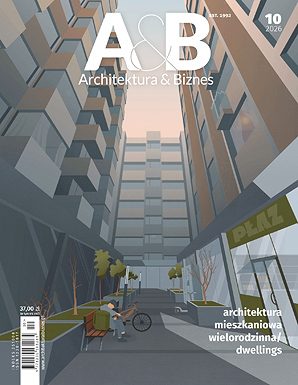





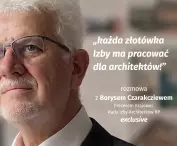
A New Beginning Instead of a Revolution — that’s how the newly elected president of the Chamber of Architects of the Republic of Poland, Borys Czarakcziew, announced his plans for his term. In an interview with Małgorzata Tomczak, he discusses his plans to rebuild the Chamber’s image, the fight for better economic conditions for the profession, support for young architects, and changing the way society perceives the role of the architect. This is a conversation about the challenges facing the professional association today and the directions of its development in the coming years.
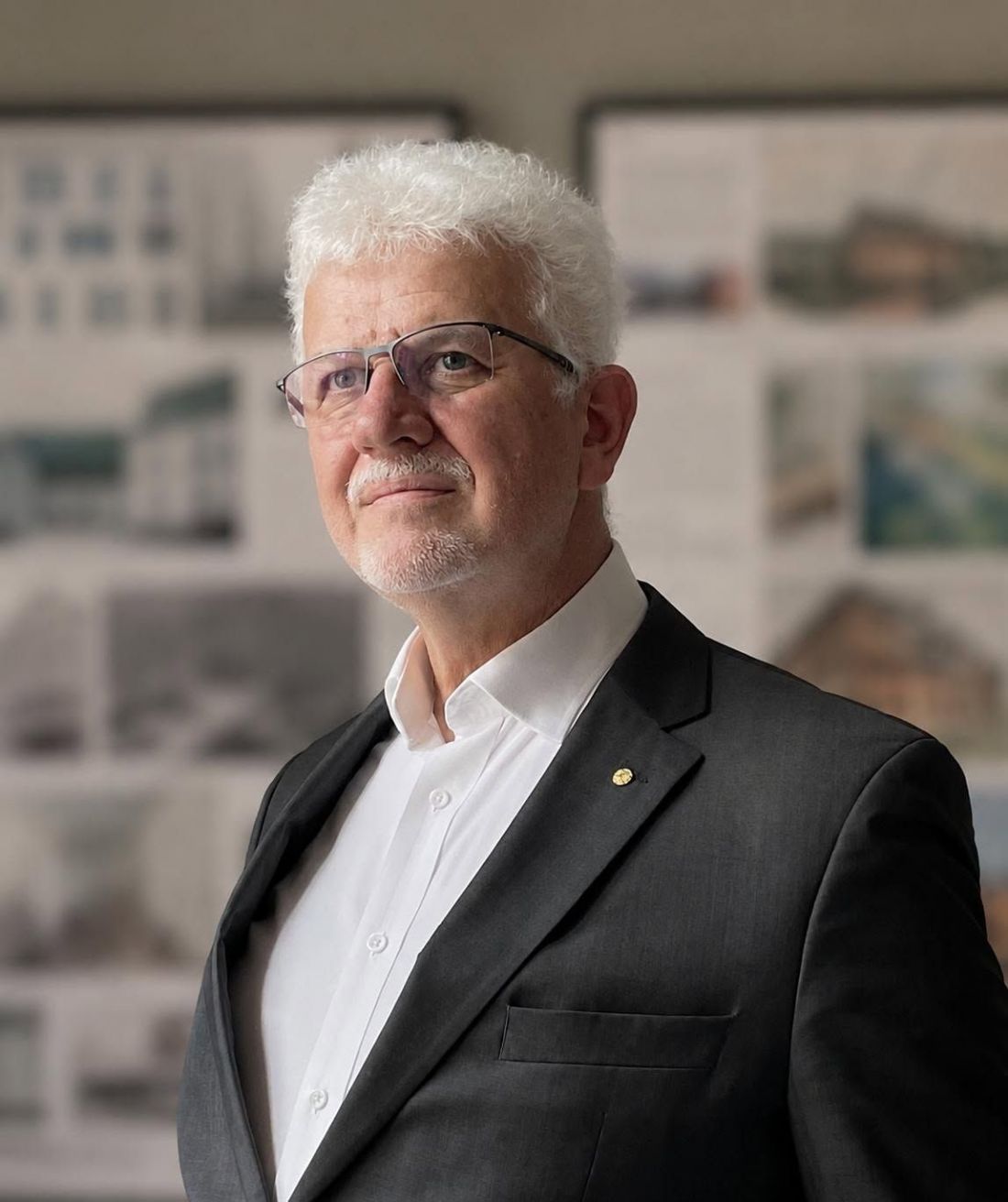
Borys CZARAKCZIEW — President of the IARP National Council for the 7th term. A practicing architect with over thirty years of professional experience. He was the owner of a small design studio, a co-owner of a design firm, and President of Miastoprojekt Kraków from 1999 to 2005. He participated in the implementation of residential, public utility, urban planning, and conservation projects, winning numerous awards and distinctions with his teams in national and international architectural and urban planning competitions, including the SARP Award of the Year. From the very beginning, he was involved in establishing the professional association of architects. From 2002 to 2014, he served as the first President of the Małopolska Regional Chamber of Architects of the Republic of Poland. He subsequently served as a member of the National Council of the Chamber of Architects of the Republic of Poland and as Vice President of the National Council responsible for international cooperation. He co-created the programs “Shaping Space,” “Designer’s Handbook,” and “Architect’s Workshop,” which for many years supported the development of the architectural community. For over fifteen years, he has represented Poland on the European stage in the work of the Architects’ Council of Europe (ACE) and the European Network of Architects’ Competent Authorities (ENACA). From 2020 to 2025, he served on the Board of the Architects’ Council of Europe, an organization representing over half a million architects. For one and a half terms, he served as ACE Treasurer. From 2024 to 2025, he coordinated the area responsible for the quality of the built environment, housing, cultural heritage, and the future of the architectural profession. He actively participates in work related to Poland’s Architectural Policy, the activities of the Polish Council of Architecture, and initiatives concerning the quality of architecture, housing, cultural heritage, and quality of life in the built environment.
Election Platform
Małgorzata Tomczak: Why did you decide to run for president of the Chamber of Architects of the Republic of Poland?
Borys Czarakcziew: There were several reasons. First of all — my experience. For nearly three-quarters of my professional life, I’ve been involved in local government work, so the Chamber is much more to me than just a professional organization. However, the last few years have been a turning point, as I had the opportunity to work within European structures. I saw that professional associations can operate differently. It’s not about simply transplanting foreign solutions onto Polish soil, because that’s not possible. It’s more about a way of thinking, an approach to problems, and setting priorities.
This perspective from a distance made me realize that in many areas we’ve stood still. Meanwhile, the biggest problem facing our profession is that, after 35 years of economic transformation, the profession of architect remains undervalued. I believe it’s high time to reverse this trend.
Małgorzata Tomczak: So, in your opinion, what should change in the Chamber first and foremost?
Borys Czarakcziew: I wouldn’t want to talk about a revolution, because that’s not what we’re planning. We’re more interested in consistent evolution. We’ve prepared a program that opens new chapters, but at the same time builds on what has already been successfully started.
Małgorzata Tomczak: What do you consider to be the most important achievements of recent years?
Borys Czarakcziew: First and foremost, the program for building the architect’s image. This document has been created, but now it needs to be effectively implemented. It is extremely important because the public still does not understand what our work really entails and what value an architect brings. And without changing this perception, it will be difficult to change the standing of our profession. At the same time, changes have also taken place that go beyond the Chamber’s activities themselves but are of immense importance to the architectural profession. More and more people are recognizing that the climate crisis and energy challenges directly impact the way spaces are designed and their quality. This makes the role of architects more visible and necessary.
A second important achievement was securing the signing of an agreement with PARP [Polish Agency for Enterprise Development—ed.] and establishing the Sectoral Council for Competencies in Architecture and Urban Planning. Discussions began during the Chamber’s fifth term, and their conclusion now offers a real opportunity for further cooperation across the entire architectural community.
The joint efforts of the Chamber and the Polish Council of Architecture were also crucial, as they succeeded in convincing the government to begin work on the National Architectural Policy. This is a step the architectural community has been waiting for for years.
Another extremely important change is the popularization of the concept of the city architect, to which Piotr Lorens [City Architect of Gdańsk—Ed.] has contributed greatly. More and more local governments are realizing that a city architect is not merely a civil servant. This is a person who can mediate between residents and authorities and translate public policies into the quality of public spaces. This is a very positive direction, and it is worth developing it consistently.
Małgorzata Tomczak: Will you seek to include a provision in the regulations stating that every major city should have a city architect, just as it has a historic preservation officer?
Borys Czarakcziew: We need to distinguish between two issues. On the one hand, work is underway on the National Architectural Policy. This is a document of fundamental importance, as it is intended to set the direction for thinking about architecture and public space. I hope it will also serve as a starting point for a broad dialogue with public administration—regardless of who is in power—and allow for discussion of specific legislative solutions.
The issue of the city architect, however, has two dimensions. The first is legislative and organizational; the second is cultural. Simply creating the position—or even a strong architectural and construction administration—is not enough. We can see this, for example, in other countries. There also needs to be an understanding of why such a role exists and what function it is meant to fulfill. Without this, even the best regulations will not produce the desired results.
architects’ fees
Małgorzata Tomczak: In your election platform, you devote a lot of attention to the economics of the architectural profession. You speak of price dumping, the conditions for running a practice, and the need to improve the economic situation of the entire profession. What actions by the Chamber do you consider most urgent in this regard today?
Borys Czarakcziew: Of course, we will continue our efforts to protect the architectural profession. However, we know that today the profession is most acutely affected by economic challenges related to the practice of architecture, and it is precisely on these issues that we intend to focus our efforts.
We are working on creating a centralized training system for architects. We also want to redefine the scope of our profession’s competencies and consistently expand it, especially in the areas of running a practice and managing its financial aspects.
One of our priorities will also be monitoring public procurement. We want to ensure that regular, monthly, or quarterly payments for design services become the norm. We will also continue to publish information on market rates for design services, as transparency in this area is extremely important.
Nor do we want to start from scratch. The architectural community has already produced many valuable studies on running a practice and managing an architectural business, including in your publication. Our task is to ensure that these materials become practical tools for architects, rather than publications that gather dust on shelves.
Małgorzata Tomczak: Improving the economic conditions of the profession is probably the most important challenge today, but creating better working conditions is equally important. How does the Chamber intend to support architects at the systemic level —in cooperation with local governments, the administration, and public institutions?
Borys Czarakcziew: Another very important area will be the implementation of the Polish National Architectural Policy at the local level. We’re considering having people on our team who will support local authorities and prepare practical guides. We want to demonstrate why it’s worth organizing architectural competitions, when they make the most sense, what role the city architect plays, and how to effectively collaborate with young designers.
We will also discuss with the Public Procurement Office changes to the rules governing competitions and tenders. It is important to us that these rules do not exclusively favor the largest firms, but also provide a real opportunity for small firms and young architects.
We plan to prepare a set of model documents—not only contracts but also recommended provisions and procedures—that small firms, in particular, which do not have daily legal support, will be able to use. We want architects to be able to operate more securely in the market.
Another key focus of our efforts will be to more actively involve the Polish architectural community in implementing the objectives of the New European Bauhaus. I have the impression that in Poland, the potential of this program is not yet being fully utilized, and the institutions responsible for its implementation do not play as significant a role as they do in many other European countries.
Image
Małgorzata Tomczak: One of the biggest challenges will be rebuilding the Chamber’s image. Many architects today feel that the organization has closed itself off from the community. How do you plan to change that?
Borys Czarakcziew: First and foremost , we want to be open to dialogue, including criticism. A professional association cannot function in isolation from its members. We want to invite architects to collaborate and create a space for the free exchange of opinions.
Małgorzata Tomczak: Does that also mean greater openness on social media? Will you enable comments?
Borys Czarakcziew: Yes. We want to maintain open communication. An organization that shuts itself off from the voices of its members ceases to fulfill its role.
For me , the greatest success of this term, which is just beginning, would be a situation in which, after four years, young architects themselves would want to get involved in the Chamber’s activities. It won’t be easy, because an entire generation is changing—and so is the way we communicate with it—but that’s precisely why we must rebuild our relationships with the younger generation.
We are also committed to greater diversity. The newly elected National Council includes five women, which shows that the Chamber is gradually changing and opening up to new perspectives.
We also plan to appoint a representative for cooperation with universities. We want to rebuild our relationships with the academic community and be closer to students and young architects right at the start of their professional careers. There will also be a person responsible for collaborating with young designers and supporting small architectural firms. The future of the Chamber depends on whether the younger generation will want to identify with it.
Małgorzata Tomczak: How will responsibilities be divided within the new National Council?
Borys Czarakcziew: We will present a detailed breakdown of tasks once the Council is constituted, but we already know which areas we want to strengthen in particular.
Teams will be formed to address the protection of the profession, legislation, cooperation with universities, and the transformation of the architectural profession—a transformation that is inevitable in the face of technological and social changes. We will also develop the “Shaping Space” program, expanding it to include public education. In this area, we are counting heavily on cooperation with the media, because building an architectural culture is not a task for the Chamber alone. It is a shared responsibility of the entire community and, above all, an investment in the quality of life for society.
We do not intend to carry out a revolution, as I mentioned at the beginning of our conversation. We want to build on what has already been established, refresh the structures, and adapt them to contemporary challenges. Because the problems of the 21st century cannot be solved with 20th-century tools.
Małgorzata Tomczak: We’ve talked about the Chamber’s opening and the planned changes. But there’s one more issue—the image of the architect. How do you plan to convince the public that architects are necessary?
Borys Czarakcziew: First and foremost, we need to change the way we communicate. We can’t speak solely in industry jargon that only architects understand. We need to show that architecture has a direct impact on quality of life: on people’s health, comfort, safety, and daily functioning.
We also need to make investors aware that an architect’s fee is not a cost, but an investment. A well-prepared design helps avoid mistakes, reduce construction costs, and create a space that will serve its purpose well for many years to come. An architect is the investor’s partner and acts in their best interest.
It is also our responsibility to show the public that an architect’s work is underpinned by knowledge, experience, professional responsibility, mandatory insurance, and continuous professional development. All of this has real value.
Małgorzata Tomczak: In recent years, you’ve had the opportunity to observe how professional associations operate in Europe. Are there any solutions worth adapting to the Polish context?
Borys Czarakcziew: There is no single ideal model. However, I have noticed a certain pattern: if the Chamber is perceived solely as an institution that imposes obligations, its members will not identify with it. Above all, it must help architects in their day-to-day work.
That is why I believe that every zloty the Chamber generates should be used to benefit its members, rather than sitting in bank accounts and deposits. I am pleased that the most recent National Congress decided to allocate the majority of the generated financial surplus to specific initiatives that can be implemented as early as this year.
Polish Architecture Congress
Małgorzata Tomczak: In May, after an eighteen-year hiatus, the Polish Architecture Congress took place. Do you intend to continue this initiative?
Borys Czarakcziew: Definitely yes, although I believe the congress should not be held every year. It is an event that must carry the appropriate prestige and be well prepared.
Next year, however, will be exceptional. The Chamber of Architects of the Republic of Poland is celebrating its 25th anniversary, and the Association of Polish Architects is marking its 150th anniversary. Together with SARP President Marek Chrobak, we agreed that this should above all be a year of cooperation and unity within the architectural community. We want to show that although our organizations have different roles, they speak with one voice on matters concerning the quality of public spaces and the future of the profession.
We also hope that this will be the year in which we succeed in securing the adoption of the Polish National Architectural Policy. This is also a time of important political events, which is why we want to actively participate in the public debate and raise awareness of the importance of architecture.
Małgorzata Tomczak: And when can we expect the next Architecture Congress?
Borys Czarakcziew: I think in about five years. However, I would like to see broad debates on the future of the architectural profession take place sooner, organized jointly by the Chamber, SARP, universities, and the media. This is a conversation that we, as a community, simply must have.
Finally, I’d like to emphasize that I’m also aware we’ve received a very strong mandate of trust from the architectural community. Now it’s our duty not to squander it and to demonstrate as soon as possible that this trust was well-founded.
Małgorzata Tomczak: We’re keeping our fingers crossed for that, and thank you for the interview.
Borys Czarakcziew: Thank you very much as well!