








We have grown accustomed to the map of our country divided into sixteen provinces with their capitals playing the role of regional centers. However, there are localities where, despite the passage of time, it is difficult to come to terms with the loss of their former importance. How are the centers that lost their status as provincial cities twenty-six years ago developing today? Do they need help, and if so, what kind of help? Or is it time to change the number of provinces again? On how the 1999 administrative reform changed the faces of medium-sized Polish cities, with Karol Walachowski, author of the book "Beyond the Biggest. A study of former provincial capitals," is interviewed by Przemek Ciępka.

Karol WAŁACHOWSKI - born in 1992 in Częstochowa. Doctor of economics, assistant professor at the Cracow University of Economics, specializes in public policies and urban development. Author of the book "Beyond the Biggest. A study of former provincial capitals".
Przemek Ciępka: You are studying the negative effects of the 1999 administrative reform , as a result of which the number of provinces was significantly reduced. Was it at all necessary tocarry it out at that point?
Karol Walachowski: This reform was necessary - before 1989 the provinces played the role of local government administration, and after the change of the system local governments were formed. So it was a closure of the local government reform, which began in 1990 with the creation of autonomous municipalities. In the years that followed, various concepts arose, and there were discussions about whether a three-tier division made sense at all. It took quite a long time, but it should not be forgotten that politicians had a whole host of other issues to deal with in the 1990s: the political transformation, and later the huge problem of unemployment.
Przemek Ciępka: What were they trying to achieve by introducingsuch drastic changes in the administrativedivision of Poland?
Karol Walachowski: The objectives of the reform fell into three categories: administrative, civic and international. The change in territorial division was primarily intended to prepare us to join the European Union and spend EU funds. Hence the strong pressure from AWS politicians to make the provinces, which would become the basic administrative cells, as large as possible. The two most important figures for this reform - Michal Kulesza and Jerzy Stępień - were lawyers, which is very evident from the way it was carried out. The process lacked economists, sociologists or political scientists. No one took into account economic goals, no perspective on the spatial development of Poland was taken . At the time, no thought was given to how the reform would affect smaller cities, or why we should have such a number of provincial cities and not another. In the end we ended up with sixteen provinces, this number is to some extent a rotten compromise.
Przemek Ciępka: That is to say?
Karol Walachowski: The basic proposal put forward by AWS was to create twelve provinces. According to other concepts, there could have been, for example, twenty-five or forty-nine, as before the reform. In the end, a division was formed, with extremely weak provinces on the map of Poland, such as Opole, with a population of less than a million, and heavily populated regions, with Mazovia, with a population of five and a half million, at the forefront. From the point of view of regional policies, this is a significant handicap - well, because what kind of partner for the government is a province with as many people as Krakow, Poland's second largest city?
Przemek Ciępka: I understand that this reform could have been done better.
Karol Walachowski: The issues I address in the book are, in my opinion, one of the untold traumas that roll over Poland. The territorial reform was a watershed moment, in which a clear division was formed between metropolises and smaller cities, and between winners and losers of the transformation. Of course, after many years it is easy for us to assess this division and come to the conclusion that it was not optimal. What I want to point out is that the localities that lost their status as provincial cities did not receive any meaningful compensation.
Przemek Ciępka: Wasn't it the case that those cities with betterdevelopment prospectsremained provincial capitals , while others were given a lower status reflecting their real potential?
Karol Walachowski: Before the 1999 reform, there was no trend indicating which provincial cities were developing better or worse. After the introduction of the new administrative division, indicators for various dimensions of socio-economic life began to vary widely, and it is clear which centers have benefited from this process, and in which development has stalled. Perhaps no one foresaw that as cities began to compete with each other on the principles of the free market economy, this should be done on an equal basis. In practice, the centers that remained provincial capitals received EU funds, highways, heavy infrastructure or universities. Those that lost this status were left with nothing.
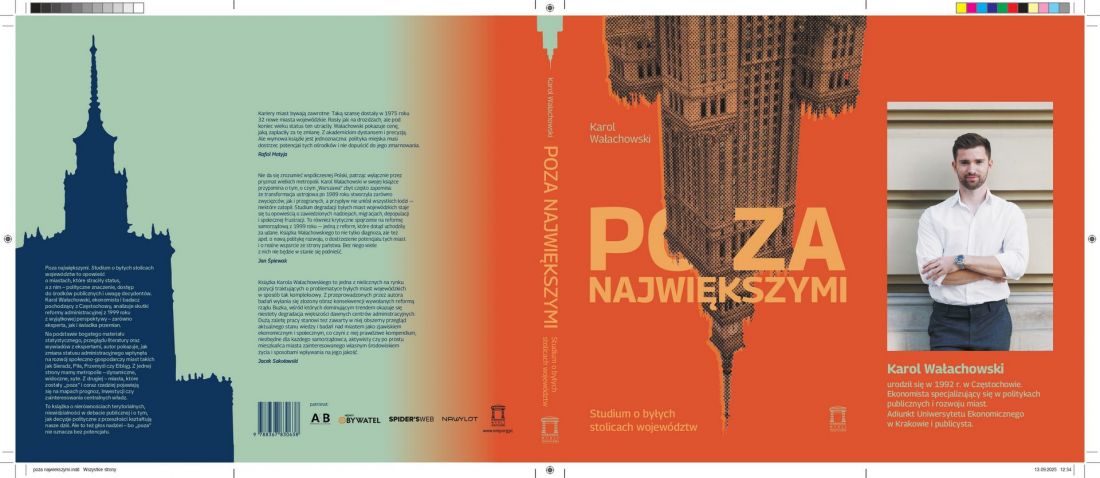
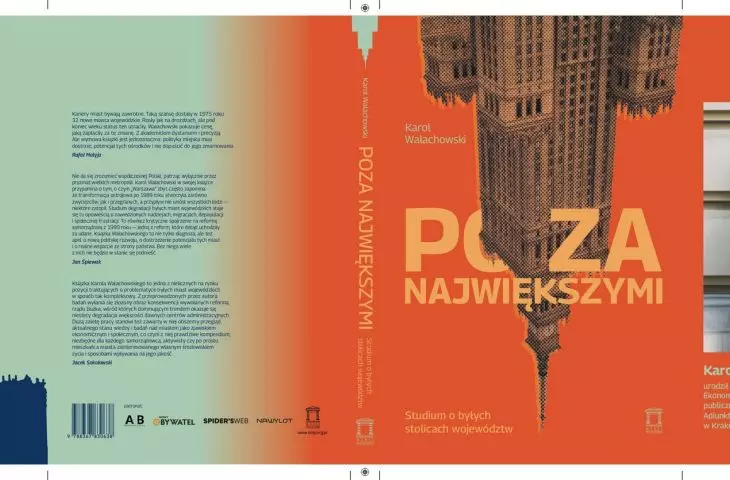
Except for the largest ones. A study of former provincial capitals
cover proj: Magdalena Milert
Przemek Ciępka: How did this reform affect the cities that lost their status as provincialcapitals ?
Karol Walachowski: One can distinguish four main areas in which we see negative consequences of the reform for these cities. The most acute consequences have included the labor market - thousands of public sector jobs have disappeared from former provincial cities due to the transfer of public administration branches, inspectorates or state-owned companies to metropolitan areas. It is among the administrative staff that local elites are formed, and their absence in the long term resulted in a significant reduction in the level of public debate in the former provincial capitals.
The second field was the availability of funds for investment. On average, the new provincial capitals received 50 percent more EU funds per capita, compared to cities that lost that status. It's natural that all provinces gravitate toward their capitals - and that's where airports, important roads and the rest of the infrastructure are built.
Administrative reform has also reduced the availability of public services. Today we are accustomed to digitization, but at the turn of the millennium proximity to offices was extremely important. One businessman from Częstochowa mentioned to me that when Częstochowa lost its status as a provincial city, he had to appear several times each week in Katowice to handle administrative matters. The difficulties, of course, did not end with business - access to specialized hospitals or cultural institutions, for example, was reduced.
Nor can we forget prestige. The city's status formats our way of thinking about reality. After the 1999 reform, Czestochowa, with a population of a quarter of a million, became as important a center as Pila or other towns with a population of less than 100,000. Opole, with a population of 130,000 at the time, was instead already a provincial city. This translated into even the smallest aspects of our everyday life. For example, when watching the weather forecast, we will see Opole on the map, but not Czestochowa or Radom anymore. The loss of its status as a provincial city was also important from the perspective of residents' aspirations. For me, as a person who grew up in Czestochowa, it was clear that eventually I had to end up in a big city, despite the fact that I had access to good universities locally.
Przemek Ciępka: Did the state carry out activities to compensate for the losses suffered by former provincial cities?
Karol Walachowski: The shielding measure was to be the Dialogue and Development program. It consisted of three components. The first was grants of a ridiculous 120 thousand zlotys, which many cities immediately gave up. In addition to this, State Higher Vocational Schools were created, and on top of this, delegations of provincial offices were established in former capitals. It was a program that was completely inadequate for the losses.
Przemek Ciępka: Have any cities managed despite administrative degradation?
Karol Walachowski: It's not that all former provincial capitals after 1999 have become unfit for life. An example of a successful medium-sized city is Bielsko-Biala. Industry had been developing there for a long time, with the opening of the Fiat production plant in 1992, and the proximity of the Upper Silesian and Zagłębie Metropolitan Area and its great tourist attractions also played their part. In a similar situation is Legnica, a city with a strong copper industry, located on the A4 highway, close to Wroclaw and the western border, which has helped attract foreign business. However, it should not be forgotten that these cities are developing not so much because of the territorial reform, but rather in spite of it. Had they remained provincial capitals or received adequate assistance from the state, they would probably have developed much better.
Przemek Ciępka: You are mainly talking about those thirty-one localities that lost their status as provincial cities. However, the settlement network is an interconnected system of vessels . Has the reform also affected lower-level centers?
Karol Walachowski: If we don't base the backbone of our state on a network of dozens of medium-sized cities, we may end up condemning residents of localities far from the metropolises to exclusion. After the reform, specialized hospitals moved to new provincial cities, and the same happened with government offices. The collapse in public transportation doesn't help either. Already young people are not choosing those schools that are better for them, but those to which they have a good commute. The Social Security Administration forecasts that more than 90 percent of the counties will see a decline in population. Considering the ongoing depopulation, in many areas maintaining hospitals or high schools in the future will no longer make sense, further excluding residents of those localities.
Przemek Ciępka: The book is full of indicators, charts and tables. How do these trends affect the life of mid-sized citiesin practice ?
Karol Walachowski: For me, the most important measure of city development is the number of residents, because people vote with their feet. They choose those places where they live better, where they have better job or educational prospects, or greater availability of housing. This is clearly seen in the number of residents. In the former provincial capitals, up to 3 million people lived in the 1990s. Today there are 450,000 fewer, which is the same as the population of Gdansk. I come from Częstochowa, from which 60,000 people, one-fifth of the city's population, have left since the 1990s. This is a very big change, felt from a business perspective, in the gastronomic or cultural sphere. The city center empties out in the evenings. Shortly after the reform, the city's traditional business, the textile industry, collapsed. The Elanex factories, which employed thousands of people, closed.
Deficits can also be seen in the elite sphere - public debate on the city's development stands at a very low level, as there is a lack of state institutions unrelated to the local government, where people who can express their opinions autonomously would work. The situation is similar with the local media. Today in Czestochowa there is one journalist from "Gazeta Wyborcza" and two from "Dziennik Zachodni." On top of that, there are less significant local media associated either with the local government or directly with local deputies. A novelty is the online medium Na Wylot, where we can read critical content about what is happening in Czestochowa. This is definitely not enough for a city of 200,000 people.
Przemek Ciępka: How does the lack of local elitesaffect public debate in Czestochowa ?
Karol Walachowski: Important topics, which in other cities would be on the front pages of newspapers, are completely ignored in Czestochowa. Such a topic, for example, is Elanex, a huge post-factory complex, located in the center of the city, which has been in the hands of a liquidator for more than twenty years, waiting to be developed. This is an area that has great potential, but today it is scary and, due to the poor state of the architecture, also dangerous. It is insufficiently reported that the Raków Football Club, the 2023 Polish Champion and participant in pan-European cups, still plays in its small, 5,000-seat stadium, called a chicken coop by Częstochowa residents. As a result, the team can't play in its own city; fans have to travel to Sosnowiec for European cup matches.
Of course, there are also positive things happening in Czestochowa, we have x-kom, Klimas Wkręt or the nearby Press Glass, companies with European operations, we have Strzykawa, a great specialty cafe, a young Czestochowa art scene is developing. However, these are isolated areas, in a broader perspective the trend is downward.
Przemek Ciępka: What is the dynamics of these processes? Are the former provincial capitals rising from their knees, continuing to stagnate, or are they doing worse and worse?
Karol Walachowski: In every area I've researched, there is a regression - whether it's the labor market, economic or social indicators or NGO activity. Things are getting worse all the time in medium-sized cities, while at the same time things are getting better in metropolitan areas. In my opinion, this is the result of central policies and the fact that medium-sized cities are not seen from their perspective.
Przemek Ciępka: Do we need another administrative reform then ?
Karol Walachowski: Today administrative status is no longer as important as it was thirty years ago. What matters now is access to resources. If I had to choose between another administrative reform and a meaningful support program for medium-sized cities, I would undoubtedly bet on the latter option.
Przemek Ciępka: What couldthis support look like?
Karol Walachowski: First of all, it should take into account the specifics of a given city. If Czestochowa specializes in metalworking, the state could subsidize universities, create various types of organizations or create friendly conditions for business related to this industry. Plock is a transportation-excluded city, so there the priority would probably be the construction of a railroad line. On a broader scale, support for housing could be a game changer. If the state is able to provide affordable housing for young people, built, for example, as part of Social Housing Initiatives , it may turn out that moving to a medium-sized city where kindergarten places are not an issue, where parents live nearby, could prove to be an attractive alternative to the metropolis, even if wages are not so high.
Przemek Ciępka: What about the administrationitself ?
Karol Walachowski: We need deglomeration, or administrative dispersion, in Poland. When I studied the distribution of the most important central offices in our country a few years ago, 90 percent of them were located in Warsaw, although there was no compelling reason for this. From the state's point of view, it would definitely be better if at least some of them were relocated to medium-sized cities. This could be combined with the specialization of particular localities:if we are talking about Lublin, there could be an
office related to mining; to Czestochowa ,for example, it should be the EnergyRegulatory Office , which would benefit from the experience and competence of local universities. These are real actions that could provide new jobs, attract young talent and foreign businesses, or help produce local elites. And in the long run, restore the development momentum of former provincial cities through the accumulation of positive developments.
Przemek Ciępka: Thank you for the interview!
interviewed: {tag:AuthorA&B}
more: A&B 10/2025 - U40 - the business of a young architect,
download free e-publications of A&B