




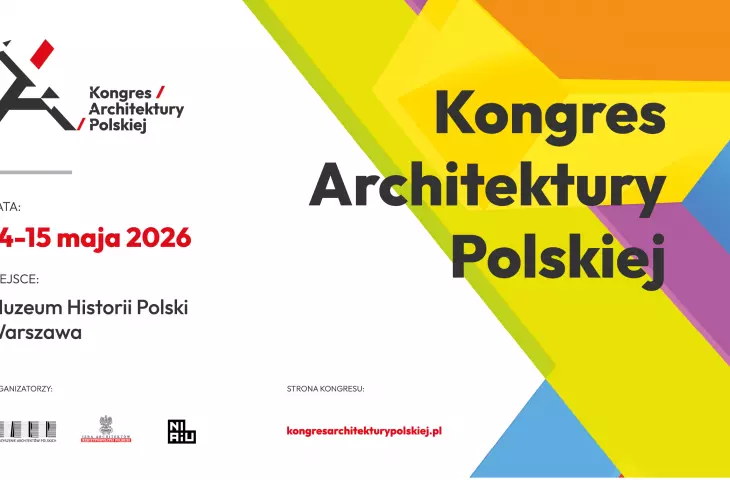

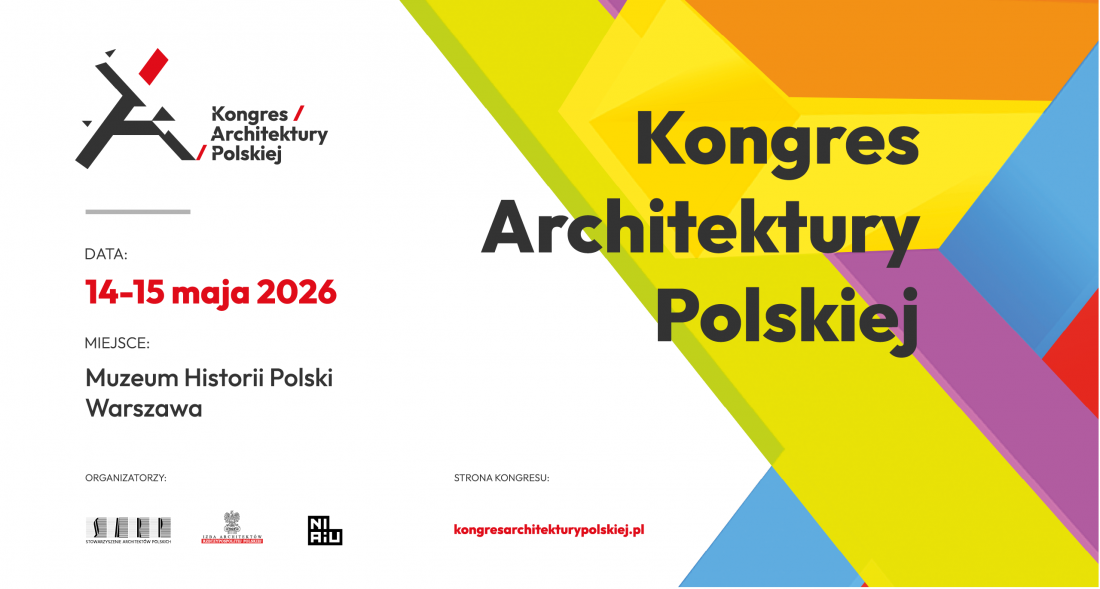
"Space - value and responsibility" is the slogan ofthe Congress of Polish Architecture, a joint venture of thePolish Chamber of Architects , the Association of Polish Architects and the National Institute of Architecture and Urban Planning, which will be held on May 14 and 15 at the Polish History Museum in Warsaw. We speak with Robert Szumielewicz, vice president of the National Council of the Polish Chamber of Architects, about expectations for the event and the State Architectural Policy.
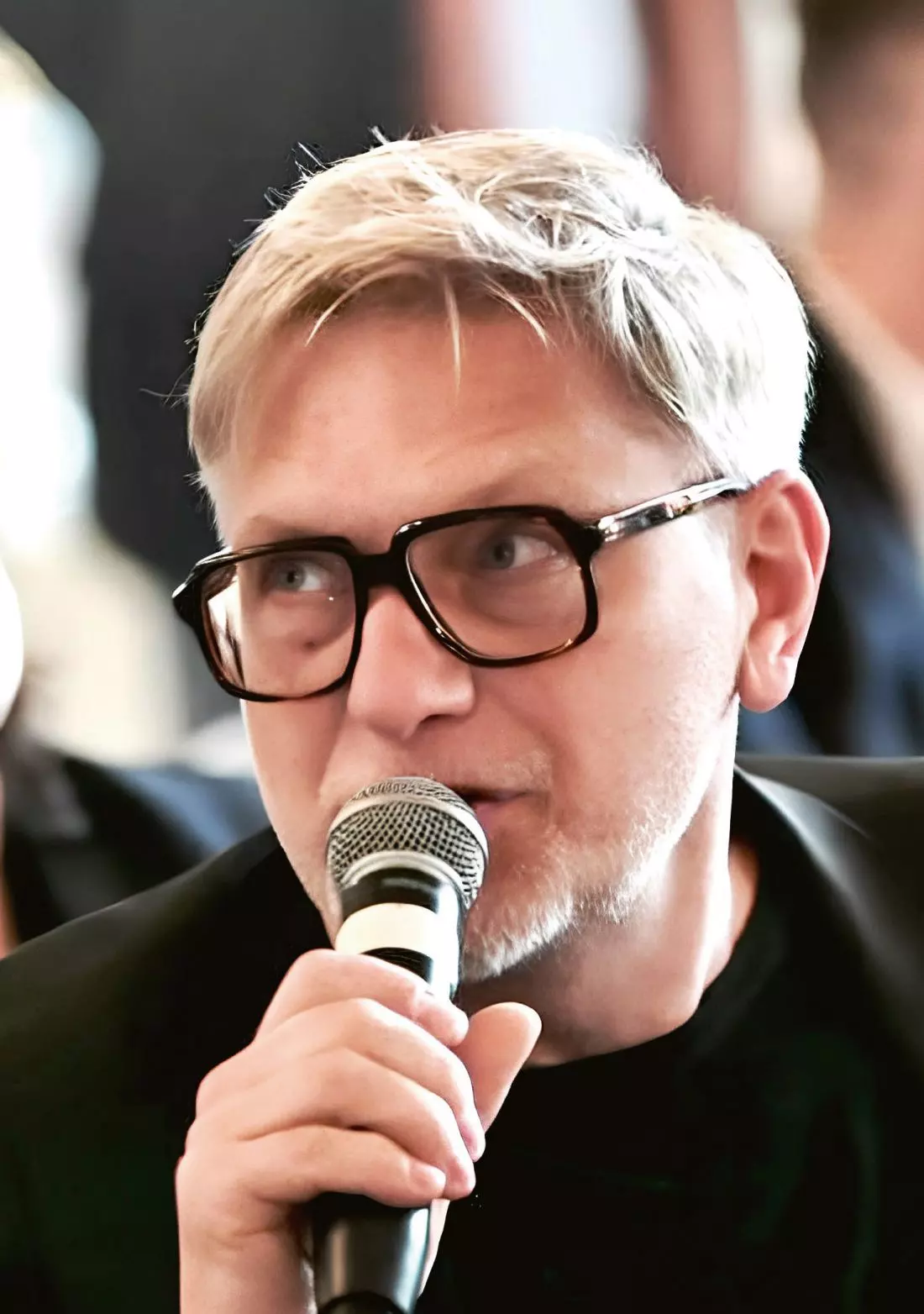
Robert SZUMIELEWICZ - IARP architect, urban planner. Vice President of the National Council of the Chamber of Architects of the Republic of Poland, from 2014 to 2022 Chairman of the Council of the Mazovian District Chamber of Architects of the Republic of Poland. In 2015 appointed by the President of the City of Warsaw to the Council of Architecture and Public Space; participant in the work of the Municipal Urban Planning and Architectural Commission of Warsaw and the Mazovian WKUA. Chairman - appointed in 2025 by the Polish Agency for Enterprise Development - of the Sector Council for Competence in Architecture and Urban Planning. Chairman of the Peer Court of the OW SARP. Served many times on the jury of the Architectural Award of the President of the City of Warsaw; one of the winners of the 4th edition of this award (Grand Prix, as well as awards in the category of Best Public Space of Warsaw and the Audience Award).
Ola Kloc: Why did you decide just this year to join forces with IARP, SARP and NIAiU and organize the Congress of PolishArchitecture ?
Robert Szumielewicz: We have been working all the time to make sure that architecture, urban planning and the space we design start to be perceived by everyone - society, politicians, officials - as something very important that surrounds us and affects our lives, in all its aspects. Last year there was a conference initiated by the European Union. In connection with the Polish presidency of the EU Council, we were asked to organize a meeting of Polish architects-directors on Polish architectural policy. The conference, thanks to the involvement of the Pomeranian District Chamber of Architects of Poland, was held in June 2025 in Gdansk.
In Poland, architectural policy is virtually nonexistent - we are one of six countries in the European Union that do not have a state architectural policy. So the Minister of Development and Technology, who was present at the meeting, decided that one should be created. In the fall of 2025, he appointed a team of experts - architects affiliated with the Chamber of Architects and the Association of Polish Architects, interior architects, landscape architects, urban planners, representatives of universities. This team is to prepare proposals and guidelines for a document called the National Architectural Policy.
Our earlier initiative related to the idea of organizing a congress, then the June meeting in Gdansk had a snowball effect. At last the voice of architects became audible and we began to talk about architecture, its importance for the country and the need to undertake legislative work, and politicians began to ask us where these actions should go.
Ola Kloc: Well, exactly - what can this document change? Not only in space, but also in the conditions for practicing the architectural profession. Does it have the chance to translate into real legislative changes? If so - what kind of changes?
Robert Szumielewicz: At the congress we will present theses saying that architecture is part of the state policy concerning not only housing, but more broadly - the economy of the state and the directions of its development. Architecture is part of the country's innovation policy, helping to meet the challenges of climate change, the need for energy transition, demographic and social changes, education of citizens. It also shapes the country's development through proper urban planning and takes care of the broader culture. And, rarely seen, it influences health policy.
Architecture, urban planning, the space around us affect our lives, and we architects and urban planners design it. We tell the story this way because we need understanding - to get out of the dogmatic thinking that an architect designs buildings to make them pretty. Beauty is important, but the most important thing is that we are comfortable in the place where we live and work. And living well affects our well-being, including our health.
Raising awareness of the essence and importance of our work is also followed by raising wages. A job well done takes time and money. We cannot, given all the difficulty of meeting the requirements of complex regulations and conditions, do a good project quickly at the lowest possible price. This is not how good architecture and good space will be created.
Congress of Polish Architecture 2026
© organizers archive
Ola Kloc: Is there a recipe for this ? What tools do architects need today to have both time and moneyfor these projects ?
Robert Szumielewicz: First of all, we need to make politicians and those ordering projects - mayors, city presidents - aware that our work needs to be properly compensated. In order for its effects to be as good as possible, we need properly prepared tenders and competitions, in which the quality criterion rather than price will be the most important. Admittedly, there are legal regulations on how to determine the amount of remuneration for design work from the value of the investment, but most procurers forget about this and set the criteria of project completion date and lowest price in the procurements, while price and time clearly affect the quality of the work and the work.
The second issue is statutory tools. The law on the professional self-government of architects is today combined with the law on the self-government of civil engineers, and these are, after all, two different professions. The architectural profession combines humanistic knowledge related to human life, with engineering knowledge. An architect should look holistically, think both about the function of the building, the correct shaping of space, adequate access to sunlight, room proportions, accessibility, as well as energy savings, bioretention, landscaping and greenery, carbon footprint, also beauty. Does the engineering profession, which is, by the way, divided into many specialties - from structural to sanitary and electrical - meet the requirements for architects? Regulating such different professions in one law is not appropriate from a systemic point of view. What is needed urgently is the introduction of a separate law on the architectural profession, and, thinking about state policy, the enactment of a law on architecture.
Ola Kloc: What would that lawbe ?
Robert Szumielewicz: France, for example, has such a law. It should establish and describe the role of architecture in the state's legal system and indicate how important architecture is for society and the country. It should include cultural issues, spatial policy, innovation, environment, economic development, among others. It would be importantto require mayors to appoint urban architects with specific competencies. I very much hope that the team working on the preparation of the National Architectural Policy will show that a law on architecture is needed and develop the assumptions for it.
Ola Kloc: The topic of public trust and the need for statutory protection of the profession also appears on the congress agenda . How could such a solution affect the architectural community? Is it about curbing phenomena like "nail architect" or rather the issue of "signers"?
Robert Szumielewicz: Both. The word "architect" is used in all possible variations and contexts, without understanding that an architect is a person who starts the process of creation, defines the framework for further action, designs the space in which we live. So it seems obvious that this name should be reserved for architects. In many countries, the title of architect is reserved. The widespread knowledge that the title of architect belongs only to those who perform architectural services would also have the effect of protecting the consumer who uses the work of an architect.
Ola Kloc: What about "signers"?
Robert Szumielewicz: Reservation of the word "architect" and preparation of new legal "tools" will not replace awareness of what a profession of public trust is. We must realize that signing a project that was not done by us is an unethical action. I'm not talking about the situation where the studio owner has employees, but it is the licensed architect who signs off on the project, checks it, evaluates it and is responsible for it, not only ethically, but also financially. In any profession of public trust there will be people who practice their profession contrary to the rules of ethics set forth in an internal legal act. Such a document in the Chamber of Architects is the Code of Ethics of the Architectural Profession. In December last year it was amended, it was supplemented, among other things, with provisions according to which an architect is obliged to carry out on his own or under his supervision a project that complies with the law, and by signing such a project he is responsible for its quality and proper execution.
Ola Kloc: I have the impression that part of the architectural community attaches high hopes to the congress. What do you, as organizers, expect from it? Will the conclusions gathered translate into concrete steps to support the daily work of architects?
Robert Szumielewicz: I think many people expect different results. For me, the important thing is togo beyond our architectural terminology, towards a clearer language. This will allow us to explain that the effects of practicing our profession realistically translate into our broader well-being. We direct the congress' message to politicians, local government officials, conservationists and investors, so that they are aware of the importance of what is built with their/our money.
We aim to let the public know that an architect is a person who combines various investor and social needs in his work. In order for this to succeed, in order for the best-prepared investments to be created, with the best possible impact on all of us, it is essential that the architect be strongly positioned in this dialogue, including by defining his correct role in the investment process.
OlaKloc: However, this is an industry event - how do you want to reach a wider audience?
Robert Szumielewicz: This is, of course, the most difficult. We organize with the district chambers and branches of SARP various events, open meetings, media talks.
We publish podcasts, record reels, give interviews, run social media campaigns, and hope that this message will break through socially. For example, thanks to our cooperation with the City of Warsaw, information about architectural events in Warsaw will be displayed on public transportation.
The conference, which will take place on May 14 and 15 at the Polish History Museum, will meet with everyone who wants to come, as it is open to everyone who wants to attend and anyone can register for it (the number of places is limited). There will be politicians, local government officials, mayors of cities, art critics and historians, scientists and students and - above all - supporters of architecture What will be the results of the congress? A lot depends on politicians - local government officials, because they are the ones who make the decisions that shape our space every day. This can be seen in the example of Warsaw. Its authorities are changing a lot in their way of looking at the city - greenery, good public transportation, interesting investments, architectural competitions. Interestingly, there are also more and more conscious investors who recognize how the quality of life of residents in their investments affects the bottom line.
Congress of Polish Architecture 2026
© organizers archive
Ola Kloc: The program covers a wide variety of themes, and despite the keynote it seems that the range of topics covered at the event will be very large, covering space, health, education, among others. Before arranging the program, did you try to diagnose the most pressing problems facing the architectural community ? Did you gather all the important aspects that should be included in the congress?
Robert Szumielewicz: Yes, this was a real challenge. So we decided to invite prominent people from the world of architecture and set up a thirty-member Congress Program Council. These are distinguished representatives of the architectural world of practice and science. Their rich knowledge and broad perspective allowed us to look at contemporary challenges and current problems. Discussions at the meetings were passionate but constructive. As a result, we have an extremely interesting, inspiring and substantive program. In it we do not focus only on beauty. We will talk about topics illustrated by the slogans of the congress: space, trust, responsibility, place to live, balance, participation, small cities, education, identity, protection, new life and beauty. It's worth taking a look at www.kongresarchitekturypolskiej.pl, where you can learn about the congress program and find more information. As you can see, the focus is not on the usual buzzwords for the profession, such as a vuzette or a building permit.
There will also be plenty of real-life examples in the panel discussions. One of the most interesting is from Stronie Śląskie, a place badly damaged by the recent flood. There, architects, out of passion and without pay, helped create a plan for reconstruction. They did not do it by themselves, but with the involvement and participation of residents. The plan was approved by the municipal council for implementation! We will also talk about the development of architectural education starting from elementary school. I hope that through the congress we will prepare the basis, the foundations of the National Architectural Policy.
Ola Kloc: However, I feel a certain deficiency - what about the current challenges of active architects? I mean, for example, salaries , business models of studios.
Robert Szumielewicz: We will be talking to architects about how to run studios and their own business, how to price projects, what professional ethics and the profession of public trust are. These issues will be the subject of debates led by the editors-in-chief of the invited publications Architektura & Biznes, Zawód:Architekt and Architektura-Murator.
Often, as architects, we are faced with a not easy choice: quality architecture or paying the bills and supporting the family. How broadly does an architect see the investment process, what is his role in the investment process, and what is his role in shaping the environment. This knowledge will allow us all to understand where an architect's salary comes from. If we don't have outside support, public understanding that architecture is important, we won't be able to change the perception of the architect only as a contractor of project drawings.
This seemingly complicated puzzle: quality, responsibility, ethics, competitions, remuneration, translates into our architectural everyday life. I hope that the congressional talks will put the pieces of this puzzle together into a clear picture. Let's take advantage of this opportunity, let's meet at the congress.
Ola Kloc: Thank you for the interview.
interviewed by: {tag:AuthorA&B}
Read more: A&B 5/2026 - Ecology,
download free e-publications of A&B